
For the past decade, platforms like CheckoutChamp and sticky.io have been the backbone of performance marketing and subscription commerce. They pioneered concepts like one-click upsells, continuity billing, and funnel-based customer journeys. But as commerce has evolved, many brands are finding that these established platforms haven't fully kept pace with modern expectations around unified tooling, automated routing, and developer experience.
This isn't just about finding a cheaper alternative or a platform with more features. It's about recognizing that the entire architecture of these legacy systems was built for a different era—one where brands operated in silos, where "integration" meant duct-taping APIs together, and where the checkout was seen as an endpoint rather than an intelligence hub.
Understanding the Legacy Architecture
CheckoutChamp and sticky.io were revolutionary when they launched. They solved a real problem: traditional ecommerce platforms couldn't handle the complexity of subscription billing, multi-step funnels, or sophisticated upsell sequences. CheckoutChamp does include a page builder, but many merchants find it difficult to use for full sales funnels. It also doesn't include native CRM, email, or AI-powered routing — which means most teams end up running 3-4 additional tools alongside it.
The architecture made sense at the time. You had your funnel builder (ClickFunnels, Kartra), your CRM (sticky.io), your payment processor (NMI, Stripe), and your email platform (Klaviyo, Omnisend). Each tool did one thing well. The CRM became the central hub that orchestrated everything else.
But this architecture has a fundamental flaw: data fragmentation. When your customer browses your store, that data lives in Shopify. When they enter your funnel, that data lives in your funnel builder. When they checkout, that data lives in your CRM. When they receive emails, that data lives in your ESP.
Each system has a partial view of the customer. No single system understands the complete journey. And when something goes wrong—a payment fails, a customer churns, a subscription lapses—you're left debugging across four or five different platforms, trying to piece together what happened.
The Real Cost of Fragmentation
Let's be specific about what this fragmentation actually costs. We've analyzed data from hundreds of merchants migrating from legacy CRMs, and the patterns are consistent:
Payment Recovery Gaps
When a subscription payment fails, the CRM triggers a dunning email. But that email doesn't know why the payment failed. Was it insufficient funds? An expired card? A fraud flag? Generic "update your payment" emails have 15-20% click rates. Context-aware emails (tailored to the failure reason) see 35-45% click rates.
Attribution Blind Spots
Your analytics show a customer came from Facebook. But did they see your TikTok ad last week? Did they click an email three days ago? Fragmented systems can't answer these questions, so you're making media buying decisions on incomplete data.
Checkout Intelligence
A returning customer enters your checkout. Is this their first order? Their fifth? Are they a subscriber who paused? Legacy systems don't know—so they show the same generic upsell to everyone, leaving money on the table.
Why Brands Leave CheckoutChamp
CheckoutChamp built its reputation on high-converting checkout pages and sophisticated upsell sequences. For many brands, it was the first platform that "just worked" for subscription funnels. So why are they leaving?
The primary driver isn't dissatisfaction with conversion rates—CheckoutChamp's checkout pages still convert well. The issue is operational bottlenecks. As brands scale beyond $5M-$10M in annual revenue, they encounter limitations:
Limited developer tooling. CheckoutChamp was designed primarily for marketers. Its API access is limited, there's no plugin ecosystem, and headless commerce support is minimal. When you need custom logic — geo-based pricing, dynamic bundles, or warehouse integrations — the platform can feel constraining for development teams.
Manual payment routing. As transaction volume grows, you need multi-processor routing for redundancy, chargeback distribution, and regional optimization. CheckoutChamp supports this, but routing rules are configured manually. Newer platforms like Tagada automate routing using AI — optimizing based on card type, geography, and real-time processor health without manual configuration.
Team scalability. With specialized roles (media buyers, email marketers, fulfillment teams, customer service), you need granular permissions and workflows. Legacy systems weren't built for large teams with complex organizational structures.
The Sticky.io Question
Sticky.io (formerly Limelight CRM) represents the enterprise end of the legacy spectrum. It's powerful, flexible, and handles complex subscription logic that simpler platforms can't touch. It's the platform of choice for many nine-figure brands.
But sticky.io's strength is also its challenge: complexity. The platform can do almost anything, but configuring it requires specialized knowledge. Most sticky.io merchants rely on agencies or dedicated internal teams just to manage the platform.
We've spoken with dozens of sticky.io customers who describe similar experiences: the platform is capable, but changes that should take hours take days. Simple A/B tests require developer involvement. And troubleshooting issues often means navigating a maze of configurations that have accumulated over years.
The question these brands are asking isn't "Can sticky.io do X?" The answer is usually yes. The question is "How long will it take, and how much will it cost?"
What Modern Brands Actually Need
After analyzing hundreds of migrations and speaking with growth teams across the industry, we've identified what brands are actually looking for when they search for alternatives:
Unified Data Architecture
Not "integrations" but true unification. Every customer touchpoint—from first ad click to tenth subscription renewal—should live in one system. This isn't just about convenience; it's about intelligence. You can't optimize what you can't see.
Developer Extensibility
The ability to build custom logic without waiting for feature requests. This means real APIs, SDKs, and the ability to deploy custom code that runs natively on the platform—not just webhook integrations.
Payment Intelligence
Multi-processor routing that happens automatically based on real-time data. The platform should know which processor is performing best for Visa cards from France and route accordingly—without manual intervention.
Operational Simplicity
Power doesn't have to mean complexity. Modern interfaces, clear workflows, and the ability for non-technical team members to make changes without breaking things.
The Platform Approach: Tagada
We built Tagada to address these specific needs. Rather than another point solution that requires integration, Tagada is designed as a complete commerce operating system—checkout, payments, subscriptions, and messaging in one unified platform.
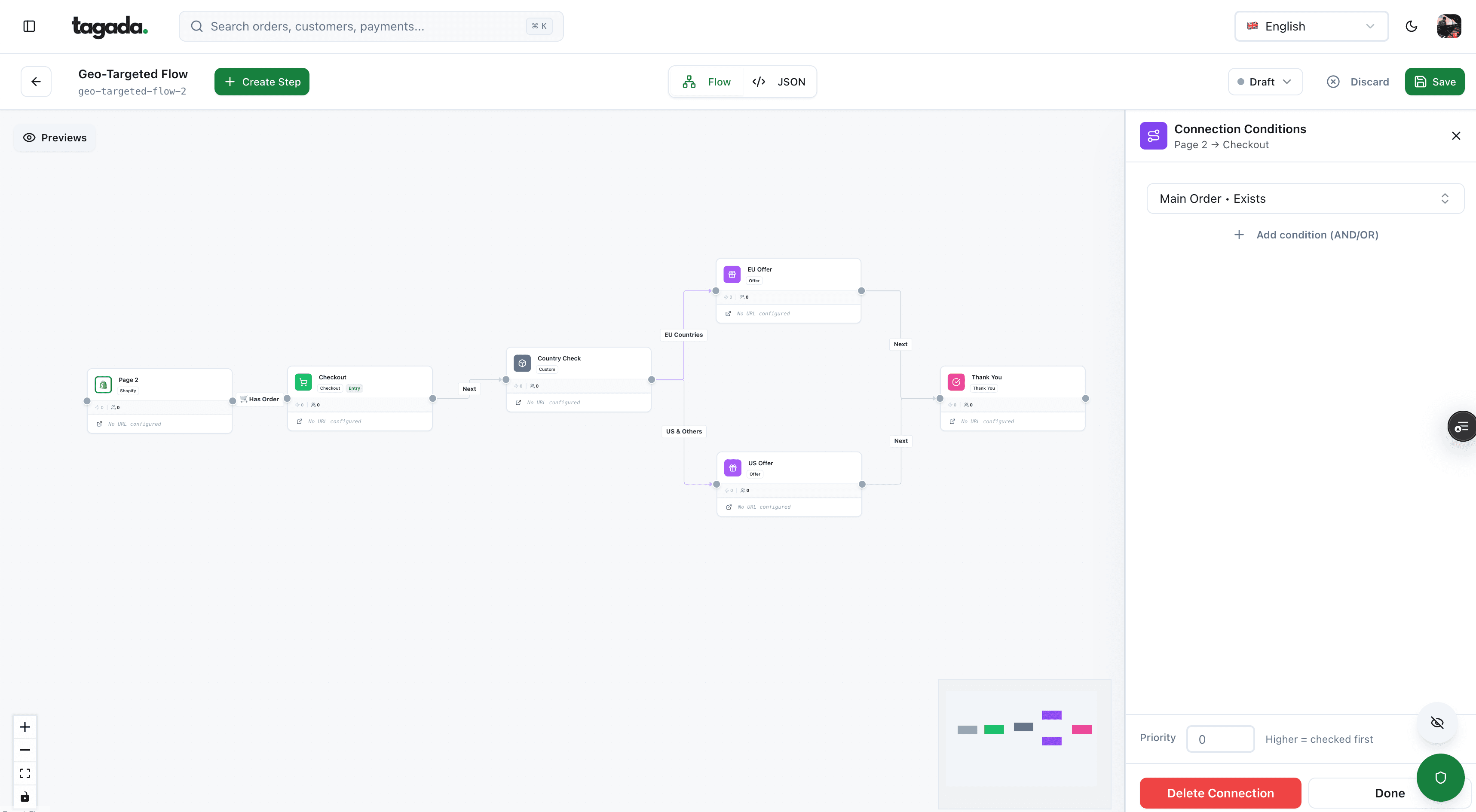
The architecture is fundamentally different. Instead of syncing data between systems, every event—page views, checkout starts, payments, emails, support tickets—writes to a single customer record. This means your email sequences can reference checkout behavior. Your checkout can adapt based on email engagement. Your support team sees the complete picture.
For developers, we've built a Plugin SDK that allows custom logic to run natively on the platform. This isn't just webhooks—it's the ability to modify checkout flows, create custom upsell rules, and build integrations that feel native.
For operators, we've focused on making complexity invisible. Smart payment routing and orchestration, intelligent retry logic, and automated dunning happen in the background. You set the strategy; the system handles the execution.
Where Funnelish Fits In—And Where It Falls Short
Funnelish occupies a different space than CheckoutChamp or sticky.io. It's a purpose-built funnel builder for Shopify and WooCommerce merchants, priced at $49-$199/month. It does one thing well: creating high-converting sales funnels with one-click upsells, A/B testing, and fast-loading pages.
For early-stage ecommerce brands running paid traffic through simple funnels, Funnelish is a solid choice. The gateway pools feature for smart payment routing is clever, and the unlimited funnels/traffic on all plans is generous.
But Funnelish has the same fundamental limitation as most funnel builders: it's just one piece of the puzzle. You still need a separate CRM, a separate payment processor, a separate email platform, and a separate subscription management tool. The data fragmentation problem we described above? Funnelish doesn't solve it—it adds another silo.
Additionally, Funnelish is limited to Shopify and WooCommerce. If you're running a headless commerce setup, a standalone store, or want to sell through multiple channels—Funnelish can't support that. For a deeper Funnelish alternative analysis, see our dedicated comparison.
CheckoutChamp vs Funnelish vs Tagada: Pricing Comparison
One of the most-searched questions is how these platforms compare on cost. Here's the honest breakdown:
| Feature | CheckoutChamp | Funnelish | Tagada |
|---|---|---|---|
| Monthly Price | $300/mo + 1% tx fee | $49–$199/mo | Competitive, no minimums |
| Min. Volume Required | $50K+/mo sales | None | None |
| Funnel Builder | Yes (basic) | Yes (core feature) | Yes (visual drag & drop) |
| Payment Orchestration | 270+ gateways (manual) | Gateway pools | Smart routing (automated) |
| Subscription Management | Yes | Limited | Yes (built-in dunning) |
| A/B Testing | 4-way split test | Built-in | Built-in |
| Platform Lock-in | Standalone | Shopify/WooCommerce only | Platform-agnostic |
| Plugin/SDK Extensibility | Limited | No | Full SDK |
| Unified CRM + Email | CRM yes, email limited | No | Yes (all-in-one) |
For a detailed head-to-head breakdown, read our full CheckoutChamp vs Funnelish comparison.
Making the Transition
Platform migrations are never trivial. There's real risk in moving your commerce infrastructure, and we take that seriously. That's why we've invested heavily in migration tooling and support.
Most merchants can run parallel operations during the transition—keeping their existing CRM active while gradually moving traffic to Tagada. This allows for validation and comparison before full cutover.
The typical timeline is 4-8 weeks from kickoff to full migration, depending on complexity. Brands with custom integrations or complex subscription logic may take longer, but we've successfully migrated merchants from both CheckoutChamp, Funnelish, and sticky.io with minimal disruption.
Conclusion
The question isn't whether CheckoutChamp or sticky.io are "bad" platforms—they're not. They were built for a different time, with different assumptions about how commerce infrastructure should work. They served (and continue to serve) thousands of brands well.
But if you're hitting the limitations we've described—data fragmentation, developer constraints, operational complexity—it's worth exploring what a unified platform approach could offer your business.
The brands that will win in 2026 and beyond are those that treat their commerce infrastructure not as a collection of tools, but as a coherent system. That's the shift we're seeing, and it's accelerating.