
Best SMS Marketing Platform for Ecommerce: How to Choose, Tool by Tool
Klaviyo, Postscript, Attentive, Omnisend, Shopify Messaging and Twilio compared from their own pages: numbers, 10DLC, quiet hours, consent, prices.





Article summary
TL;DR
The best SMS marketing platform for an ecommerce brand is the one that reads your store's checkout and order events, records consent, registers your sending number and holds texts during quiet hours. Klaviyo and Omnisend pair SMS with email, Postscript is SMS-first on Shopify, Shopify Messaging stays in the admin, and Twilio is for building your own.
- Pick on four tests before features: store events that trigger texts, consent records, number registration handled for you, and quiet hours by the recipient's time zone.
- Klaviyo, Postscript, Omnisend and Shopify Messaging send US texts from toll-free numbers by default. 10DLC registration matters when you send from an ordinary 10-digit number, typically on Twilio.
- Throughput is set by the number type and, on 10DLC, by your Trust Score: Twilio lists 12 to 225 messages per second across the major US networks for standard campaigns, and 3 per second by default on a toll-free number.
- Pricing models differ: per message plus a plan fee (Postscript, Omnisend), a dollar plan spent per message (Klaviyo), pay per message (Shopify Messaging, Twilio), or quote only (Attentive).
- No vendor publishes delivery rates measured the same way. Ask for delivery reports by carrier and error code, and judge on your own data.
 ChatGPT
 Claude
 Perplexity
 Grok
GrokOn this page
Every SMS platform for ecommerce sends texts. What separates them is everything around the send: which store events can trigger a text, how consent is captured and stored, who registers your sending number with the carriers, and whether a text waits when it's 10 p.m. where the customer lives. This guide gives the criteria, then compares Klaviyo, Postscript, Attentive, Omnisend, Shopify Messaging and Twilio using only their own pages, read on October 14, 2026.
The legal rules (TCPA consent, CTIA guidelines, 10DLC, EU consent) are covered in our guide to SMS marketing for ecommerce. This page is about choosing the tool.
Which SMS marketing platform is best for ecommerce?
The right tool depends on where your store runs and whether you want SMS alone or with email. Start from your situation, then check the tool against the criteria in the next section.
| Your situation | Start your shortlist with | Why |
|---|---|---|
| Shopify store, SMS as its own channel | Postscript | Built on Shopify data, per-message rates published, toll-free number verified at no charge7Postscript, Pricing (read October 14, 2026) |
| Email and SMS in one tool, Shopify or WooCommerce | Klaviyo, Omnisend | Both channels share one profile and one flow builder4Klaviyo, Pricing (read October 14, 2026)13Omnisend, Pricing (read October 14, 2026) |
| Small Shopify store, a few campaigns a month | Shopify Messaging | Campaigns from the Shopify admin, pay per message17Shopify Help Center, Shopify Messaging SMS pricing (read October 14, 2026) |
| Large program, several countries, budget for a quote | Attentive | Usage-based pricing on quote, 20+ countries listed10Attentive, Pricing (read October 14, 2026)12Attentive, Messaging |
| Developers on staff, custom checkout or app | Twilio | You build triggers, consent and quiet hours on an API19Twilio, SMS pricing for the United States (pricing current as of October 2026)22Twilio Docs, Advanced Opt-Out |
This isn't a ranking. Each row is a starting point, and the tables further down show what each vendor documents.
What to check before you compare features
Feature pages look alike: templates, flows, segments, AI. These eight criteria are where tools actually differ for a DTC brand.
Store integration and events
Native connection to Shopify, WooCommerce or your platform, with checkout started, order placed, fulfilled and refunded events arriving fast enough to trigger a text.
Consent capture and proof
A checkout and form opt-in, double opt-in if you want it, and an exportable record of each consent: time, source, wording shown.
Number registration handled
The tool submits your toll-free verification, 10DLC brand and campaign, or short code application, and shows you the status.
Quiet hours enforced
Texts held until morning in the recipient's time zone, with state rules where they're stricter.
MMS and two-way
Images when the offer needs one, and a number customers can reply to. Some sender types can't receive replies.
Segmentation
Segments built from orders, products and subscriptions, not only from campaign clicks.
Pricing model
Per message, a monthly plan spent per message, plan plus usage, or quote. Carrier fees included or added.
International
Which countries you can text, with which sender type, at what rate per country.
Checkout and payment events: the trigger test
The texts that bring revenue start from a store event, not from a calendar. An SMS tool is only as good as the events it receives.
Klaviyo documents this for WooCommerce: a Started Checkout event when a shopper reaches checkout and enters a billing email, and a Placed Order event when Klaviyo syncs an order in processing status.5Klaviyo Help Center, Data synced with the WooCommerce integration On Shopify, Klaviyo says SMS consent syncs once the shopper enters a phone number, ticks the SMS box and clicks "Continue to shipping", before the order is finished.6Klaviyo Help Center, How to collect SMS consent at checkout on Shopify That's what makes an abandoned checkout text possible for someone who never paid.
Ask every vendor which of these events it receives natively, which need a webhook or an app, and how fast each one arrives:
| Event | Text it triggers | What to ask |
|---|---|---|
| Checkout started, no order | One abandoned checkout reminder | Does the event carry SMS consent given at checkout? |
| Order paid | Order confirmation | Is it triggered by payment, or by order creation? |
| Payment declined at checkout | A link back to pay another way | Is a decline visible at all, or only "no order"? |
| Subscription renewal coming | Reminder with amount and date | Does it come from your subscription app? |
| Renewal payment failed | Update-card link | Does the flow stop as soon as the card is updated? |
| Refund or chargeback | Suppress marketing texts | Can a refund or dispute remove someone from campaigns? |
The stop condition matters as much as the trigger
A failed-payment text that keeps going after the customer has paid is worse than no text. For every payment flow, check the exit rule: the event that ends the sequence, and how quickly it reaches the SMS tool.
Payment flows depend on your checkout and billing systems more than on the SMS tool. What each payment message should say is in payment confirmation email. The recovery sequence for renewals is in what is dunning, and the causes of failed renewals in subscription payment failures. For the abandoned checkout side, see how to reduce cart abandonment. If your checkout sends events through webhooks, confirm the SMS tool can receive them.
Consent capture and proof
US marketing texts need prior express written consent, and carriers expect you to keep proof of it. The details are in SMS marketing for ecommerce. What to check in a tool:
- A separate, unchecked SMS box at checkout and on forms, with the full disclosure next to it.
- Double opt-in as an option. Attentive says its standard flows use double opt-in to reaffirm consent and validate phone numbers.11Attentive, Compliance Klaviyo recommends it.6Klaviyo Help Center, How to collect SMS consent at checkout on Shopify
- A record per subscriber: Attentive describes records of opt-in, opt-out and message activity in its audit tool.11Attentive, Compliance Ask every vendor to export one sample record.
- Opt-out across all flows when the customer replies STOP or a plain-language equivalent.
- Reply capability. Klaviyo says a number must be able to receive SMS for double opt-in, keywords such as STOP, and two-way conversations; branded sender IDs can't receive replies.1Klaviyo Help Center, Understanding SMS sending numbers (updated March 9, 2026)
On Twilio, the opt-out list is handled for you: STOP and the other default keywords add the number to a block list, and later messages to it fail.22Twilio Docs, Advanced Opt-Out Consent capture and quiet hours are left to you.
Sending numbers: 10DLC, toll-free or short code
The number type decides how you register, how fast you can send and how much it costs. Most ecommerce SMS tools pick a toll-free number for you in the US.
| Number type | How it's approved | Who uses it by default |
|---|---|---|
| Toll-free | Toll-free verification | Klaviyo (US and Canada default), Postscript, Omnisend, Shopify Messaging1Klaviyo Help Center, Understanding SMS sending numbers (updated March 9, 2026)8Postscript Help Center, Comparing short code and toll-free numbers14Omnisend Help Center, Verify your toll-free number for SMS (September 14, 2026)16Shopify Help Center, Setting up SMS marketing with Shopify Messaging |
| 10DLC (ordinary 10-digit number) | Brand and campaign registered with The Campaign Registry through your provider | Twilio and other messaging APIs20Twilio Help Center, Pricing and fees for A2P 10DLC service |
| Short code (5 or 6 digits) | Application and carrier review | Optional, for high volume, monthly fee1Klaviyo Help Center, Understanding SMS sending numbers (updated March 9, 2026)8Postscript Help Center, Comparing short code and toll-free numbers |
Toll-free verification, as the vendors describe it:
- Klaviyo assigns the number and submits it for verification once you give your business information. It takes 2 to 5 business days, and not all industries are eligible.1Klaviyo Help Center, Understanding SMS sending numbers (updated March 9, 2026)
- Postscript assigns a toll-free number when the shop is created. The number and its verification are free.8Postscript Help Center, Comparing short code and toll-free numbers
- Omnisend requires a verified toll-free number to text US and Canada contacts. It usually takes about 5 business days, up to 2 weeks, with no expedited option. SHAFT accounts (sex, hate, alcohol, firearms, tobacco) are not verified.14Omnisend Help Center, Verify your toll-free number for SMS (September 14, 2026)
- Shopify Messaging asks for contact, business, privacy policy and terms of service details. Registration takes 2 to 5 business days. The sender number is assigned at random and can't receive replies.16Shopify Help Center, Setting up SMS marketing with Shopify Messaging
Short codes cost more and take longer. Postscript charges $750 a month for one and audits your opt-in methods during the application. It says short codes are 7x faster for SMS and 10x faster for MMS on average, a figure it publishes without method.8Postscript Help Center, Comparing short code and toll-free numbers Klaviyo recommends a short code above 300,000 messages at a time and says approval takes several weeks.1Klaviyo Help Center, Understanding SMS sending numbers (updated March 9, 2026)
10DLC registration and throughput
A2P 10DLC is the US carrier system for business texts from ordinary 10-digit numbers. A brand can't register with The Campaign Registry (TCR) itself; it goes through a messaging provider.23The Campaign Registry, The 10DLC ecosystem So "the best platform for 10DLC registration" is the provider that submits your brand and campaign correctly, shows you the result, and doesn't mark up the fees.
Throughput is not set by the platform. Twilio's documentation says it depends on brand type, campaign type and, for Standard brands, a Trust Score from 0 to 100 assigned during secondary vetting.21Twilio Help Center, Message throughput (MPS) and Trust Scores for A2P 10DLC in the US
Fig. 1A2P 10DLC throughput for standard campaigns, as published by Twilio
| Trust Score or campaign | Total toward major US networks | AT&T | T-Mobile | Verizon |
|---|---|---|---|---|
| 75 to 100 | 225 MPS | 75 | 75 | 75 |
| 50 to 74 | 120 MPS | 40 | 40 | 40 |
| 1 to 49 | 12 MPS | 4 | 4 | 4 |
| Low Volume Standard brand (no vetting) | 12 MPS | 4 | 4 | 4 |
| Low Volume Mixed campaign | 3.75 MPS | 1.25 | 1.25 | 1.25 |
Your Trust Score sets the ceiling
The same page lists what lowers a score: details that don't match your official business registration (a different address than the one tied to your EIN, for example) and a small brand footprint. Scores don't change on their own over time. T-Mobile also caps daily messages separately from throughput.21Twilio Help Center, Message throughput (MPS) and Trust Scores for A2P 10DLC in the US
What it means for a launch, with 50,000 single-segment texts (our arithmetic on the published rates):
4 h 38 min
At 3 MPS, a toll-free number's default at Twilio
1 h 9 min
At 12 MPS, a 10DLC Trust Score under 50
3 min 42 s
At 225 MPS, a 10DLC Trust Score of 75 or more
Registration fees on Twilio, passed through from TCR and carriers at no markup according to Twilio:20Twilio Help Center, Pricing and fees for A2P 10DLC service
| Fee | Amount |
|---|---|
| Brand registration, Sole Proprietor or Low Volume Standard | $4.50 one-time |
| Brand registration, Standard (includes secondary vetting) | $46 one-time |
| Campaign vetting | $15 per campaign |
| Standard campaign | $10 per month |
| Low Volume Mixed campaign (up to 2,000 segments a day toward T-Mobile) | $1.50 per month |
| Sole Proprietor campaign | $2 per month |
Carrier fees come on top of every message segment. Twilio passes them through per carrier.20Twilio Help Center, Pricing and fees for A2P 10DLC service
Inside Tagada
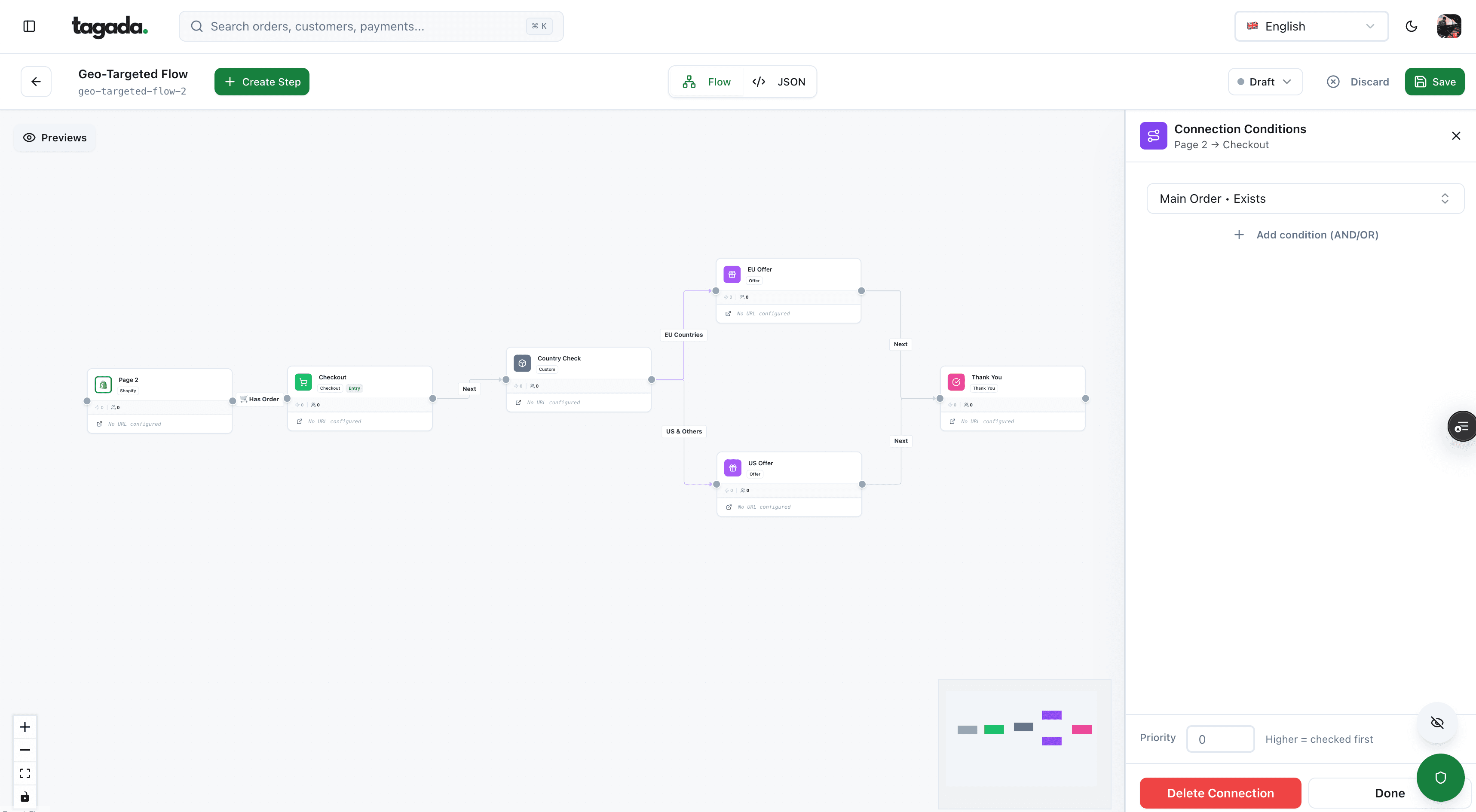
Build the funnel once, route every customer to the right offer
Checkout, upsells and subscriptions on one flow, with conditions per country, order or customer.
Quiet hours: who holds the text
Under the FCC rules, telephone solicitations can't go out before 8 a.m. or after 9 p.m. at the recipient's location, and some states are stricter (details in SMS marketing for ecommerce). A tool that enforces this per recipient saves you from scheduling by hand.
- KlaviyoFlows wait during quiet hours, by profile location or area code; state-level hours available in the US; can be turned off per message, except mandatory rules such as FranceLeave it on for marketing flows; check the state option
- PostscriptCampaigns and automations held until waking hours in the subscriber's time zone, from the phone number; 8 a.m. to 8 p.m. in FL, CT, MD, OK, WA; Texas hours optionalTurn on Texas quiet hours if you text Texas customers
- AttentiveLists quiet hours violations among the risks its compliance tools help reduceAsk how hours are set per state and per country
- Omnisend, Shopify MessagingNot described on the pages we readAsk the vendor before your first campaign
- TwilioNot part of the opt-out feature; you build itSchedule by recipient time zone in your own code
Sources: Klaviyo,3Klaviyo Help Center, Understanding text message quiet hours in flows (updated October 8, 2026) Postscript,9Postscript Help Center, Guide to quiet hours (August 18, 2026) Attentive,11Attentive, Compliance Twilio.22Twilio Docs, Advanced Opt-Out
SMS marketing platforms compared, from their own pages
Every cell below comes from the vendor's own pages, read on October 14, 2026. "Not stated" means we didn't find it on the pages listed in the sources, not that the feature doesn't exist.
| Tool | Store integration | Default US number and registration | Two-way | MMS | International |
|---|---|---|---|---|---|
| Klaviyo1Klaviyo Help Center, Understanding SMS sending numbers (updated March 9, 2026)2Klaviyo Help Center, FAQ: Mobile Messaging per-message pricing (2026), updated July 13, 20265Klaviyo Help Center, Data synced with the WooCommerce integration6Klaviyo Help Center, How to collect SMS consent at checkout on Shopify | Shopify, WooCommerce and others; checkout and order events | Toll-free, verified by Klaviyo in 2 to 5 business days; short codes extra | YesOn numbers that can receive SMS | Priced as its own channel | Sending numbers listed for 23 countries |
| Postscript7Postscript, Pricing (read October 14, 2026)8Postscript Help Center, Comparing short code and toll-free numbers | Shopify data for segments; SDK for other shops | Toll-free, verification free; short code $750/month | YesResponse management | Priced per message | Published rates cover US and Canada |
| Attentive10Attentive, Pricing (read October 14, 2026)11Attentive, Compliance12Attentive, Messaging | 100+ integrations | Not stated | YesReplies and AI or live-agent support | Text plan covers SMS, MMS and RCS | 20+ countries |
| Omnisend13Omnisend, Pricing (read October 14, 2026)14Omnisend Help Center, Verify your toll-free number for SMS (September 14, 2026)15Omnisend, homepage (platforms and channels) | Shopify, BigCommerce, WooCommerce, Wix and others | Verified toll-free required for US and Canada; short code on request | Not stated | US and Canada only | About 200 countries for SMS |
| Shopify Messaging16Shopify Help Center, Setting up SMS marketing with Shopify Messaging18Shopify Help Center, Shopify Messaging (plans and requirements) | Shopify only, Basic plan and up | Toll-free, registration in 2 to 5 business days | NoThe toll-free sender can't receive replies | Not stated | US, Canada, UK and listed EU countries; Spain and Austria paused |
| Twilio19Twilio, SMS pricing for the United States (pricing current as of October 2026)20Twilio Help Center, Pricing and fees for A2P 10DLC service | API: any store, built by you | 10DLC, toll-free or short code, registered through Twilio | YesInbound messages are priced | $0.022 per outbound MMS in the US | Priced per country |
How to read this table
No tool wins every column. A Shopify brand that only needs campaigns can start in Shopify Messaging and move when it needs replies or flows. A brand running flows from checkout, orders and subscriptions should test Klaviyo, Postscript or Omnisend on its own events. Twilio only makes sense with developers who will own consent and quiet hours.
Which tool fits which store
Fits if
- Klaviyo: you already send email in Klaviyo, or want one profile for email and SMS on Shopify or WooCommerce, with quiet hours by area code and state.
- Postscript: you're on Shopify, want SMS as its own program, and want published per-message prices with a toll-free number verified at no charge.
- Attentive: you run a large program across several countries and want compliance tooling, two-way support and a negotiated price.
- Omnisend: you want email and SMS on Shopify, WooCommerce, BigCommerce or Wix with prices on the page, and text outside North America.
- Shopify Messaging: you send a few campaigns a month from the Shopify admin and don't need customers to reply.
- Twilio: you have engineers, a custom checkout or app, and need control over number type, registration and every trigger.
Look elsewhere if
- Klaviyo: you need a per-message US rate table before you sign: the pricing page shows a calculator, not a rate list.
- Postscript: you sell outside the US and Canada, which its published rates don't cover.
- Attentive: you need a price before a sales call.
- Omnisend: you sell SHAFT products in the US: those accounts aren't verified.
- Shopify Messaging: you want two-way conversations or keyword opt-ins on your US number.
- Twilio: nobody on your team will build consent capture, quiet hours and segments.
What SMS costs: pricing models and public prices
Pricing models differ more than prices. Read each page on the day you compare: prices below were read on October 14, 2026.
| Tool | Pricing model | Public US prices | Source |
|---|---|---|---|
| Klaviyo | A monthly plan in dollars, spent per message at a rate by channel, country and, in the US and Canada, number type; carrier fees included in the rate | Free plan includes $5 of mobile messages a month; paid rates shown in the pricing calculator | 2Klaviyo Help Center, FAQ: Mobile Messaging per-message pricing (2026), updated July 13, 20264Klaviyo, Pricing (read October 14, 2026) |
| Postscript | Plan fee plus per-message rate, plus carrier fees | Starter $0/month ($49 minimum spend), SMS $0.009, MMS $0.045; Growth $100/month, SMS $0.008, MMS $0.03; Professional $500/month, SMS $0.007, MMS $0.024; average US carrier fee $0.0033 per SMS | 7Postscript, Pricing (read October 14, 2026) |
| Attentive | Usage-based, on list size and messages sent | Not published | 10Attentive, Pricing (read October 14, 2026) |
| Omnisend | Plan plus SMS credits; Pro gives bonus credits equal to the monthly bill | Pro shown at $41.30/month billed monthly; US SMS from $0.009 down to $0.007 per message by credit volume | 13Omnisend, Pricing (read October 14, 2026) |
| Shopify Messaging | Pay per message sent, billed monthly on the Shopify bill | $0.012 per SMS (US), $0.025 (Canada), $0.06 (UK); $2.15/month per toll-free number | 17Shopify Help Center, Shopify Messaging SMS pricing (read October 14, 2026) |
| Twilio | Pay per segment, plus carrier fees, plus 10DLC registration | $0.0083 per outbound SMS on long code, toll-free or short code; $0.022 per outbound MMS; $0.001 per failed message | 19Twilio, SMS pricing for the United States (pricing current as of October 2026)20Twilio Help Center, Pricing and fees for A2P 10DLC service |
Count segments, not messages
Shopify bills a campaign split into 2 messages to 100 recipients as 200 messages.17Shopify Help Center, Shopify Messaging SMS pricing (read October 14, 2026) Twilio's carrier fees apply to each outbound segment.20Twilio Help Center, Pricing and fees for A2P 10DLC service One emoji can push a text from 160 to 70 characters per segment, as explained in SMS marketing for ecommerce. Confirmations, double opt-in messages and HELP replies are billed too on Shopify Messaging.17Shopify Help Center, Shopify Messaging SMS pricing (read October 14, 2026)
Fig. 210,000 single-segment US texts a month, at list price
| Tool | Calculation | Monthly total | What you still do yourself |
|---|---|---|---|
| Postscript Starter | 10,000 × $0.009 + 10,000 × $0.0033 average carrier fee | About $123 | Nothing extra: flows, quiet hours, opt-outs included |
| Shopify Messaging | 10,000 × $0.012 + $2.15 toll-free number | About $122 | Accept one-way texts and campaign-only scope |
| Twilio (10DLC) | 10,000 × $0.0083 + $35 to $50 carrier fees + $10 campaign | About $128 to $143, plus $61 once for brand and vetting | Consent capture, quiet hours, segments, flows |
Close at the bottom line, far apart on what's included
At this volume the bills are close. The difference is what's inside: a tool that holds texts at night and keeps consent records saves the engineering, and the legal risk, of building those yourself. When comparing email and SMS tools together, add the email side of each plan; our guide to triggered email campaigns covers the flows both channels share.
Questions to ask in the demo
- Which sending number will I get in the US, and who handles verification or registration? Ask for the expected timeline and what happens if it's rejected.
- Which store events trigger texts natively? Checkout started, order paid, fulfilled, refunded, subscription renewal and failed payment. Which ones need a webhook or an app?
- Show me one consent record. Time, source, wording shown, phone number, and how it's exported.
- How are quiet hours set? By recipient time zone or area code, with state rules, and can a user switch them off?
- Can customers reply? Two-way inbox, keyword opt-in, STOP in plain language.
- What's my throughput? Messages per second on my number type, and how long a send to my whole list takes.
- What delivery reporting do I get? Delivered, failed and filtered, by carrier, with error codes.
- How is a message billed? Per segment or per message, carrier fees included or added, MMS rate, and countries.
Ask for answers in writing. The first three can rule a tool out.
Deliverability claims can't be compared across vendors: none publishes a delivery rate measured the same way. Delivery depends mostly on what you control: a verified or registered number, consent you can prove, content that matches the registered use case, and fast opt-out handling. Measure each flow against a holdout group, as described in our SMS marketing guide, and check the SMS marketing glossary entry for the terms.
Where Tagada fits
How Tagada helps
The events your best texts start from
The texts that earn their place follow checkout and subscription events. Tagada runs the checkout, with one-click upsells, order bumps, Apple Pay and Google Pay, and subscriptions with trials, billing cycles, dunning and automatic retries. Payments route across Stripe, Adyen and Tagada's own processor, TagadaPay, with a cascade on decline. It works standalone, on Shopify, on WooCommerce or headless. Pricing is on the pricing page.
Whichever SMS tool you choose, the method holds: confirm it receives the store and payment events your flows need, keeps proof of consent, gets your number approved, and holds texts until morning in your customer's time zone.
Frequently asked questions
What is the best SMS marketing platform for ecommerce?
Which platform is best for 10DLC campaign registration and throughput?
Do I need 10DLC registration if I use Klaviyo, Postscript or Shopify Messaging?
Which SMS marketing tool has the best deliverability?
How much does SMS marketing cost for an ecommerce store?
Which SMS platform works best for a product launch?
Sources
Checked October 14, 2026- Klaviyo Help Center, Understanding SMS sending numbers (updated March 9, 2026)
- Klaviyo Help Center, FAQ: Mobile Messaging per-message pricing (2026), updated July 13, 2026
- Klaviyo Help Center, Understanding text message quiet hours in flows (updated October 8, 2026)
- Klaviyo, Pricing (read October 14, 2026)
- Klaviyo Help Center, Data synced with the WooCommerce integration
- Klaviyo Help Center, How to collect SMS consent at checkout on Shopify
- Postscript, Pricing (read October 14, 2026)
- Postscript Help Center, Comparing short code and toll-free numbers
- Postscript Help Center, Guide to quiet hours (August 18, 2026)
- Attentive, Pricing (read October 14, 2026)
- Attentive, Compliance
- Attentive, Messaging
- Omnisend, Pricing (read October 14, 2026)
- Omnisend Help Center, Verify your toll-free number for SMS (September 14, 2026)
- Omnisend, homepage (platforms and channels)
- Shopify Help Center, Setting up SMS marketing with Shopify Messaging
- Shopify Help Center, Shopify Messaging SMS pricing (read October 14, 2026)
- Shopify Help Center, Shopify Messaging (plans and requirements)
- Twilio, SMS pricing for the United States (pricing current as of October 2026)
- Twilio Help Center, Pricing and fees for A2P 10DLC service
- Twilio Help Center, Message throughput (MPS) and Trust Scores for A2P 10DLC in the US
- Twilio Docs, Advanced Opt-Out
- The Campaign Registry, The 10DLC ecosystem
Tagada
The checkout and subscription events behind every text
Funnels, one-click upsells, subscription billing and payment routing, on one customer record.
- 01Create your free account
- 02Connect your store or build a checkout
- 03Launch funnels, upsells and subscriptions