
Your dashboard says MRR is growing. New customers arrive every day, upgrades look healthy, and the forecast assumes each renewal will collect automatically. Then finance checks the bank account and finds a different story: failed renewals, delayed recovery, refunds, processor fees, and customers who lost access after a payment error rather than choosing to leave.
Subscription billing and revenue management exists to close that gap. It connects the customer contract, payment authorization, entitlement, messaging, processor routing, and accounting treatment into one operating process. A founder shouldn't have to guess whether lost revenue came from a weak offer, an expired card, a bank block, an incorrect retry, or a deferred-revenue entry posted in the wrong period.
This guide follows the money through that system, from checkout and renewal mechanics to decline intelligence, dunning, pricing, payment routing, dispute exposure, and ASC 606 reporting. The central lesson is simple: revenue management isn't a month-end finance exercise. It's a daily payment-operations discipline.
Why Subscription Revenue Leaks Even When Sales Climb
A subscription business can add customers faster than it collects cash. The problem usually appears between the original authorization and the next billing event. A renewal may fail because funds aren't available, a bank blocks the transaction, a credential expires, or the processor interprets the payment differently in a particular market.
The customer may still want the product. Yet if the system immediately suspends access, sends a generic cancellation email, or records the account as churned, the business converts a recoverable payment event into a lost relationship. The sales dashboard still shows the original signup, while the cash dashboard absorbs the failure later.
Operator rule: Treat every renewal failure as an event that needs classification, not as proof that the customer has decided to leave.
Revenue management therefore starts with plumbing. You need a reliable record of the plan, billing date, payment method, authorization result, decline reason, entitlement state, retry history, customer message, refund, and eventual accounting outcome. A spreadsheet might show a subscription as active, but it usually won't explain which processor attempted the renewal, whether the issuer returned a soft decline, or whether the customer updated their credentials after the first failure.
The operating map has several connected parts:
- Billing mechanics: Create invoices, calculate changes, collect payment, and preserve the contract history.
- Payment recovery: Separate soft declines from hard declines, select an appropriate retry path, and stop before repeated attempts create more risk.
- Customer lifecycle: Handle upgrades, pauses, cancellations, inactive accounts, and reactivations without treating every state as permanent churn.
- Revenue reporting: Distinguish bookings, billings, cash, deferred revenue, recognized revenue, refunds, and expected collections.
- Payment orchestration: Route transactions across suitable processors and methods, then feed the results back into analytics and finance.
The goal isn't to make every failed payment succeed. The goal is to make every decision explainable, measurable, and aligned with the customer's actual state.
How Subscription Billing Actually Works
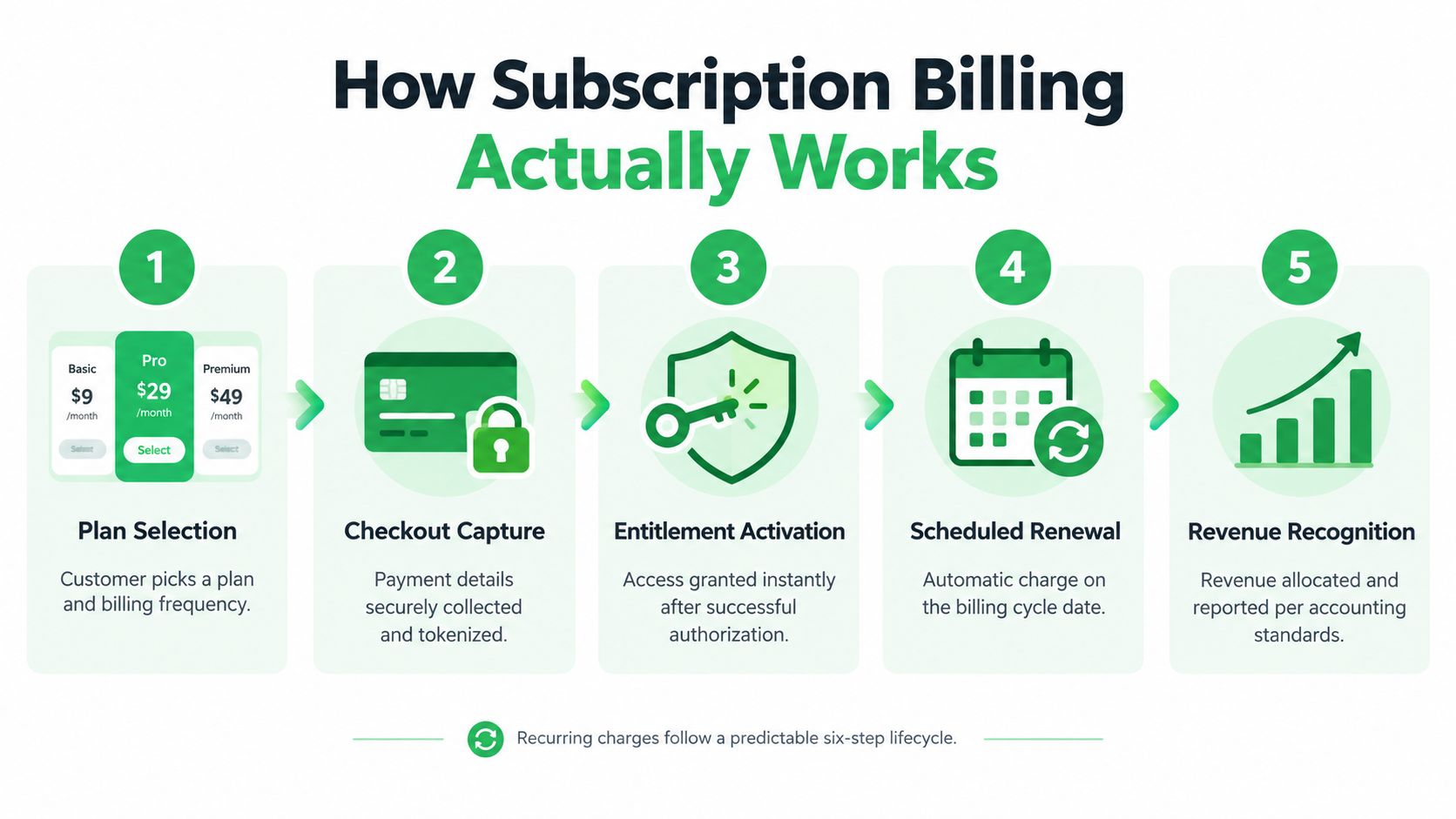
Subscription billing is a recurring contract for access, delivery, or usage. A useful analogy is a rental agreement. The customer pays according to an agreed schedule, but the payment date and the period of access are related rather than identical. A successful charge proves that money was collected. It doesn't, by itself, prove that all contracted service has been delivered.
The lifecycle usually contains these events:
- Plan selection: The customer chooses the product, price, billing frequency, currency, tax treatment, and any add-ons. The system should store the exact version of the offer, not only a plan name that may change later.
- Checkout capture: Payment details are collected and tokenized through a compliant payment flow. The merchant records the customer, payment method, processor, authorization result, invoice, and consent or mandate details.
- Entitlement activation: Access begins only after the business has a clear rule for authorization, payment status, trial status, and any grace period. The entitlement should have a start date, end date, and source event.
- Scheduled renewal: The billing engine creates the next invoice and attempts collection. It needs to account for plan changes, credits, taxes, usage, currency, and the payment method's recurring authorization rules.
- Lifecycle change: An upgrade, downgrade, pause, resume, refund, credit, or cancellation changes the contract. Mid-cycle changes may require proration or a separate allocation treatment.
- Expiration or cancellation: The subscription moves to a defined state, with the reason, effective date, remaining entitlement, and possible reactivation path preserved.
The records that make the system auditable
At minimum, retain immutable event IDs, customer and contract IDs, plan version, effective date, billing period, currency, tax components, processor reference, fees, payment status, entitlement status, and communication history. Store upgrades and downgrades as events rather than overwriting the original subscription.
A spreadsheet often misses the difference between “invoice created,” “authorization approved,” “funds settled,” and “service delivered.” Those are separate moments. If the system merges them, support can't explain an account state and finance can't reconcile the ledger without manual adjustments.
A recurring charge is not just a card transaction. It's a contract event, an entitlement event, an accounting event, and a customer communication event.
Revenue Recognition Beyond the Charge
Cash collection and accounting revenue answer different questions. Cash asks whether money arrived. Revenue recognition asks how much of that money has been earned through delivered service.
Under ASC 606 and IFRS 15, a business generally identifies the contract, identifies distinct performance obligations, determines the transaction price, allocates that price using standalone selling prices, and recognizes revenue as each obligation is satisfied. For an annual subscription paid upfront, revenue is generally spread across the access period as the service is delivered. Bundled onboarding, implementation, usage, or add-on services may require separate allocation and different recognition patterns, as outlined in this subscription revenue recognition guide.
Consider a brand that sells an annual access plan with onboarding and usage-based add-ons. The checkout system may bill the customer upfront, but the accounting system shouldn't automatically recognize the entire amount on the invoice date. The access component may be recognized across the service period, onboarding when that obligation is delivered, and usage as the customer consumes the measured service.
The five questions finance must answer
- What contract exists? Preserve the signed terms, plan version, renewal rule, discounts, and effective dates.
- What must the business deliver? Separate access, onboarding, implementation, usage, and add-on obligations where appropriate.
- What is the transaction price? Include relevant discounts, refunds, credits, and variable usage charges.
- How is the price allocated? Use the standalone selling prices of the distinct obligations.
- When is each obligation satisfied? Post revenue according to delivery, not according to billing or settlement.
This requires a contract-level subledger. Every invoice, upgrade, downgrade, pause, refund, credit, cancellation, tax component, and entitlement period should produce an auditable trail. A useful dashboard separates bookings, billings, cash, recognized revenue, deferred revenue, refunds, and expected collections.
For teams designing the accounting layer, practical examples of deferred revenue journal entries can help translate contract events into posting logic. The payment system should pass immutable event IDs, effective dates, currencies, processor fees, and contract-version metadata into finance.
Guardrails against common errors
Don't recognize an annual prepayment immediately merely because the processor settled it. Don't treat a recovered failed renewal as a new sale if it continues the original contract. Don't overwrite a canceled subscription with a new active record without preserving the cancellation and reactivation history.
A reconciliation job should compare checkout events, processor responses, settlements, refunds, entitlement periods, and accounting entries. When those records share stable identifiers, month-end review becomes a controlled exception process rather than a search through payment exports.
Involuntary Churn and the Decline-Reason Problem
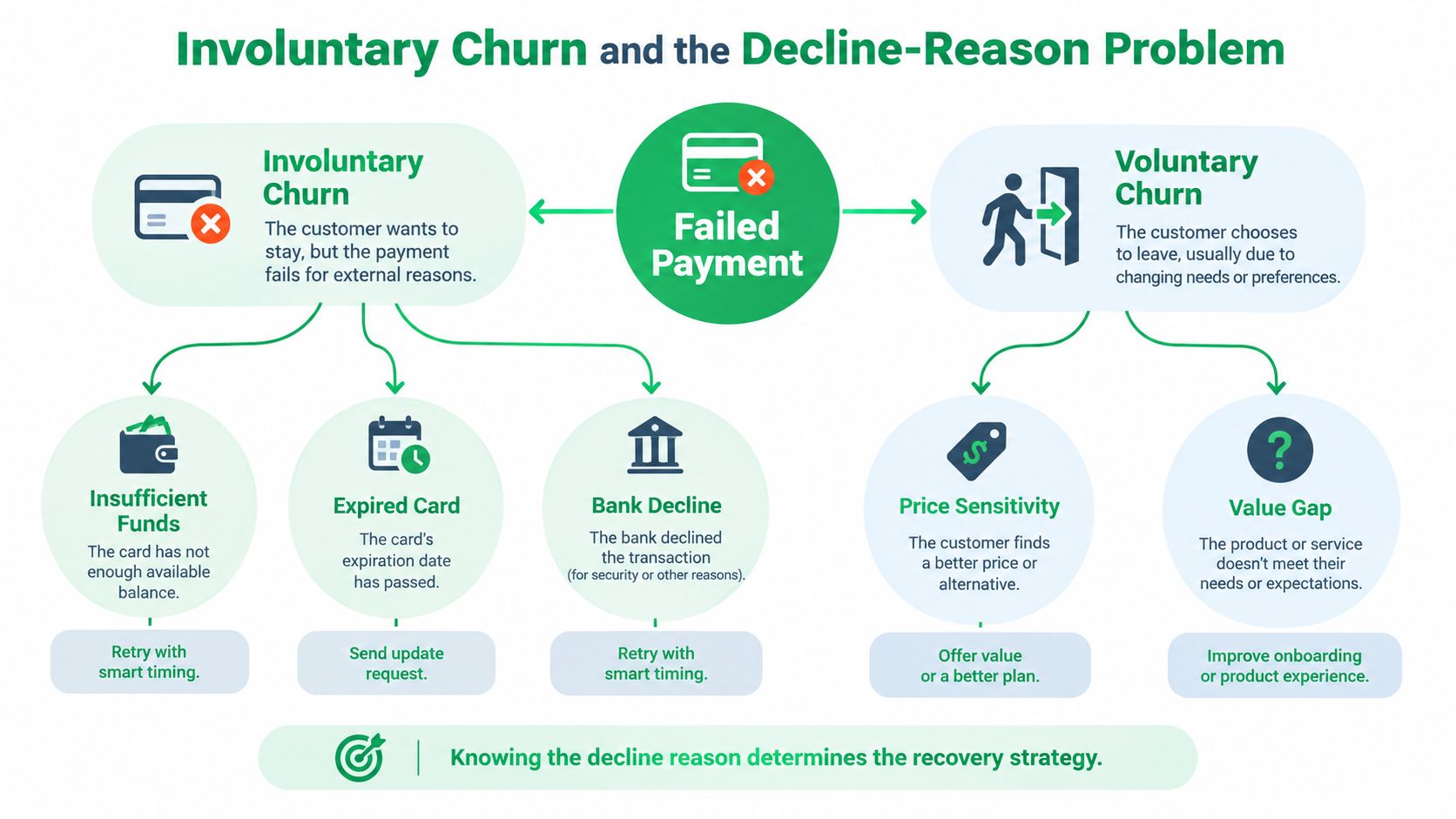
A renewal can fail even when the customer still wants the product. An issuer may reject the transaction, a card may have expired, or the account may lack funds on that day. This is involuntary churn. It is a payment-orchestration problem before it becomes a retention or accounting problem.
Industry compilations such as Billed's subscription billing statistics analysis place involuntary churn at roughly 20% to 40% of total subscription churn. Insufficient funds, transaction restrictions, outdated credentials, and generic issuer declines are common causes. The sequence is simple: authorization fails, access is interrupted, and the account may be marked as churned before the payment problem is fixed.
The State of Retention 2025 analysis examined more than $3 billion in subscription revenue and 6 million failed payments. It found that insufficient funds represented 42.3% of declines. It also reported involuntary churn near 1% overall, reaching 40% or more of total churn for some businesses, while 54% of surveyed businesses said that more than 20% of their churn was involuntary. These findings support measuring your own decline mix instead of applying one universal assumption.
The reason code determines the next move
A decline reason acts like a traffic signal for the recovery workflow. An insufficient-funds response may justify a later retry after the customer receives income. An expired card calls for a credential update. A fraud or risk block may require authentication, another payment method, or a different processor. A customer-initiated bank block should not receive the same sequence as a temporary issuer timeout.
| Decline category | What it can mean | Operator response |
|---|---|---|
| Insufficient funds | The account cannot cover the renewal at that moment | Retry later and communicate clearly |
| Expired or outdated credential | The stored payment method is no longer usable | Request an update or use an available updater |
| Issuer or bank decline | The bank rejected the transaction for risk, policy, or transaction rules | Review the code, consider routing, and avoid blind repetition |
| Customer payment block | The customer blocked recurring activity through a bank or banking app | Explain the issue and offer a controlled alternative |
| Processor or regional method failure | The chosen route or method is not authorizing reliably in that market | Test another processor or a locally suitable method |
The operating question is “Why did it fail, and which intervention has a reasonable chance of resolving that reason?” Capture the response code, processor, country, currency, payment method, retry number, customer state, and eventual outcome. A payment recovery software reference can help teams map those events to routing, retries, customer messages, and the final subscription state. Those records also give finance a clearer trail for reporting the difference between a failed renewal, recovered revenue, and genuine churn.
Dunning That Recovers Revenue Without Burning Trust
A renewal fails at 2 a.m. because an issuer times out. Another fails because the customer's card expired. A third is blocked by the customer's bank. Sending the same reminder and retrying each payment on one fixed schedule treats three different problems as one. Dunning works better as a state machine, where each account moves through states such as payment failed, recovery pending, payment method update needed, recovered, overdue, suspended, or canceled. Every state needs an owner, next action, eligibility rule, and stop condition.
Separate soft declines from hard declines before setting the sequence. A temporary issuer timeout may justify a later attempt. An expired credential, confirmed fraud block, or customer-initiated bank block needs a different action. Use the failure reason, customer-local timing, account value, payment method, processor, and prior retry history to select that action.
Retry timing should be tested, not assumed. Several attempts packed into a short period can look like repeated pressure to an issuer and an anxious customer. A later attempt may succeed after a balance changes or a temporary issuer issue clears. The right schedule depends on the decline reason, customer time zone, payment method, and the cost of another authorization request.
A practical recovery sequence
- Record the failure event: Store the decline code, processor, timestamp, amount, currency, and subscription state. These fields connect payment operations to later revenue reporting.
- Choose the intervention: Retry a recoverable soft decline, request a credential update for an expired method, or route a suitable attempt through another processor or payment method.
- Message the customer: Use email, SMS, or an in-product notice tied to the actual payment event. Explain what happened without suggesting that the customer voluntarily canceled.
- Protect entitlement deliberately: Apply a defined grace period or restricted-access policy instead of an immediate, unexplained cutoff.
- Stop at a controlled limit: Excessive retries can increase issuer distrust, customer irritation, processor costs, and dispute exposure.
Use the earlier decline categories as the diagnosis layer, then keep the action table focused on the retry decision:
| Decline Reason Category | Retry Decision |
|---|---|
| Insufficient funds | Retry in a later timing window |
| Expired card | Do not repeat the same credential. Request an update |
| Generic issuer decline | Retry only under a reason-based rule or try another route |
| Fraud or risk block | Stop blind retries and request an approved alternative or authentication |
| Customer bank block | Stop until the customer changes the setting or chooses a permitted method |
High-value or enterprise accounts may need support or account management involvement. Lower-value accounts can use automated flows if messages stay clear and the system preserves account state. Teams handling many exceptions can use finance workflow automation with AI for classification, routing, and reconciliation support, while keeping payment-policy decisions auditable.
Connect recovery events to the finance layer. A failed renewal, a later recovered payment, and genuine churn should remain distinguishable when the team reviews subscription performance and ASC 606 reporting. That requires consistent event records across the billing system, processors, customer messaging, and accounting workflow.
Measure recovery rate, recovered MRR, retries per recovered account, authorization rate, incremental processor costs, and recovered gross profit. Recovered subscriptions can give a false sense of success if retry fees, support effort, refunds, or fraud exposure consume the margin. A controlled dunning management software workflow should make those trade-offs visible.
Pricing Models That Shape Recurring Revenue
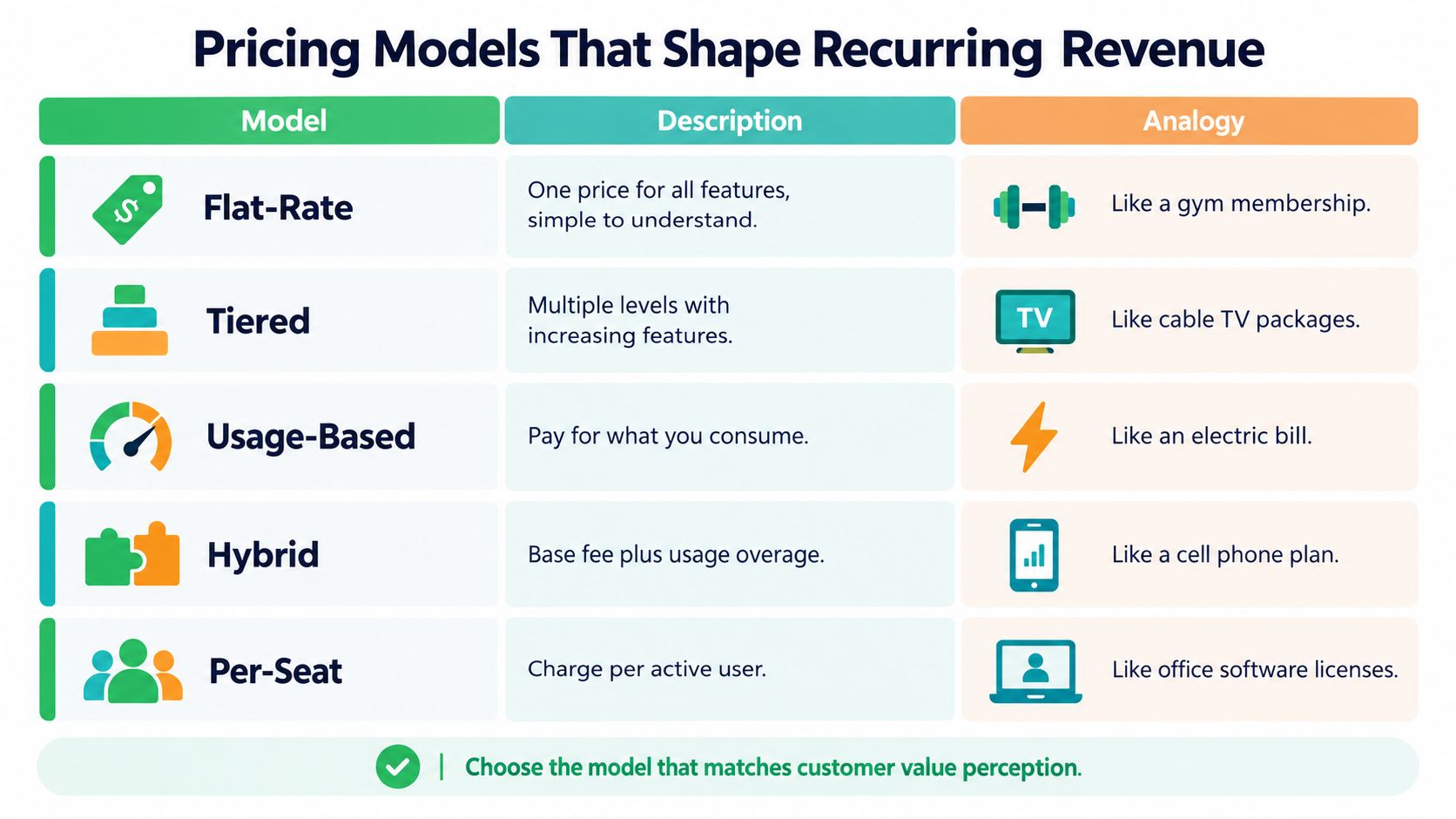
Pricing determines what the billing engine must measure. A flat subscription resembles a gym membership: the customer pays for ongoing access regardless of each visit. Usage-based pricing resembles a utility bill, while a hybrid plan works like a phone plan with a base allowance and additional charges.
The right model reflects how customers perceive value and how reliably you can measure delivery. A simple offer can reduce billing confusion, but it may leave expansion opportunities unused. A detailed usage model can align price with consumption, but it requires accurate metering, customer visibility, and revenue allocation.
Comparing the main models
| Model | Best fit | Revenue behavior | Main operational risk |
|---|---|---|---|
| Flat-rate | Predictable access and simple products | Stable recurring billing | Limited expansion path and poor fit for variable usage |
| Tiered | Clear feature or service differences | Expansion through upgrades | Customers may struggle to choose between boundaries |
| Usage-based | Consumption closely reflects value | Revenue follows actual use | Forecasting, metering, and bill-shock challenges |
| Hybrid | Variable costs with a need for predictability | Base recurring revenue plus expansion | More complex invoices and recognition rules |
| Per-seat | Team products where users drive value | Revenue expands as accounts add users | Seat changes, proration, and inactive-user disputes |
A flat-rate offer is often a sensible starting point when the product and usage are easy to understand. Tiered pricing works when features map cleanly to customer segments. Usage-based pricing needs trustworthy meters and an explanation of what creates the bill. Hybrid pricing can balance predictable access with consumption, but the customer should always see the allowance, current usage, and overage logic before renewal.
Pricing also changes accounting. Usage, credits, discounts, and bundled services can alter the transaction price and allocation. Your commercial page, checkout logic, invoice model, entitlement service, and contract-level subledger must all describe the same offer.
Choose the pricing model your billing system can explain line by line, not the one that looks most sophisticated on a pricing page.
Checkout, Payment Routing, and Analytics as One Revenue Layer
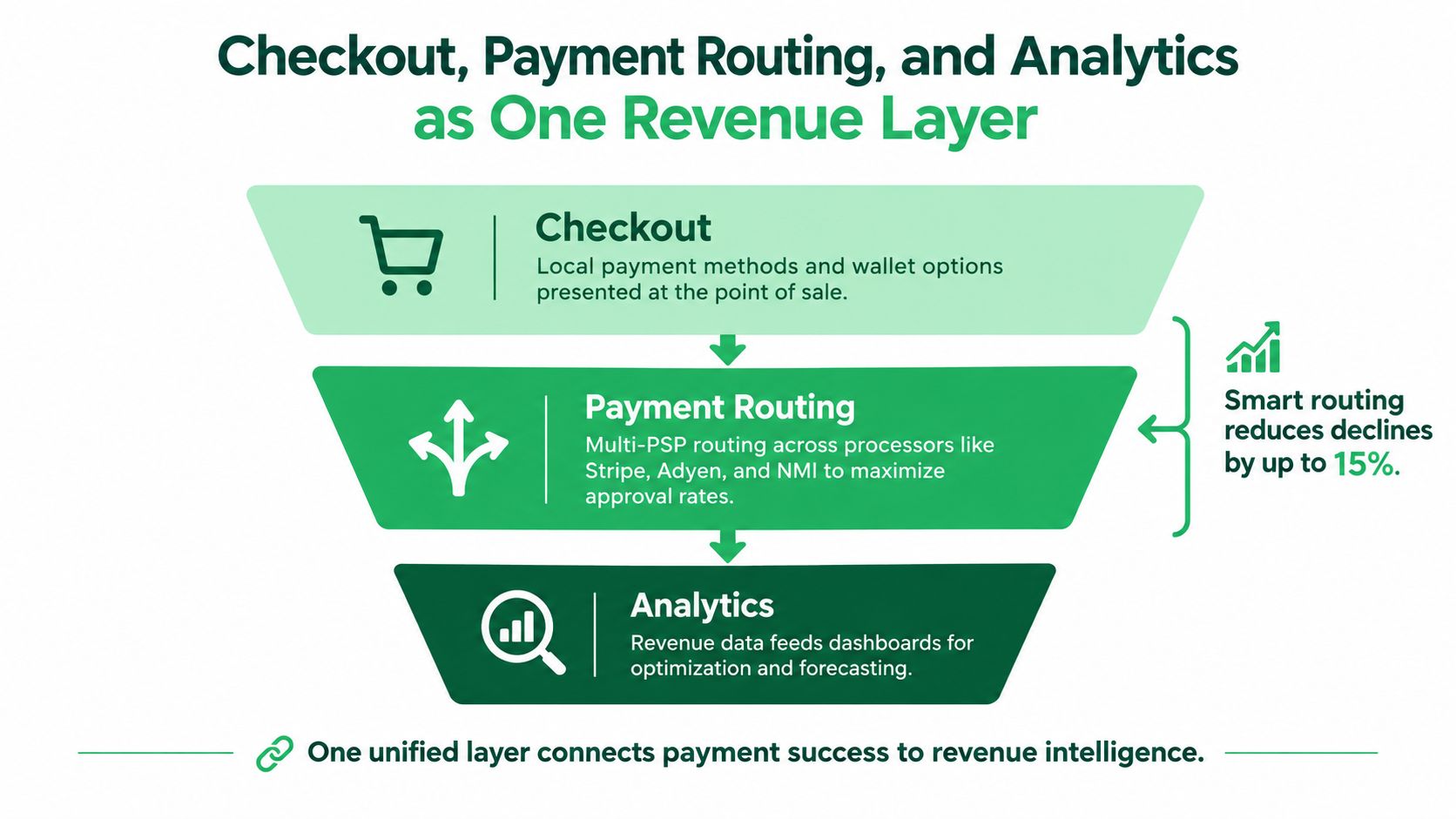
A checkout is more than a form that captures card details. It decides which payment methods customers recognize, which currency they use, which processor receives the authorization, and which event triggers entitlement. Those decisions affect both the initial purchase and future rebills.
Digital wallets became the largest ecommerce payment method globally in 2024, representing 53% of online transaction value. Global ecommerce and in-person wallet spending reached approximately $15.6 trillion, including $3.6 trillion in online wallet spend, according to the Worldpay Global Payments Report. For international subscription businesses, wallets belong beside cards when recurring authorization is available and operationally suitable.
A multi-PSP design can route transactions across processors such as Stripe, Adyen, and NMI, using rules based on country, currency, payment method, issuer response, risk, and processor availability. Routing isn't a promise that every decline will disappear. It creates more informed choices than sending every transaction through one path.
The analytics layer must follow the transaction
Dashboards should separate gross churn from involuntary churn, then connect recovery to recovered MRR and recovered gross profit. They should show authorization rates by processor and market, payment-method performance, retry outcomes, customer messages, refunds, and incremental fees.
Dispute exposure needs both rate and absolute volume. Visa's VAMP ratio combines TC40 fraud transactions and TC15 non-fraud disputes, divided by settled Visa card-not-present transactions. For most regions, the excessive merchant threshold was 2.20% beginning June 1, 2025, falling to 1.50% beginning April 1, 2026, with a minimum of 1,500 combined fraud and dispute events for the merchant threshold, according to Visa monitoring mechanics.
A documented Visa and Mastercard guideline also identifies a standard threshold of at least 100 chargebacks and a 1% chargeback-to-sales ratio, with an excessive threshold of at least 500 chargebacks and a 2% ratio. Separate Visa program documentation describes additional entry conditions involving 200 chargebacks per month at a rate above 2% for four consecutive months, or 100 chargebacks with a rate above 1.49% and more than 1,000 monthly sales transactions for two consecutive months, as detailed in these fraud and chargeback risk thresholds.
For checkout design decisions, a practical Shugert's Shopify checkout playbook can complement processor and payment-method analysis. Tagada is one orchestration option that combines checkout, payment routing, subscription management, smart retries, messaging, and payment-event data in a connected layer. Its routing workflow can be reviewed through dynamic payment routing.
An Operator Checklist for Subscription Revenue in 2026
Use this checklist to turn subscription billing and revenue management into a repeatable operating rhythm:
- Build the subledger: Preserve contract versions, event IDs, effective dates, currencies, fees, invoices, entitlements, refunds, credits, and recognition entries.
- Instrument decline reasons: Separate insufficient funds, expired credentials, issuer blocks, fraud controls, customer bank blocks, and regional or processor failures.
- Set recovery rules: Define eligible retries, customer-local timing, message escalation, grace periods, and a hard stop for each category.
- Review routing: Compare processors, payment methods, currencies, markets, authorization rates, fees, and dispute outcomes instead of relying on one global route.
- Reconcile revenue: Separate bookings, billings, cash, deferred revenue, recognized revenue, refunds, and expected collections.
- Design reversible exits: Offer clear cancellation, pause, swap, and reactivation states. A consumer survey found 82% of surveyed consumers were more likely to subscribe when cancellation was easy, 78% wanted pause or swap options, and 58% had paused rather than canceled when that option existed, as reported in this consumer cancellation survey.
Cancellation transparency matters even as regulatory rules change across jurisdictions. Customers increasingly judge a subscription by how easily they can understand, pause, cancel, and return. Review these controls every quarter, because revenue management is an operating discipline, not a project that ends after implementation.
Tagada connects checkout, multi-processor payment routing, subscription rebills, smart retries, revenue-aware messaging, and payment-event analytics in one orchestration layer. Visit Tagada to see how your team can make renewal recovery, international payments, and subscription revenue reporting work from the same operational system.