
What Is CLTV? How to Calculate Customer Lifetime Value in Ecommerce
CLTV formulas for repeat buyers and subscriptions, revenue vs margin, cohort LTV, LTV:CAC and payback, and how Shopify, Klaviyo and Stripe compute it.

Article summary
TL;DR
CLTV (customer lifetime value) is what one customer is worth to your business over the whole relationship. The common formula is average order value × purchase frequency × customer lifespan. For subscriptions, it's monthly revenue per subscriber ÷ monthly churn rate. Multiply by your gross margin to see what you can afford to spend acquiring that customer.
- CLTV, CLV and LTV are the same metric. In mortgage lending, CLTV means combined loan-to-value, which is unrelated.
- Revenue CLTV tells you how much a customer spends. Gross-margin CLTV tells you how much you keep, and it's the one to compare with acquisition cost.
- The subscription formula ARPU ÷ churn assumes churn never changes. Real cohorts lose most subscribers early, so check the formula against a cohort table.
- Shopify, Klaviyo, Stripe and Chargebee each compute lifetime value differently. Know which one your dashboard shows before you act on it.
- LTV:CAC only means something next to payback: how many months before a customer's margin repays what you spent to acquire them.
 ChatGPT
 Claude
 Perplexity
 Grok
GrokOn this page
CLTV, or customer lifetime value, is what a customer is worth to your brand from the first order to the last. It decides how much you can spend to acquire a customer, which channels deserve budget, and whether a subscription offer is worth its discount. This guide gives the formulas for repeat buyers and for subscriptions, works each one through with numbers, and shows how Shopify, Klaviyo, Stripe and Chargebee calculate it.
What is CLTV?
Customer lifetime value (CLTV, CLV or LTV: the three acronyms mean the same thing) is the total value one customer brings over the whole time they buy from you. A customer who places a 60 USD order and never returns is worth 60 USD. A customer who reorders the same 60 USD product every two months for three years is worth 1,080 USD in revenue. Same first order, very different customer.
If you searched "CLTV" and landed here by mistake: in mortgage lending, CLTV means combined loan-to-value ratio, the total of all loans secured by a property divided by its value. This article covers the ecommerce metric only.
The word "value" hides two choices that change the number completely:
| Choice | Option A | Option B |
|---|---|---|
| What you count | Revenue: what the customer pays you | Gross margin: what you keep after product, shipping, payment fees, discounts and refunds |
| Which orders | Historical: orders already placed | Predictive: orders you expect, from a formula or a model |
| Over what period | Lifetime: until the customer stops buying | Fixed window: 12, 24 or 36 months after the first order |
Revenue CLTV is fine for comparing customers with each other. Gross-margin CLTV is the one to put next to customer acquisition cost, because acquisition is paid out of margin, not revenue. Historical CLTV is a fact. Predictive CLTV is an estimate, and only as good as its assumptions. Whatever mix you choose, write it next to the number.
How to calculate CLTV for repeat purchases
For a brand selling one-off orders that customers may repeat, the standard formula multiplies three averages:
CLTV = average order value × purchase frequency × customer lifespan
- Pick a period of order data. The last 12 months: 480,000 USD of net sales, 8,000 orders, 5,000 unique customers.
- Average order value. Revenue ÷ orders: 480,000 ÷ 8,000 = 60 USD.
- Purchase frequency. Orders ÷ customers: 8,000 ÷ 5,000 = 1.6 orders per customer per year.
- Customer lifespan. Share of last year's customers who bought again this year: 60%. Lifespan = 1 ÷ (1 − 0.60) = 2.5 years.
- Revenue CLTV. 60 × 1.6 × 2.5 = 240 USD.
- Gross-margin CLTV. With a 55% gross margin: 240 × 0.55 = 132 USD.
Illustrative example. The numbers are invented to show the method.
Average order value and frequency come straight from your order export. Lifespan is the weak input. The 1 ÷ (1 − retention) shortcut assumes the same share of customers comes back every year, forever. A brand less than two years old can't observe that, and a long guessed lifespan inflates CLTV faster than anything else. If you have to guess, use a fixed window instead: "12-month CLTV" is less flattering and much harder to get wrong.
Use net sales, not gross sales: returns and refunds aren't revenue you kept. Count unique customers by email or customer ID, not by order, or guest checkouts will look like new customers every time.
Revenue vs gross-margin CLTV
Revenue CLTV overstates what a customer is worth, sometimes by half. Gross margin per order is what's left after every cost that grows with the order. Here's the 60 USD order from the example:
| Per order | Amount | What goes in it |
|---|---|---|
| Net revenue | 60.00 USD | Price paid, after discounts |
| Product cost | −15.00 USD | Landed cost of goods |
| Shipping and fulfillment | −7.00 USD | Postage, packaging, pick and pack |
| Payment processing | −2.00 USD | Processor fees on the order |
| Refunds, chargebacks, promotions | −3.00 USD | Averaged across orders, including chargeback fees |
| Gross margin | 33.00 USD (55%) |
240 USD
Revenue CLTV: 60 × 1.6 × 2.5 (illustrative)
132 USD
Gross-margin CLTV: 33 × 1.6 × 2.5
45%
Share of revenue that never reaches margin
Keep fixed costs out (salaries, software, rent): they don't change with one more customer. Keep acquisition cost out too, so you can compare CLTV with it. Some guides subtract CAC from CLTV and still call it CLTV; that's a different metric, closer to profit per customer.
How to calculate LTV for a subscription
A subscription has a cancellation date, so lifespan comes from churn. If a constant share of subscribers leaves every month, the average subscriber stays 1 ÷ monthly churn months. That gives the subscription formula:
Subscription LTV = ARPU × gross margin ÷ monthly churn rate
ARPU is average monthly revenue per subscriber. Illustrative example: ARPU of 40 USD, gross margin of 60% (24 USD a month), monthly churn of 6%. The average subscriber stays 1 ÷ 0.06 = 16.7 months. Revenue LTV is 40 ÷ 0.06 = 667 USD, and gross-margin LTV is 24 ÷ 0.06 = 400 USD.
Billing tools publish their own versions:
- Stripe Billing: subscriber lifetime value = ARPU ÷ subscriber churn rate, where ARPU is total MRR ÷ active subscribers. Stripe's example: an ARPU of 500 USD and a 9% monthly churn give 5,555 USD. There's no margin in it, so it's revenue LTV.1Stripe Docs, Billing analytics: metric definitions (ARPU, subscriber lifetime value, subscriber churn rate, retention by cohort)
- Chargebee RevenueStory: LTV = subscription lifetime × average revenue per paid subscription, with lifetime as the inverse of the average churn of the last three months, and churn divided by active paid customers at the end of the month.2Chargebee Docs, How is the lifetime value metric calculated in RevenueStory
The formula's weakness is the churn rate itself. LTV is divided by it, so small changes in churn move LTV a lot:
| Monthly churn | Average lifetime | Gross-margin LTV at 24 USD a month |
|---|---|---|
| 3% | 33.3 months | 800 USD |
| 4% | 25.0 months | 600 USD |
| 5% | 20.0 months | 480 USD |
| 6% | 16.7 months | 400 USD |
| 8% | 12.5 months | 300 USD |
| 10% | 10.0 months | 240 USD |
Your churn definition changes your LTV
The same month can give a churn rate of 4.50%, 4.58% or 5.13% depending on the denominator, as shown in how to calculate churn rate. At 24 USD of monthly margin, that's an LTV of 533, 524 or 468 USD for identical customers. Use one churn definition, and use involuntary churn from failed payments in it: a subscriber lost to a declined card is as gone as one who canceled.
Three more limits to keep in mind:
- Churn isn't constant. Subscribers leave fastest in the first months, then the ones who stay are stickier. A blended monthly rate mixes both, so the formula can be off in either direction. A cohort table shows the real curve.
- ARPU moves. Upgrades, add-ons and price increases raise it; downgrades and longer delivery intervals lower it. Net revenue retention, covered in gross vs net retention, captures that.
- Very low churn breaks it. At 1% monthly churn the formula assumes a 100-month average lifetime, longer than most brands have existed. Cap the horizon at what you can observe, or use a 24- or 36-month window.
Cohort-based CLTV: what customers actually spent
A cohort is every customer whose first order fell in the same month. Instead of multiplying averages, you add up what the cohort really spent, month after month, and divide by the number of customers it started with, including those who never came back.
Cohort CLTV at month n = cumulative gross margin from the cohort through month n ÷ customers in the cohort at the start
Fig. 1January cohort: 1,000 first-time customers
| Months after first order | Share who ordered again | Cumulative revenue per customer | Cumulative margin per customer |
|---|---|---|---|
| Month 0 | 4% | 64 USD | 35.20 USD |
| Month 1 | 9% | 71 USD | 39.05 USD |
| Month 3 | 18% | 86 USD | 47.30 USD |
| Month 6 | 27% | 104 USD | 57.20 USD |
| Month 12 | 38% | 131 USD | 72.05 USD |
Divide by everyone who started, not by who's left
Compare this with the formula. The averages promised 132 USD of margin over 2.5 years; the cohort has produced 72 USD after 12 months. Both can be right, but only the cohort number is observed. Lay several cohorts side by side and you'll see whether newer customers are worth more or less than older ones at the same age, which no single average shows. The full method is in what is cohort analysis.
Shopify builds this table for you. Its customer cohort analysis report groups customers by the date of their first order, lets you choose number of customers, customer retention rate, gross sales, net sales or average order value as the metric, and can show projections of future amount spent per customer, which Shopify notes "aren't a guarantee of future sales."5Shopify Help Center, Customers reports (customer cohort analysis) Stripe Billing does the same for subscriptions, with cohorts by the month a subscriber first generated MRR, and both subscriber and revenue retention.1Stripe Docs, Billing analytics: metric definitions (ARPU, subscriber lifetime value, subscriber churn rate, retention by cohort)
Inside Tagada
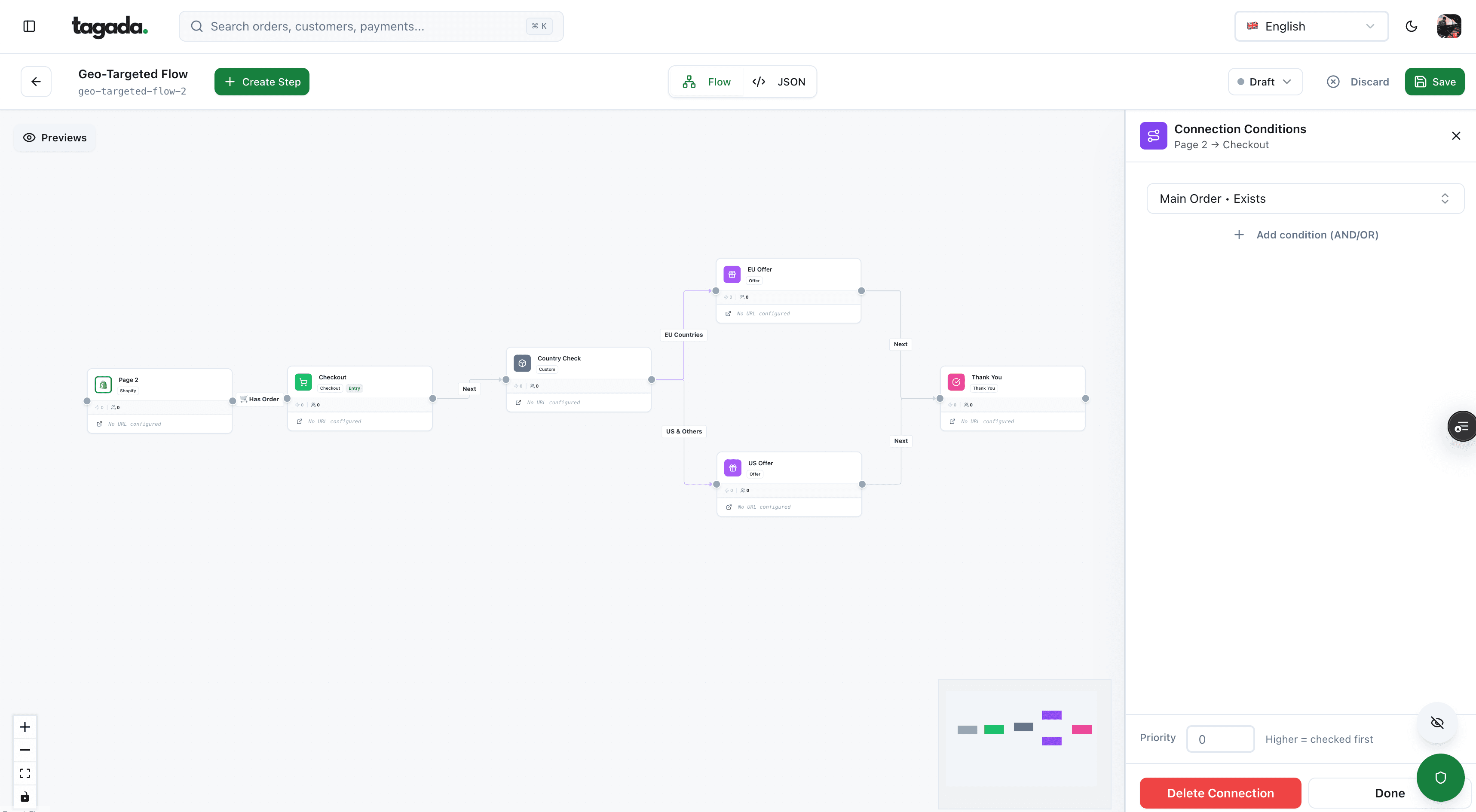
Build the funnel once, route every customer to the right offer
Checkout, upsells and subscriptions on one flow, with conditions per country, order or customer.
Historical vs predictive CLTV: how Shopify, Klaviyo and Stripe compute it
Your dashboard probably already shows a lifetime value. Before you act on it, check which kind it is:
| Tool | Metric | How it's calculated |
|---|---|---|
| Klaviyo | Historic CLV | Total value of all a customer's past orders, net of refunds and returns3Klaviyo Help Center, Understanding Klaviyo's predictive analytics |
| Klaviyo | Predicted CLV | Model's forecast of what the customer will spend in the next year; Total CLV = historic + predicted3Klaviyo Help Center, Understanding Klaviyo's predictive analytics |
| Shopify | Predicted spend tier | High, Medium or Low, from purchase frequency, order value compared with the store average, number of orders and recency4Shopify Help Center, Predicted spend tier |
| Shopify | Cohort analysis | Spend per customer by first-order cohort, with optional projections5Shopify Help Center, Customers reports (customer cohort analysis) |
| Stripe Billing | Subscriber lifetime value | ARPU ÷ subscriber churn rate1Stripe Docs, Billing analytics: metric definitions (ARPU, subscriber lifetime value, subscriber churn rate, retention by cohort) |
| Chargebee | LTV | Subscription lifetime (inverse of the last 3 months' average churn) × revenue per paid subscription2Chargebee Docs, How is the lifetime value metric calculated in RevenueStory |
Predictive models need data. Klaviyo shows predictive analytics only when at least 500 customers have placed an order, with at least 180 days of order history, orders in the last 30 days, and some customers with three or more orders. It retrains the model at least once a week and warns that predictions "work best when averaged over many customers and are not expected to be exact for any single individual."3Klaviyo Help Center, Understanding Klaviyo's predictive analytics Shopify's predicted spend tier requires a store with over 100 sales and only covers customers who have bought.4Shopify Help Center, Predicted spend tier
So use predicted CLV to rank and segment customers (VIP flows, win-back targets, who gets a discount), not as the input to your acquisition budget. For budgets, use cohort data you have observed.
Discounted CLTV, for finance teams
A dollar in three years is worth less than a dollar today. The classic discounted formula values the future years of a customer as m × r ÷ (1 + d − r), where m is annual margin per customer, r the annual retention rate and d the discount rate. With the repeat-buyer example (m = 52.80 USD, r = 60%, d = 10%), future years are worth 52.80 × 0.6 ÷ 0.5 = 63.36 USD. Add the first year's 52.80 USD: 116.16 USD, against 132 USD undiscounted. Illustrative example.
LTV:CAC and payback
CLTV only becomes a decision when you compare it with what a customer costs to acquire. Two numbers do that:
- LTV:CAC = gross-margin LTV ÷ customer acquisition cost. CAC is acquisition spend for a period divided by new customers in the same period.
- Payback period = the number of months before a customer's cumulative gross margin covers their CAC.
Back to the subscription example, with a CAC of 90 USD:
LTV:CAC
400 ÷ 90 = 4.4. Each acquired subscriber is expected to return 4.4 times their acquisition cost in margin, if churn stays at 6%.
Simple payback
90 ÷ 24 = 3.75 months for a subscriber who stays. This ignores the ones who leave before month 4.
Cohort payback
Counting churn, cumulative margin per original subscriber is 87.70 USD after 4 months and 106.40 USD after 5. Payback lands in month 5.
For the repeat-buyer cohort above, with a CAC of 45 USD, cumulative margin crosses 45 USD between month 1 (39.05 USD) and month 3 (47.30 USD). Its 12-month LTV:CAC is 72.05 ÷ 45 = 1.6, while the formula LTV gives 132 ÷ 45 = 2.9. The gap is the part of the value you're still waiting for. The step-by-step method, with variants, is in the CAC payback formula.
Is there a "good" ratio? Rules of thumb such as 3:1 circulate widely, mostly from software-industry content, without a published dataset behind them or any account of cash timing. A brand with cheap capital and a sticky subscription can grow on a lower ratio; a brand paying for inventory up front may need fast payback whatever the ratio. Track your own ratio and payback by channel and by offer, and watch the trend.
How to increase customer lifetime value
CLTV has four inputs, and each one has its own levers. Work on the one that's weakest in your cohort table.
| Input | Levers | Where to go deeper |
|---|---|---|
| Lifespan (retention) | Subscribe-and-save offers, replenishment reminders timed to how fast a product runs out, pause and skip instead of cancel | Subscription-based ecommerce, churn prevention software |
| Lifespan (involuntary churn) | Retries on declined renewals, card update requests, dunning emails, a second processor when one declines | What is dunning, subscription payment failures, payment acceptance rate |
| Order value | Post-purchase upselling, order bumps, bundles, cross-selling at checkout | 1-click upsells, bundle pricing |
| Frequency | Lifecycle emails and SMS triggered by order history, second-order offers | Lifecycle email marketing |
| Margin | Fewer refunds and disputes, lower payment costs, smaller discounts | Chargeback prevention, interchange fees |
Two of these levers get underestimated. The first is involuntary churn: a subscriber whose renewal is declined and never recovered stops paying without ever deciding to leave, and every recovered renewal adds a full month to their lifespan. The second is the moment right after checkout: a one-click post-purchase offer raises order value without a second acquisition cost, which lifts CLTV and LTV:CAC at the same time.
Be careful with discounts. A deep first-order discount brings in customers who buy at that price. Compare the cohort it produces with a full-price cohort at month 6 before you call it a win.
Common CLTV mistakes
- CLTV looks healthy but cash keeps getting tighterRevenue CLTV is being compared with CACUse gross-margin CLTV, and add payback to the report
- CLTV jumps after a small change in churnThe subscription formula is very sensitive at low churnCap the horizon, or use a 24- or 36-month cohort value
- Lifespan of 5 years in a 2-year-old brandLifespan was guessed, not observedUse a 12-month window until your cohorts are older
- Klaviyo, Shopify and your spreadsheet disagreeEach uses a different method: historic, predicted, formulaName the method next to every CLTV you report
- Blended CLTV stable while a channel underperformsOne average hides channels, offers and productsSplit CLTV by acquisition channel and entry offer
- Newest cohort looks worse than older onesIt hasn't had time to reorder yetCompare cohorts at the same age only
A few more that don't show up as a pattern:
- Counting new customers twice. Guest checkouts and different emails split one customer into several, which lowers frequency and CLTV. Deduplicate before you calculate.
- Forgetting refunds and chargebacks. Klaviyo nets refunds and returns out of historic CLV;3Klaviyo Help Center, Understanding Klaviyo's predictive analytics do the same in your own numbers.
- Mixing subscribers and one-time buyers. They have different lifespans and different formulas. Calculate each, then weight them by their share of new customers.
Where Tagada fits
How Tagada helps
Raise the inputs of CLTV in one stack
Tagada runs the checkout and the subscriptions in the same place. On the checkout: one-click upsells, order bumps and A/B tests, with Apple Pay and Google Pay. On subscriptions: trials, billing cycles, dunning and automatic retries. Payments can be routed across Stripe, Adyen and Tagada's own processor, TagadaPay, with one set of rules and a cascade on decline, and the card vault moves customers between merchant accounts without collecting their cards again, so running subscriptions keep charging. Pricing is on the pricing page.
Whatever stack you use, the method doesn't change: calculate CLTV on gross margin, check the formula against cohorts, say which tool and which method produced each number, and judge it against acquisition cost and payback, not on its own.
Frequently asked questions
What does CLTV stand for?
What is the formula for CLTV?
Is CLV the same as LTV?
What is a good LTV to CAC ratio?
How do you calculate LTV for a subscription business?
What is a CLTV model?
Sources
Checked October 14, 2026- Stripe Docs, Billing analytics: metric definitions (ARPU, subscriber lifetime value, subscriber churn rate, retention by cohort)
- Chargebee Docs, How is the lifetime value metric calculated in RevenueStory
- Klaviyo Help Center, Understanding Klaviyo's predictive analytics
- Shopify Help Center, Predicted spend tier
- Shopify Help Center, Customers reports (customer cohort analysis)
Tagada
Keep the subscribers you already paid to acquire
Funnels, one-click upsells, subscription billing and payment routing, on one customer record.
- 01Create your free account
- 02Connect your store or build a checkout
- 03Launch funnels, upsells and subscriptions