
What Is Abandoned Cart Recovery and How Does It Work?
Abandoned cart recovery explained: channels and consent rules, how Shopify and Klaviyo trigger it, payment recovery vs shopper recovery, and the math.

Article summary
TL;DR
Abandoned cart recovery is the process of bringing back a shopper who left items in an online cart or checkout without buying. Stores do it with email, text, push or retargeting ads, sent with the shopper's consent where the law requires it. It is different from recovering a failed payment, which is fixed with retries and another payment method.
- Recovery starts after the shopper leaves. Prevention, fixing the checkout so fewer people leave, is a separate job.
- A shopper who left and a payment that failed need different fixes: a reminder for the first, a retry or another payment method for the second.
- Each channel has its own consent rule. In the US, marketing texts sent with an autodialer need prior express written consent; email needs an ad disclosure, a postal address and a working opt-out.
- Shopify marks a checkout as recovered even when the shopper comes back on their own. Use a holdout group to count the orders your reminders actually add.
 ChatGPT
 Claude
 Perplexity
 Grok
GrokOn this page
What is abandoned cart recovery?
Abandoned cart recovery is what a store does after a shopper leaves, to bring that shopper back to the same order. It starts where cart abandonment ends: abandonment is the exit, recovery is the follow-up. Making the checkout better so fewer people leave is prevention, a separate job covered in how to reduce cart abandonment.
Recovery needs a way to reach the shopper. An email address or phone number typed at checkout lets you send a message. A cookie or pixel lets you show an ad. That is why Shopify only lists a checkout as abandoned once the customer has entered contact information and the checkout "remains incomplete for more than ten minutes".1Shopify Help Center, Abandoned checkouts (read October 14, 2026)
Cart vs. checkout recovery. Klaviyo separates them by trigger: a flow on Added to Cart "targets abandoned carts", a flow on Started Checkout "targets abandoned checkouts", and it recommends running both.3Klaviyo Help Center, How to create an abandoned cart flow (updated October 7, 2026) Checkout recovery reaches fewer people, but people closer to buying.
Shopper recovery vs. payment recovery
Some carts are not abandoned at all: the shopper clicked pay and the payment failed. In your analytics, both look like an order that never happened. The fixes have nothing in common.
| Shopper who left | Payment that failed | |
|---|---|---|
| What happened | Closed the tab, compared prices, got distracted | The issuer declined, or 3D Secure was not completed |
| Fix | A reminder by email, text, push or ad | Smart retry of soft declines, another payment method, a second processor through cascading payments |
| What not to do | Message shoppers you have no right to contact | Retry a hard decline such as a lost or stolen card |
| Who owns it | Marketing and CRM | Payments |
Join your processor's payment attempts to checkout sessions before you send any reminder. A shopper whose card was declined needs a link to pay another way, not a "you forgot something" email.
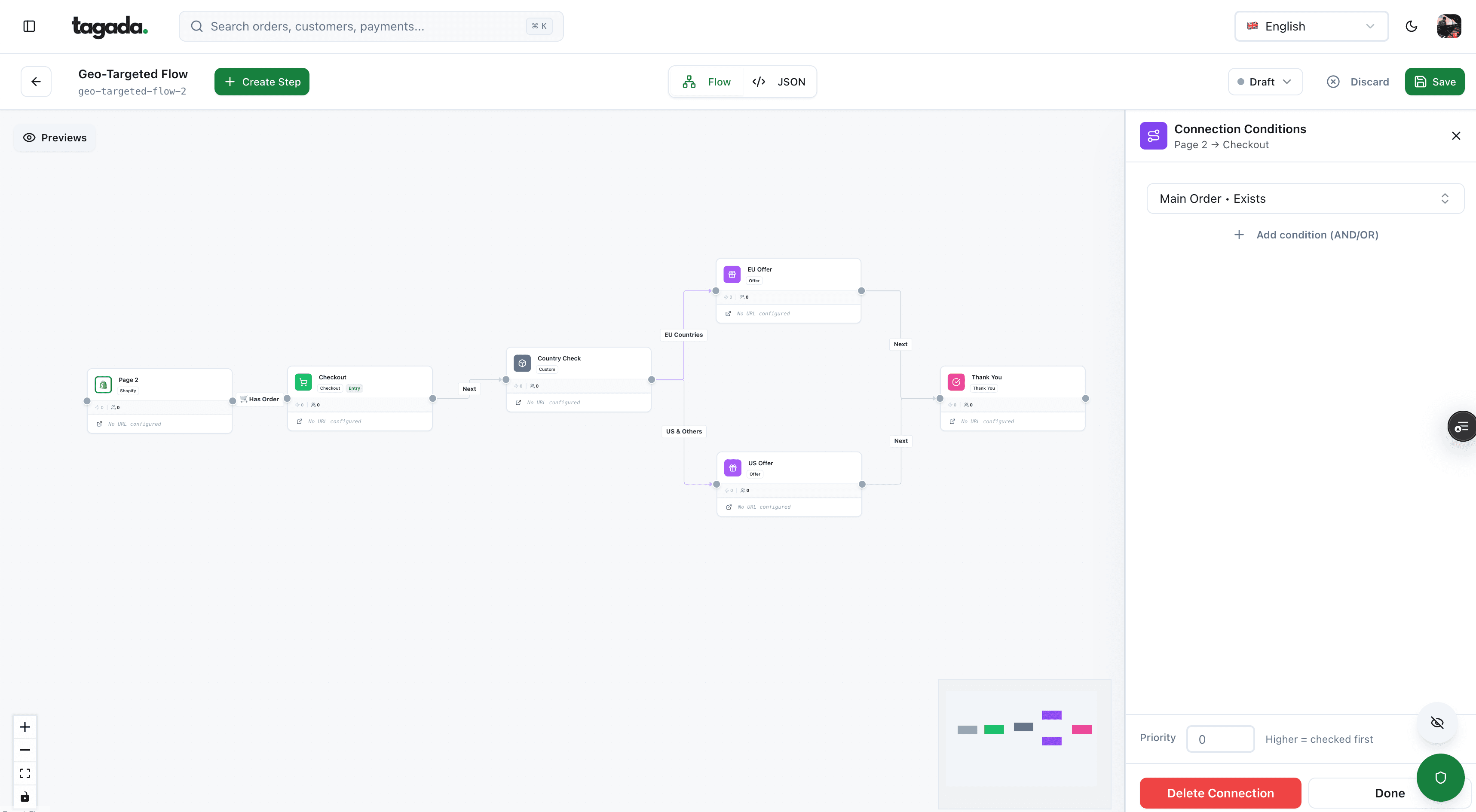
Inside Tagada
Build the funnel once, route every customer to the right offer
Checkout, upsells and subscriptions on one flow, with conditions per country, order or customer.
Recovery channels and the consent rule for each
| Channel | How it reaches the shopper | Consent rule |
|---|---|---|
| Address typed at checkout | US: CAN-SPAM needs no prior consent, but a marketing email must say it is an ad, include a valid postal address and an opt-out honored within 10 business days.5FTC, CAN-SPAM Act: A Compliance Guide for Business (read October 14, 2026) Transactional status covers only a transaction "the recipient already has agreed to", which an unfinished checkout has not reached | |
| Text (SMS) | Phone number typed at checkout | US: marketing texts sent with an autodialer need prior express written consent, signed (electronic signatures count), naming the number, with a statement that consent is not a condition of purchase.6eCFR, 47 CFR 64.1200, FCC TCPA delivery restrictions (text as of October 1, 2026) STOP, QUIT, END, REVOKE, OPT OUT, CANCEL or UNSUBSCRIBE revokes it |
| Push | Browser or app notification | Only after the shopper grants permission: until then, the browser acts as if permission was denied.8MDN Web Docs, Notification.requestPermission() (read October 14, 2026) |
| Retargeting ads | Cookie or pixel on the store | UK: non-essential cookies need consent, with "particular care" for behavioural tracking (ICO).7ICO, Guide to PECR: Cookies and similar technologies (read October 14, 2026) |
| On-site (saved cart, reminder on return) | Cart cookie or customer account | UK: a cookie that remembers "the goods a user wishes to buy" is unlikely to need consent (ICO).7ICO, Guide to PECR: Cookies and similar technologies (read October 14, 2026) |
For EU and UK email rules, including the ICO's soft opt-in, see cart abandonment. Texting details are in SMS marketing for ecommerce. This is not legal advice.
How platforms trigger it
- The shopper leaves contact details and starts checkout. Without them, there is no one to email.
- Shopify waits 10 minutes, then lists the checkout as abandoned. Recovery works only on the Online Store and Buy Button channels, and abandoned checkouts are deleted after three months.1Shopify Help Center, Abandoned checkouts (read October 14, 2026)
- The first reminder goes out. Shopify's automation is "only sent to customers that are subscribed to email marketing" by default; a second automation defaults to a 10-hour wait.2Shopify Help Center, New abandoned checkout experience and automation (read October 14, 2026) Klaviyo's pre-built flows wait 4 hours.3Klaviyo Help Center, How to create an abandoned cart flow (updated October 7, 2026)
- The flow stops on purchase. Klaviyo recommends the filter "Placed Order zero times since starting this flow", and tells customers in regions with data protection laws to consult their legal team before going live.3Klaviyo Help Center, How to create an abandoned cart flow (updated October 7, 2026)
What Shopify and Klaviyo document by default.
Timing, message content and discounts are covered in how to reduce cart abandonment.
How to measure recovered revenue
An illustrative formula, not an industry standard:
Recovery rate = recovered orders ÷ recoverable carts × 100, counted within a fixed attribution window.
- Recoverable carts: abandoned carts you can legally contact, with contact details and, where needed, consent.
- Recovered orders: orders placed from those carts within the window after a reminder.
- Recovered revenue: the value of those orders.
- 1,000 checkouts are abandoned.
- 600 of them have an email address with marketing consent: these are the recoverable carts.
- 48 orders come back within 5 days of a reminder click: a recovery rate of 48 ÷ 600 = 8%.
- At a $70 average order, that is $3,360 in recovered revenue.
Illustrative example: one store, one month.
Two caveats change the reading. Shopify counts a checkout as recovered once the customer completes the order, whether through the email link or on their own.1Shopify Help Center, Abandoned checkouts (read October 14, 2026) Klaviyo credits the last message clicked or opened, with default windows of 5 days for email clicks and 5 days for email opens.4Klaviyo Help Center, How to change your email, SMS, and push message attribution and tracking settings (updated November 20, 2025) Both count some orders that would have come back anyway.
To get the number your reminders actually add, keep a random holdout group of recoverable carts that receives nothing. Your incremental recovery rate is the messaged group's rate minus the holdout's rate. To measure abandonment itself, the formulas are in checkout abandonment rate.
How Tagada helps
Recover the shopper and the payment
Tagada's checkout supports one-click upsells, order bumps, A/B tests, and Apple Pay and Google Pay. Server-side tracking sends checkout events to Meta, Google and TikTok, so a blocked browser tag doesn't hide a real order. Payments route across Stripe, Adyen and Tagada's own TagadaPay processor with one logic, with a cascade on decline, and subscriptions get automatic retries and recoveries when a payment fails.
Frequently asked questions
What is abandoned cart recovery?
What is abandoned cart payment recovery?
Do I need consent to send abandoned cart texts in the US?
What is a good abandoned cart recovery rate?
What are the advantages of cart recovery?
Sources
Checked October 15, 2026- Shopify Help Center, Abandoned checkouts (read October 14, 2026)
- Shopify Help Center, New abandoned checkout experience and automation (read October 14, 2026)
- Klaviyo Help Center, How to create an abandoned cart flow (updated October 7, 2026)
- Klaviyo Help Center, How to change your email, SMS, and push message attribution and tracking settings (updated November 20, 2025)
- FTC, CAN-SPAM Act: A Compliance Guide for Business (read October 14, 2026)
- eCFR, 47 CFR 64.1200, FCC TCPA delivery restrictions (text as of October 1, 2026)
- ICO, Guide to PECR: Cookies and similar technologies (read October 14, 2026)
- MDN Web Docs, Notification.requestPermission() (read October 14, 2026)
Tagada
Bring back the shopper and the payment
Funnels, one-click upsells, subscription billing and payment routing, on one customer record.
- 01Create your free account
- 02Connect your store or build a checkout
- 03Launch funnels, upsells and subscriptions