The Access Control Server is the issuer-side brain of every 3D Secure transaction. While most payment documentation focuses on what merchants configure, the ACS is where authentication decisions actually get made — and where fraud liability is won or lost. Understanding how it works is essential for anyone optimizing authorization rates, managing 3DS integrations, or building payment infrastructure.
How Access Control Server (ACS) Works
Every 3D Secure transaction follows a structured protocol exchange that terminates at the ACS. The issuer configures the ACS with its risk models, challenge preferences, and authentication methods. The following steps describe the full EMV 3DS 2.x flow from the merchant's first call to the final authentication result.
Merchant Initiates Authentication Request
The merchant's 3DS Server (or SDK on mobile) collects device data, browser fingerprint, and transaction details. It sends an Authentication Request (AReq) message — containing dozens of optional data elements — to the card scheme's Directory Server. The richer this data, the better the ACS can risk-score the transaction without a challenge.
Directory Server Routes to Issuer ACS
The Directory Server validates the card number, confirms the cardholder is enrolled in 3DS, and forwards the AReq to the correct issuer ACS. It also appends scheme-level risk signals. The DS does not make authentication decisions — it only routes.
ACS Performs Real-Time Risk Assessment
The ACS applies the issuer's fraud models to the incoming data. It evaluates device fingerprint, transaction velocity, purchase history, geolocation consistency, and any behavioral signals provided in the 3DS data elements. This assessment typically completes in under 200 milliseconds.
ACS Decides: Frictionless or Challenge
Based on its risk score, the ACS chooses one of three paths: (a) frictionless approval — authenticate silently and return a success; (b) frictionless decline — reject without a challenge; or (c) challenge — require the cardholder to verify identity. Issuers configure risk thresholds that determine which path triggers.
Challenge Flow (Conditional)
If the ACS requests a challenge, it presents the cardholder with a one-time passcode via SMS or authenticator app, a biometric prompt (EMV 3DS 2.x supports native biometrics on mobile), or a knowledge-based question. The challenge occurs within an ACS-controlled iframe or native SDK screen.
ACS Returns Authentication Response
Once authentication completes, the ACS sends an Authentication Response (ARes) back to the Directory Server and on to the merchant. The response contains the ECI code, a Cardholder Authentication Verification Value (CAVV) or Accountholder Authentication Value (AAV), and a transaction status indicator (Y = authenticated, A = attempted, N = not authenticated, U = unable to authenticate).
Merchant Submits Authorization with ACS Proof
The merchant includes the ECI code and CAVV/AAV in the card authorization request sent to the acquirer. The card scheme validates these values, and if correct, the liability shift applies. The issuer's authorization system receives the authentication proof alongside the standard authorization data.
Why Access Control Server (ACS) Matters
The ACS is a critical chokepoint in card-not-present payment flows, and its behavior directly shapes both fraud outcomes and merchant revenue. A well-configured ACS with high frictionless approval rates reduces cart abandonment while maintaining strong fraud controls.
EMVCo data indicates that global EMV 3DS transaction volume exceeded 100 billion authentications annually by 2023, with the protocol now processing the vast majority of authenticated e-commerce transactions across Europe, Asia-Pacific, and increasingly North America. Within that volume, issuer ACS performance varies dramatically: top-performing issuers achieve frictionless approval rates above 90%, while the industry average sits closer to 70–75%, according to payment network benchmarks. That 20-percentage-point gap translates directly into checkout abandonment for merchants whose cardholders hit high-friction issuers.
From a liability perspective, the ACS is the mechanism through which strong customer authentication requirements under PSD2 and equivalent regulations are operationalized. A successful authentication result — carrying a valid ECI 05 or 02 — eliminates merchant exposure to fraud chargebacks on authenticated transactions. Industry data from Visa and Mastercard consistently shows that 3DS-authenticated transactions carry fraud rates 8–10 times lower than unauthenticated card-not-present transactions at equivalent merchant categories. For high-volume merchants, this liability shift can represent millions of dollars annually in avoided chargeback losses.
ACS Performance Varies by Issuer
Not all ACSes are equal. A merchant may see frictionless rates above 90% with one major bank's cards and below 50% with another. Monitoring ACS challenge rates broken down by BIN range lets you identify friction hotspots and escalate data quality improvements for those card programs specifically.
Access Control Server (ACS) vs. Directory Server
These two components are frequently conflated, but they serve entirely different functions in the EMV 3DS architecture. Understanding the distinction matters when debugging authentication failures or designing a 3DS integration.
| Dimension | Access Control Server (ACS) | Directory Server (DS) |
|---|---|---|
| Operated by | Card issuer (or issuer's vendor) | Card scheme (Visa, Mastercard, Amex) |
| Primary role | Authenticate the cardholder | Route authentication requests; check enrollment |
| Risk decision | Yes — approves or challenges | No — passes data through |
| Challenges cardholder | Yes — OTP, biometric, KBA | No |
| Returns ECI + CAVV | Yes | No |
| Liability impact | Direct — ACS decision determines shift | Indirect — enrollment check required |
| Protocol position | End node | Intermediary hub |
| One per transaction | One ACS per issuer per transaction | One DS per card scheme per transaction |
| Configurable by merchant | No (issuer controls) | Indirectly (via data richness) |
The practical implication: when a 3DS authentication fails or produces an unexpected ECI, the root cause is almost always in the ACS — issuer risk model misconfiguration, missing data elements, or an ACS vendor outage — not in the Directory Server.
Types of Access Control Server (ACS)
ACS deployments fall into three categories based on architecture and ownership model. Each has different implications for issuers choosing a vendor and for merchants trying to predict authentication behavior.
In-House ACS — Large issuing banks with significant card portfolios sometimes build and operate their own ACS infrastructure. These deployments give the issuer maximum control over risk model tuning, challenge method selection, and regulatory compliance. The trade-off is high maintenance cost and the need for dedicated fraud science teams.
Outsourced ACS (Third-Party Vendor) — Most mid-size and smaller issuers license ACS software from specialist vendors. Leading providers include Netcetera (strong in European banks), Worldline (particularly in France and Benelux), Broadcom (via the former CA Technologies Arcot platform, widely deployed in North American issuers), and GMO Payment Gateway (dominant in Japan). These vendors manage EMV 3DS specification compliance and certifications, reducing issuer burden.
Cloud-Native / SaaS ACS — Newer entrants offer fully managed, cloud-hosted ACS deployments targeting fintechs, neobanks, and smaller credit unions entering card issuing. These platforms provide API-first configuration, built-in machine learning risk models, and faster time-to-certification. The trade-off is less fine-grained control over risk model parameters compared to in-house deployments.
Best Practices
For Merchants
Send the maximum available data elements. The EMV 3DS 2.x specification includes over 150 optional data elements covering device fingerprint, browser characteristics, shipping address history, account age, and prior transaction behavior. Issuers' ACS risk models weight these heavily. Merchants who send only required fields give the ACS insufficient signal, forcing challenge rates up by 15–25 percentage points in controlled tests.
Monitor challenge and abandonment rates by BIN range. Aggregate 3DS metrics obscure the fact that ACS performance varies dramatically by issuer. Segment your authentication data by the first six or eight digits of the card number to identify which issuers are generating disproportionate friction and target data enrichment efforts accordingly.
Handle ACS timeouts and U-status responses without hard-declining. When the ACS returns a U (unable to authenticate) response — often caused by a technical issue at the issuer — the correct response is to proceed with the transaction and accept the associated liability, or to apply a merchant-side risk decision. Automatically declining all U-status transactions penalizes legitimate customers for their bank's infrastructure issues.
Implement 3DS 2.x device SDK for native mobile flows. Browser-based 3DS introduces iframe dependencies that degrade on mobile browsers. The EMV 3DS 2.x native SDK enables the ACS challenge to render within the app using native UI, supporting biometric authentication and reducing challenge abandonment significantly.
For Developers
Parse all ARes status values correctly. The ACS can return Y (authenticated), A (attempted — no cardholder verification possible), N (not authenticated), U (unable to authenticate), C (challenge required), R (rejected — issuer blocked), or D (decoupled challenge). Each requires a different downstream handling path. Treating all non-Y statuses as failures is incorrect and will suppress valid liability-shifted transactions.
Log the full ARes for every transaction. The ACS response contains debug fields including authentication type, challenge cancel indicator, and DS transaction ID. These fields are essential for diagnosing issuer-side issues and for supporting chargeback representments where you need to prove authentication occurred.
Validate the CAVV/AAV before passing it to authorization. Malformed or truncated authentication values will cause the authorization to reject or strip the liability shift. Implement format validation against the EMV 3DS specification for each card network's expected encoding before including the value in the authorization message.
Test against issuer ACS simulators. Card schemes provide test environments with configurable ACS simulators that can force specific ECI outcomes, challenge flows, and error conditions. Integrate these into your CI pipeline to catch regression in authentication handling before it reaches production.
Common Mistakes
Sending minimal 3DS data elements. The single biggest driver of unnecessarily high challenge rates is merchants sending only the required fields and skipping optional data. The ACS risk engine relies on behavioral signals — account age, prior purchase count, shipping address consistency — that only the merchant can supply. Skipping them forces the ACS toward challenge by default.
Misinterpreting ECI codes across card networks. Visa and Mastercard use different ECI numbering. Visa's fully authenticated ECI is 05; Mastercard's is 02. A system that checks eci === "05" for all networks will silently misclassify Mastercard authenticated transactions as unauthenticated, incorrectly reporting them as non-liability-shifted and potentially triggering erroneous fraud controls.
Hard-declining on ACS challenge abandonment. When a cardholder abandons an ACS challenge without completing it, the transaction fails authentication — but this does not mean the cardholder is fraudulent. Abandonment is often caused by the cardholder not receiving their OTP, a UX issue in the ACS interface, or a mobile session timeout. Merchants who retry with a new session, or offer an alternative payment method, recover a meaningful portion of these orders.
Ignoring decoupled authentication (EMV 3DS 2.2+). Decoupled authentication allows the ACS to authenticate the cardholder asynchronously — via a banking app notification, for example — outside the real-time checkout flow. Merchants who don't implement decoupled authentication handling will abandon these transactions during the wait period rather than polling for a result.
Treating all ACS vendor outages the same. When an issuer's ACS is unreachable, the DS typically returns a U-status response. Merchants should not treat ACS infrastructure failures identically to fraud-driven authentication failures. Applying a merchant risk decision and proceeding — accepting liability — is often the right call for low-risk transaction profiles rather than declining the sale.
Access Control Server (ACS) and Tagada
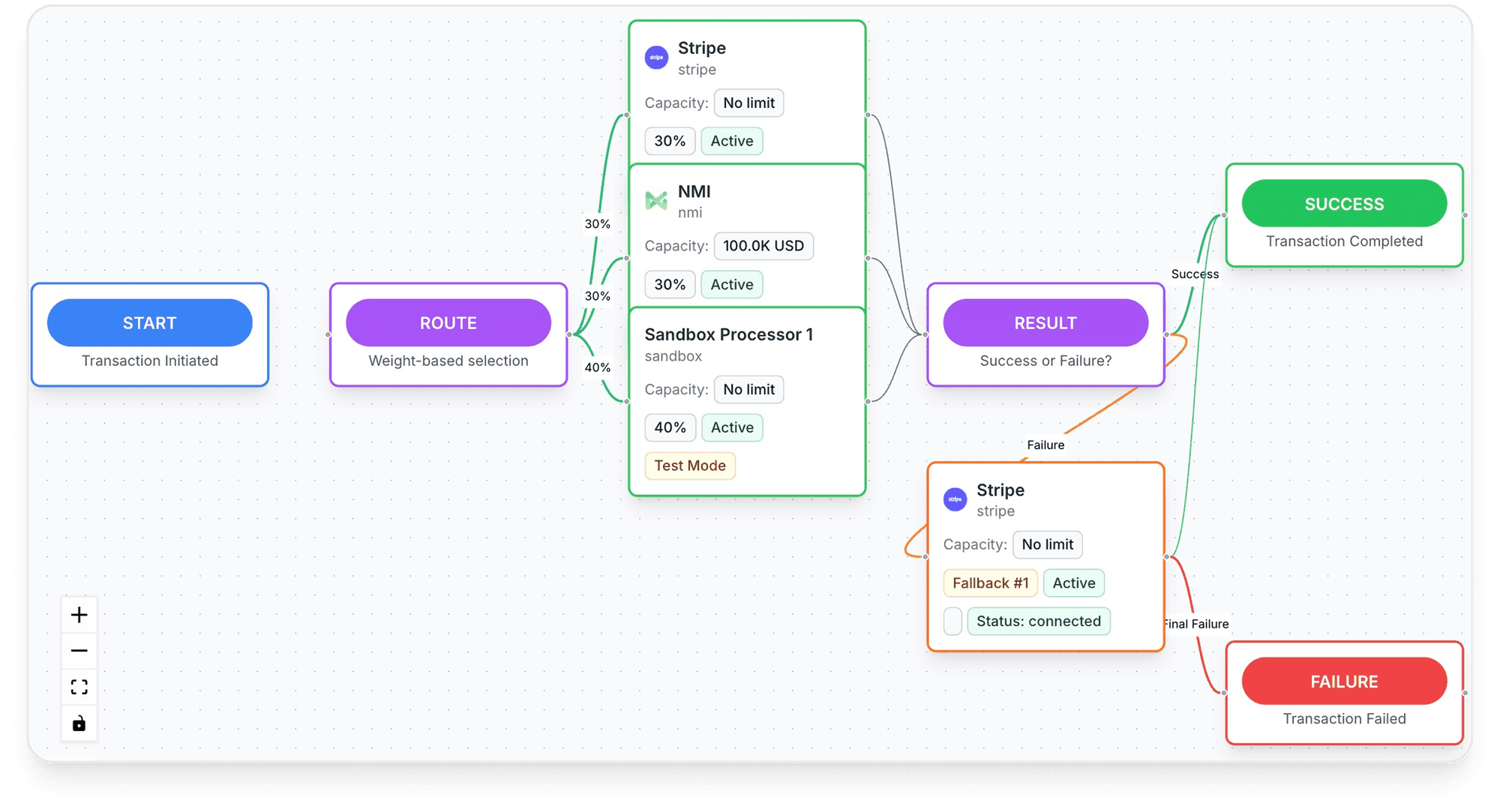
Tagada's payment orchestration layer sits upstream of the 3DS authentication flow, which makes ACS performance a first-class concern in how transactions are routed and retried. Because Tagada connects to multiple acquirers and payment providers, it can apply intelligent logic around 3DS results before and after the ACS responds.
Optimize ACS Frictionless Rates Through Tagada
Tagada normalizes and enriches the 3DS data payload sent to the ACS across all connected payment providers, ensuring the maximum available data elements are transmitted regardless of which underlying acquirer processes the transaction. This gives issuer ACS systems the richest possible signal set — reducing challenge rates without requiring merchants to maintain separate 3DS configurations per payment partner. Additionally, Tagada's retry logic handles U-status and timeout responses gracefully, applying configurable risk rules rather than defaulting to blanket declines.