
What Is a Customer-Initiated Transaction (CIT)?
Customer-initiated transaction (CIT) explained: CIT vs MIT table, when SCA applies, how the first CIT stores a card, and the Visa rules behind each.

Article summary
TL;DR
A customer-initiated transaction (CIT) is a card payment the cardholder starts and takes part in, like paying at checkout or clicking "buy" with a saved card. Its opposite is a merchant-initiated transaction (MIT), which the merchant charges later on a stored card without the customer present, such as a subscription renewal.
- A CIT is started by the cardholder. An MIT is started by the merchant on a stored card, under an earlier agreement.
- The first payment that saves a card is a CIT. It sets up every MIT that follows.
- In Europe, a CIT needs strong customer authentication unless an exemption applies. MITs are out of scope, but setting up the mandate is not.
- Visa treats them differently: a card-absent CIT authorization is valid for 10 days, an MIT for 5 (Visa Core Rules, April 2026).
 ChatGPT
 Claude
 Perplexity
 Grok
GrokOn this page
A customer-initiated transaction is any card payment where the customer is there and acts. Card networks sort every card payment into this group or its opposite, the merchant-initiated transaction, and apply different rules to each.
What is a customer-initiated transaction?
Stripe sums up the split: an MIT is a transaction "you initiate without direct participation of your customer, based on a prior agreement," and CITs "include all other transaction types, including any transaction where the cardholder is available to participate in the payment flow."3Stripe Docs, Customer-Initiated Transactions (CIT) and Merchant-Initiated Transactions (MIT) (read October 14, 2026) Visa's rules use the name Cardholder-initiated Transaction.1Visa Core Rules and Visa Product and Service Rules, April 18, 2026
Common CITs:
- A one-time checkout purchase.
- The first payment of a subscription, when the customer saves the card.
- A returning customer clicking "buy" with a card on file.
A saved card can be used in both. What matters is who starts the payment, not where the card details come from.
CIT vs MIT
| Customer-initiated (CIT) | Merchant-initiated (MIT) | |
|---|---|---|
| Who starts it | The cardholder | The merchant, under an earlier agreement |
| Customer present | Present in the payment flow | Not present |
| SCA in Europe | Required unless exempt2EBA Single Rulebook Q&A 2018_4031, payee-initiated card payments (read October 14, 2026) | Out of scope2EBA Single Rulebook Q&A 2018_4031, payee-initiated card payments (read October 14, 2026) |
| Examples | Checkout, first subscription payment, one-click with a saved card | Recurring payments, installments, unscheduled top-ups |
| Visa authorization validity (card-absent) | 10 calendar days | 5 calendar days |
| Visa dispute 13.2 (canceled recurring) | Invalid for a CIT | Can apply to a recurring MIT |
The validity periods come from Visa table 5-12 (section 5.7.3.5), which lists installment, recurring, advance payment and unscheduled credential-on-file transactions as MITs. The dispute row comes from section 11.10.3.3.1Visa Core Rules and Visa Product and Service Rules, April 18, 2026
On SCA, the European Banking Authority says payments started by the payee only, "provided that those transactions do not need to be preceded by a specific action of the payer," are not subject to SCA. But "the setting up of such a mandate is subject to strong customer authentication."2EBA Single Rulebook Q&A 2018_4031, payee-initiated card payments (read October 14, 2026) Exemptions for CITs are covered in strong customer authentication.
Inside Tagada
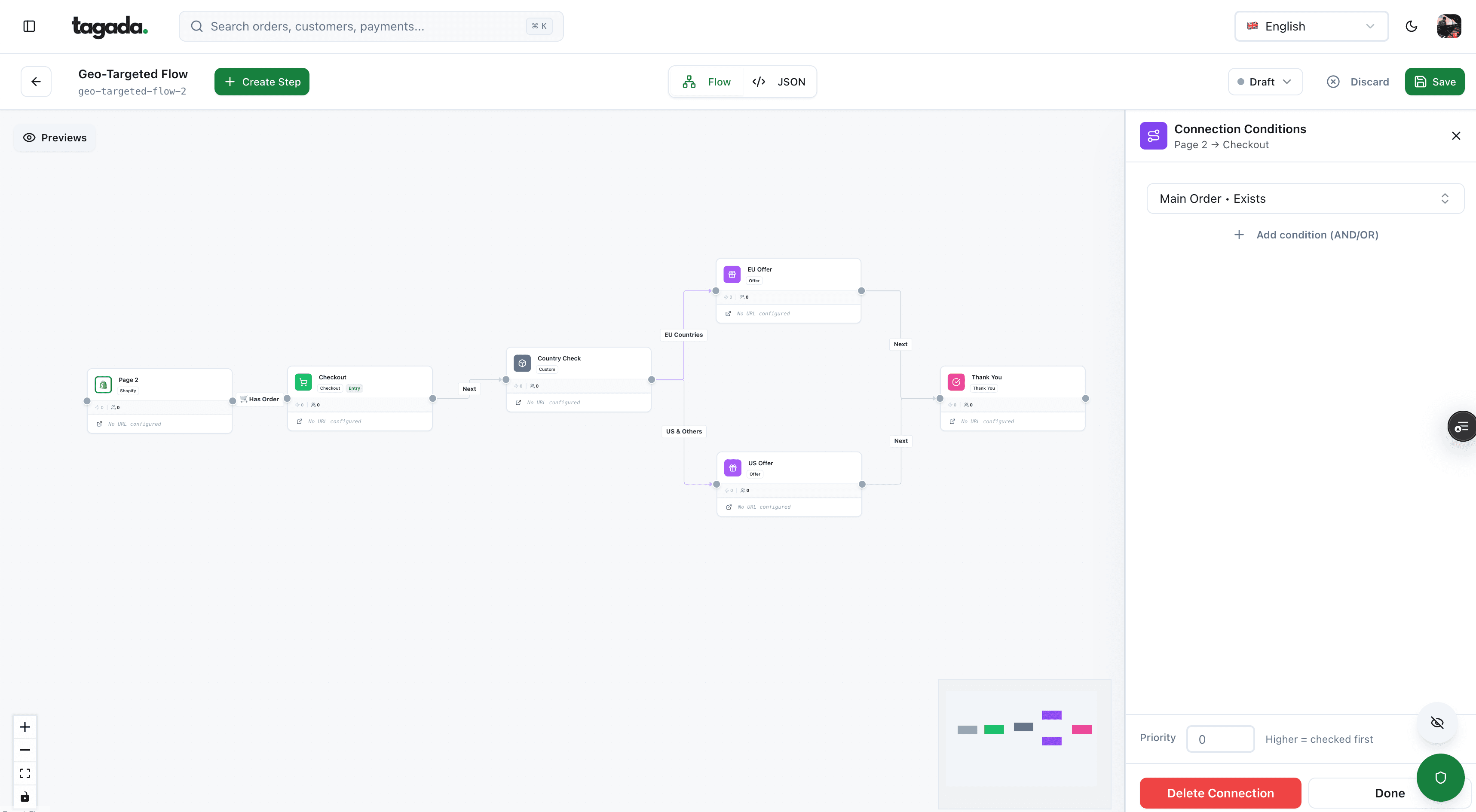
Build the funnel once, route every customer to the right offer
Checkout, upsells and subscriptions on one flow, with conditions per country, order or customer.
How the first CIT sets up later MITs
Visa's stored credential rules (section 5.8.11.1, tables 5-20 and 5-22) turn the first CIT into the base for every later charge:1Visa Core Rules and Visa Product and Service Rules, April 18, 2026
- The customer gives express consent to terms that say how the stored card will be used, the amount and the timing, shown apart from the general terms.
- The merchant authorizes the amount due, or sends a zero-dollar authorization if nothing is due, with the recurring, installment or unscheduled indicator.
- If that first request is declined, "the Merchant must not store the credential."
- In Europe, the customer completes SCA on this first payment, since it sets up the mandate.
- Later charges go out as MITs, with POS Entry Mode 10 and the same indicator.
Based on Visa Core Rules (April 2026), the EBA Q&A 2018_4031 and Stripe's API docs.
In Stripe, step 2 is a PaymentIntent with setup_future_usage=off_session, for a card your customer "may or may not be present" to use. Each renewal then sets off_session=true: the customer "isn't in your checkout flow during this payment attempt and can't authenticate."4Stripe API reference, Create a PaymentIntent (read October 14, 2026)
What it changes for a merchant
- Flag each payment by who starts it. A delayed or one-click payment the customer started is still a CIT.
- Check identity on saved-card CITs. Visa requires it "before processing a Cardholder-initiated Transaction," for example "with a login ID and password" (table 5-22).1Visa Core Rules and Visa Product and Service Rules, April 18, 2026
- Plan for declined MITs. The merchant must notify the cardholder in writing and allow "at least 7 calendar days to pay by other means" (table 5-22).1Visa Core Rules and Visa Product and Service Rules, April 18, 2026 See subscription billing for the full cycle.
- Keep the consent record. Stripe asks merchants to "keep a record of each customer's agreement to your terms."3Stripe Docs, Customer-Initiated Transactions (CIT) and Merchant-Initiated Transactions (MIT) (read October 14, 2026)
For how to save cards at checkout, see our guide to saved payment methods.
How Tagada helps
First payments and renewals, handled
Tagada runs subscriptions with trials, billing cycles, dunning, and automatic retries and recoveries. TagadaPay includes native 3DS2 for the payments your customers start. Tagada follows Visa and Mastercard rules and the laws that apply to payments.
Frequently asked questions
What does CIT mean in payments?
Is the first payment of a subscription a CIT?
Is paying with a saved card a CIT or an MIT?
Do merchant-initiated transactions need SCA?
Sources
Checked October 15, 2026- Visa Core Rules and Visa Product and Service Rules, April 18, 2026
- EBA Single Rulebook Q&A 2018_4031, payee-initiated card payments (read October 14, 2026)
- Stripe Docs, Customer-Initiated Transactions (CIT) and Merchant-Initiated Transactions (MIT) (read October 14, 2026)
- Stripe API reference, Create a PaymentIntent (read October 14, 2026)
Tagada
Subscriptions that bill on cards saved the right way
Funnels, one-click upsells, subscription billing and payment routing, on one customer record.
- 01Create your free account
- 02Connect your store or build a checkout
- 03Launch funnels, upsells and subscriptions