
What Is Interac, and How Does It Work for Merchants?
What Interac means: Interac Debit, Flash and e-Transfer, what replaced Interac Online, how Stripe and Adyen accept it, and Visa's debit rules in Canada.

Article summary
TL;DR
Interac is Canada's domestic payment network, run by Interac Corp. It powers Interac Debit, the bank card Canadians insert, tap or add to Apple Pay and Google Pay, and Interac e-Transfer, which sends money between Canadian bank accounts with an email address or phone number. It has operated since 1984 and links more than 300 financial institutions.
- Interac is a Canadian network, not a bank. Interac Corp. says it has operated since 1984 and connects more than 300 financial institutions.
- Interac Debit is for paying a business, in store or through Apple Pay and Google Pay. Interac e-Transfer is for sending money from one bank account to another.
- Interac Online, the old bank redirect at checkout, closed on October 31, 2024. Its successor for bank account payments, Interac Direct, launched on KONEK in November 2025.
- Stripe accepts Interac in person only, with automatic capture and in-person refunds. Adyen lists it online and in person, in CAD.
- Most Canadian debit cards are co-badged. Online, a co-badged card usually pays as Visa Debit, and Visa's Canada rules then apply, including partial approvals for many retail MCCs.
 ChatGPT
 Claude
 Perplexity
 Grok
GrokOn this page
You searched "what is Interac", or a Canadian customer asked if you take it. Interac is the network behind most debit payments and bank transfers in Canada. Here is what each Interac product does, which one closed in 2024, how a merchant accepts Interac today, and which Visa rules apply to Canadian debit cards.
What Interac is
Interac is a Canadian payment network run by Interac Corp. It sits between banks: when a Canadian pays with a bank card or sends an e-Transfer, Interac routes the transaction from one institution to another. It is not a bank: there is no "Interac account", only your normal bank account.
Interac Corp. gives these figures on its company page, read October 14, 2026:1Interac Corp., Company overview (read October 14, 2026)
- It has used innovation to move Canadians forward "since 1984".
- More than 300 financial institutions are connected.
- Canadians completed more than 6.5 billion Interac Debit transactions in the year ending October 2023.
- 88% of Canadians have used Interac e-Transfer.
The network started with shared bank machines (ABMs) and debit at the till. Cash withdrawals at any Interac-enabled ABM in Canada are still part of Interac Debit.2Interac Corp., Pay with Interac Debit (read October 14, 2026)
Interac products: what each one does
The word "Interac" covers several products, often mixed up.
Interac Debit
The bank card Canadians insert, tap or add to a phone. Interac says it works in store, in apps and online through Apple Pay or Google Pay, and in the U.S. where accepted.
Interac Flash
The contactless tap of Interac Debit. Stripe documents a limit of CAD 250, and asks for card insertion and PIN above CAD 100 or on the fourth tap in a row.
Interac e-Transfer
Money sent between Canadian bank accounts with an email address or phone number. Autodeposit skips the security question.
Interac Direct on KONEK
A newer online payment from a chequing, savings or line of credit account, approved with an online banking login. Launched in November 2025.
Sources: Interac Debit and e-Transfer pages,2Interac Corp., Pay with Interac Debit (read October 14, 2026)3Interac Corp., Interac e-Transfer (read October 14, 2026) Stripe Terminal docs for Flash,9Stripe Docs, Terminal regional considerations: Canada (read October 14, 2026) Interac's KONEK release.6Interac Corp., Staples Canada Customers First to Benefit from KONEK, November 4, 2025
Interac Online is gone. The old checkout option that sent shoppers to their bank's login page closed. Interac's notice reads: "Interac Online is no longer available as of Oct 31, 2024."5Interac Corp., Interac Online Decommissioning (read October 14, 2026)
Interac Direct is its newer cousin. On November 4, 2025, Interac announced KONEK, an e-commerce checkout built with Canadian banks, with Staples Canada as first national merchant. Customers of BMO, National Bank of Canada, RBC, Scotiabank and TD get it first. Interac Direct is the bank account option inside KONEK, "a new digital payments solution with a low cost of acceptance available exclusively on KONEK".6Interac Corp., Staples Canada Customers First to Benefit from KONEK, November 4, 2025 Interac's business page says it supports recurring payments, refunds and split shipments, but it still showed a "Coming Soon" notice for the official launch date when we read it.7Interac Corp., Interac Direct: a new e-commerce payment solution, published October 31, 2024, updated May 30, 2025
e-Transfer for business. Interac advertises sending up to $25,000 per transaction and bulk files of up to 10,000 payments. It says fees "are set by financial institutions" and that e-Transfer for Business is ISO 20022 compliant, so invoice and customer numbers can travel with the payment.4Interac Corp., Interac e-Transfer for Business (read October 14, 2026) Personal limits also come from the bank: Scotiabank, for example, shows a daily limit per account in online banking instead of publishing one figure.14Scotiabank Help Centre, What's my Interac e-Transfer limit?, updated May 12, 2026
How an Interac Debit payment works
- The customer inserts or taps a Canadian debit card, or a phone holding it.
- The terminal reads the card profile and decides whether to route the payment over Interac. Stripe says a co-branded Interac card must still go through Interac in person.
- The terminal asks for the PIN when required, for example above the Flash limit.
- The bank approves and the payment is authorized and captured in one step. Interac has no hold-then-capture.
- A refund needs the same card, presented again on the terminal.
Simplified in-store flow, based on Stripe's Terminal documentation for Canada.
Stripe states that "Interac doesn't support placing a 'hold' on a card and capturing the funds later," and that a PaymentIntent set to manual capture is always declined on Interac.9Stripe Docs, Terminal regional considerations: Canada (read October 14, 2026)
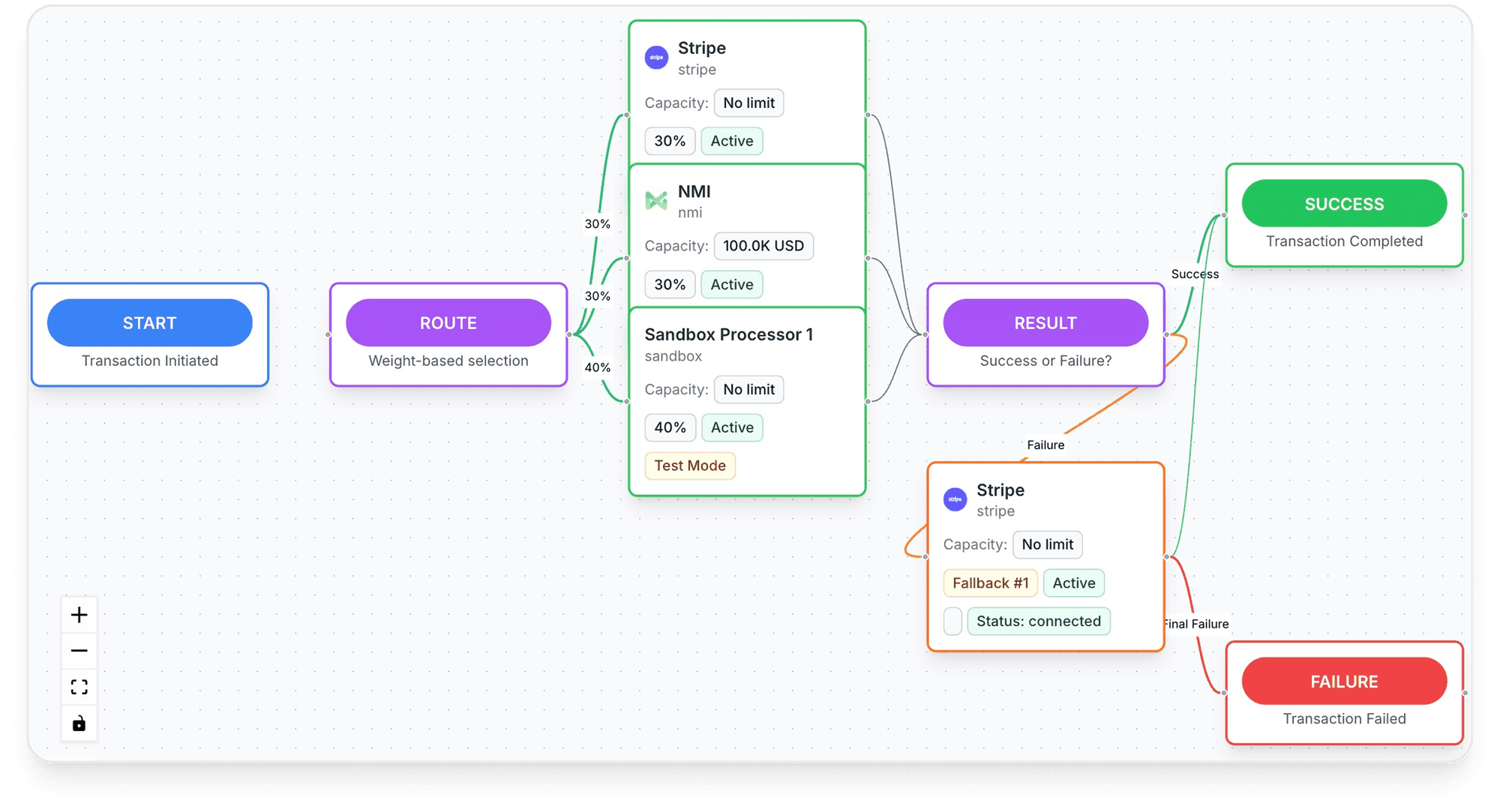
Inside Tagada
See every payment's route, processor by processor
Set the order your processors are tried in, per store, per country or per product.
Interac Debit vs Visa Debit vs e-Transfer
Most Canadian bank cards carry the Interac mark and a second network, often Visa Debit. Visa's merchant sheet explains the split: at the point of sale, such a card is "processed as an Interac transaction in Canada, but as a Visa transaction outside of Canada", and the Visa Debit number is what lets the customer pay online, by phone and by mail order.13Visa Canada, All about Visa Debit, merchant sheet, 2014
| Interac Debit | Visa Debit (co-badged) | Interac e-Transfer | |
|---|---|---|---|
| Who starts it | Customer pays a business | Customer pays a business | Sender pushes money to a person or business |
| Where | Canadian stores, ABMs, apps via Apple Pay or Google Pay | Online, phone, mail, and stores outside Canada | Banking app or online banking |
| Customer enters | PIN or tap | Card number, expiry, CVV | Recipient's email or phone number |
| Network | Interac | Visa | Interac |
| Card rules that apply | Interac's | Visa Core Rules | Bank transfer, no card rules |
Sources: Interac,2Interac Corp., Pay with Interac Debit (read October 14, 2026)3Interac Corp., Interac e-Transfer (read October 14, 2026) Visa Canada.13Visa Canada, All about Visa Debit, merchant sheet, 2014
Verdict
In a store, a co-badged Canadian card runs on Interac. Online, without a wallet, it usually runs as Visa Debit, so it follows Visa's rules.
How a merchant accepts Interac
You don't sign with Interac directly. You go through an acquirer or payment provider that offers it. Interac's own list, read October 14, 2026, names these providers for Interac Debit in apps and browsers: Chase Merchant Services, Everlink Payment Services, First Data Canada, Moneris and PayFacto Payments.8Interac Corp., Find an Acquirer (read October 14, 2026) Its list for in-store Interac Debit is longer and includes Adyen Canada, Square Canada, Global Payments Canada and others.8Interac Corp., Find an Acquirer (read October 14, 2026)
Here is what two global providers document today.
So "no chargebacks" is not quite right: Adyen lists Interac chargebacks for technical errors and goods not received. Pricing is not public on these pages. Adyen says network and interchange fees are lower than on other cards, without a number.11Adyen, Interac payment method (read October 14, 2026)
For which local methods matter in each country, see our guide to local payment methods.
Visa's rules for Canadian debit cards
When a Canadian debit card pays as Visa Debit, Visa's Core Rules (April 2026) apply. Four points concern merchants and acquirers.12Visa Core Rules and Visa Product and Service Rules, April 2026
- You can choose debit or credit. In Canada, a merchant can elect to be a Visa Debit Acceptor or a Visa Credit Acceptor and decline the other category of domestic Visa cards (section 1.5.4.3).
- Don't steer the customer. If a Visa card also bears another payment mark, such as Interac, the merchant "may not intentionally mislead the Cardholder concerning what payment service or system will be used" (section 1.5.4.3).
- The statement says which network. Issuers must identify Visa Debit transactions as Visa transactions on account statements (section 4.1.4.4). That is why one purchase shows as "Interac purchase" and another as Visa Debit.
- Partial approvals. Canadian acquirers must support partial authorization on Visa Debit and prepaid cards, card-absent and card-present, for a list of MCCs that includes 5411 grocery, 5310 discount stores, 5977 cosmetics, 5999 specialty retail and 7399 business services (Table 7-3, p. 542 to 543). The merchant then sends the partial authorization indicator, reverses the approval if the buyer walks away, and clears no more than the approved amount.
A partial approval means the bank approves less than the order total, for example $60 on a $100 basket, and the customer pays the rest another way. Illustrative example.
How Tagada helps
Canadian card payments, routed
On the card side of a Canadian checkout, Visa Debit and credit cards route across Stripe, Adyen and Tagada's own TagadaPay processor with one logic, with a cascade on decline, and the checkout offers Apple Pay and Google Pay. Tagada follows Visa and Mastercard rules and the laws that apply to payments.
Frequently asked questions
What does Interac mean in banking?
What is an Interac e-Transfer?
Are there fees on Interac e-Transfer?
Can I still pay with Interac Online?
Is Interac Direct the same as Interac Direct Payment?
Can you use Interac outside Canada?
Sources
Checked October 15, 2026- Interac Corp., Company overview (read October 14, 2026)
- Interac Corp., Pay with Interac Debit (read October 14, 2026)
- Interac Corp., Interac e-Transfer (read October 14, 2026)
- Interac Corp., Interac e-Transfer for Business (read October 14, 2026)
- Interac Corp., Interac Online Decommissioning (read October 14, 2026)
- Interac Corp., Staples Canada Customers First to Benefit from KONEK, November 4, 2025
- Interac Corp., Interac Direct: a new e-commerce payment solution, published October 31, 2024, updated May 30, 2025
- Interac Corp., Find an Acquirer (read October 14, 2026)
- Stripe Docs, Terminal regional considerations: Canada (read October 14, 2026)
- Stripe Docs, Payment method support (read October 14, 2026)
- Adyen, Interac payment method (read October 14, 2026)
- Visa Core Rules and Visa Product and Service Rules, April 2026
- Visa Canada, All about Visa Debit, merchant sheet, 2014
- Scotiabank Help Centre, What's my Interac e-Transfer limit?, updated May 12, 2026
TagadaPay
Selling to Canada? Keep every card processor in play
Tell us what you sell and how you sell it. Each application is underwritten, and approval is not guaranteed.
- 01Tell us what you sell and how
- 02Underwriting reviews your business
- 03Process through TagadaPay alongside your other processors