
What Are Invisible Payments?
Invisible payments: how background charges on a saved card work, the Visa consent rules and SCA behind them, and when they turn into silent billing.

Article summary
TL;DR
Invisible payments are charges that happen in the background, without a checkout step when the customer buys. The customer saves a card once, agrees to how it will be used, and later charges run automatically: at the end of a ride, when leaving a cashierless store, or at each subscription renewal.
- The payment step disappears, not the consent. The customer agrees once, at setup, to how the saved card will be used.
- Visa requires express informed consent to a stored-credential agreement, shown apart from the general terms, before the card is stored.
- In Europe, the setup needs strong customer authentication. Later charges started by the merchant alone do not.
- "Silent billing" in the bad sense means charges the customer never knowingly agreed to. The FTC treats them as unauthorized.
 ChatGPT
 Claude
 Perplexity
 Grok
GrokOn this page
An invisible payment still happens. The customer just doesn't see a payment screen when it does. That works only because of an agreement made earlier, and card network rules and the law decide whether that agreement is good enough.
What are invisible payments?
Invisible payments are charges taken in the background on a payment method the customer saved earlier. There is no checkout, no button, no card entry at the moment of purchase. Some event triggers the charge. Common examples:
- Ride-hailing: the app charges the saved card when the trip ends.
- Cashierless stores: with Amazon's Just Walk Out, "you'll be charged automatically for the items you take after you leave the store."5Just Walk Out technology by Amazon (read October 14, 2026)
- Subscriptions and in-app plans: the saved card is charged at each renewal date.
- Top-ups: a balance is reloaded when it falls below a set amount.
Paying with a saved card and clicking "buy" is not invisible. That is a customer-initiated transaction, where the customer acts.
Inside Tagada
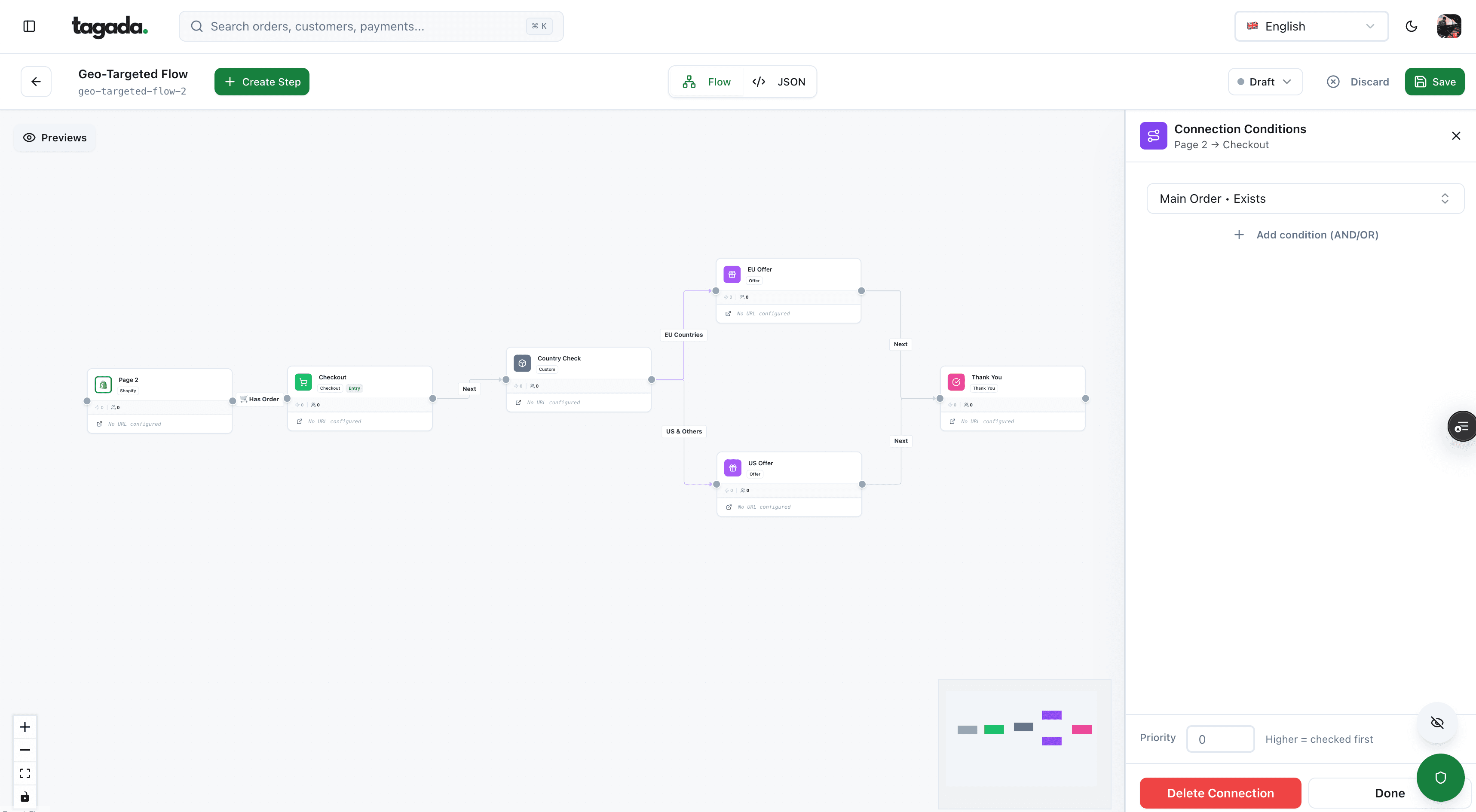
Build the funnel once, route every customer to the right offer
Checkout, upsells and subscriptions on one flow, with conditions per country, order or customer.
How invisible payments work
The customer pays or verifies once, in person or online. Every later charge is a merchant-initiated transaction (MIT) on the stored card. Visa's stored-credential rules (section 5.8.11.1, tables 5-20 and 5-22) set the sequence:1Visa Core Rules and Visa Product and Service Rules, April 18, 2026
- The customer gives "express informed consent" to an agreement that says how the stored card will be used, the amount or how it is set, and the timing or the event that triggers a charge.
- The merchant authorizes the first amount, or sends a zero-dollar authorization if nothing is due. If it is declined, "the Merchant must not store the credential."
- In Europe, the customer completes strong customer authentication on this setup.
- Each later charge goes out as an MIT, flagged as recurring, installment or unscheduled card-on-file.
- When the bank reissues the card, a card account updater or a network token keeps the stored details current.
Based on Visa Core Rules (April 2026) and the EBA Q&A 2018_4031.
The SCA step comes from the European Banking Authority: payments "initiated by the payee only" are out of scope, but "the setting up of such a mandate is subject to strong customer authentication."2EBA Single Rulebook Q&A 2018_4031, payee-initiated card payments (read October 14, 2026)
Invisible payments vs silent billing
"Silent billing" is sometimes used as a synonym. It is also used for something else entirely: charges the customer never knowingly agreed to. The FTC calls one form of it "cramming," where phone bills are "used as a vehicle for unauthorized charges placed by third parties."4Federal Trade Commission, Mobile Cramming (read October 14, 2026)
| Invisible payment | Silent billing (negative sense) | |
|---|---|---|
| Customer agreement | Express consent to a stored-card agreement | Missing, buried or misleading |
| Terms | Shown apart from the general terms (Visa table 5-20) | Hidden in fine print |
| Failed charge | Written notice and at least 7 days to pay another way (Visa table 5-22) | Repeated attempts, no notice |
| Outcome | A normal sale | Disputes, refunds, regulator action |
In the US, online offers that renew or convert automatically also fall under ROSCA. It requires a seller to disclose "all material terms" before taking billing details, get express informed consent before charging, and provide simple ways to stop recurring charges.3Restore Online Shoppers' Confidence Act, 15 U.S.C. § 8403 (read October 14, 2026) See free trial for how this applies to trials, and our guide to negative option billing for the full legal picture.
How Tagada helps
Background charges that follow the rules
Tagada runs subscriptions with trials, billing cycles, dunning, and automatic retries and recoveries. TagadaPay includes native 3DS2 for the first payment that sets up a saved card. Tagada follows Visa and Mastercard rules and the laws that apply to payments.
Frequently asked questions
What is silent billing?
Are invisible payments the same as frictionless payments?
Do invisible payments need strong customer authentication?
Sources
Checked October 15, 2026- Visa Core Rules and Visa Product and Service Rules, April 18, 2026
- EBA Single Rulebook Q&A 2018_4031, payee-initiated card payments (read October 14, 2026)
- Restore Online Shoppers' Confidence Act, 15 U.S.C. § 8403 (read October 14, 2026)
- Federal Trade Commission, Mobile Cramming (read October 14, 2026)
- Just Walk Out technology by Amazon (read October 14, 2026)
Tagada
Subscriptions and saved cards, billed the right way
Funnels, one-click upsells, subscription billing and payment routing, on one customer record.
- 01Create your free account
- 02Connect your store or build a checkout
- 03Launch funnels, upsells and subscriptions