
What Is an Issuer Processor?
What an issuer processor does for a card issuer: authorization, stand-in, tokens, JIT funding, who's who in a card program, and the Visa rules to check.

Article summary
TL;DR
An issuer processor is the company that runs the card issuer's side of every card payment: it approves or declines authorization requests, receives clearing records, settles with the network and keeps the cardholder ledger. Banks and fintech card programs hire one instead of connecting to Visa or Mastercard themselves. The issuer stays responsible to the network.
- The issuer processor decides on the issuer's behalf. The issuer, the bank that licenses the BIN, stays responsible to Visa for everything it does.
- Visa's rulebook has no "issuer processor" entry. It calls the role a VisaNet Processor or, for a non-connected provider, a Third Party Agent.
- If the issuer or its processor does not answer in time, Visa answers through Stand-In Processing, and the issuer is still responsible for the result.
- With JIT funding, the card account is funded during the authorization itself, so the program's own system can approve or decline each payment.
- Switching processors does not move liability: the issuer registers the new one before use and notifies Visa of the change.
 ChatGPT
 Claude
 Perplexity
 Grok
GrokOn this page
A card program has more companies behind it than the logo on the card. This page explains what the issuer processor does, where it sits next to the bank and the program manager, and what Visa's rules say about it.
What is an issuer processor?
An issuer processor is the company that runs card processing for the card issuer. Visa defines the issuer as a member that "enters into a contractual relationship with a Cardholder for the issuance of one or more Card products."1Visa Core Rules and Visa Product and Service Rules, April 18, 2026 The processor does the technical work for that member: it answers authorization requests, receives clearing records and settles.
Visa's rulebook has no "issuer processor" entry. A processor directly connected to VisaNet is a VisaNet Processor. Any other company providing payment services to a member is a Third Party Agent.1Visa Core Rules and Visa Product and Service Rules, April 18, 2026 Those definitions, and the merchant-side equivalent, are on our acquirer processing page. A member can provide authorization services "directly, as a VisaNet Processor" or "through another VisaNet Processor, including Visa" (section 7.3.3.1).1Visa Core Rules and Visa Product and Service Rules, April 18, 2026
What an issuer processor does
Authorization decisioning
Checks card status, available funds or credit and the issuer's rules, then approves or declines. Visa's limit at the point of sale is 10 seconds, or 5 seconds in Europe (section 7.3.4.1).
Stand-in
If the issuer side is down or too slow, Visa's Stand-In Processing answers "on behalf of the Issuer." The issuer remains responsible for those decisions (sections 7.3.4.1 and 1.4.4.3).
Card lifecycle
Issues, activates, blocks and replaces cards. Lost or blocked cards go on the Visa Account Screen immediately (section 7.3.5.1). PIN verification must be certified, or delegated to Visa (section 1.4.4.2).
Tokenization requests
Approves or declines token provisioning for wallets. Visa requires tokens to reflect the latest account number and expiry date, the update that also feeds the card account updater (section 4.1.15.1).
Clearing and settlement
Receives the clearing records sent by acquirers, matches them to authorizations and settles the issuer's net position with the network.
Ledger and statements
Posts each transaction to the cardholder account. Visa makes the member guarantee that "payments received from Cardholders are applied for the purpose for which they were remitted" (section 10.2.2.7).
Who's who in a card program
| Role | What it does | Responsible to the network? |
|---|---|---|
| Issuing bank (BIN sponsor) | Holds the Visa or Mastercard membership and the BIN, contracts with the cardholder | Member; fully responsible |
| Program manager | Designs the card product, manages it with the bank, handles day-to-day compliance tasks | Through a direct written contract with the bank, as a Third Party Agent (section 1.9.8.5) |
| Issuer processor | Authorization, clearing, settlement, ledger, card lifecycle | Through the bank, which registers it |
| Card network | Routes messages, runs clearing and settlement, stands in when the issuer side fails | Sets the rules |
Visa calls the BIN holder a BIN Licensee, "an Issuer that is allocated responsibility by Visa for a specific BIN," and an issuer using a sponsor's BIN a BIN User.1Visa Core Rules and Visa Product and Service Rules, April 18, 2026 One company can hold two roles. Marqeta, for example, is an issuer processor, and in its "Managed By" model "Marqeta is the Program Manager."4Marqeta, Understanding card program differences, developer guide (read October 14, 2026) For corporate programs, see commercial card. For non-bank brands offering cards, see embedded finance.
Inside Tagada
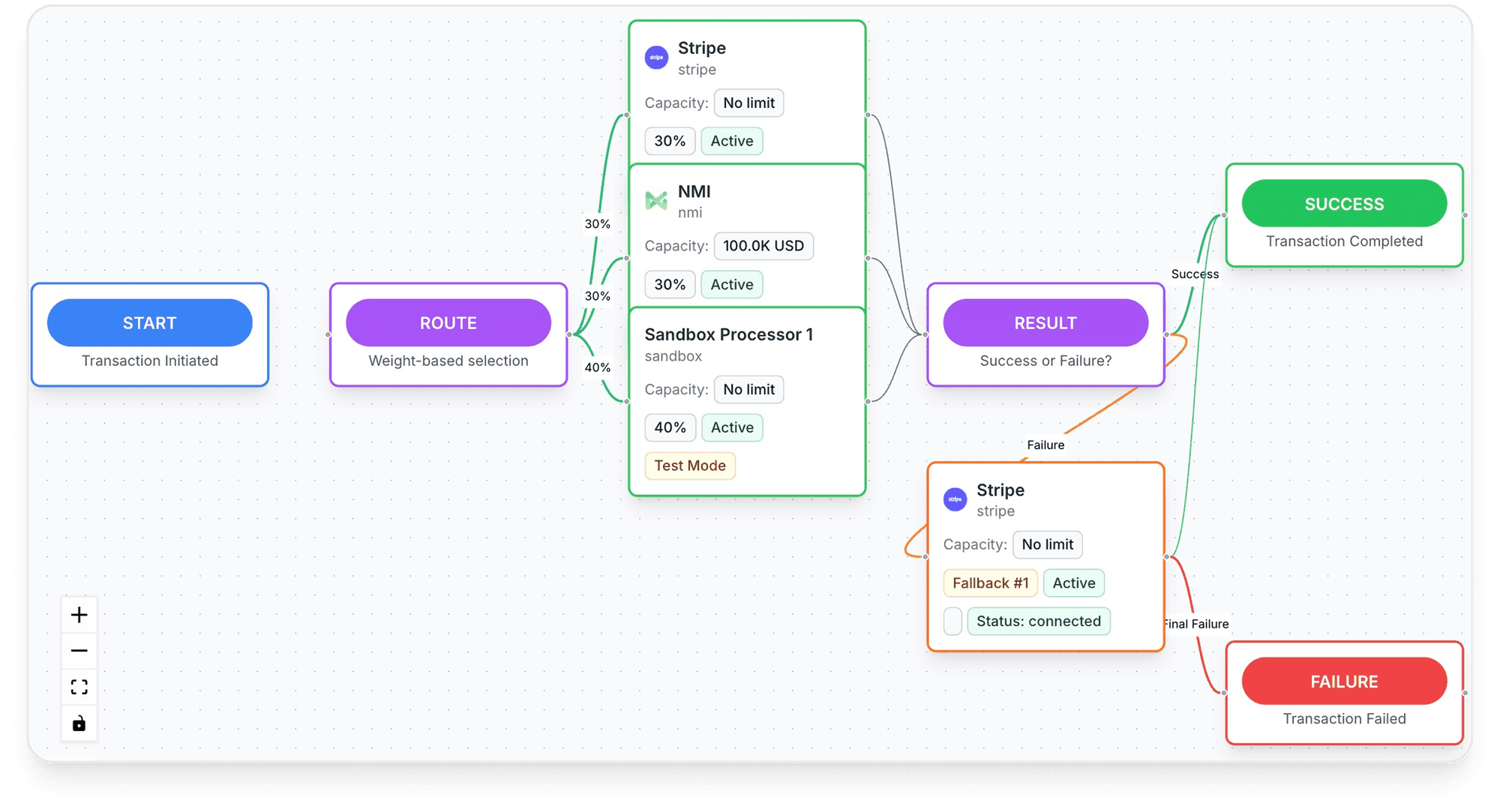
See every payment's route, processor by processor
Set the order your processors are tried in, per store, per country or per product.
How authorization works with JIT funding
Marqeta defines Just-in-Time funding as "a method of automatically funding an account in real time during the transaction process."2Marqeta, About Just-in-Time Funding, developer guide (read October 14, 2026) The card holds no balance until a purchase arrives.
- The network routes the request. The issuer processor receives the authorization request from Visa or Mastercard.
- The processor runs its checks. Card status, spend controls, fraud rules.
- The program decides. With Marqeta's Gateway JIT, "the gateway endpoint on your system must respond to every JIT Funding request." Stripe Issuing sends a real-time request and waits 2 seconds for an approve or decline.
- Funds move, the answer goes back. On approval, the account is funded and the processor answers the network.
- Fallbacks apply if someone is silent. Stripe applies your timeout settings. Marqeta uses "Commando Mode" with your business rules. If the network cannot reach the processor at all, it performs Stand-In Processing.
Sources: Marqeta, About Just-in-Time Funding; Stripe, Issuing real-time authorizations; Visa Core Rules, April 2026, section 7.3.4.1.
How to evaluate an issuer processor
| Check | Why it matters | Source |
|---|---|---|
| PCI DSS compliance | The issuer's contract with its processor must require it | Visa, sections 10.2.1.1 and 1.9.4.1 |
| PCI PIN security, if it handles PINs | The issuer can be assessed for its agent's failures | Visa, section 12.5.2.1 |
| Visa registration | A VisaNet Processor needs a client information questionnaire and a VisaNet Letter of Agreement; a Third Party Agent is registered before any service | Visa, sections 1.9.8.1 and 1.9.8.6 |
| Contract terms | Service levels, Visa audit rights, a termination clause | Visa, section 10.2.1.1 |
| Token service support | Token provisioning and credential updates for Visa Token Service | Visa, section 4.1.15.1 |
| Stand-in setup | STIP parameters and your own timeout fallback decide what happens in an outage | Visa, section 1.4.4.3; Stripe; Marqeta |
These are rule checks, not a ranking. Uptime, latency and pricing vary by contract.
Who handles compliance during a card program switch?
The issuer does. Visa states that "a Member is responsible for any and all losses caused by its VisaNet Processor" (section 1.1.8.22) and "for all Card activities [...] whether performed directly or indirectly by the Member or a Third Party Agent" (section 10.2.2.7).1Visa Core Rules and Visa Product and Service Rules, April 18, 2026 During a switch, the issuer must:
- register the new processor before using it (sections 1.9.8.1 and 1.9.8.6);
- notify Visa of a change in a Third Party Agent's business relationship within 5 business days (section 10.2.2.5);
- keep contingency plans for processor failure (section 1.9.8.3).
If a processor fails, the issuer must make sure it returns cardholder data or proves its secure destruction (section 1.9.8.4). An issuer can limit its liability for a failed processor only if it told Visa it had ended the relationship before the failure (section 1.1.8.23).
How Tagada helps
Payments that follow the card network rules
Tagada follows Visa and Mastercard rules and the laws that apply to payments.
Frequently asked questions
What is an issuer processor?
What is the difference between an issuer processor and an acquirer processor?
Can a bank be its own issuer processor?
What is JIT funding?
What happens if an issuer processor goes down?
What issuer processor handles compliance during a card program switch?
Sources
Checked October 15, 2026- Visa Core Rules and Visa Product and Service Rules, April 18, 2026
- Marqeta, About Just-in-Time Funding, developer guide (read October 14, 2026)
- Stripe, Issuing real-time authorizations, documentation (read October 14, 2026)
- Marqeta, Understanding card program differences, developer guide (read October 14, 2026)
TagadaPay
Accept cards from every issuer, across more than one processor
Tell us what you sell and how you sell it. Each application is underwritten, and approval is not guaranteed.
- 01Tell us what you sell and how
- 02Underwriting reviews your business
- 03Process through TagadaPay alongside your other processors