

A winning A/B test isn't necessarily the variant with the highest front-end conversion. If more visitors complete checkout but fewer transactions receive authorization, the apparent win may reduce revenue. The same problem appears when a promotion lifts first orders but attracts customers who refund, dispute, or cancel before the next rebill.
The useful result follows the full payment lifecycle: checkout completion, payment approval, average order value, recurring payment recovery, lifetime value, refunds, and chargebacks. Treat each experiment as a blueprint, not a promise. Define one primary outcome, then add guardrails that expose damage downstream.
Segment results by device, geography, payment method, subscription status, and risk profile. A payment option that helps one market can underperform in another. A shorter form can increase completion while removing data your fraud controls need. A compelling trial can acquire more customers while weakening rebill quality.
The examples below connect storefront decisions to payment operations. Use them to diagnose funnel bottlenecks, then connect checkout variants, payment routing, testing, and server-side measurement so the experiment follows the customer beyond the thank-you page.
1. Payment Method Display and Trust Signals A/B Test
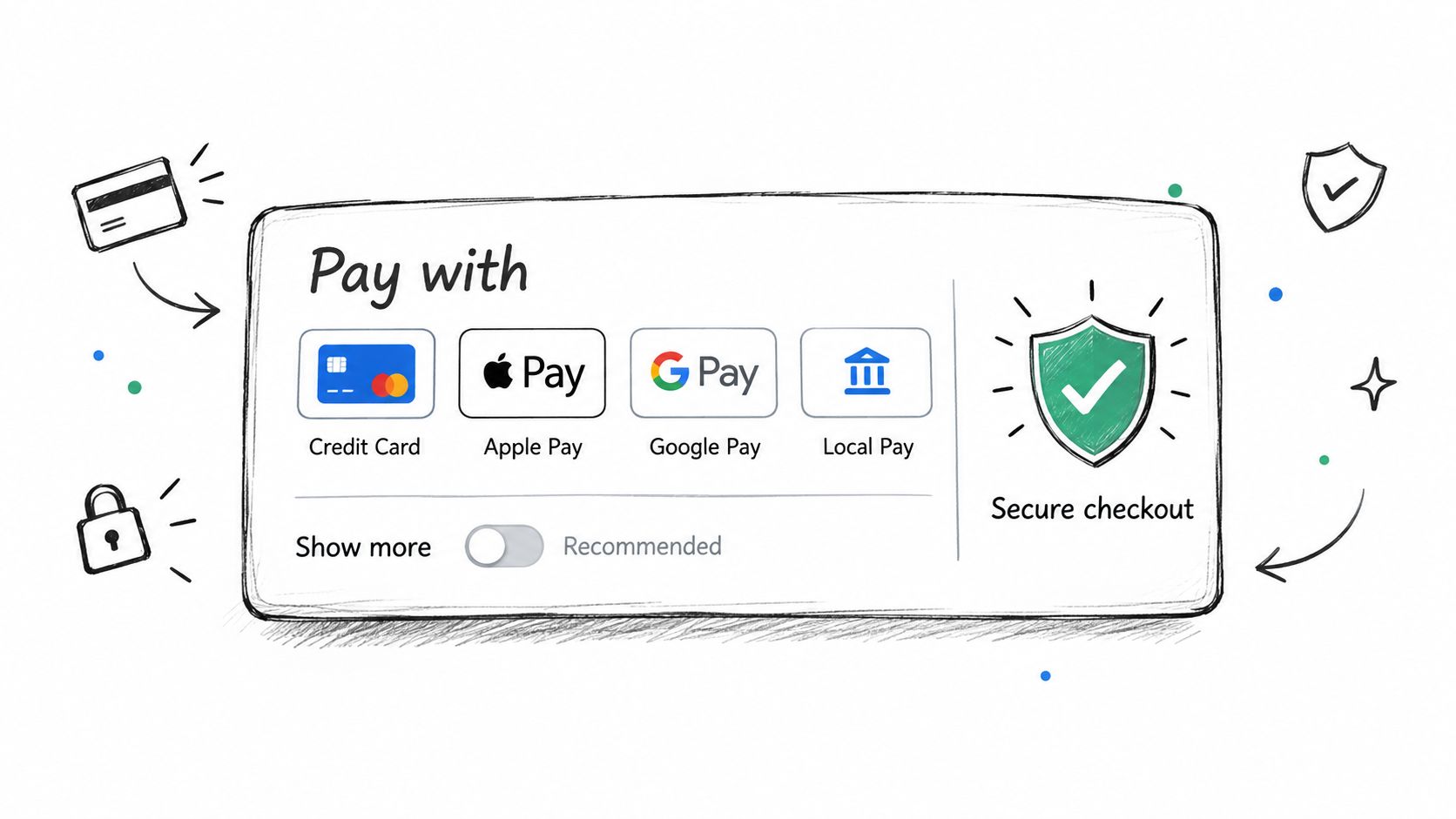
Payment choice is part of the value proposition. Test an all-options-first checkout against progressive disclosure, where the shopper sees a focused default and expands alternatives when needed. The presentation matters too. Compare trust badges above the payment form with the same assurances below it, and test whether local payment methods appear beside cards or in a separate selector.
A subscription box brand might compare prominent Affirm or Klarna placement for younger audiences with a credit-card-first experience for older cohorts. A high-risk CBD retailer could test bank transfer and cryptocurrency beside cards, subject to processor and legal constraints. An international course creator might compare card-first checkout with locally familiar methods such as Alipay, WeChat Pay, and iDEAL.
The primary metric could be completed checkout, but that isn't enough. Track authorization rate, payment-method mix, refund behavior, chargebacks, and recurring dunning success. Server-side events should connect the method shown and selected to the eventual transaction outcome.
Segment before you interpret
Separate geography and risk profile before declaring a winner. A method can raise conversion among international shoppers while producing weak approval in a particular corridor. For subscriptions, compare not only the initial payment but also whether the stored method succeeds when the next recurring charge is due.
Practical rule: Trust signals should reduce uncertainty, not conceal the payment terms. Make security, billing frequency, cancellation conditions, and accepted methods easy to understand.
2. Checkout Field Reduction and Progressive Disclosure A/B Test
Long forms create friction, but removing fields blindly can weaken approval and fraud decisions. Compare a form that displays every required field with a progressive flow that reveals fields according to the payment method, customer type, or shipping destination. The test should measure where people abandon, not just whether the final button gets more clicks.
For cards, address and identity data may support verification. Digital wallets can supply much of that information automatically, so showing the same fields to every shopper adds unnecessary work. A high-risk supplement retailer could show a smaller first screen while retaining the complete data capture in the backend. A course platform might test address autofill against manual entry, provided the data is validated before payment submission.
Research cited by Edmonds Commerce's checkout optimization benchmark found that single-page checkout outperformed multi-step checkout by 21.8% across 147 ecommerce sites, using about 2.3 million sessions. The same research reported that reducing fields from 15 to 9 increased completion rates by 35%. Those figures are useful benchmarks, not a reason to copy the same layout for every business.
Keep compliance data available
Measure completion, payment failures, authorization, fraud review outcomes, and chargebacks together. A shorter visible form may win the first metric and lose the last one if it removes information needed to assess a risky order.
Test field reduction by payment method, track abandonment at each step, and use server-side validation to catch errors before the shopper advances. The best variant usually asks for what the next decision requires, then collects additional detail at the point where it becomes useful.
3. Subscription Billing Cycle and Trial Length A/B Test
Trial design changes the quality of acquired revenue, not merely the number of signups. Compare a free trial with a paid entry, shorter and longer trial windows, monthly and annual billing, or immediate billing with deferred billing. The key question is whether the offer produces customers who reach a healthy rebill, not whether it fills the top of the funnel.
A fitness app could test a 7-day free trial against a 14-day free trial. The shorter option may convert more quickly, while the longer option can give serious users more time to experience the product. A SaaS company might compare a nominal paid trial with a free registration to filter low-intent and fraudulent activity. A streaming service could test annual billing against monthly billing, with transparent pricing and cancellation terms.
Treat trial conversion as a risk event
The trial-to-paid transition deserves its own measurement window. Track initial approval, trial-end authorization, refund requests, chargebacks, churn, and recovered payments separately from ordinary recurring performance. A trial that ends without a clear reminder can create disputes even when the terms were technically available.
Cohort results matter. High-intent users may convert quickly, while browsers need education or a different offer. Segment by acquisition source, payment method, geography, and risk profile before changing the whole pricing model.
The strongest trial isn't the one that produces the largest signup count. It's the one that creates clear consent, successful billing, and customers who keep receiving value.
For high-risk subscriptions, test paid trials only within processor rules and applicable law. Pair the offer with clear rebill messaging and dunning before the first renewal attempt, then evaluate recurring revenue quality rather than headline conversion.
4. Upsell and Cross-Sell Offer Timing A/B Test
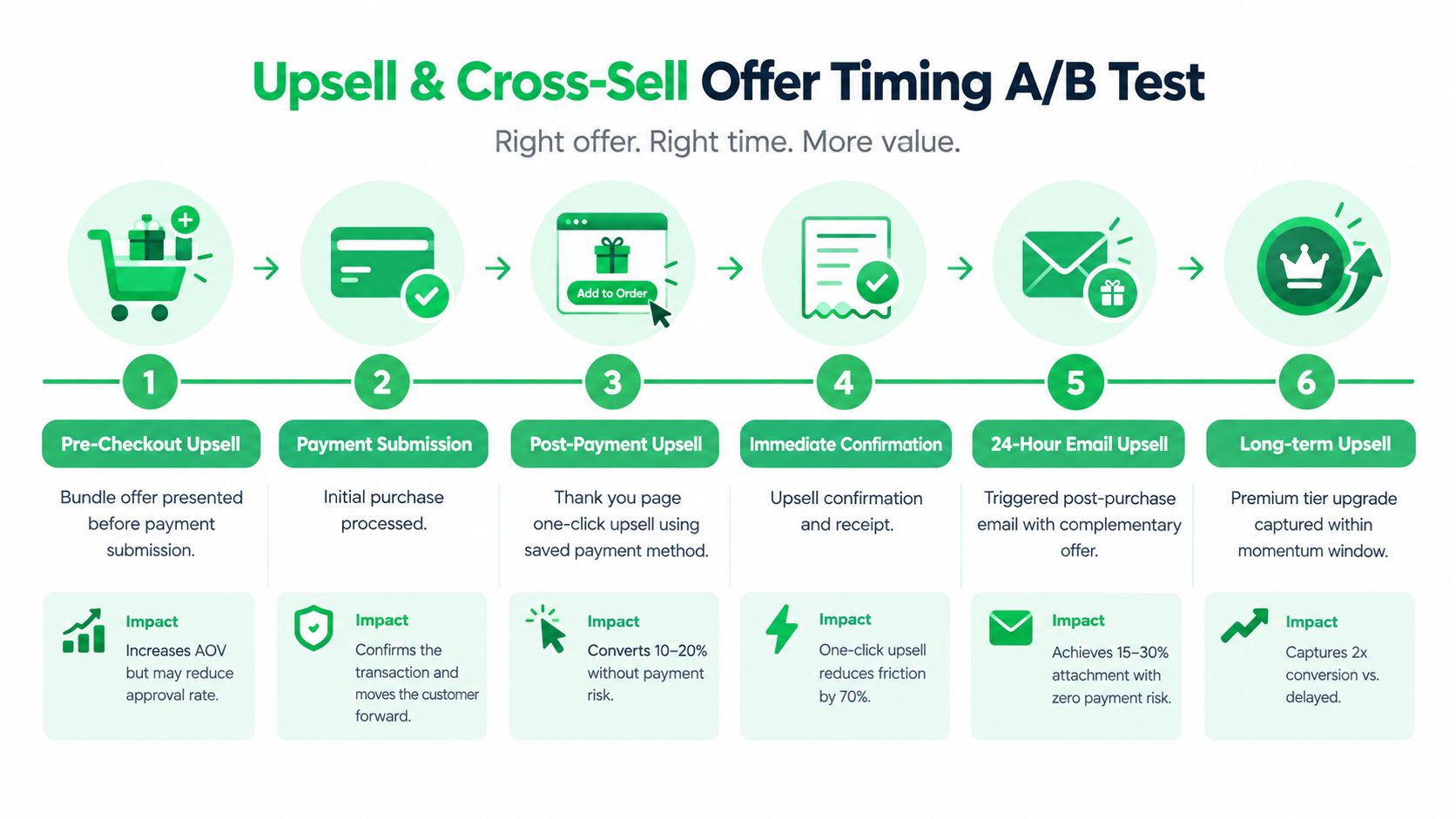
An upsell can increase order value or interfere with the payment that already works. Test the offer before payment, immediately after payment, on the confirmation page, and later through email. Pre-payment offers may increase basket size, but they also add decisions to the most sensitive part of the funnel.
A practical starting point is a post-payment upsell. A high-volume retailer could compare a checkout bundle with a one-click thank-you-page offer. The post-payment version protects the primary order from a hesitant response. A subscription box company might compare an immediate premium upgrade with an offer sent after the customer has received the first box. A course business could present a complementary course after purchase rather than adding another decision before payment.
For subscription brands, evaluate upgrade rate, premium-tier churn, recurring revenue, refunds, and chargebacks separately. Customers who accept a discount-heavy upgrade may have a different retention pattern from customers who choose the premium tier at full value.
Make one-click offers explicit. Show the product, price, billing cadence, and confirmation action. Ambiguous saved-payment flows can create disputes, especially when the customer doesn't understand that an additional charge has been submitted.
Read Tagada's guide to upsells after checkout when designing the post-payment path. The operating principle is simple: protect the original authorization first, then expand the order with informed consent.
5. Dunning and Retry Logic Optimization A/B Test
Failed recurring payments aren't all the same. An expired card may respond to a reminder and a later retry. A fraud-related decline usually needs a new payment method or a review, not repeated blind attempts. Test retry timing, message tone, payment-method fallback, and processor routing by decline reason.
A SaaS business could compare three retries with five retries over a defined recovery window. A subscription app might test one processor against a multi-processor route when the decline category supports another attempt. A fitness service could compare emotional messaging with functional instructions, then track payment-update behavior and complaints.
Route by failure context
Use server-side decline tracking to distinguish expired credentials, insufficient funds, authentication failures, and suspected fraud. The retry policy should respond to that reason. Processor rotation can help in some cases, but it can also create inconsistent customer experiences or violate processor controls if applied without governance.
Monitor recovered recurring revenue, cancellation, complaints, refunds, and chargebacks by retry attempt. Repeated attempts after a customer has clearly disengaged can increase dispute risk and damage the relationship.
Operational software can support this work, but the test still needs disciplined cohorts and guardrails. Dunning management software should be evaluated by the controls it gives your team over decline logic, messaging, retries, and payment-method updates.
6. Payment Authorization and Velocity Check A/B Test
Fraud controls can protect the business while blocking good customers. Test hard declines against soft warnings, strict and contextual velocity rules, different device-fingerprint sensitivity, and always-on versus risk-based 3D Secure. The correct variant is the one that improves the economics of approved orders, not the one that blocks the most suspicious traffic.
A supplement retailer could compare 3D Secure for every transaction with a risk-based challenge policy. An international merchant might test a strict limit on repeated card attempts against a more moderate threshold. A subscription service could test new-device rules while allowing trusted repeat customers to pass through a lower-friction path.
Start with the least restrictive compliant setting that protects the business, then tighten one rule at a time. Server-side decline reason tracking should identify whether a rule blocked a legitimate returning customer, a risky first order, or a transaction that failed for an unrelated payment reason.
Balance approval and loss
Track authorization, legitimate-customer false positives, fraud, refunds, and chargebacks by rule and segment. High-risk merchants should work with their payment providers on approved controls and decline codes rather than testing outside contractual or network requirements.
Repeat customers can justify contextual treatment, but high customer value isn't proof of safety. A valuable customer can still use a compromised device or payment credential. Use purchase history as one signal, not an automatic bypass.
<iframe width="100%" style="aspect-ratio: 16 / 9;" src="https://www.youtube.com/embed/kLneJKAqRtk" frameborder="0" allow="autoplay; encrypted-media" allowfullscreen></iframe>
7. Checkout Messaging, Email Capture and Cart Recovery A/B Test
Words can change the shopper's understanding of the transaction. Test action-specific CTAs, guarantees, reassurance copy, urgency, cancellation language, and the position of email capture. Then connect the checkout test to abandoned-cart recovery, because a message that improves immediate conversion can still attract customers who later dispute the charge.
A digital product business might compare “Complete Order” with “Get Access Now.” A subscription brand could test clear money-back language against a shorter reassurance statement. A DTC retailer might capture email before checkout or request it on the thank-you page. Post-purchase capture often protects the main transaction, while pre-checkout capture can create an earlier recovery opportunity.
Measure the asynchronous revenue loop
Test abandoned-cart timing and message content by cart value. High-value carts may justify more persistent follow-up, but repeated contact can create pressure and complaints. Segment deal-driven subscribers from full-price customers when testing discounts, because opt-in volume isn't the same as customer quality.
For every messaging variant, track checkout completion, authorization, refunds, cancellations, complaints, and chargebacks. Subscription copy should state the billing schedule and cancellation path plainly. Transparency can reduce confusion even when it makes the offer feel less aggressive.
The best CTA describes the immediate action without disguising the commercial commitment. “Get access” should still sit beside the price, recurring terms, and payment details. Conversion copy works when it removes uncertainty, not when it hides it.
8. Mobile Checkout Optimization and Device-Specific A/B Test
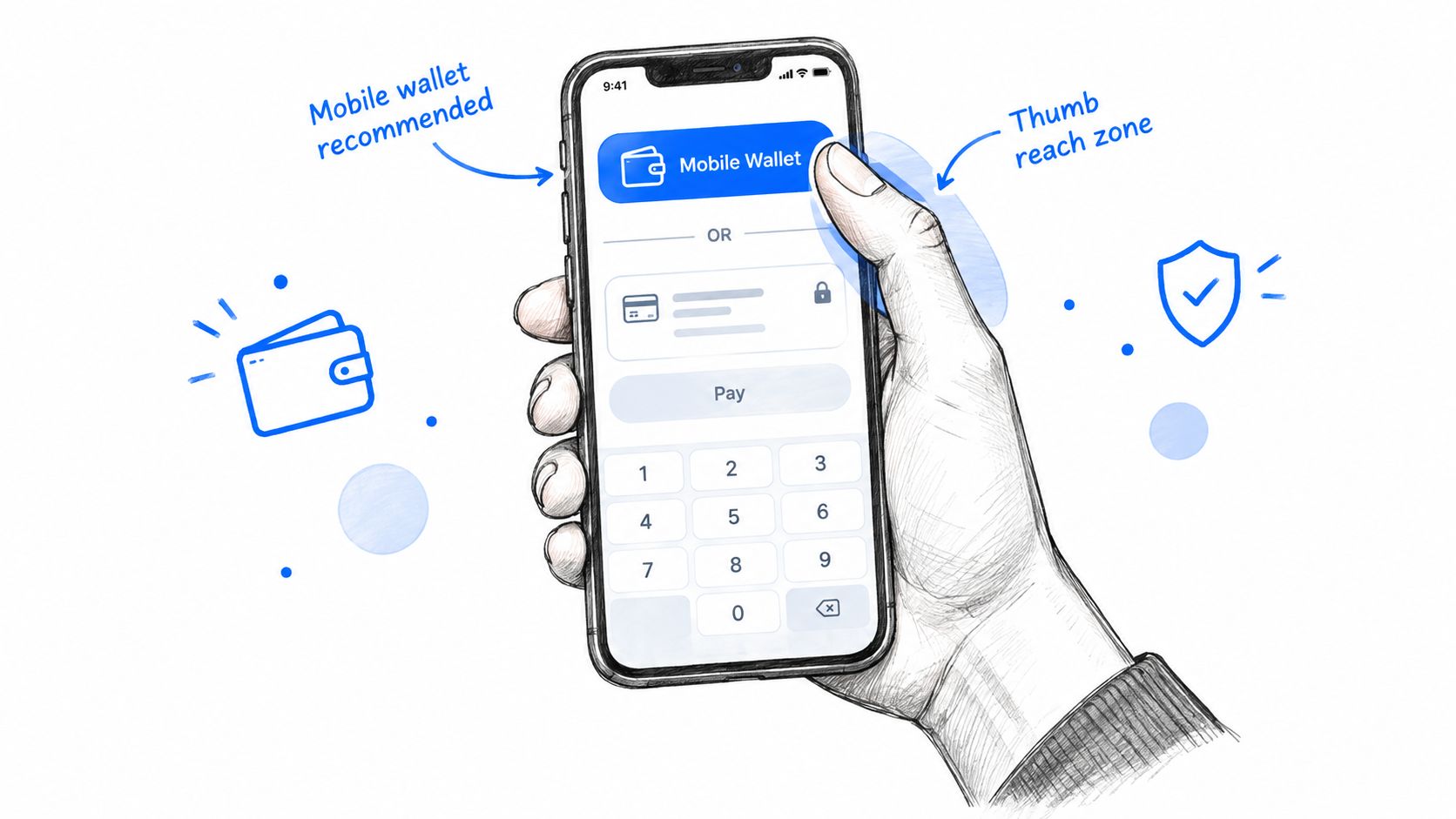
Mobile checkout needs its own experiment plan. Compare one-hand input, wallet prominence, keyboard types, autofill, step-by-step forms, and full forms on actual mobile devices. Desktop results don't transfer automatically because network conditions, screen size, authentication behavior, and payment selection all change.
A mobile commerce brand could place a wallet above cards, then compare it with a card-first layout. A subscription app might test a compact multi-step flow against a single long form. An international retailer could compare manual entry with autofill for returning customers. Each test should report mobile conversion and mobile payment failure separately.
Design for the payment moment
Use touch-friendly controls, readable error messages, and a clear saved-payment choice for subscribers. A field that works with a desktop keyboard may be painful on a phone. A wallet that reduces typing may still require a different confirmation or authentication path.
Don't treat a mobile completion lift as sufficient evidence. Check approval by device and payment method, then inspect refunds and disputes. A fast tap can produce a poor customer experience if the final amount, recurring terms, or merchant descriptor isn't clear.
Mobile optimization ends at successful, understood payment. It doesn't end when the shopper taps the primary button.
9. High-Risk Industry Vertical-Specific A/B Test
High-risk testing starts with what the business is allowed to sell, bill, and process. Supplements, CBD, dating, gambling, nutraceuticals, pharmaceuticals, and financial services can require different verification, disclosures, payment methods, and processor controls. A higher-converting flow that violates those conditions isn't a viable winner.
Test the placement and wording of age verification, terms acceptance, recurring-billing consent, compliance messages, and payment restrictions. A CBD retailer could compare verification before checkout with verification later in fulfillment only where regulations and processor rules permit. A dating service might compare generic terms with explicit monthly rebill language. A supplement subscription could compare card and bank-based payment options while tracking disputes and approval.
Compliance belongs in the experiment
Don't remove a legally required step to improve conversion. Test whether the explanation appears before the form, beside consent, or at the relevant decision point. Make recurring authorization specific, visible, and easy to revisit in the customer record.
Review chargeback exposure by vertical, acquisition source, payment method, and compliance interaction. Processor monitoring matters because Visa's early-warning threshold is a 0.65% chargeback ratio with at least 75 chargebacks in a month, while its Threshold Program uses 1.0% with at least 100 monthly chargebacks, as summarized by Seamless Chex's payment-processing risk guide.
Mastercard uses separate volume and ratio triggers. Its Excessive Chargeback Merchant program covers 100 to 299 monthly chargebacks with a 1.5% to 2.99% ratio, while the High Excessive tier starts at 300 or more chargebacks and a 3% ratio, according to Chargeflow's explanation of high-risk merchant accounts. These are operational guardrails, not optimization targets.
10. International and Multi-Currency Checkout A/B Test
International checkout tests should reflect local expectations instead of merely translating a domestic page. Compare the shopper's local currency with a base-currency display, local payment-method prominence, country-specific address fields, and transparent VAT or tax treatment. A payment route that works well in one market may create approval problems or unfamiliarity in another.
A DTC brand could test USD against automatic local-currency display. An ecommerce platform might compare a single global processor with region-specific routing. A course company could show VAT before payment rather than adding it at the final step. The useful result includes completed checkout, authorization, refund behavior, and customer support contacts.
Localize recurring consent
Subscription merchants need more than localized prices. Test recurring-billing consent in the customer's language, including the amount, frequency, renewal behavior, cancellation method, and payment method storage. Translation quality affects comprehension and can influence disputes even when the payment itself is authorized.
Use server-side country detection, but let customers correct the detected market. Test local payment methods by segment rather than assuming cards should remain the default. Address fields should match regional requirements without asking every customer for irrelevant data.
Payment processors commonly treat recurring subscriptions as high risk because they can generate cancellations, disputes, and chargebacks, as described by Chargeback Gurus on high-risk businesses. Another Chargeback Gurus guide to protecting high-risk merchants notes that processors often use a chargeback rate around 1% as a risk boundary and may also view monthly transaction volume of $20,000 or more as a high-risk signal. Build international tests with those processing realities in mind.
Local payment methods should be part of the hypothesis, not a late integration after the page experiment has already ended.
10 AB Test Examples: Checkout & Payment Comparison
| Test | 🔄 Implementation Complexity | ⚡ Resources & Integrations | 📊 Expected Outcomes | 💡 Ideal Use Cases & Key Advantages (⭐) |
|---|---|---|---|---|
| Payment Method Display & Trust Signals A/B Test | High, multi-PSP routing + A/B bucketing; tracking required | Payment processors, server-side pixel, UI variants | ↑ approval/approval for local methods; subscription failures ↓15–25% 📊 | International & high‑risk merchants; ⭐ increases trust & approval |
| Checkout Field Reduction & Progressive Disclosure A/B Test | Medium, conditional logic & multi-step flows | Visual builder, conditional field logic, address validation | Cart abandonment ↓15–35%; signup ↑20–30% 📊 | Mobile-first DTC & subscriptions; ⭐ reduces friction, improves mobile UX |
| Subscription Billing Cycle & Trial Length A/B Test | Medium, subscription engine + billing timing controls | Subscription management, dunning tooling, tracking | Trial converts 30–50%; annual reduces churn 20–40% 📊 | SaaS/recurring revenue models; ⭐ improves LTV predictability |
| Upsell & Cross-Sell Offer Timing A/B Test | Low–Medium, offer placement & saved-payment flows | One-click builder, saved payment, email system | Post-payment upsell converts 10–20%; email upsells 15–30% 📊 | High-volume ecommerce & subs; ⭐ increases AOV with lower payment risk |
| Dunning & Retry Logic Optimization A/B Test | High, orchestrated retries, PSP rotation, decline logic | Multi-PSP retry orchestration, dunning emails, server tracking | Recovers 12–20% (smart retries); +3–8% via rotation 📊 | Subscriptions with churn risk; ⭐ recovers recurring revenue, reduces churn |
| Payment Authorization & Velocity Check A/B Test | High, fraud rules, 3DS, device fingerprinting tuning | Risk engine, 3DS integration, server-side decline tracking | Chargebacks ↓20–30% with balanced rules; conversion trade-offs 📊 | High-risk & international sellers; ⭐ prevents fraud while preserving approval |
| Checkout Messaging, Email Capture & Cart Recovery A/B Test | Low–Medium, copy tests & email workflows | Dynamic text A/B, email capture, recovery workflows | Abandoned cart recovery 12–20%; CTAs can ↑ conversion 2–15% 📊 | All ecommerce; ⭐ boosts recovered revenue & opt-ins (watch chargebacks) |
| Mobile Checkout Optimization & Device-Specific A/B Test | Medium, device detection + mobile UX variants | Mobile wallet integrations, responsive layouts, server detection | Mobile conversion ↑25–40% with wallets; form optimizations ↑40%+ 📊 | Mobile-first traffic sites; ⭐ fastest UX wins on mobile devices |
| High-Risk Industry Vertical-Specific A/B Test | High, compliance, age/ID verification, restricted PSPs | Age/ID modules, compliance messaging, vertical routing | Chargebacks ↓40–60% with proper checks; conversion cost ↑5–15% 📊 | CBD, gambling, supplements; ⭐ reduces regulatory & dispute risk |
| International & Multi-Currency Checkout A/B Test | High, currency, tax, multi-language, routing logic | Multi-currency PSPs, geo-detection, tax engine, translations | Intl conversion ↑20–30% with local currency; failures ↓10–15% 📊 | Global sellers; ⭐ improves approval & reduces surprise abandonment |
Turn Winning Variants Into Revenue Systems
Start with one measurable bottleneck. It might be payment failure on mobile, low approval for a particular region, trial-end churn, weak recovery of expired cards, or excessive disputes from a high-risk acquisition source. A test becomes useful when the hypothesis names the bottleneck and the proposed change has a plausible mechanism for improving it.
Define a primary outcome and explicit guardrails before traffic is randomized. Checkout completion may be primary for a form experiment. Approval rate, chargebacks, refunds, recurring recovery, AOV, or LTV may be guardrails, depending on the flow. For a subscription trial, the first signup is an early signal, while trial-end payment success and subsequent retention determine whether the offer deserves rollout.
Randomize eligible traffic consistently. Don't let returning customers, geography, device type, or processor assignment drift between variants. If the experiment changes payment routing, preserve a record of the route, decline reason, authentication outcome, and final transaction status. Client-side pixels can report clicks, but server-side measurement is needed to connect a displayed variant to authorization, rebills, refunds, and disputes.
Run the test long enough to capture the relevant payment lifecycle. A checkout change can be judged earlier than a trial-length test. A dunning experiment needs enough time for its retry and messaging sequence to complete. Avoid stopping because a variant briefly leads on conversion, especially when the guardrails mature later.
Traffic volume also changes the design. A 2025 Ascend2 study of A/B testing in marketing found that limited traffic was the top challenge for 51% of marketers, ahead of lack of resources at 47%. The same source reported that 84% of marketers test at least monthly and 38% weekly. Smaller merchants should therefore use carefully chosen primary metrics, secondary signals, and cohort analysis instead of forcing every experiment to depend on purchase volume alone.
Document the result at segment level. Record which variant won for mobile, desktop, geography, payment method, subscription status, and risk profile. A global average can conceal a valuable local win or a serious loss in a high-risk cohort.
The operating layer matters. Tagada can connect checkout variants, multi-PSP routing, payment methods, subscription management, dunning, messaging, upsells, and server-side tracking. Its documentation describes weighted and geo-based A/B tests through a REST API, while its merchant dashboard includes conversion tracking and step-by-step analytics. That makes it possible to treat an experiment as part of the revenue system rather than as an isolated page change.
The strongest A/B testing examples don't end with a higher click-through rate. They show a controlled improvement in approved, understood, retained revenue, with chargebacks and customer quality monitored throughout the lifecycle.
Tagada unifies checkout, payment routing, A/B testing, subscription billing, dunning, messaging, and server-side revenue tracking in one orchestration layer. If you want to test payment and funnel changes without losing sight of approval, rebills, and chargebacks, visit Tagada and explore how it can fit your ecommerce operation.