
AI Funnel Builders: What the AI Actually Does, Task by Task
What AI does in ClickFunnels, HighLevel, Shopify and Systeme.io, read on their help pages, and the FTC, EU and ad platform rules for AI-written funnels.

Article summary
TL;DR
An AI funnel builder is a funnel tool that drafts pages, copy, images and emails from a prompt. In 2026, ClickFunnels, HighLevel, Shopify and Systeme.io all document such features, mostly for drafting. None of the help pages we read describes AI that runs your tests or checks your claims: you still review everything, and you're still liable for it.
- Read on the vendors' own help pages on October 14, 2026: ClickFunnels and HighLevel generate full funnel pages from a prompt, Shopify writes product descriptions and email text, Systeme.io connects outside assistants through MCP.
- AI drafts. It doesn't decide. No help page we read says the AI picks an A/B test winner, and every one of them tells you to review what it produces.
- The FTC says there's no AI exemption: a claim written by a tool is still your claim, and health claims still need competent and reliable scientific evidence.
- The EU AI Act's transparency rules (Article 50) apply from August 2, 2026. Deepfakes must be disclosed, and AI chatbots must say they're AI.
- Ad and shopping platforms have their own rules: Meta labels AI-made ad images, and Google Merchant Center requires special attributes for AI-written titles and descriptions.
 ChatGPT
 Claude
 Perplexity
 Grok
GrokOn this page
Most "AI funnel builder" pages promise a funnel in seconds and stop there. This one reads what the main funnel tools actually document on their own help pages, sorts it by task, then covers what the AI can't do for you: check your claims, follow ad platform rules, and meet the EU AI Act. Everything vendor-related was read on October 14, 2026.
What is an AI funnel builder?
An AI funnel builder is a funnel tool with generative AI inside. You describe your business, offer and audience. The tool drafts pages, copy, images or emails, and they open in the normal editor for you to change.
The term covers two different products in search results:
- Funnel and page tools (ClickFunnels, HighLevel, Shopify, Systeme.io): the AI drafts landing pages, sales pages, product descriptions and emails. This guide covers these.
- Sales outreach tools: the AI finds prospects, writes first messages and times follow-ups for a sales team. Useful for B2B, rarely for a DTC brand selling online.
Here is what each vendor documents, and where:
| Vendor | AI feature | What its page says | Status on the page |
|---|---|---|---|
| ClickFunnels | ClickFunnels AI | Researches your market, designs pages, writes copy, generates images, builds a funnel1ClickFunnels Support, Getting Started with ClickFunnels AI, updated September 16, 2026 | Open beta per the changelog; usage allowance per team2ClickFunnels changelog, Build funnels faster with ClickFunnels AI (beta) |
| HighLevel | Funnel & Website AI, Content AI | Page structure, copy, layout and visuals from a prompt, URL or image; email text and subject lines3HighLevel Support, Funnel & Website AI, modified October 8, 20264HighLevel Support, How to create Emails using Content AI, modified April 5, 2023 | Pages without extra AI charge, "subject to usage limits"; Content AI billed per word |
| Shopify | Sidekick and admin AI features | Product descriptions, pages, blog posts, email text, image edits, data analysis6Shopify Help Center, AI features in the Shopify admin7Shopify Help Center, Sidekick | Built into the admin |
| Systeme.io | MCP server | Connects ChatGPT, Claude or any MCP tool to your account to create funnels, newsletters and automations8systeme.io, MCP server page, last updated April 2026 | Native AI page builder announced as "soon"9systeme.io, AI prompt generator (free tool, beta) |
| Funnelish | None found | Its public site describes no AI feature | Checked October 14, 2026 |
| CheckoutChamp | None found | Its public site describes no AI feature | Checked October 14, 2026 |
What AI does in funnel tools today, task by task
Vendor pages describe features by product name. A merchant thinks in tasks. Here are the same features sorted by the job they do.
Pages and copy
Full funnel pages from a prompt: ClickFunnels, HighLevel. Through an outside assistant: Systeme.io.
Product descriptions
Shopify's Generate text in the product editor. Your feed rules still apply.
Images
ClickFunnels generates them. Shopify edits them. HighLevel uses yours as a style reference.
Emails
HighLevel Content AI, Shopify Messaging email text, Systeme.io newsletters via MCP.
Analysis
Shopify Sidekick analyzes store data and answers questions.
Page and copy generation
This is where the category is most mature.
ClickFunnels AI has two modes, per its changelog. Quick Mode: "Type in your idea and land directly in the funnel builder with the ClickFunnels AI sidebar open." Research Mode "studies your market first": it analyzes the niche, builds a customer profile with goals, pain points and objections, recommends a funnel type, then builds from that research.2ClickFunnels changelog, Build funnels faster with ClickFunnels AI (beta) It generates "full pages including lead magnets, thank you pages, content, buttons, and more" and can replace template placeholder text with copy for your business. Admins get access automatically; other team members need an admin to grant them the AI role. Each team has a usage allowance, and at the limit "the assistant pauses new requests".1ClickFunnels Support, Getting Started with ClickFunnels AI, updated September 16, 2026
HighLevel's Funnel & Website AI offers Assist (guided fields: niche, page goal, audience, offer) and Build (a free-form prompt). It can also start from a URL or an image, used as inspiration, not as an exact clone. You then edit by chat: rewrite copy, regenerate a section, add a pricing, testimonial or FAQ section. It also suggests SEO titles and descriptions.3HighLevel Support, Funnel & Website AI, modified October 8, 2026
Systeme.io has no native page generator yet. Its MCP server lets ChatGPT, Claude or another MCP-compatible assistant act on your account: "Ask it to create a funnel, tag new leads, build an email campaign, and set up the automation rule connecting them all."8systeme.io, MCP server page, last updated April 2026 A free tool writes a prompt that you paste into an AI, which returns HTML for a Raw HTML element. The same page says: "We're building a native AI page builder inside systeme.io that skips the copy-paste step."9systeme.io, AI prompt generator (free tool, beta)
Shopify works on the store rather than funnel pages: Sidekick writes text for online store pages and blog posts, generates custom theme blocks from a text prompt, and can build a personalized theme from a business description.6Shopify Help Center, AI features in the Shopify admin
Product descriptions
Shopify's "Generate text" icon writes product descriptions in the product editor, and Sidekick lists product descriptions among the content it creates.6Shopify Help Center, AI features in the Shopify admin7Shopify Help Center, Sidekick Shopify also suggests product categories and category metafields.
If those descriptions also feed Google Shopping, a rule applies. Google Merchant Center says AI-generated titles and descriptions "must" go in alternative attributes, structured_title and structured_description, with the digital_source_type sub-attribute set to trained_algorithmic_media.21Google Merchant Center Help, AI-generated content Check that your feed app supports them before you bulk-generate a catalog.
Images
| Tool | What the AI does with images |
|---|---|
| ClickFunnels AI | "Ask it to add images to your pages and it creates them for you"2ClickFunnels changelog, Build funnels faster with ClickFunnels AI (beta) |
| Shopify | Changes an image from a text prompt, replaces a background with a color; Sidekick creates images6Shopify Help Center, AI features in the Shopify admin7Shopify Help Center, Sidekick |
| HighLevel Funnel & Website AI | Generates "visuals" for the page; an imported image serves as a style or structure reference3HighLevel Support, Funnel & Website AI, modified October 8, 2026 |
Two platform rules follow the image wherever it goes. Google Merchant Center: AI-generated product images "must contain meta data indicating that the image was AI-generated" (the IPTC DigitalSourceType tag, value trainedAlgorithmicMedia), and you must not strip it.21Google Merchant Center Help, AI-generated content Image compressors and some upload pipelines remove metadata by default: test yours. Meta: ad images "created or edited using third-party AI tools" get an "AI info" label, except minor edits such as resizing or color correction.18Meta, How AI-generated images in ads are identified and labeled
A/B test ideas vs automated testing
AI is good at producing variants. HighLevel's Content AI "can create variations of email content, including subject lines, which can be used for A/B testing."4HighLevel Support, How to create Emails using Content AI, modified April 5, 2023 ClickFunnels and HighLevel can regenerate a section until you have two versions worth testing.
Running the test is a different job. None of the help pages we read describes an AI that splits traffic, decides when a test has enough data and ships the winner. You still set up the split test in the tool, size the sample, and decide. The method is in what is A/B testing, with sample sizes in how to increase ecommerce conversion rates.
More variants, same traffic
Generating ten headlines takes seconds. Testing ten headlines splits your traffic ten ways, and each version needs its own sample. Test the two that differ most, not all ten.
Personalization
Here the documented features are thinner than the marketing. Shopify's AI writes plain-language descriptions of customer segments and shows spending projections in the customer cohort analysis report.6Shopify Help Center, AI features in the Shopify admin HighLevel's AI page describes an "AI Marketer" for "personalized, data-driven campaigns that target customers at the right time", without detailing how on that page.5HighLevel, AI product page
Matching the landing page to the ad or the traffic source is still mostly rules you write: one page per campaign, or dynamic text tied to a URL parameter. AI can draft each version faster. It doesn't decide who sees which.
Email and SMS sequences
| Tool | What its page documents |
|---|---|
| HighLevel Content AI | Outlines, introductions, sections and variations for promotional, coupon and newsletter emails; button text; subject lines4HighLevel Support, How to create Emails using Content AI, modified April 5, 2023 |
| Shopify | Text for Shopify Messaging emails6Shopify Help Center, AI features in the Shopify admin |
| Systeme.io via MCP | "Draft a newsletter", build an email campaign and the automation rule that connects it8systeme.io, MCP server page, last updated April 2026 |
| HighLevel AI page | Chat automation and AI agents that answer leads "around the clock"5HighLevel, AI product page |
The AI writes the messages. The sequence logic (who enters, when it stops, what happens after a purchase or a failed payment) is still something you set. So is consent: an AI that drafts an SMS doesn't check that the contact agreed to receive it. The full sequence, step by step, is in building a funnel.
Analytics summaries
Shopify's Sidekick can "handle tasks" such as "analyzing data, managing orders, or editing products", and it "presents changes for your review before applying them".7Shopify Help Center, Sidekick In practice, that means asking a question in plain language instead of building a report.
The answer is only as good as the data under it. If the purchase event fires twice, or the checkout isn't tracked, the AI summarizes wrong numbers fluently. Fix tracking first: see what is server-side tracking.
What the vendors themselves say about AI output
The most useful lines on these help pages are the warnings. They come from the vendors, not from critics:
AI outputs can contain errors, so review anything a tool creates or changes.
HighLevel asks you to "Review AI-generated content before publishing", naming copy, claims, contact details, offers, links and images.3HighLevel Support, Funnel & Website AI, modified October 8, 2026 ClickFunnels' editor shows a caution that the AI "may make unintended changes", and lets you ask it to revert to a previous version.1ClickFunnels Support, Getting Started with ClickFunnels AI, updated September 16, 2026 Systeme.io's MCP page says the AI must show each create, change or delete action and wait for your approval, and lets you set each tool to "Always allow," "Needs approval," or "Blocked."8systeme.io, MCP server page, last updated April 2026
What AI does well in a funnel tool
- A first draft of a page from a short brief
- Copy variants and subject lines to choose from
- Product descriptions from a title and a few keywords
- Image edits and background changes
- Answers about your store data in plain language
What stays with you
- The offer, the price and the guarantee
- Every factual and health claim on the page
- Which test to run and when to stop it
- Consent for emails and SMS
- Disclosures required by law and by ad platforms
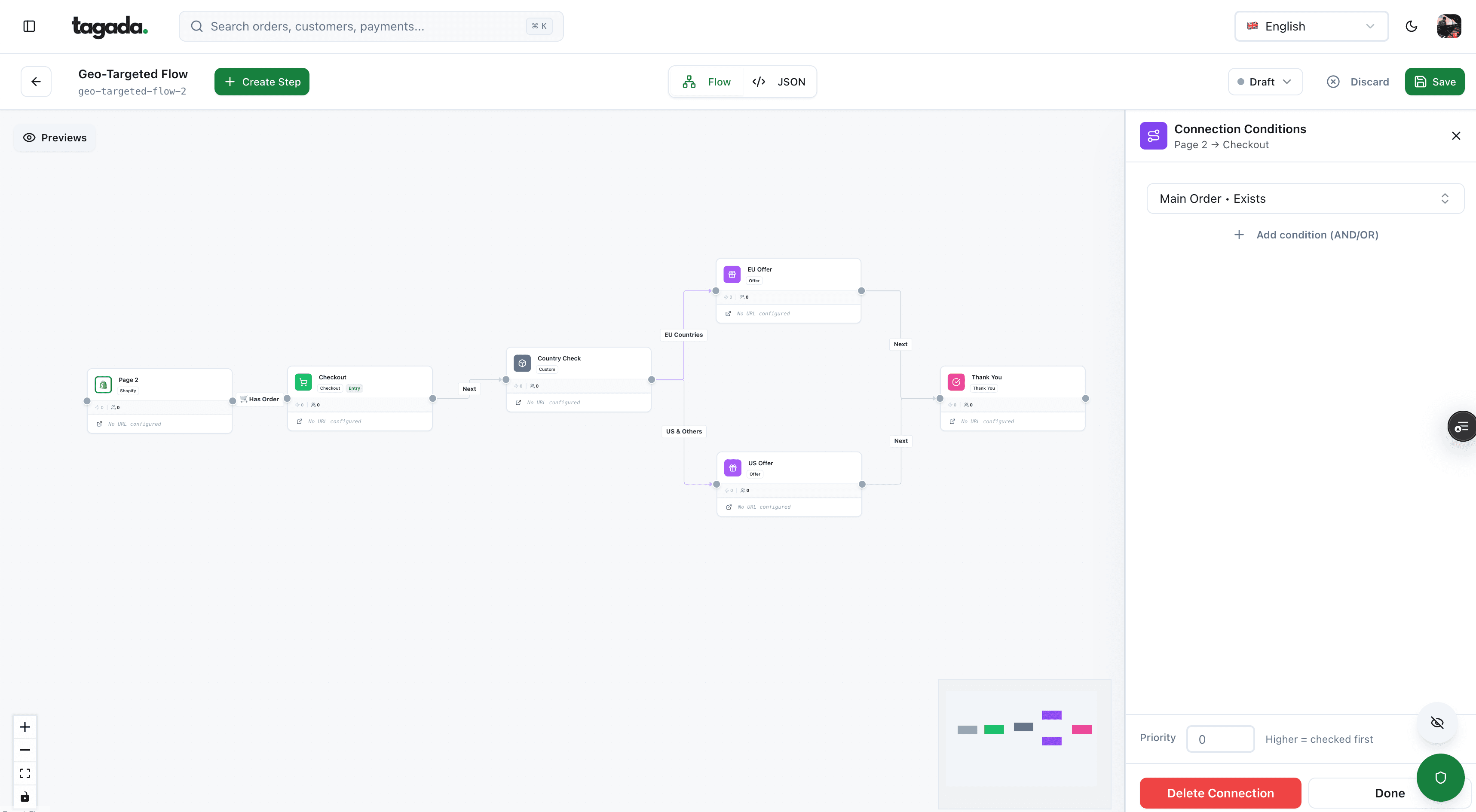
Inside Tagada
Build the funnel once, route every customer to the right offer
Checkout, upsells and subscriptions on one flow, with conditions per country, order or customer.
The rules: AI-written copy is still your ad
FTC: there is no AI exemption
Section 5 of the FTC Act declares "unfair or deceptive acts or practices in or affecting commerce" unlawful.1215 U.S.C. § 45, FTC Act Section 5 (Cornell LII) It doesn't care who drafted the sentence. In September 2024, the FTC announced "Operation AI Comply", five actions against companies that used AI hype or sold AI tools that could deceive. Chair Lina Khan: "The FTC's enforcement actions make clear that there is no AI exemption from the laws on the books."11FTC, FTC Announces Crackdown on Deceptive AI Claims and Schemes (Operation AI Comply), September 25, 2024
One of the five cases concerns AI-written content directly. Rytr sold an AI writing assistant with a "Testimonial & Review" feature that produced detailed reviews from minimal input. The FTC alleged those reviews contained details that "would almost certainly be false" for anyone posting them, and its proposed order bars Rytr from selling any service that generates reviews or testimonials.11FTC, FTC Announces Crackdown on Deceptive AI Claims and Schemes (Operation AI Comply), September 25, 2024 Separately, the FTC's rule on fake reviews names "AI-generated fake reviews" among the reviews it bans.13FTC, Final Rule Banning Fake Reviews and Testimonials, August 14, 2024
What this means for a funnel: an AI-generated testimonial, a made-up customer quote or an invented "results" figure on a sales page is your deceptive claim, not the tool's.
Health and supplement claims need evidence, not good wording
AI copy tools tend to write confident benefit statements. For anything health-related, that's a risk. The FTC's Health Products Compliance Guidance, announced December 20, 2022, replaced its 1998 dietary supplement guide and extended it to "all health-related products".15FTC, New Business Guidance for Marketers and Sellers of Health Products, December 20, 2022 Its main points:
- A benefit stated outrightMarketers must make sure that whatever they say expressly is accurateFind the study behind it, or cut the line
- A benefit only implied by an image or a before/afterThe marketer is equally responsible for claims reasonably impliedRead the page as a buyer would, not word by word
- A health outcome with no studyHealth claims need competent and reliable scientific evidence, generally randomized, controlled human clinical trialsRemove it before publishing
- A claim the agency or freelancer addedAnyone participating in deceptive marketing is potentially liableOne reviewer signs off on every claim
Source: FTC Health Products Compliance Guidance.14FTC, Health Products Compliance Guidance The FTC press release says it generally "expects high quality randomized, controlled human clinical trials."15FTC, New Business Guidance for Marketers and Sellers of Health Products, December 20, 2022
EU AI Act: Article 50 transparency, from August 2, 2026
The EU AI Act (Regulation (EU) 2024/1689) sets transparency duties in Article 50. Article 113 makes them apply from August 2, 2026.16Regulation (EU) 2024/1689 (AI Act), Articles 50 and 113
| Article 50 duty | Who it falls on | What it means for a funnel |
|---|---|---|
| 50(1): people must be told they are interacting with an AI system, unless it's obvious | Providers of the AI system | A sales or support chatbot on your funnel says it's an AI |
| 50(2): synthetic audio, image, video and text marked "in a machine-readable format" | Providers of generative AI | Your tool vendor marks outputs; don't strip the marks |
| 50(4): deepfake image, audio or video must be disclosed | Deployers (you, if you publish it) | A realistic AI "customer" or spokesperson in an ad or video is disclosed |
| 50(4): AI text published to inform the public on matters of public interest | Deployers | Exempt if it went through human review and someone holds editorial responsibility; ordinary product copy is rarely in scope |
| 50(5): information given clearly, at the latest at first interaction or exposure | Providers and deployers | The disclosure sits on the asset, not in your terms |
Fig. 1EU AI Act dates that touch a funnel
- Aug 1, 2024AI Act enters into force
- Feb 2, 2025Prohibited practices apply
- Aug 2, 2026Article 50 transparency duties apply
- Dec 2, 2026Marking deadline for generators already on the market, as reported
Transparency duties are live.
In July 2026, the EU adopted the "Digital Omnibus on AI", Regulation (EU) 2026/1744, which amends the AI Act.17European Parliament, P10_TA(2026)0198, Digital Omnibus on AI, final act Regulation (EU) 2026/1744 As reported by legal commentators, it gives providers of generative tools already on the market before August 2, 2026 until December 2, 2026 for the machine-readable marking in Article 50(2). The chatbot and deepfake duties weren't moved. That's a duty for your tool vendor; your part is not to remove the marks.
Ad and shopping platforms add their own layer
| Platform | Rule | Scope |
|---|---|---|
| Meta | Ad images made or significantly edited with Meta's AI features or third-party AI tools get an "AI info" label18Meta, How AI-generated images in ads are identified and labeled | All ads; minor edits excluded |
| Meta | Advertisers must disclose photorealistic AI images, video or realistic audio; undisclosed ads are rejected19Meta Transparency Center, Ads about social issues, elections or politics | Ads about social issues, elections or politics |
| Google Ads | Tick "Altered or synthetic content" and add a prominent disclosure where Google doesn't generate one20Google Ads, Update to our policy on disclosure requirements for synthetic content, July 2024 | Election ads |
| Google Merchant Center | AI images keep IPTC metadata; AI titles and descriptions use structured_title and structured_description21Google Merchant Center Help, AI-generated content | Product data for Shopping |
For a product brand, the Meta label and the Merchant Center attributes are the ones that apply every day. The political and election rules matter only if a campaign touches those topics.
A practical workflow: what AI drafts, what a human checks
The rule that comes out of all this: let AI draft anything that can be checked, and keep a person on anything that commits you.
| Task | Let AI draft? | What a person must check |
|---|---|---|
| Page structure and layout | Yes | Mobile rendering, speed, that the offer above the fold matches the ad |
| Headlines and body copy | Yes | Every factual claim, guarantees, prices, brand voice |
| Product descriptions | Yes | Ingredients, sizes, materials; Merchant Center attributes if used in the feed |
| Health or results claims | No | Write from the evidence file, with the study in hand |
| Testimonials and reviews | No | Only real customers, real words, disclosed relationships |
| Product and lifestyle images | Conditional | That the product shown is the product shipped; AI metadata kept |
| Realistic people in ads | Conditional | Deepfake disclosure in the EU; Meta AI labels |
| Email and SMS text | Yes | Consent, unsubscribe, offer terms, sending rules |
| A/B test variants | Yes | Which two to test, sample size, stop rule |
| Data summaries | Conditional | The tracking behind the numbers |
| Checkout, prices, subscription terms | No | Price, renewal terms and cancellation, against card network and consumer rules |
- Write the brief yourself. Offer, audience, price, guarantee, and the list of claims you can prove. The AI works from this, not from the internet.
- Generate the draft. Pages, copy variants, images, emails.
- Strip unproven claims. Go line by line against your evidence list. Delete what you can't back.
- Check the assets. Real product in the images, metadata kept, disclosures where needed.
- Test before launch. Every link, the checkout, the payment, the confirmation email.
- Run one test at a time. Two variants, a sample size, a stop date.
- Keep a record. Which tool, which prompt, who approved. If a claim is ever questioned, you'll want it.
One owner per step. The AI never publishes on its own.
For subscription offers, the checkout terms matter more than the copy: see negative option billing for the FTC and Visa rules an AI draft won't know about.
How to evaluate an AI funnel builder
The AI features change monthly, often in beta. Judge them like any other feature, then judge the funnel tool on everything else.
- Is the AI feature documented on a help page, with a date? A help article with steps and limits beats a homepage promise.
- Is it beta or Labs? ClickFunnels' changelog calls its AI an open beta.2ClickFunnels changelog, Build funnels faster with ClickFunnels AI (beta) Fine for drafts, risky as a workflow you depend on.
- What are the usage limits and costs? Allowances, per-word billing or "no additional charge, subject to usage limits" all exist today.1ClickFunnels Support, Getting Started with ClickFunnels AI, updated September 16, 20263HighLevel Support, Funnel & Website AI, modified October 8, 20264HighLevel Support, How to create Emails using Content AI, modified April 5, 2023
- Can you review before anything goes live, and revert? Approval steps and version history matter more than generation speed.
- Does it keep AI metadata on images? Needed for Merchant Center.
- Does the AI touch checkout and payments? In every tool we read, it doesn't. The checkout, upsells, payment methods and subscription logic are the funnel tool's own features, and they decide more of your revenue than the copy does.
The comparison of funnel tools on those other criteria is in sales funnel software. To find the step where the funnel actually loses buyers, see increase ecommerce conversion rates.
Where Tagada fits
How Tagada helps
Build the funnel with AI, keep checkout and payments in one place
TagadaStudio, Tagada's funnel builder, is described on tagada.io as "AI-assisted", with "Built-in AI, or connect your own tools via the MCP protocol."10Tagada, homepage (TagadaStudio section), read October 14, 2026 The checkout includes one-click upsells, order bumps, A/B tests, Apple Pay and Google Pay, with purchases tracked server-side to Meta, Google and TikTok. On the payment side, Tagada routes across Stripe, Adyen and its own processor, TagadaPay, with a cascade on decline. More in TagadaStudio and building a store with Claude and Tagada. Pricing is on the pricing page. Tagada follows Visa and Mastercard rules and the laws that apply to payments.
Whatever tool you pick, the split stays the same: the AI writes the first draft, and a person signs off on every claim, image and disclosure before it reaches a buyer.
Frequently asked questions
What is an AI funnel builder?
Can AI build a whole sales funnel for me?
What is the best AI tool for finding funnel leaks?
Do I have to disclose AI-generated content in my ads or pages?
Who is responsible for claims in AI-written ad copy?
Do Funnelish and CheckoutChamp have AI features?
Sources
Checked October 14, 2026- ClickFunnels Support, Getting Started with ClickFunnels AI, updated September 16, 2026
- ClickFunnels changelog, Build funnels faster with ClickFunnels AI (beta)
- HighLevel Support, Funnel & Website AI, modified October 8, 2026
- HighLevel Support, How to create Emails using Content AI, modified April 5, 2023
- HighLevel, AI product page
- Shopify Help Center, AI features in the Shopify admin
- Shopify Help Center, Sidekick
- systeme.io, MCP server page, last updated April 2026
- systeme.io, AI prompt generator (free tool, beta)
- Tagada, homepage (TagadaStudio section), read October 14, 2026
- FTC, FTC Announces Crackdown on Deceptive AI Claims and Schemes (Operation AI Comply), September 25, 2024
- 15 U.S.C. § 45, FTC Act Section 5 (Cornell LII)
- FTC, Final Rule Banning Fake Reviews and Testimonials, August 14, 2024
- FTC, Health Products Compliance Guidance
- FTC, New Business Guidance for Marketers and Sellers of Health Products, December 20, 2022
- Regulation (EU) 2024/1689 (AI Act), Articles 50 and 113
- European Parliament, P10_TA(2026)0198, Digital Omnibus on AI, final act Regulation (EU) 2026/1744
- Meta, How AI-generated images in ads are identified and labeled
- Meta Transparency Center, Ads about social issues, elections or politics
- Google Ads, Update to our policy on disclosure requirements for synthetic content, July 2024
- Google Merchant Center Help, AI-generated content
Tagada
Build the funnel with AI, keep checkout and payments in one place
Funnels, one-click upsells, subscription billing and payment routing, on one customer record.
- 01Create your free account
- 02Connect your store or build a checkout
- 03Launch funnels, upsells and subscriptions