

Your average order value has stalled, paid acquisition is getting more expensive, and the team is split between cutting prices and adding a “buy two, save 15%” offer to the product page. The offer looks simple, but the core question is harder: will it add profitable demand, or will it give a discount to customers who were already ready to buy your hero product?
A bundle pricing strategy groups two or more products or services into one purchasable offer with its own price. The bundle should serve a defined commercial job, not act as a reflexive markdown. A razor brand might pair a handle with refill cartridges, while a coffee subscription could present a sampler of three roasts as one discovery plan. In both cases, the package helps the customer make a more complete decision.
The basic mechanic is selling multiple products together at a combined price below the sum of their standalone prices, as described in this bundle pricing definition. Before changing your offer, it's useful to calculate and improve your AOV with a broader view of order composition, margin, and repeat behavior.
What Bundle Pricing Strategy Really Means for Your Store
A bundle can do three jobs particularly well.
First, it can lift average order value by attaching a lower-consideration product to a high-demand item. A customer who arrives for a razor handle may not search for cartridges, but a clearly named starter kit turns replenishment into part of the initial solution. The same pattern works for a camera with a memory card, a coffee machine with pods, or a skincare serum with the toner needed to use it comfortably.
Second, bundling can move slow inventory without forcing a site-wide markdown. Pairing a best seller with a slower-moving product gives the less popular item a reason to enter the cart. Retail merchandising guidance specifically recommends combining high-demand products with slower-moving or lower-margin stock to improve revenue and inventory movement, while warning that the pairing still needs to protect profitability (retail bundle pricing approaches).
Third, the bundle can anchor perceived value. If a customer sees a complete coffee tasting set at a clear package price, the individual bags can still appear fairly priced rather than arbitrarily expensive. The bundle provides context, but it shouldn't make the standalone product look like a penalty.
The commercial job comes before the discount
Research on subscription bundles describes a useful distinction. Bundled offers can carry higher absolute prices while producing lower effective prices per service, and adoption responds strongly to the relative discount. The research also reports lower price sensitivity for bundles, which is consistent with customers evaluating a simpler package rather than scrutinizing every line item (empirical analysis of subscription bundle pricing and adoption).
That doesn't mean every bundle should be heavily discounted. A package works when it makes the buying decision easier and the combined use case more compelling. A random collection of products may increase units per order while reducing trust, creating support questions, and leaving customers with items they never wanted.
Before publishing the offer, define whether it's meant to increase basket size, introduce a product, clear stock, protect conversion, or improve subscription activation. The rest of the strategy follows from that choice. Your storefront, checkout, payment routing, and billing system must then carry the same logic without breaking inventory, retries, refunds, or cohort reporting.
For a deeper vocabulary reference, see the product bundling glossary.
The Three Bundle Types and When Each One Wins
The three useful operating models are pure bundling, mixed bundling, and complementary bundling. They differ less by how many products they contain than by how much choice the customer keeps and how directly the products solve one problem.
Pure bundling
With pure bundling, customers can buy the set but not the individual components. A gift set, starter kit, or complete skincare routine can fit this structure. It works when the combined experience feels inseparable, such as a guided tasting set or a device package that requires its accessories to function properly.
The best business goal is simplification and controlled product discovery. The KPI is usually bundle conversion or units per transaction. The risk is trial friction. A shopper who only needs one item may leave rather than accept the full package, so pure bundles need strong product education and a clear explanation of the complete outcome.
Mixed bundling
Mixed bundling sells the components individually and offers the package at a lower combined price. This is common in “frequently bought together” placements, cart offers, and starter kits. The standalone path must remain visible. Otherwise, the customer can feel trapped or assume the brand is hiding the actual product price.
Mixed bundling is often the strongest default for DTC stores because it supports choice while creating an upsell. Track bundle attach rate, contribution margin per order, and the share of bundle buyers who would otherwise have purchased the hero SKU alone. The failure mode is cannibalization, particularly when the bundle discount is larger than the incremental value created.
Complementary bundling
Complementary bundles combine products that remove a real usage barrier. Batteries with a device, toner with a serum, or a workout stack with the accessories needed to use it are stronger examples than arbitrary cross-category groupings.
The goal is completion and convenience. Conversion, attach rate, and post-purchase satisfaction tend to matter more than raw units. Research on bundling finds stronger satisfaction, recommendation, and repurchase outcomes when customers perceive a coherent package, while the economics become more favorable when willingness to pay across products isn't strongly aligned (research on price bundling and heterogeneous valuations).
| Bundle Type | Mechanic | Best For | Primary KPI Moved | Watch Out For |
|---|---|---|---|---|
| Pure | Components sold only as one set | Complete solutions and giftable kits | Bundle conversion | Stalling shoppers who need only one item |
| Mixed | Components sold alone and as a package | DTC upsells and starter offers | Attach rate and margin per order | Cannibalizing full-price single sales |
| Complementary | Products remove a usage or ownership friction | Routines, accessories, and replenishment | Conversion and repeat purchase | Pairings that look irrelevant |
The practical distinction is customer self-selection. Mixed bundling lets buyers choose the option that gives them the most value, which is why it often handles heterogeneous willingness to pay better than forcing every shopper into the same package. For adjacent cross-sell mechanics, SelfServe on cross-sell strategies offers useful context, but the offer still needs its own margin and payment analysis.
Designing Bundles With Margin Math That Holds
Start with SKU selection, not the discount field. The most reliable pairing is a hero product plus a high-attach-rate or high-margin secondary item. Avoid combining two weak sellers unless the bundle solves a clear customer problem, and exclude products already carrying an active promotion unless your margin model explicitly includes the stacked reduction.
Your spreadsheet should calculate contribution, not just gross sales. For each candidate, enter standalone price, cost of goods, blended payment processing fees, any international-card surcharge, fulfillment cost per shipment, expected return exposure, and expected support load. Subscription operators should also include the economic effect of failed renewals and cancellations because the first transaction isn't the whole relationship.
A copyable calculation
Suppose a two-SKU offer has a combined standalone price of 100 units of currency. A 15% bundle discount produces a selling price of 85. If product cost, payment fees, fulfillment, and expected service costs together leave a contribution that supports a 38% gross margin before the discount, the discount can reduce that margin to 32%. That may still be a healthy offer if the bundle increases profitable order value and doesn't replace a more profitable standalone sale.
A weaker candidate starts at 28% gross margin and falls to 18% after the same discount. The order may look larger in the dashboard, but the extra units don't compensate for the margin lost. The two offers require different decisions even though the customer-facing discount is identical.
| Line Item | Healthy Bundle | Margin-Eroding Bundle |
|---|---|---|
| Combined standalone price | 100 | 100 |
| Bundle discount | 15% | 15% |
| Bundle selling price | 85 | 85 |
| Gross margin before discount | 38% | 28% |
| Gross margin after discount | 32% | 18% |
| Operator decision | Test with guardrails | Reject or reprice |
The practical discount zone is commonly 10% to 25% below the standalone total, according to ecommerce bundle-pricing guidance (Shopify bundle pricing guide). Lower discounts can fail to register as meaningful, while deeper discounts can train customers to wait and weaken contribution. The exact point depends on category, price salience, and how much incremental utility the package creates.
Set a minimum margin floor before launch. Cap bundle penetration as a share of revenue so the offer can't become the default purchase path, and require sign-off whenever the projected bundle falls below the floor. For the broader unit-economics framework, use a structured profitability analysis, then reconcile it with actual payment, fulfillment, return, and support data after launch.
Testing Bundles the Way Operators Actually Do It
A bundle test needs a control group and a clean exposure rule. A practical design uses a randomized 50/50 split at the product-page or cart level, with a holdout group that never sees the bundle. Run it long enough to clear novelty effects, with a four-week minimum window as an operating baseline rather than calling the test on the first strong weekend.
Don't judge the result from bundle sales alone. The KPI stack should include:
- Average order value: Did the offer increase what customers spend per order?
- Margin per order: Did contribution rise after discount, processing, fulfillment, returns, and support?
- Conversion rate: Did more qualified shoppers complete checkout?
- Attach rate: How often did customers add the secondary product?
- Refund rate: Did the package create confusion or dissatisfaction?
- 30-day repeat purchase: Did the bundle introduce products customers later reorder?
Read the trade-off, not the headline
If AOV rises while margin per order falls, the offer isn't automatically successful. Compare incremental contribution against the control and inspect whether the bundle took customers away from a higher-margin hero SKU. A larger basket can conceal a weaker business result.
If conversion rises but repeat purchase or subscription retention falls, the bundle may be attracting customers with a discount that doesn't match long-term value. In a recurring business, measure the cohort beyond the first payment. A customer who accepts a package but cancels at the first renewal may be less valuable than a customer who buys a smaller offer and stays engaged.
A single variant also teaches very little. Use a structured matrix across price point, discount depth, and placement, while changing one dimension at a time wherever possible. A PDP module, cart recommendation, checkout upsell, and post-purchase offer reach customers at different moments and shouldn't share one blended conclusion.
Operator rule: Record the hypothesis, audience, exposure logic, price, cost assumptions, dates, primary KPI, guardrails, and final decision before anyone reads the result.
Finance needs the contribution bridge. Merchandising needs the SKU and inventory read. Engineering needs the exact offer logic and event definitions. Store those details with the test result so the next team can reproduce the learning rather than debate a dashboard screenshot.
Subscriptions, International Payments, and High-Risk Verticals
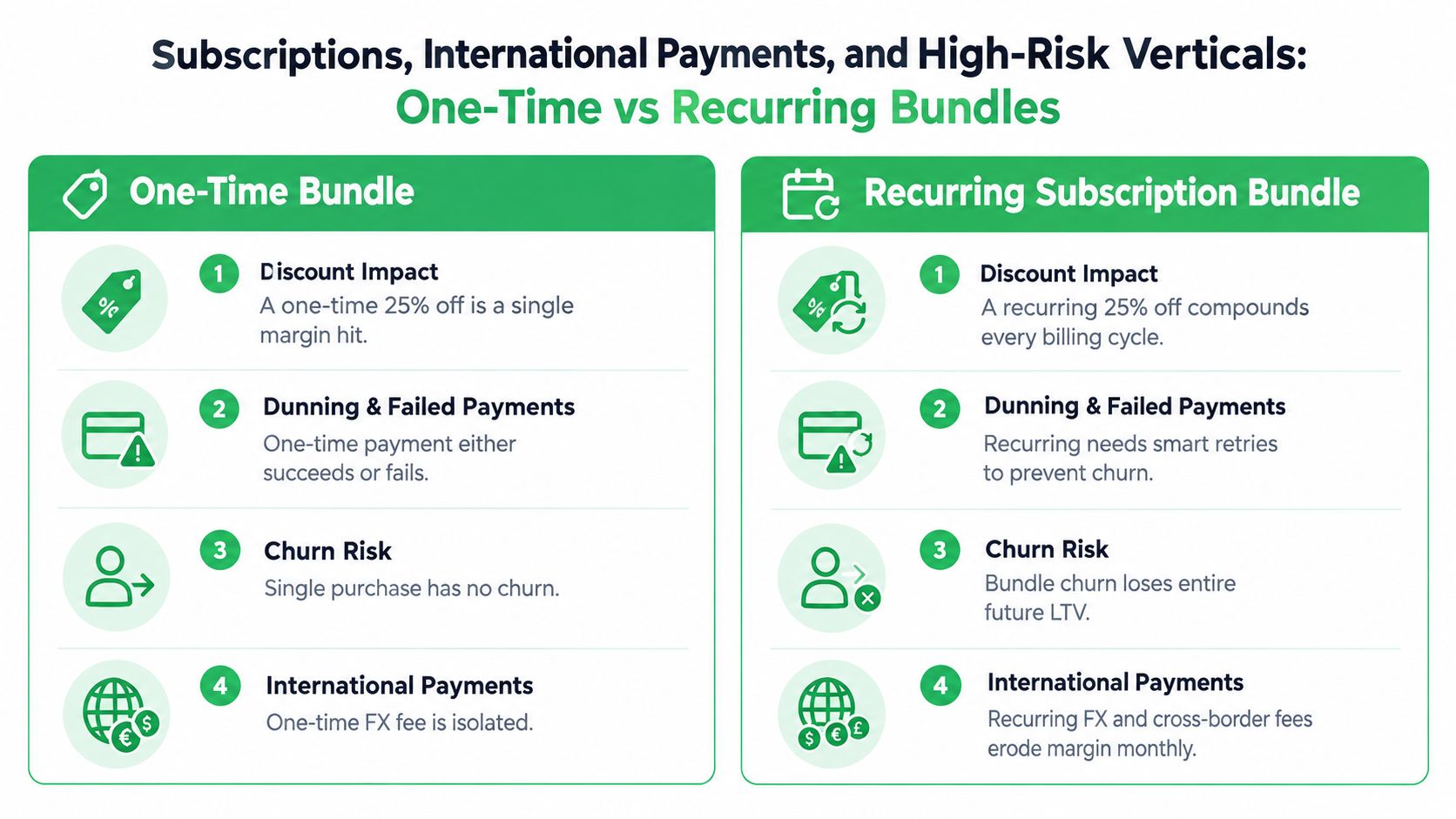
A one-time bundle takes one payment decision. A recurring bundle creates a repeated obligation across billing cycles, payment methods, currency conversion, fulfillment, and customer support. The discount therefore changes more than the first order. A 25% reduction on a single shipment is one margin event, while the same reduction on a monthly box can apply again at every renewal and alter the economics of the entire cohort.
Prepaid or multi-cycle offers add another layer. They can improve cash collection and commitment, but they can also create a sharper cancellation moment when the customer reaches renewal. The billing engine must know the original offer, renewal price, applicable taxes, entitlement period, and dunning path. If those values are unclear, customers open disputes instead of renewing.
International pricing changes the bundle
A €19.99 offer in Germany isn't the same commercial object as a $19.99 offer in the United States. Currency presentation, FX rounding, tax treatment, duty-inclusive pricing, local acquiring, and cross-border fees can change the amount captured and the margin retained. Merchants should price and report by market rather than convert one global bundle price and assume the economics remain stable.
The checkout should also preserve the bundle's component data for refunds, tax calculation, fulfillment, and customer service. A single package price is useful for the buyer, but operations still need to understand what was sold.
High-risk categories need payment resilience
Supplements, adult products, CBD, and ticketing face additional underwriting, dispute, and processor-continuity concerns. A bundle that converts well can still fail commercially if the payment path declines too many legitimate customers or a processor restricts the category.
Cascade routing across multiple PSPs, local methods such as iDEAL and Boleto, and smarter retry logic can determine whether a recurring offer survives. For subscription operators, subscription-based ecommerce guidance is most useful when paired with actual authorization, dunning, churn, and chargeback data.
The economics of bundling also change as products become more complementary. A formal model finds that mixed-bundle sales and profits rise with complementarity, and that highly complementary products can support a bundle price near the less elastic product's price (model of bundling complementary goods). In practical terms, the payment stack must protect the value created by the pairing instead of turning every failed renewal into lost future revenue.
Bundle Pricing Pitfalls That Quietly Destroy Margin
The dangerous bundles are rarely obvious on launch day. Week-one dashboards may show higher AOV and healthy order volume, while month-three cohort data reveals that the offer replaced profitable sales, increased service work, or created a renewal problem.
Cannibalization hides behind bigger baskets
A mixed bundle can steal buyers from a higher-margin hero SKU. Compare the bundle cohort with a control group and review gross margin per order by SKU mix. If bundle penetration rises while standalone hero sales fall without enough incremental buyers, pause the offer or reduce its visibility.
Discount stacking is another common leak. A customer may combine the bundle price with loyalty points, a welcome code, free shipping, and a seasonal promotion. Review effective discount after every incentive, not only the advertised bundle reduction. A bundle that meets its floor before stacking may fall below it at checkout.
Inventory and support create second-order costs
Slow-moving inventory can help a bundle, but a weak component can also restrict availability for the hero item. Track stockouts, bundle availability, and the sell-through of each component. If the slow SKU repeatedly blocks the offer or ties up cash, replace it rather than forcing the bundle to continue.
Support teams often expose a design problem before finance does. Confusing component names, missing size choices, and unclear renewal contents generate tickets and refunds. Monitor support tickets per bundle and refund rate by SKU mix. A sustained rise versus the control should trigger a content or offer review.
Subscription discounts can create a renewal cliff
A customer may accept a discounted first cycle and then cancel when the recurring price changes. Compare retention curves by bundle type and inspect the exact renewal event. If churn concentrates at the discount cliff, show the renewal price early, offer a coherent ongoing value, or use a less aggressive acquisition incentive.
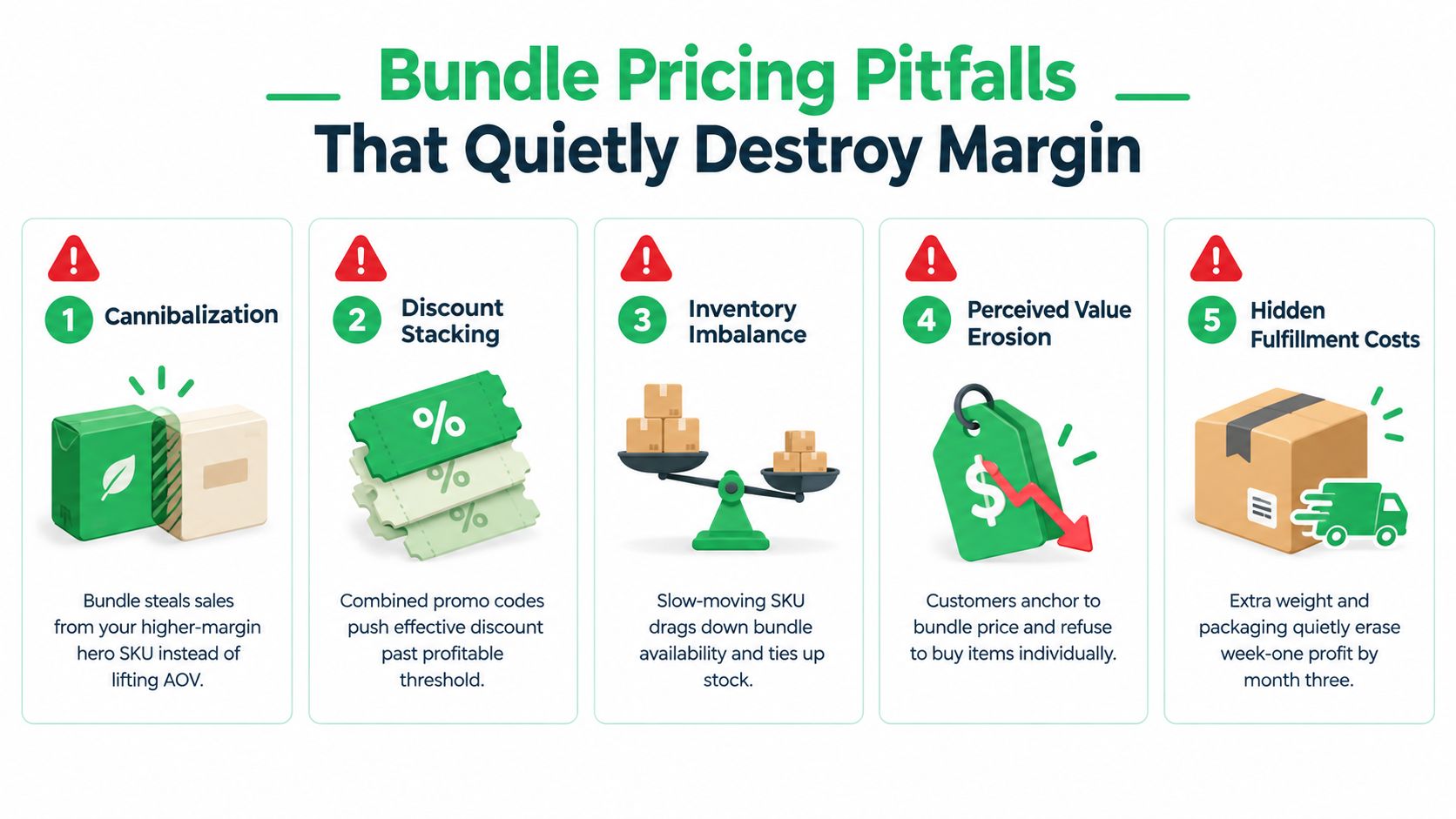
The same discipline applies to fulfillment. Extra weight, packaging, split shipments, and pick-and-pack complexity can erase the apparent gain. Review fulfillment cost per shipment by bundle, then set a pause threshold before launch for margin, refunds, support volume, and retention. Don't wait for a quarterly review to discover that the offer was profitable only in the cleanest orders.
<iframe width="100%" style="aspect-ratio: 16 / 9;" src="https://www.youtube.com/embed/vCVSI7uuWuE" frameborder="0" allow="autoplay; encrypted-media" allowfullscreen></iframe>
A Rollout Plan and Pricing Templates You Can Ship This Week
A practical rollout starts small and makes the payment path part of the launch checklist.
A five-day launch sequence
Day one, choose the job. Select one hero SKU, one commercial objective, and a narrow customer segment. Pull existing order combinations, margin inputs, inventory constraints, and payment-method performance.
Day two, build the economics. Create the bundle offer, calculate the post-discount contribution, include fulfillment and support assumptions, and define the minimum margin floor. Decide whether the offer is pure, mixed, or complementary.
Day three, configure the experience. Use Shopify Functions for discount and cart logic where appropriate. Use Stripe Tax for tax calculation when the setup supports it, and connect inventory behavior to the bundle structure. Recharge or Bold can handle subscription-specific bundle and recurring-offer workflows, but verify how each system passes renewal price and component data.
Day four, connect payments. Assign the first transaction to the gateway with the strongest approval and category fit. Define the fallback route, local payment methods, refund behavior, and retry sequence before traffic arrives. For recurring offers, confirm where failed renewals land and how dunning messages reflect the bundle.
Day five, launch the test. Start the randomized split, preserve a holdout, annotate every promotion, and monitor margin, authorization, fulfillment, refunds, support, and repeat behavior. Keep the offer only if incremental contribution supports the business goal.
For merchants that need a unified orchestration layer, Tagada can combine checkout flows, payment routing, subscription management, dunning, A/B testing, and server-side tracking across processors such as Stripe, Adyen, and NMI. Treat it as an implementation option, not a substitute for the margin model.
Templates ready for an operating review
The figures below are templates, not claims about expected performance. Replace the placeholders with your actual costs and target margin.
| Template | SKUs | Discount | Gross Margin % | Payment Routing |
|---|---|---|---|---|
| Starter kit | 2 SKUs, hero plus required accessory | Enter approved discount | Enter modeled margin | Primary gateway for first payment, defined fallback |
| Curated collection | 4 complementary SKUs | 15% | Enter post-discount margin | Route by market and payment method, preserve component data |
| Subscribe and save | Recurring bundle plus gift incentive | Enter acquisition discount | Enter first-cycle and renewal margin | Billing engine handles retries and dunning on discounted renewals |
A two-SKU pure-bundle P&L should list standalone prices, COGS for both products, fulfillment, processing, returns, support, taxes, and the final bundle price. A four-SKU curated offer at 15% off should also model stock availability and whether one component limits the whole package.
For subscribe-and-save, separate first-cycle economics from renewal economics. Record the gift cost, renewal price, payment fees, retry path, cancellation behavior, and cohort retention. The billing engine should never rely on a customer remembering what changed after the introductory period.
Hand finance a contribution view, merchandising a SKU and inventory view, and engineering an event and routing specification. That one-page summary should include the offer name, components, customer eligibility, standalone total, bundle price, discount, margin floor, test split, success criteria, rollback condition, gateway order, retry rules, refund logic, and reporting owner. A bundle is ready only when all three teams can explain the same offer in the same terms.
Tagada helps ecommerce and subscription operators connect bundle offers to checkout, multi-processor payment routing, local methods, smart retries, subscription billing, dunning, and revenue-aware messaging. Visit Tagada to evaluate whether its orchestration layer fits your bundle tests and payment stack.