
A/B Testing Tools for Ecommerce: What to Check Before You Pick One
Choose an A/B testing tool for your store: flicker, Shopify checkout limits, stats engines, revenue after refunds, pricing. 9 options from official pages.

Article summary
TL;DR
Choose an A/B testing tool by where it splits traffic and what it can measure. Browser scripts suit product and landing pages but can delay rendering. Checkout and payment tests need a server-side, checkout-level or payment-level split. Then check the stats engine, revenue metrics net of refunds, GA4 and consent support, and how the price scales.
- Client-side tools rewrite the page in the browser. Shopify's own docs say anti-flicker snippets often cost over 2 seconds of First Contentful Paint and hurt LCP. Server-side tests don't have that cost.
- On Shopify, apps that customize the information, shipping and payment steps are Shopify Plus only. Native Rollouts experiments need the Grow plan or higher and report checkout conversion rate only for checkout tests.
- To test which payment methods buyers see, Stripe runs payment method experiments from its Dashboard, judged on average revenue per session.
- Sequential and Bayesian engines handle early looks differently from a fixed-sample test. Know which one your tool uses before you read a dashboard.
- Published prices go from free (GrowthBook self-hosted) to $495 a month (Kameleoon Starter). Pricing scales on tracked users, visitors, orders or seats depending on the vendor.
 ChatGPT
 Claude
 Perplexity
 Grok
GrokOn this page
Most lists of A/B testing tools rank vendors by features you can't verify. This guide does the opposite: it gives the criteria that decide whether a tool can test what matters in a store, from the product page to the payment form, then compares nine options using only their own pricing and documentation pages, read on October 14, 2026. How to run a valid test (hypothesis, sample size, duration) is covered in our guide to ecommerce A/B testing.
What kinds of A/B testing tools are there?
"A/B testing tool" covers four families of products. They don't test the same things, and the first decision is which family you need.
Web experimentation suites
A script on your site plus a visual editor. Marketers change headlines, layouts and images without a developer. Most also sell a server-side product. Wingify (VWO and AB Tasty), Optimizely, Convert and Kameleoon sit here.
Feature flags and server-side platforms
Your code asks an SDK which variant a visitor gets. Built for developers, it can test prices, checkout logic and back-end rules. GrowthBook is the open source option; the suites above have their own.
Shopify-native testing
Apps from the Shopify App Store, such as Shoplift and Intelligems, plus Shopify's own Rollouts. They test themes, templates, prices and shipping inside Shopify's rules.
Tests in the checkout or payment layer
The checkout or payment provider splits traffic itself. Stripe's payment method experiments are one example; some checkout platforms include A/B tests on their own pages.
A store often needs two of them: one for the storefront, one for the checkout and payments. The criteria below sort them.
Client-side vs server-side testing: where does the split happen?
This is the criterion that decides the rest. A client-side tool loads a script in the visitor's browser, assigns a variant, then rewrites the page. A server-side tool, or a feature flag SDK, picks the variant before the page or the API response is built.
| Client-side (browser script) | Server-side (SDK or feature flags) | |
|---|---|---|
| Who builds tests | Marketers, in a visual editor | Developers, in code |
| What it can test | Copy, layout, images, page order, pop-ups | Prices, shipping rules, checkout logic, payment rules, search and recommendations |
| Flicker risk | Possible: the original page can show before the variant | None: the variant is in the first response |
| Effect on page speed | Script download, and often a render-blocking snippet | Small, if assignment is fast or cached |
| Checkout and payments | Only where the checkout lets scripts run | YesIf you own the checkout code |
| SEO | Googlebot sees what cookieless visitors see | Same rules: no cloaking, no special version for bots |
On SEO, Google's guidance applies to both types: don't show Googlebot a different version than users, use rel=canonical on variant URLs and 302 redirects for split URL tests, and end the test once it's done.20Google Search Central, Minimize A/B testing impact in Google Search, updated December 10, 2025 The details are in our ecommerce A/B testing guide.
Flicker and Core Web Vitals
To avoid showing the original page for a split second before the variant, many client-side tools add an anti-flicker snippet. It hides the page until the testing script has loaded. Shopify's developer documentation describes the cost plainly.
The anti-flicker snippet is synchronous JavaScript that blocks rendering by hiding content until the testing script loads. This performance cost is often over 2 seconds on First Contentful Paint (FCP) and directly hurts Largest Contentful Paint (LCP).
Google's target for a good Largest Contentful Paint is 2.5 seconds or less, measured at the 75th percentile of page loads on mobile and desktop.17web.dev, Largest Contentful Paint (LCP) A snippet that holds the page for two seconds uses most of that budget. Shopify's advice: disable the snippet when no test is running, close finished tests immediately, and note that "server-side A/B testing has no anti-flicker performance cost."16Shopify Dev Docs, Disable A/B testing anti-flicker snippets when inactive
What to ask a client-side vendor
Does the snippet block rendering, and for how long at most (the timeout)? Is it removed automatically when no test runs on the page? Can you load the script from your own domain? Ask for a test page and measure LCP with and without the script on a mid-range phone.
Some vendors make their own claims here. Convert's pricing page says its SmartInsert technology "prevents flickering out-of-the-box."6Convert, Pricing, read October 14, 2026 Measure it on your own pages before you rely on it.
Can you A/B test the Shopify checkout?
Partly, and the rules depend on your plan. Shopify's checkout isn't a page you can rewrite with a script. Apps work through checkout UI extensions, which "run in an isolated sandbox" and don't have access to "the checkout page itself (HTML or other assets)."14Shopify Dev Docs, Checkout UI extensions That's why most browser-based testing tools stop at the cart.
 Thank you and order status pagesApps that customize them: Basic plan or higher
- Information, shipping, payment stepsApps that customize them: Shopify Plus only
- Rollouts experimentsA/B test whole checkout configurations: Grow plan or higher
- Headless or custom storefrontsCan't be tested with Rollouts
The details, from Shopify's own pages:
- Checkout apps. Apps that customize the information, shipping and payment pages "are available only to Shopify Plus." Apps for the Thank you and order status pages are available from the Basic plan.15Shopify Help Center, Checkout apps
- Rollouts. Since June 2026, Shopify lets you "run an A/B test between two entirely different themes or checkout setups," from Markets > Rollouts in the admin.13Shopify Changelog, Schedule, publish and A/B test new themes and checkout and customer account configurations, June 5, 2026 Rollouts are available from the Basic plan, Experiments from the Grow plan. Liquid templates can't be changed in a rollout, vintage themes aren't supported, and headless or custom storefront checkouts can't be tested.11Shopify Help Center, Rollouts: requirements and considerations
- What Rollouts reports. A checkout experiment reports checkout conversion rate only. Average order value and gross sales don't appear in any experiment table, and the metrics can't be customized.12Shopify Help Center, Rollouts analytics
- Apps on top of Shopify. Intelligems' pricing page says its checkout tests "require Shopify Plus", while price, content and post-purchase tests work on any plan, and shipping rate tests need Advanced or Plus.10Intelligems, Pricing, read October 14, 2026
So a Shopify brand not on Plus can test whole checkout configurations natively, judged on conversion rate, and test everything before and after the checkout with apps. Testing a single element inside the payment step needs Plus. The ranked list of checkout changes worth testing is in our ecommerce checkout optimization guide.
How to A/B test payment methods and express buttons
Adding a buy now, pay later option or moving Apple Pay up is one of the most common checkout tests. It can't run as a page script, because the payment form decides which methods appear. The test has to run in the payment layer or in a checkout you control.
Stripe documents one way to do it. If your integration uses dynamic payment methods with the Payment Element (Payment Intents API) or Stripe Checkout in payment mode, you can create an experiment from the Dashboard, without code, and offer a set of payment methods to a share of sessions.18Stripe Docs, A/B testing a payment method
- What you test
- New payment methods (Klarna, Affirm, Afterpay, Apple Pay, Google Pay…) or rules such as a minimum amount
- Split
- Treatment share from 1% to 99%; 50% recommended
- Assignment
- Per session, from user agent, IP address and date
- Main metric
- Average revenue per session, plus conversion rate and AOV
- Statistics
- z-test at 5%; 80% power to detect a 1% difference
- Time limit
- Ended by Stripe after 180 days
Summary of Stripe Docs, read October 14, 2026.
Three points from Stripe's page matter for reading results. First, it recommends average revenue per session as the guiding metric, because conversion rates and order values vary a lot by payment method. Second, a session is rebuilt each day from the user agent, IP address and date, so the same person can be counted again on another day or device. Third, with a 50/50 split, Stripe says 80,000 sessions give enough power to detect a 100 basis point change in conversion rate.18Stripe Docs, A/B testing a payment method Payment method settings can't be changed while the experiment runs.
What these tests leave out: refunds, disputes and late payment failures. A buy now, pay later option that lifts orders but adds returns needs a second look once the refund window has passed. Which methods to test first is covered in alternative payment methods; testing a processor route instead of a payment method is in the ecommerce A/B testing guide.
The statistics engine: frequentist, Bayesian, sequential
Every tool decides when a result is "significant" in its own way. The method changes what you're allowed to do with the dashboard, especially whether you can stop early.
| Method | What it tells you | Can you stop early? | Stated by |
|---|---|---|---|
| Fixed-sample frequentist | Whether the difference is larger than chance at a set confidence level | NoDecide the sample before the test and stop there | Stripe (z-test at 5%)18Stripe Docs, A/B testing a payment method; Convert, Kameleoon and GrowthBook list frequentist methods |
| Sequential | Same question, with corrections for looking at results repeatedly | YesBy its own stopping rule | Convert, Kameleoon, GrowthBook (Pro), Wingify's sequential testing option |
| Bayesian | A probability that B beats A, and by how much | Depends on the setup; still plan a minimum duration | Wingify ("Bayesian-powered reporting"), Shoplift ("Bayesian predictive analysis"), Convert, GrowthBook, Kameleoon Enterprise |
| False discovery rate control | Limits false wins when you track many metrics or variants | Combined with the above | Optimizely Stats Engine4Optimizely Docs, Statistical significance, read October 14, 2026 |
Sources for the vendor columns: Convert6Convert, Pricing, read October 14, 2026, Kameleoon7Kameleoon, Plans, read October 14, 2026, GrowthBook8GrowthBook, Pricing, read October 14, 2026, Wingify2Wingify, Pricing and plans, read October 14, 2026, Shoplift9Shoplift, Pricing, read October 14, 2026.
Why it matters: with a standard fixed-sample test, checking every day and stopping at the first significant reading multiplies false wins. Sequential methods were designed to fix that. The research behind Optimizely's engine describes "always valid" p-values that stay correct however often you look.5Johari, Pekelis, Walsh, Always Valid Inference: Bringing Sequential Analysis to A/B Testing, arXiv 1512.04922 If your tool uses one, follow its stopping rule. If it doesn't, size the sample first and wait. Wingify's pricing page says its sequential testing option makes "in-built adjustments for peeking errors."2Wingify, Pricing and plans, read October 14, 2026
Two checks that don't depend on the tool
Compare the visitors in each version with the split you set (a sample ratio mismatch means the data is broken). And run an A/A test once: two identical versions should show no winner. Both are explained in ecommerce A/B testing.
Revenue metrics, refunds and guardrails
A test tool that only counts clicks and add-to-carts can't tell you whether a change made money. For a store, the decision metric is revenue per visitor, ideally after refunds, and a few guardrails show what the win cost.
- Conversion rate upA discount or a pushier offer can raise orders and lower revenueCan the test be judged on revenue per visitor?
- Revenue per visitor upGross revenue: returns and refunds arrive weeks laterCan refunds and cancellations be imported and joined to the variant?
- Checkout completion upA declined card looks like abandonment; a fraud spike looks like salesCan payment outcomes (approved, declined, disputed) feed the report?
- One winning segment out of twentyMultiple comparisons: one false win is likelyDoes the engine correct for multiple metrics or segments?
- Guardrail metric flaggedA secondary number moved the wrong wayCan you set guardrails that block shipping a winner?
What the vendor pages say: Intelligems puts "profit per visitor" in its headline10Intelligems, Pricing, read October 14, 2026; Stripe judges payment method tests on average revenue per session18Stripe Docs, A/B testing a payment method; Shopify Rollouts reports conversion rate, not order value or sales.12Shopify Help Center, Rollouts analytics Warehouse-native tools such as GrowthBook connect to Snowflake, BigQuery, Redshift, Databricks or ClickHouse8GrowthBook, Pricing, read October 14, 2026, which lets you join refunds and disputes from your own data.
Holdouts. After you ship a winner, keeping a small share of visitors on the old version for a few weeks shows whether the gain lasts. Check that the tool can keep a holdout group outside every other test. Our revenue per visitor entry and the worked example in ecommerce A/B testing show why a conversion win can lose money.
Inside Tagada
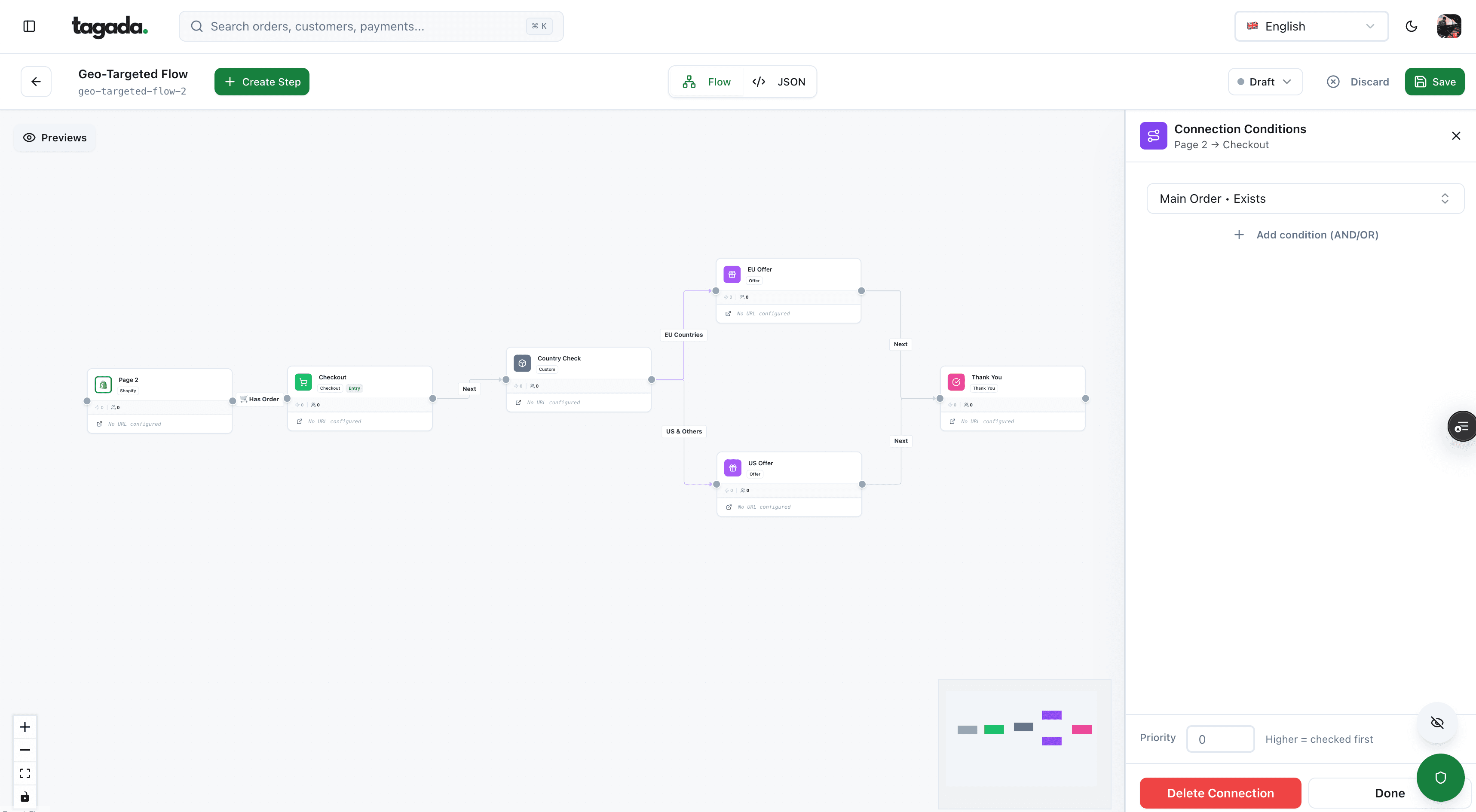
Build the funnel once, route every customer to the right offer
Checkout, upsells and subscriptions on one flow, with conditions per country, order or customer.
Integrations: GA4, Shopify and your data
A testing tool has to send its assignments somewhere you trust. Three connections matter for a store.
- Google Analytics 4. Google Optimize and Optimize 360 "are no longer available as of September 30, 2023." Google said it was collaborating on integrations with AB Tasty, Optimizely and VWO, and that its public APIs let any A/B testing tool connect to Google Analytics.19Google Analytics Help, Sunset of Google Optimize (September 2023) Shoplift lists GA4 analysis on its Advanced plan.9Shoplift, Pricing, read October 14, 2026 The events to send are listed in our GA4 ecommerce events guide.
- Shopify. Check whether the tool is a Shopify app, a theme script or both, and what it can reach (see the checkout section above). Kameleoon lists a Shopify extension on both plans7Kameleoon, Plans, read October 14, 2026; Convert lists Shopify price, shipping and theme testing.6Convert, Pricing, read October 14, 2026
- Your order and payment data. Ask whether the variant ID can be stored on the order, so refunds, renewals and disputes can be attributed later. Purchase events sent from the server are covered in server-side tracking.
VWO and AB Tasty are now one company
After their 2026 merger, VWO and AB Tasty use Wingify as their shared suite brand, and both sites redirect their pricing pages to wingify.com. Wingify says current VWO and AB Tasty products keep running "as-is" and that "current contracts, pricing, and service levels carry over unchanged."1Wingify, Wingify: the unified Digital Experience Optimization suite, updated September 18, 2026, read October 14, 2026
Privacy and consent
A test assigns each visitor to a group and remembers it, usually with a cookie or a device identifier, and joins that group to what the visitor buys. Depending on where your customers are, that can require a disclosure or consent.
Stripe's documentation is explicit: its payment method tests use customers' IP address and user agent, and "depending on the law applicable to you and your customers," running them "might require you to take steps such as providing disclosures and collecting customers' consent."18Stripe Docs, A/B testing a payment method Questions to ask any vendor:
- Where is data stored? Convert, for example, lists EU servers in Frankfurt on all plans.6Convert, Pricing, read October 14, 2026
- Can visitors be kept out of tests until they consent? Convert lists this option.6Convert, Pricing, read October 14, 2026
- Which cookies are set, first-party or third-party, and for how long?
- Does the tool work with your consent management platform, and what happens to the split when many visitors refuse?
The last point is a statistics question too: if only consenting visitors are tested, the results describe consenting visitors.
How A/B testing tools are priced
The query "best A/B testing tool with usage-based pricing" has a short answer: most are usage-based, but on different units. Compare them at your own traffic and order volume.
| Pricing unit | Who uses it (per their pricing pages) | What makes the bill grow |
|---|---|---|
| Tested or tracked users per month (MTU) | Convert, Kameleoon | Traffic included in tests; Convert bills overages per block of users6Convert, Pricing, read October 14, 20267Kameleoon, Plans, read October 14, 2026 |
| Total monthly visitors | Shoplift | All site visitors, "not tested visitors"9Shoplift, Pricing, read October 14, 2026 |
| Monthly orders | Intelligems | Order volume tiers, per store, no per-visitor charges10Intelligems, Pricing, read October 14, 2026 |
| Seats | GrowthBook Cloud Pro | Number of users of the tool, plus usage above included CDN and event volumes8GrowthBook, Pricing, read October 14, 2026 |
| Custom quote | Optimizely, Wingify | Packaged per customer; no public price3Optimizely, Pricing, read October 14, 20262Wingify, Pricing and plans, read October 14, 2026 |
| Included in a platform | Shopify Rollouts, Stripe payment method tests | Your Shopify plan or Stripe account11Shopify Help Center, Rollouts: requirements and considerations18Stripe Docs, A/B testing a payment method |
A/B testing tools compared
Everything below comes from each vendor's own pages, read on October 14, 2026. A blank or "not stated" means the page read didn't say; it doesn't mean the feature is missing. This isn't a ranking.
| Tool | Server-side or feature flags | Checkout and payments | Stats method stated | Published price |
|---|---|---|---|---|
| Wingify (VWO and AB Tasty), web suite | "Feature Experimentation, Personalization & Rollout", SDKs in 10+ languages2Wingify, Pricing and plans, read October 14, 2026 | Not stated on the pricing page | Bayesian reporting, sequential testing option2Wingify, Pricing and plans, read October 14, 2026 | On request (Growth, Pro, Enterprise)2Wingify, Pricing and plans, read October 14, 2026 |
| Optimizely, web suite | "A/B, multi-page, feature and server-side testing"3Optimizely, Pricing, read October 14, 2026 | Not stated on the pricing page | Stats Engine, false discovery rate control4Optimizely Docs, Statistical significance, read October 14, 2026 | "Individually packaged"; no public price3Optimizely, Pricing, read October 14, 2026 |
| Convert, web suite | Full Stack and feature flags (Pro, Enterprise)6Convert, Pricing, read October 14, 2026 | Shopify price, shipping and theme testing6Convert, Pricing, read October 14, 2026 | Frequentist and Bayesian, sequential testing6Convert, Pricing, read October 14, 2026 | Growth $299/mo billed annually ($399 monthly), 100K tested users6Convert, Pricing, read October 14, 2026 |
| Kameleoon, web suite | Feature Experimentation add-on; server-side testing on Enterprise7Kameleoon, Plans, read October 14, 2026 | Shopify extension7Kameleoon, Plans, read October 14, 2026 | Sequential testing; frequentist and Bayesian on Enterprise7Kameleoon, Plans, read October 14, 2026 | PBX Starter (prompt-based experimentation) from $495/mo, 50,000 MTUs; Enterprise custom7Kameleoon, Plans, read October 14, 2026 |
| GrowthBook, open source feature flags | YesWarehouse-native8GrowthBook, Pricing, read October 14, 2026 | Through your own code | Bayesian and frequentist; sequential and CUPED on Pro8GrowthBook, Pricing, read October 14, 2026 | Self-hosted free; Cloud Starter free; Pro $40 per seat/mo8GrowthBook, Pricing, read October 14, 2026 |
| Shoplift, Shopify app | Not stated | Theme, template, URL split and price tests; checkout not mentioned9Shoplift, Pricing, read October 14, 2026 | "Bayesian predictive analysis"9Shoplift, Pricing, read October 14, 2026 | Core from $99/mo ($74/mo billed annually); 14-day trial9Shoplift, Pricing, read October 14, 2026 |
| Intelligems, Shopify app | Not stated | Checkout tests on Shopify Plus; prices, shipping, offers, post-purchase10Intelligems, Pricing, read October 14, 2026 | Not stated | Modules from $69/mo, by order volume; 14-day trial10Intelligems, Pricing, read October 14, 2026 |
| Shopify Rollouts, built into Shopify | Not applicable | Whole theme and checkout configurations; checkout conversion rate only11Shopify Help Center, Rollouts: requirements and considerations12Shopify Help Center, Rollouts analytics | Not stated | Included; Experiments from the Grow plan11Shopify Help Center, Rollouts: requirements and considerations |
| Stripe payment method tests, built into Stripe | Not applicable | Which payment methods appear, in Payment Element or Checkout18Stripe Docs, A/B testing a payment method | z-test at 5%, 80% power18Stripe Docs, A/B testing a payment method | Included in Stripe; no separate price stated18Stripe Docs, A/B testing a payment method |
| Tagada, checkout and payments | Not applicable | Checkout with one-click upsells, order bumps, A/B tests, Apple Pay and Google Pay | Not stated | See pricing |
| Google Optimize, discontinued | Discontinued | Discontinued | Discontinued | Shut down September 30, 202319Google Analytics Help, Sunset of Google Optimize (September 2023) |
How to read this table
Start with the column you can't work around: where the test has to run. Product and landing pages work with any family. The checkout and the payment form need a tool that runs inside them. Statistics and price come after, compared at your own traffic.
Which type of tool fits which store?
There's no best tool in general, only a best fit for what you need to test and who will build the tests.
| Your situation | Start with | Why |
|---|---|---|
| Shopify store, testing themes, product pages and prices, no developer | A Shopify testing app or native Rollouts | Built for Shopify's themes, templates and plan rules |
| Shopify Plus, testing checkout blocks | An app built on checkout UI extensions | Apps that change the information, shipping and payment steps are Plus only |
| Marketing team running many page tests on a custom site | A web experimentation suite | Visual editor, targeting, reporting for non-developers |
| Developers on staff, testing prices, shipping or checkout logic | Feature flags and server-side SDKs | NoFlicker, can test back-end rules, results join to your own data |
| Testing which payment methods to offer | Your payment provider or checkout platform | The payment form decides which methods appear |
| Under a few thousand orders a month | Fewer, bigger tests, or none | Small differences need large samples; see the sample size example |
Before you sign
Ask for a trial on your own store and run an A/A test: same page in both versions. If the tool declares a winner, or the split isn't close to what you set, you've learned more than any demo could show.
Where Tagada fits
How Tagada helps
A/B tests in the checkout itself
Tagada's checkout comes with one-click upsells, order bumps, A/B tests, Apple Pay and Google Pay, so checkout tests run where the payment happens instead of in a script over the page. Details and plans are on the pricing page.
Whatever you choose, keep the method the same: one hypothesis, a sample sized before launch, full weeks, and a decision on revenue that stays after refunds. More ways to raise conversion are in increasing ecommerce conversion rates.
Frequently asked questions
What is the best A/B testing tool for ecommerce?
Can you A/B test the Shopify checkout?
What replaced Google Optimize?
Do A/B testing tools slow down your site?
How can I A/B test payment methods and express buttons at checkout?
What is the difference between client-side and server-side A/B testing?
Sources
Checked October 14, 2026- Wingify, Wingify: the unified Digital Experience Optimization suite, updated September 18, 2026, read October 14, 2026
- Wingify, Pricing and plans, read October 14, 2026
- Optimizely, Pricing, read October 14, 2026
- Optimizely Docs, Statistical significance, read October 14, 2026
- Johari, Pekelis, Walsh, Always Valid Inference: Bringing Sequential Analysis to A/B Testing, arXiv 1512.04922
- Convert, Pricing, read October 14, 2026
- Kameleoon, Plans, read October 14, 2026
- GrowthBook, Pricing, read October 14, 2026
- Shoplift, Pricing, read October 14, 2026
- Intelligems, Pricing, read October 14, 2026
- Shopify Help Center, Rollouts: requirements and considerations
- Shopify Help Center, Rollouts analytics
- Shopify Changelog, Schedule, publish and A/B test new themes and checkout and customer account configurations, June 5, 2026
- Shopify Dev Docs, Checkout UI extensions
- Shopify Help Center, Checkout apps
- Shopify Dev Docs, Disable A/B testing anti-flicker snippets when inactive
- web.dev, Largest Contentful Paint (LCP)
- Stripe Docs, A/B testing a payment method
- Google Analytics Help, Sunset of Google Optimize (September 2023)
- Google Search Central, Minimize A/B testing impact in Google Search, updated December 10, 2025
Tagada
A/B tests inside the checkout, payments behind it
Funnels, one-click upsells, subscription billing and payment routing, on one customer record.
- 01Create your free account
- 02Connect your store or build a checkout
- 03Launch funnels, upsells and subscriptions