
Credit Card Surcharges: What You Can Charge, and Where
Credit card surcharge rules: Visa's 3% cap, the 30-day notice, no debit cards, US state bans, EU and UK bans, and surcharge vs convenience fee.

Article summary
TL;DR
A credit card surcharge is a fee a merchant adds when the customer pays by credit card, to recover the cost of card acceptance. In the US, Visa caps it at your processing cost and 3%, requires 30 days' notice to your acquirer, and bans it on debit cards. Some states, the EU and the UK ban it on consumer cards.
- A surcharge is only for credit cards. Debit and prepaid cards are excluded by Visa and Mastercard, even when the customer presses "credit".
- In the US, the cap is your own average processing cost on credit cards, and never more than 3% on Visa or 4% on Mastercard.
- Tell your acquirer, and Mastercard, at least 30 days before you start. Disclose the fee on your site and at checkout, and refund it with the order.
- Connecticut, Massachusetts and Maine ban surcharges. New York allows them only if the card price is the price you post.
- In the EU, surcharges on consumer cards are banned. In the UK, they're banned on consumer cards when both payment providers are in the UK.
 ChatGPT
 Claude
 Perplexity
 Grok
On this page
A credit card surcharge is an extra line added to the order when the customer pays by credit card. It recovers what the card costs you to accept. In the US it's allowed in most states, but Visa and Mastercard set the cap, the notice and the wording, and a few states, the EU and the UK ban it outright.
3%
Maximum Visa credit card surcharge in the US, and never above your own cost
4%
Maximum Mastercard surcharge in the US, same cost limit
30 days
Notice to your acquirer before you announce or charge it
Credit only
Debit and prepaid cards can never be surcharged
What is a credit card surcharge?
A surcharge is a fee you add to the price when the customer pays with a particular payment method, almost always a credit card. The customer who pays another way doesn't pay it. That's the test: if the fee disappears when the customer switches to debit or bank transfer, it's a surcharge, whatever you call it on the receipt.
You charge it, not Visa or Mastercard. The card networks only set the conditions, and Visa forbids presenting the fee as a Visa charge.1Visa Core Rules and Visa Product and Service Rules, April 18, 2026 The amount is part of the card payment: it's included in the transaction amount, not collected separately.
Why merchants do it: every card payment costs a merchant discount rate, made of interchange, network fees and your processor's margin. Credit cards, especially rewards and commercial cards, usually cost more to accept than debit cards. A surcharge passes that difference to the customer who chose the card. For the cost levels themselves, see our guides to credit card interchange fees and what a transaction fee is made of.
Surcharge vs convenience fee vs service fee vs cash discount
Four ways to recover card costs. They aren't interchangeable: each one has its own trigger and its own rules, and calling a surcharge a "service fee" doesn't change what it is.1Visa Core Rules and Visa Product and Service Rules, April 18, 2026
| Surcharge | Convenience fee | Service fee | Cash discount | |
|---|---|---|---|---|
| Triggered by | Paying by credit card | Paying through a non-standard channel | Paying a bill in an eligible category | Paying by cash, debit or another cheaper method |
| Who can use it | Most US merchants, where state law allows | Merchants whose usual channel is in person | Government, utilities, schools only (US) | Any merchant |
| Amount | Up to your cost, 3% max on Visa | A flat amount, the same for every payment method | Reflects your card costs | Your choice |
| Debit cards | Never | Same fee for every method in the channel | Set by the category rules | Not concerned |
| Pure online store | Conditional | No | No | Yes |
| On recurring payments | Not banned by Visa's rules | Not allowed | Under conditions | Yes |
Verdict
For an online store, there are only two real options: a credit card surcharge within the network and state rules, or a cash discount from a price that already includes card costs. A "convenience fee" or "service fee" on an ecommerce checkout is a surcharge under another name.
Under Visa's US rules, a convenience fee is only for a "bona fide convenience" outside your usual payment channels. It has to apply to every payment method in that channel, it's a flat amount, it can't be added to a surcharge or to a recurring or installment payment, and it can't be charged by a merchant that operates only in a card-absent environment.1Visa Core Rules and Visa Product and Service Rules, April 18, 2026 A service fee is limited, in the US, to utilities (MCC 4900), schools and universities, courts, fines, taxes and government services.1Visa Core Rules and Visa Product and Service Rules, April 18, 2026
A discount is the other way around. Visa lets US merchants offer a discount from the standard price, a rebate or another benefit to customers who pay another way, express a preference for a payment method, and tell customers what each method costs the merchant.1Visa Core Rules and Visa Product and Service Rules, April 18, 2026 On dual pricing, where the card price and the cash price are posted side by side, state law decides: Connecticut accepts it, New York requires the card price to be the one you post.
The US rules: what Visa and Mastercard require
Surcharges on credit cards have been allowed in the US since January 27, 2013, after the settlement of the merchant class action against the networks.2Mastercard, Merchant surcharge rules (US) Before you charge the first customer:
- Check your state. The network rules apply "subject to applicable laws or regulations". A state ban wins.1Visa Core Rules and Visa Product and Service Rules, April 18, 2026
- Notify in writing, 30 days ahead. Tell your acquirer at least 30 calendar days before you announce the surcharge or first charge it, whichever comes first (Visa). Mastercard asks for notice to both Mastercard and your acquirer at least 30 days before, through its online form.2Mastercard, Merchant surcharge rules (US)
- Pick brand level or product level. One rate on all Visa credit cards, or one rate per Visa credit product. Not both at once.
- Set the rate at or below your cost. Your average credit card discount rate, never above 3% on Visa or 4% on Mastercard.
- Disclose it twice. On the first page that shows the card brands you accept, and on the checkout page, with the exact rate.
- Show it on the receipt. As a separate line, on the front, in the same font as the rest.
- Refund it. In full with the order, in proportion for a partial refund.
Visa Core Rules, April 2026, sections 1.5.4, 5.5.1 and 11.12.4; Mastercard merchant surcharge rules.
In the US Region or a US Territory: The Credit Card Surcharge maximum amount is 3.00%.
If you also accept American Express or Discover
Visa adds a "similar treatment" rule. If another credit card brand restricts how you can surcharge it in a channel, you can't surcharge Visa on stricter terms than that brand in the same channel, with a few exceptions (the other brand costs you less, or you surcharge it anyway).1Visa Core Rules and Visa Product and Service Rules, April 18, 2026 Mastercard has the same principle: the conditions depend on the costs and surcharge rules of the other brands you accept.2Mastercard, Merchant surcharge rules (US) In practice, ask your acquirer before surcharging only one brand.
How much can you surcharge?
The surcharge can't be higher than what accepting credit cards actually costs you. Visa defines the limit as your average merchant discount rate on credit cards, calculated over the previous 1 or 12 months at your choice, and in no case above the 3% maximum.1Visa Core Rules and Visa Product and Service Rules, April 18, 2026 Mastercard uses the same rule with a 4% ceiling.2Mastercard, Merchant surcharge rules (US)
Brand level
One rate for every Visa credit card, whatever the issuer or the card type. Cap: your average credit card discount rate, 3% at most.
Product level
One rate per Visa credit product, such as rewards cards. Cap: your cost for that product, minus what a debit card costs you.
The disclosure
At checkout, state that the surcharge isn't greater than your discount rate on Visa credit cards.
A worked example. Your statements show an average of 2.4% on credit cards over the last 12 months. Your maximum surcharge is 2.4%, not 3%. On a $100 order, the customer pays $102.40. If your cost is 3.4%, you're capped at 3% on Visa. Your discount rate is on your processor statement; our transaction fee guide shows how to read it.
Debit cards: never
Visa and Mastercard both exclude debit and prepaid cards.1Visa Core Rules and Visa Product and Service Rules, April 18, 20262Mastercard, Merchant surcharge rules (US) On a terminal with "credit" and "debit" buttons, Visa requires that a debit card is never surcharged, even if the customer presses "credit", and that the customer is told so.1Visa Core Rules and Visa Product and Service Rules, April 18, 2026 Online, your checkout has to detect the card type from the card number before showing the fee.
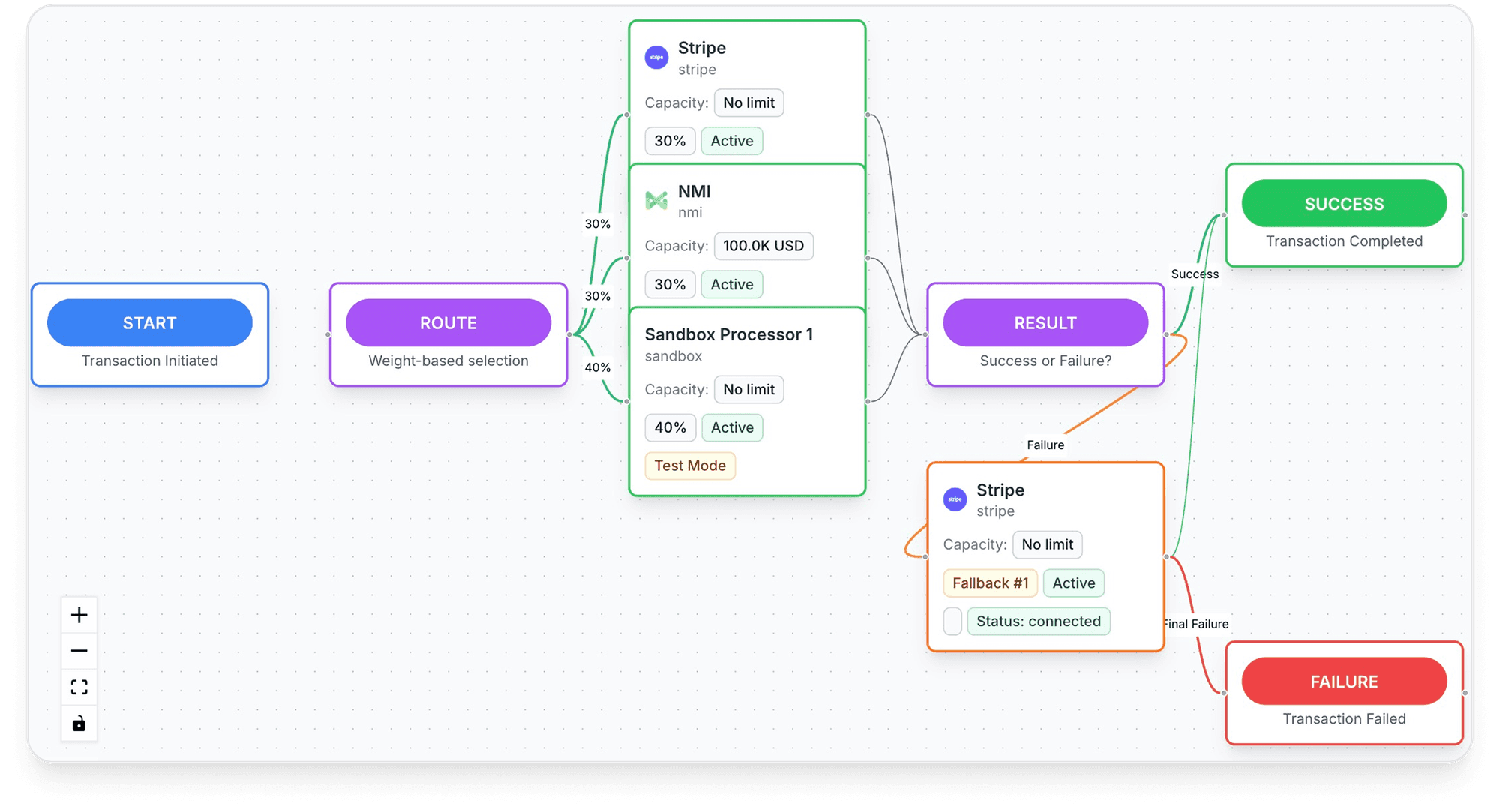
Inside Tagada
See every payment's route, processor by processor
Set the order your processors are tried in, per store, per country or per product.
What the checkout has to show
Visa's rules spell out the disclosure for each channel. For an online store, it's two places, in at least 10-point Arial and never smaller or less visible than the text around it: the first page that lists the card brands you accept, and the checkout page.1Visa Core Rules and Visa Product and Service Rules, April 18, 2026
Fig. 1A compliant surcharge line
- Order
- $100.00
- Credit card surcharge
- 2.4% · $2.40
- Notice
- We add 2.4% on credit cards. Not applied to debit cards. Not greater than our cost of accepting Visa credit cards.
- Total
- $102.40
- Option
- Change card or cancel without paying
Illustrative record.
Disclose, then let them cancel
The checkout notice must include three things: the exact amount or rate, a statement that the surcharge is charged by you and only applies to credit cards, and, in the US, a statement that it isn't greater than your discount rate on Visa credit cards. For online, phone and mail orders, the customer must be able to cancel after seeing the surcharge.1Visa Core Rules and Visa Product and Service Rules, April 18, 2026 In the transaction data, the surcharge is identified as such, and on the receipt it appears on its own line.
Where surcharges are banned or restricted
The network rules are a ceiling, not a permission. Local law can be stricter, and only the states below were checked against their official text for this article. Others have their own caps or notice rules: check yours before you switch the fee on.
| Where | Credit card surcharge | What the law says |
|---|---|---|
| Connecticut | Prohibited | Any fee that raises the total because of the payment method is banned. A cash discount from the posted price is allowed. A "non-cash adjustment" on the receipt often signals an illegal surcharge6Connecticut Department of Consumer Protection, Credit card surcharge |
| Massachusetts | Prohibited | "No seller" may surcharge a customer who pays by credit card instead of cash or check. A cash discount is allowed if offered to all buyers and clearly disclosed5Massachusetts General Laws, chapter 140D, section 28A |
| Maine | Prohibited | Sellers can't surcharge credit or debit cards. Discounts are not surcharges. Government bodies have an exception7Maine Revised Statutes, Title 9-A, section 8-509 |
| New York | Restricted | Since February 11, 2024: post the highest total price including the surcharge, no more than what the card company charges you, and no separate processing or service fee line on the receipt8Erie County Consumer Protection, NYS General Business Law §518 changes, February 11, 2024 |
| Rest of the US | Allowed | Within Visa and Mastercard rules, unless your state sets its own cap, notice or ban |
| European Union | Prohibited | Consumer debit and credit cards, SEPA transfers and direct debits: no charge at all. Other methods: no more than your direct cost, and each country can go further3Directive (EU) 2015/2366 (PSD2), Article 62 |
| United Kingdom | Prohibited | Consumer cards and other consumer payment methods: no fee when both payment providers are in the UK. Any other fee: no more than your cost4The Consumer Rights (Payment Surcharges) Regulations 2012, regulations 4, 6A and 6B |
| Canada | Restricted | Visa credit cards only, with 30 days' notice, capped at your cost and at 1% plus Visa's average credit interchange in Canada1Visa Core Rules and Visa Product and Service Rules, April 18, 2026 |
| Other countries | Restricted | Visa forbids adding any amount to the normal price unless local law expressly says merchants must be allowed to surcharge. Australia and New Zealand have their own rules1Visa Core Rules and Visa Product and Service Rules, April 18, 2026 |
Selling online into several states
The state lists above don't say which law applies when a store in one state ships to a customer in another. Many merchants turn the surcharge off for addresses in the strict states. Ask counsel for your setup.
The EU ban in detail
Article 62 of the Payment Services Directive works in layers. Your payment provider can't stop you from charging, offering a discount or steering customers to a payment method, but any charge stays below your direct cost (62(3)). Member states must ban charges on cards whose interchange is capped by the Interchange Fee Regulation, which means consumer debit and credit cards, and on SEPA credit transfers and direct debits (62(4)). And each country may ban or limit the rest (62(5)).3Directive (EU) 2015/2366 (PSD2), Article 62 What's left is mostly commercial cards. Visa adds that in Europe, the customer must be told the amount and agree to it before the payment.1Visa Core Rules and Visa Product and Service Rules, April 18, 2026
The UK ban in detail
Since January 13, 2018, a payee must not charge any fee for consumer cards, other consumer payment methods, or euro SEPA payments (regulation 6A). The ban applies when both your payment provider and the customer's are in the UK. If only one is, the fee is allowed but can't exceed your cost.4The Consumer Rights (Payment Surcharges) Regulations 2012, regulations 4, 6A and 6B A UK store taking a card issued abroad, through a UK acquirer, falls in that second case.
What happens if you get it wrong
- A debit or prepaid card is surchargedThe customer's bank can file a Visa compliance case for the surchargeDetect the card type before showing the fee
- The rate is above your costSame compliance case, for the surcharge amountRecalculate from your last 1 or 12 months of statements
- No line on the receipt or no notice at checkoutA compliance case, even if the rate is rightShow the rate before payment and on the receipt
- Refund issued without the surchargeThe customer's bank can recover itRefund the surcharge with the order, pro rata if partial
- A customer in a ban state is surchargedState enforcement, on top of network rulesTurn the fee off for those addresses
Visa lets the customer's bank open a compliance case when a surcharge is too high, charged where it isn't allowed, charged by a third party, not disclosed, missing from the receipt, not refunded, or combined with a convenience or service fee. The bank recovers the surcharge amount and credits the customer.1Visa Core Rules and Visa Product and Service Rules, April 18, 2026 A compliance case is a dispute: see what chargeback fees cost when you contest one.
Should you surcharge?
Why it can make sense
- You recover the cost of the most expensive cards without raising every price.
- It works best with large orders and B2B invoices, where buyers are used to itemized costs.
- Customers who don't want to pay it can choose debit or bank transfer.
What it costs you
- A new line at the last step of checkout, where buyers leave.
- Setup: card type detection, notice, receipts, refunds, state rules.
- Not usable in the EU, the UK or several US states, so two checkouts to run.
There are other ways to deal with card costs. Build them into your prices and offer a discount for cheaper methods, which Visa explicitly allows in the US.1Visa Core Rules and Visa Product and Service Rules, April 18, 2026 Or lower the cost itself: route payments to the processor that costs you less for each card type and country, and push lower-cost methods like ACH for large orders.
The rules may move. Visa and Mastercard's settlement with US merchants has preliminary court approval and awaits final approval. According to Visa, it would give merchants more options to surcharge, including when they don't surcharge other credit networks, and let them choose whether to accept commercial, premium and standard credit cards.9Visa, Merchant surcharging considerations and requirements (US) Until it's final, the April 2026 rules above apply.
How Tagada helps
Payments that follow the card network rules
Tagada follows Visa and Mastercard rules and the laws that apply to payments. TagadaPay runs native 3DS2, device intelligence and a rules engine, and payments route across Stripe, Adyen and TagadaPay with one logic. See pricing for plans.
Frequently asked questions
Is it legal to charge a credit card surcharge?
Can you charge a surcharge on debit cards?
How much can a merchant surcharge?
What is the difference between a surcharge and a convenience fee?
Do you have to refund the surcharge when you refund an order?
Can I surcharge customers in Europe or the UK?
Sources
Checked October 14, 2026- Visa Core Rules and Visa Product and Service Rules, April 18, 2026
- Mastercard, Merchant surcharge rules (US)
- Directive (EU) 2015/2366 (PSD2), Article 62
- The Consumer Rights (Payment Surcharges) Regulations 2012, regulations 4, 6A and 6B
- Massachusetts General Laws, chapter 140D, section 28A
- Connecticut Department of Consumer Protection, Credit card surcharge
- Maine Revised Statutes, Title 9-A, section 8-509
- Erie County Consumer Protection, NYS General Business Law §518 changes, February 11, 2024
- Visa, Merchant surcharging considerations and requirements (US)
- Visa, Statement on preliminary approval of the MDL settlement
TagadaPay
Selling across several processors? Run them from one checkout
Tell us what you sell and how you sell it. Each application is underwritten, and approval is not guaranteed.
- 01Tell us what you sell and how
- 02Underwriting reviews your business
- 03Process through TagadaPay alongside your other processors