
Credit Card Interchange Fees: Who Sets Them and What You Pay
Visa's April 2026 interchange rates, what makes them rise online, the US debit cap and EU caps, and the legitimate ways to pay less on every card sale.

Article summary
TL;DR
An interchange fee is the share of each card sale that goes to the customer's bank. Visa and Mastercard set the rates; your processor takes them out before you're paid. On Visa's April 2026 US table, a $100 online sale on a basic consumer credit card carries $1.99 of interchange, and $2.70 on a top-tier rewards card.
- Card networks set interchange, the card issuer receives it, and your processor passes it on to you inside your fees.
- Online sales cost more than in-store sales: 1.89% + $0.10 against 1.51% + $0.10 on a basic Visa credit card.
- In the US, debit from banks above $10 billion in assets is capped at 21 cents + 0.05%, plus 1 cent for fraud prevention. Credit has no federal cap.
- In the EU, consumer cards are capped at 0.2% for debit and 0.3% for credit. Commercial cards and Amex-style schemes are outside the caps.
- You can't negotiate interchange, but you can qualify for lower rates: recurring flags, network tokens, Level 3 data on business cards, and the right MCC.
 ChatGPT
 Claude
 Perplexity
 Grok
On this page
Every time a customer pays by card, part of the sale goes to their bank. That part is interchange, and it's usually the biggest line in your processing costs. Here are the 2026 rates from Visa's own table, what makes them move, the rules in the US and the EU, and the levers that legitimately lower them.
What is an interchange fee?
An interchange fee is a fee paid on each card transaction by the merchant's bank (the acquirer) to the cardholder's bank (the issuer). Visa calls it a transfer fee between financial institutions, used "to balance and grow the payment system."2Visa, Regulations and fees for small business The European Commission describes the same flow: the acquiring bank pays the fee to the issuing bank, then passes it on to the retailer, who includes it in prices like any other cost.4European Commission, Commission accepts commitments by Mastercard and Visa to cut inter-regional interchange fees, April 29, 2019
Fig. 1Where a card sale's fees go
- Card issuerReceives interchange: the customer's bank
 Card networkSets the interchange table, charges its own scheme fees
 Acquirer and processorPay interchange, add their markup, bill you
 YouReceive the sale minus all of the above
interchange is the biggest slice
Technically, you never pay interchange yourself. You pay your processor, and interchange is inside that price.
Merchants do not pay interchange reimbursement fees; merchants pay "merchant discount" to their financial institution.
That merchant discount, often called the merchant discount rate, has three parts: interchange to the issuer, scheme fees (or assessment fees) to the network, and your processor's markup. Interchange is the part nobody on your side of the deal sets. For a view of every fee on a payment, from gateway to currency conversion, see what a transaction fee is.
How much are credit card interchange fees in 2026?
Visa revises its US table periodically. The current one took effect on April 18, 2026.1Visa, Visa USA Interchange Reimbursement Fees, April 18, 2026 Here is what a $100 online purchase costs in interchange, depending on the card the customer uses.
| Card used for a $100 online sale | Visa program | Rate | Interchange |
|---|---|---|---|
| Regulated debit (large US bank) | Any | 0.05% + $0.21, + $0.01 | $0.27 |
| Debit from a small bank (exempt) | CPS/e-Commerce Basic, Debit | 1.65% + $0.15 | $1.80 |
| Basic consumer credit | Product 1, All Other Products | 1.89% + $0.10 | $1.99 |
| Rewards credit | Product 1, Traditional Rewards | 2.04% + $0.10 | $2.14 |
| Premium credit (Visa Signature Preferred) | Product 1 | 2.50% + $0.10 | $2.60 |
| Top-tier credit (Visa Infinite, spend qualified) | Product 1 | 2.60% + $0.10 | $2.70 |
| Business credit (Tier V) | Business Product 1 | 3.00% + $0.10 | $3.10 |
| Any consumer credit card, requirements missed | Non-Qualified Consumer Credit | 3.15% + $0.10 | $3.25 |
Verdict
The same $100 sale can cost 27 cents or $3.25 in interchange. The card in your customer's wallet decides most of the gap; the way you submit the payment decides the rest.
Each row comes from Visa's table.1Visa, Visa USA Interchange Reimbursement Fees, April 18, 2026 The extra cent on regulated debit goes to issuers that certify they meet the Fed's fraud-prevention standards. Mastercard publishes its own US table, with its own programs and rates: these figures are Visa's only. American Express sets its own merchant pricing, outside this system.
What makes interchange go up or down
Visa's table has dozens of programs. They come down to six questions, and you control the answer to four of them.
- Card type: debit, credit, rewards, premium, businessRewards and business cards cost the most; regulated debit the leastNothing, it's the customer's card
- Card present or not presentOnline and phone sales pay more for the fraud riskUse network tokens and authentication to earn online discounts
- Your merchant category (MCC)Charities, utilities and government have their own, lower programsMake sure your MCC matches what you actually sell
- Payment type: one-time or recurringRecurring payments flagged as such get a lower programSend the right recurring and stored-card indicators
- Data sent with the paymentMissing data drops the sale to a non-qualified rate; Level 3 data cuts business card ratesSend the data your processor asks for, and line items on business cards
- Where the card was issuedEU caps, US debit caps and cross-border tables all differNothing, but know which rules apply to your sales
Card present against card not present
The gap shows up on every card type. Here is Visa's in-store "Product 2" program against its online "Product 1" program, for the same cards (both plus $0.10).1Visa, Visa USA Interchange Reimbursement Fees, April 18, 2026
Fig. 2In store vs online, Visa consumer credit
In store (Product 2)Online (Product 1)
- Basic
- Traditional Rewards
- Signature Preferred
- Infinite, spend qualified
online always costs more
Visa takes part of that gap back for online sales that carry more security. A card-not-present sale paid with an EMV token gets 0.05 points off, a sale under Visa's Digital Commerce Authentication Program (DCAP) gets 0.10 points off, and both together get 0.15 points off. The discount only applies when the sale qualifies for Visa's CPS programs in the first place.1Visa, Visa USA Interchange Reimbursement Fees, April 18, 2026 See tokenization for how network tokens work.
Your MCC picks the program
Your merchant category code tells the network what you sell, and some categories have their own programs. On the same basic Visa credit card, online:1Visa, Visa USA Interchange Reimbursement Fees, April 18, 2026
| Visa online program (All Other Products) | Rate |
|---|---|
| Charity 1 | 1.35% + $0.05 |
| Recurring | 1.53% + $0.05 |
| Government 1 | 1.55% + $0.10 |
| Services 1 (sales of $100 or more) | 1.65% + $0.10 |
| Travel 1 | 1.75% + $0.10 |
| Product 1 (general online retail) | 1.89% + $0.10 |
| Restaurant 1 | 2.20% (min. $0.08) |
The MCC isn't yours to choose for the price. Visa requires it to describe your main business, and a high-risk line of business needs its own MCC, separate from the rest.11Visa, Merchant Data Standards Manual, April 2026 Picking a cheaper code than the one that fits is a misclassification, and Visa can require a correction. To check yours, see how to find your MCC code on Stripe, Adyen and Shopify.
Level 2 and Level 3 data on business cards
Business, corporate and purchasing cards carry the highest interchange. They are also the only cards where sending more data lowers the rate. Level 2 data adds the sales tax; Level 3 adds the invoice's line items (see Level 2 and Level 3 processing).
Visa replaced its Level 3 program with the Commercial Enhanced Data Program (CEDP). The new rate is called "Product 3."9PayPal Business Resource Center, Visa's Commercial Enhanced Data Program, February 17, 2026
- April 2025CEDP launches, with a 5 bps fee on flagged sales Visa reviews
- October 2025Product 3 rates replace Commercial Level III
- January 24, 2026Higher small business credit rates
- April 2026Level 2 interchange incentives end
| Visa commercial program (April 2026) | Rate |
|---|---|
| Commercial Card Not Present (no enhanced data) | 2.70% + $0.10 |
| Commercial Product 3 (Level 3 data, verified) | 1.75% + $0.10 |
| Commercial Product Large Ticket | 1.30% + $35.00 |
| Non-Qualified | 2.95% + $0.10 |
On a $1,000 purchasing card order, that's $27.10 without enhanced data against $17.60 with it.1Visa, Visa USA Interchange Reimbursement Fees, April 18, 2026 Visa checks the data 10 to 15 days after settlement and applies the lower rate only if it passes. Airlines, hotels, car rental, restaurants and cruise lines are excluded.9PayPal Business Resource Center, Visa's Commercial Enhanced Data Program, February 17, 2026 If you sell to businesses, ask your processor whether it sends CEDP data for you.
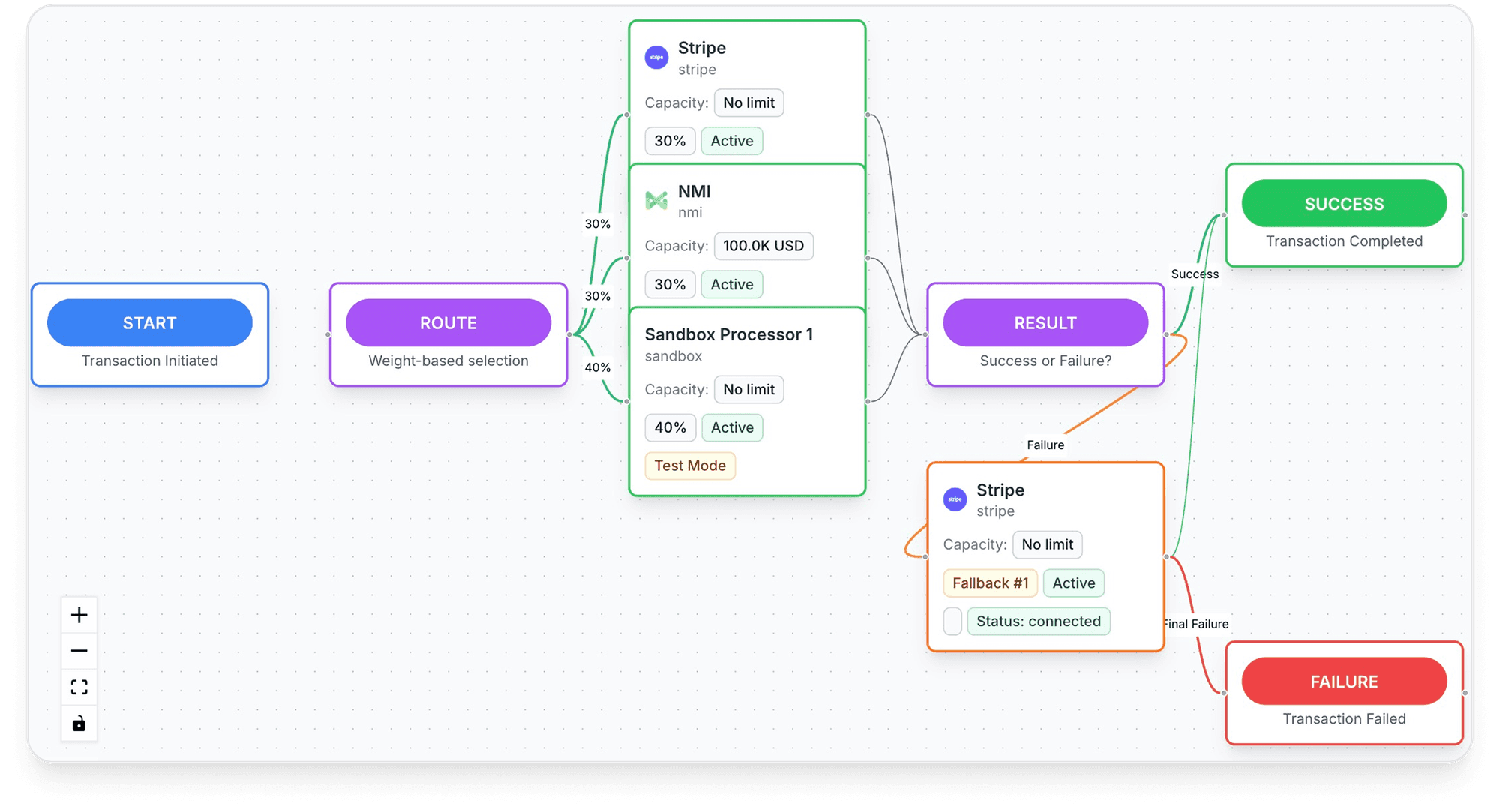
Inside Tagada
See every payment's route, processor by processor
Set the order your processors are tried in, per store, per country or per product.
Debit interchange: the US cap (Regulation II)
US debit cards from large banks are the one place where interchange is capped by law. The Durbin Amendment led to the Federal Reserve's Regulation II (see Durbin Amendment).
21¢ + 0.05%
Maximum interchange on a debit card from a covered bank, per transaction
+1¢
Fraud-prevention adjustment, for issuers that meet the Fed's standards
$10 billion
Bank assets below which issuers are exempt from the cap
The cap applies to issuers with $10 billion or more in assets. Smaller banks and credit unions are exempt.5Federal Reserve, Regulation II: average debit card interchange fee by payment card network (updated December 19, 2025) The Fed's own data shows the effect: in 2024, the average interchange on a covered debit transaction was $0.23 (0.47% of the average sale), against $0.51 (1.21%) on an exempt one.5Federal Reserve, Regulation II: average debit card interchange fee by payment card network (updated December 19, 2025)
In November 2023, the Fed proposed lowering the cap to 14.4 cents + 0.04%, with a 1.3-cent fraud adjustment, and updating it every two years.6Federal Register, Debit Card Interchange Fees and Routing, proposed rule, November 14, 2023 The Fed's data page, last updated in December 2025, still states the 21-cent standard.5Federal Reserve, Regulation II: average debit card interchange fee by payment card network (updated December 19, 2025) Credit cards have no federal cap.
Interchange in the EU and the US
Europe caps consumer card interchange by regulation. The US caps only large-bank debit. Here is how the rules compare.
| Rule | European Union | United States |
|---|---|---|
| Consumer credit cards | Capped at 0.3% of the sale | Uncapped; Visa's online rates run from 1.89% to 2.60% + $0.10 |
| Consumer debit cards | Capped at 0.2% (member states can go lower for domestic payments) | 21¢ + 0.05% + 1¢ for banks above $10 billion; uncapped below |
| Commercial cards | Not covered by the caps | Credit uncapped; business debit from large banks falls under the debit cap |
| Three-party schemes (Amex-style) | Not covered, unless they license other banks | Credit uncapped, whatever the network |
| Per-card breakdown on your statement | Required: interchange shown separately, unless you agree in writing to blended pricing | Depends on your contract |
The EU caps come from Regulation 2015/751 and have applied since December 9, 2015.3Regulation (EU) 2015/751 on interchange fees for card-based payment transactions For cards issued outside Europe and used at European merchants, Visa and Mastercard committed in 2019 to cap online interchange at 1.15% for debit and 1.50% for credit, for five years and six months.4European Commission, Commission accepts commitments by Mastercard and Visa to cut inter-regional interchange fees, April 29, 2019 Check with your acquirer which inter-regional rates apply today.
Cards issued abroad also cost more in the US. Visa's international table charges a base of 1.10% on a Classic card and 1.85% on a Signature card used at a US merchant, rising to 1.65% and 1.90% when the sale is downgraded.1Visa, Visa USA Interchange Reimbursement Fees, April 18, 2026
Why the US caps only debit
The Durbin Amendment, and the Fed's Regulation II that came from it, cover debit cards only. For credit cards, the change most likely to land first is the merchant settlement below, not a law.
The Visa and Mastercard settlement (2025-2026)
On November 10, 2025, Visa announced a proposed settlement with the injunctive relief class of US merchants, the group seeking changes to network rules rather than damages.7Visa Inc., Form 8-K, November 10, 2025 What it would change:
10 bps less
The combined average effective US credit interchange rate goes down by 10 basis points, for five years.
Capped tables
Posted US credit interchange rates are capped for five years.
1.25% for standard cards
Standard US consumer credit rates are capped at 125 bps through the term of the agreement.
More choice at checkout
Merchants can choose to accept commercial, premium consumer and standard consumer credit cards separately, and get more room to surcharge.
The settlement is subject to court approval.7Visa Inc., Form 8-K, November 10, 2025 On June 9, 2026, Payments Dive reported that the judge in the Eastern District of New York had granted preliminary approval, and that a merchant group planned to appeal if final approval is granted.8Payments Dive, Court approves Visa, Mastercard settlement, June 9, 2026 Nothing in Visa's April 2026 table reflects it yet. The 1.25% cap covers standard consumer cards, not premium ones. If you plan to surcharge, read our guide to surcharges first; Visa requires you to notify your acquirer 30 days before you start.2Visa, Regulations and fees for small business
How interchange shows up in your pricing
Your processor bills interchange in one of two ways. Stripe describes both in its pricing policy.10Stripe, Pricing policy (last modified October 12, 2026)
| Flat-rate (blended) | Interchange-plus (IC+) | |
|---|---|---|
| What you pay | One agreed fee per transaction | The actual interchange and scheme fees, plus a fixed markup |
| When a customer pays with debit | Same fee | You pay less |
| When a customer pays with a premium or business card | Same fee | You pay more |
| What you can see | The total only | Every component, per transaction |
| Best for | Small volume, simple setups | Steady volume, mixed card base, merchants who want to optimize |
Under a blended model, Stripe says you pay the agreed fee "regardless of the underlying differences in Network Costs." Under IC+, it passes those costs to you and "adds a Stripe fee (markup)."10Stripe, Pricing policy (last modified October 12, 2026) See flat-rate pricing and interchange-plus pricing for both models in detail.
- Interchange (Product 1)
- 2.04% + $0.10 = $2.14
- Scheme fees
- Network costs, passed through
- Processor markup
- Fixed by your contract
- You receive
- $100 minus the three lines
Illustrative example. Scheme fees and markup depend on your contract.
In the EU, you have a right to this breakdown. Acquirers must quote and charge separately by card category and brand, unless you ask in writing for a blended rate, and must show the interchange of each transaction on your statements.3Regulation (EU) 2015/751 on interchange fees for card-based payment transactions
Practical rule
With a flat rate, interchange savings stay with your processor. Every lever below pays off only if you're on IC+, or if you use the data to renegotiate your flat rate.
How to lower interchange fees legitimately
You can't negotiate the table. You can make sure each sale lands in the cheapest program it qualifies for.
- Flag recurring payments. A subscription renewal on a rewards card costs 1.53% + $0.05 in Visa's Recurring program against 2.04% + $0.10 as a one-time online sale. That's $1.58 against $2.14 on $100. The renewal must carry the recurring indicator from your processor.
- Use network tokens and authentication. EMV tokens, DCAP, or both take 0.05, 0.10 or 0.15 points off qualifying online sales.
- Avoid downgrades. A sale that misses Visa's qualification requirements falls to Non-Qualified Consumer Credit, at 3.15% + $0.10. The requirements are in Visa's rate qualification guide; ask your processor for a report of downgraded sales.
- Send Level 3 data on business cards. It takes a Visa purchasing card sale from 2.70% to 1.75% + $0.10, once Visa verifies the data.
- Check your MCC. If your code is wrong, you may miss a program you qualify for. If it's wrong in your favor, expect it to be corrected.
- Know the small merchant rates. Merchants with up to $280,000 a year in Visa consumer credit sales get their own programs: 1.58% + $0.10 online on a basic card, instead of 1.89% + $0.10.
Rates: Visa USA Interchange Reimbursement Fees, April 18, 2026. Ask your processor which indicators and data it sends for you.
Two levers sit outside interchange but cut the same bill: pricing (IC+ against flat-rate, above) and debit mix. A customer paying with regulated debit costs you 27 cents of interchange on $100, against about $2 on credit.
Disputes matter too. Visa's cheapest retail tiers require, among other criteria, a dispute ratio of no more than 0.020% of transactions, and huge volumes: 19.2 million transactions a year for the entry tier.1Visa, Visa USA Interchange Reimbursement Fees, April 18, 2026 Few ecommerce brands get there, but disputes cost you on every other line. See chargeback fees for what each dispute costs at each processor.
Surcharging isn't a fix
Passing the fee to customers moves the cost, it doesn't lower it, and it can cost conversions. In the US, it comes with network notice rules and state laws. Fix how your transactions qualify first.
How Tagada helps
Payments that follow the card network rules
Tagada follows Visa and Mastercard rules and the laws that apply to payments. TagadaPay runs native 3DS2, device intelligence and a rules engine, and payments route across Stripe, Adyen and TagadaPay with one logic. See pricing for plans.
Frequently asked questions
What is the interchange fee on a credit card?
Who sets interchange fees and who gets the money?
Are interchange fees negotiable?
Why are interchange fees higher for online payments?
Are credit card interchange fees capped in the US?
What is the difference between interchange and the merchant discount rate?
Sources
Checked October 14, 2026- Visa, Visa USA Interchange Reimbursement Fees, April 18, 2026
- Visa, Regulations and fees for small business
- Regulation (EU) 2015/751 on interchange fees for card-based payment transactions
- European Commission, Commission accepts commitments by Mastercard and Visa to cut inter-regional interchange fees, April 29, 2019
- Federal Reserve, Regulation II: average debit card interchange fee by payment card network (updated December 19, 2025)
- Federal Register, Debit Card Interchange Fees and Routing, proposed rule, November 14, 2023
- Visa Inc., Form 8-K, November 10, 2025
- Payments Dive, Court approves Visa, Mastercard settlement, June 9, 2026
- PayPal Business Resource Center, Visa's Commercial Enhanced Data Program, February 17, 2026
- Stripe, Pricing policy (last modified October 12, 2026)
- Visa, Merchant Data Standards Manual, April 2026
TagadaPay
Selling across several processors? Run them from one checkout
Tell us what you sell and how you sell it. Each application is underwritten, and approval is not guaranteed.
- 01Tell us what you sell and how
- 02Underwriting reviews your business
- 03Process through TagadaPay alongside your other processors