

The most popular payment advice is usually wrong. Changing the button colour, removing a form field, or polishing the checkout animation can help, but none of those changes can approve a transaction that reaches the wrong processor, triggers an unsuitable fraud rule, or fails to recover from a recoverable decline.
A payment experience is the full revenue path, from payment-method selection and authorization through confirmation, rebilling, dunning, refunds, and disputes. The checkout is only the visible layer. The less visible routing and recovery decisions often determine whether a ready-to-buy customer becomes revenue or an abandoned session.
Redefining the Payment Experience Beyond the Checkout UI
A polished checkout can't rescue a weak payment operation. If the issuer rejects an authorization because the request lacks the required authentication result, or if a merchant sends every market and transaction type through one poorly matched processor, the customer experiences the outcome as a failed payment. They don't care whether the interface looked modern.
The scale makes this distinction commercially important. Baymard Institute's meta-analysis of 49 studies places average cart abandonment at about 70.2%, or roughly 7 in 10 shoppers who begin checkout, with an estimated $260 billion in recoverable annual ecommerce revenue across the U.S. and EU alone, according to this summary of online payment statistics. Payment method availability and checkout complexity are direct contributors, not cosmetic details.
A 2025 ecommerce payments survey found that 45% of customers won't retry a declined payment, 61% abandoned a cart because their preferred payment option wasn't available, and one in six left because of hidden fees and surcharges. Those behaviours show why a merchant should treat payment reliability as part of conversion design, while using data-driven checkout optimization to test the customer-facing layer with evidence rather than instinct.
The experience continues after payment
The transaction lifecycle includes several operational moments:
- Authorization: The processor and issuer decide whether the payment can proceed.
- Authentication: The merchant handles required or risk-triggered customer verification.
- Capture and confirmation: The customer needs a clear, timely outcome and the merchant needs a reliable order state.
- Rebilling: Subscription merchants must update expired credentials, manage retries, and communicate before a failed renewal becomes churn.
- Disputes and refunds: Clear receipts, cancellation records, and fulfilment evidence help prevent avoidable disputes.
A unified commerce architecture can connect those events with storefront, order, and customer data. A unified commerce solution is useful to evaluate here because fragmented systems often leave marketing, support, finance, and payments working from different versions of the same transaction.
Practical rule: Optimize the point where a payment fails, not only the point where a customer clicks.
The strongest payment experience reduces unnecessary friction in the interface, but it also gives each transaction an appropriate route, a compliant recovery path, and a useful post-purchase message. That is where payment processing becomes a growth function rather than a back-office utility.
Key Metrics That Diagnose Payment Health
A single checkout conversion rate can't tell a payments team what broke. You need to separate customer intent, processor performance, issuer behaviour, fraud decisions, latency, and recovery. Otherwise, teams end up redesigning a form to solve a routing problem.
Start with authorization, not approval theatre
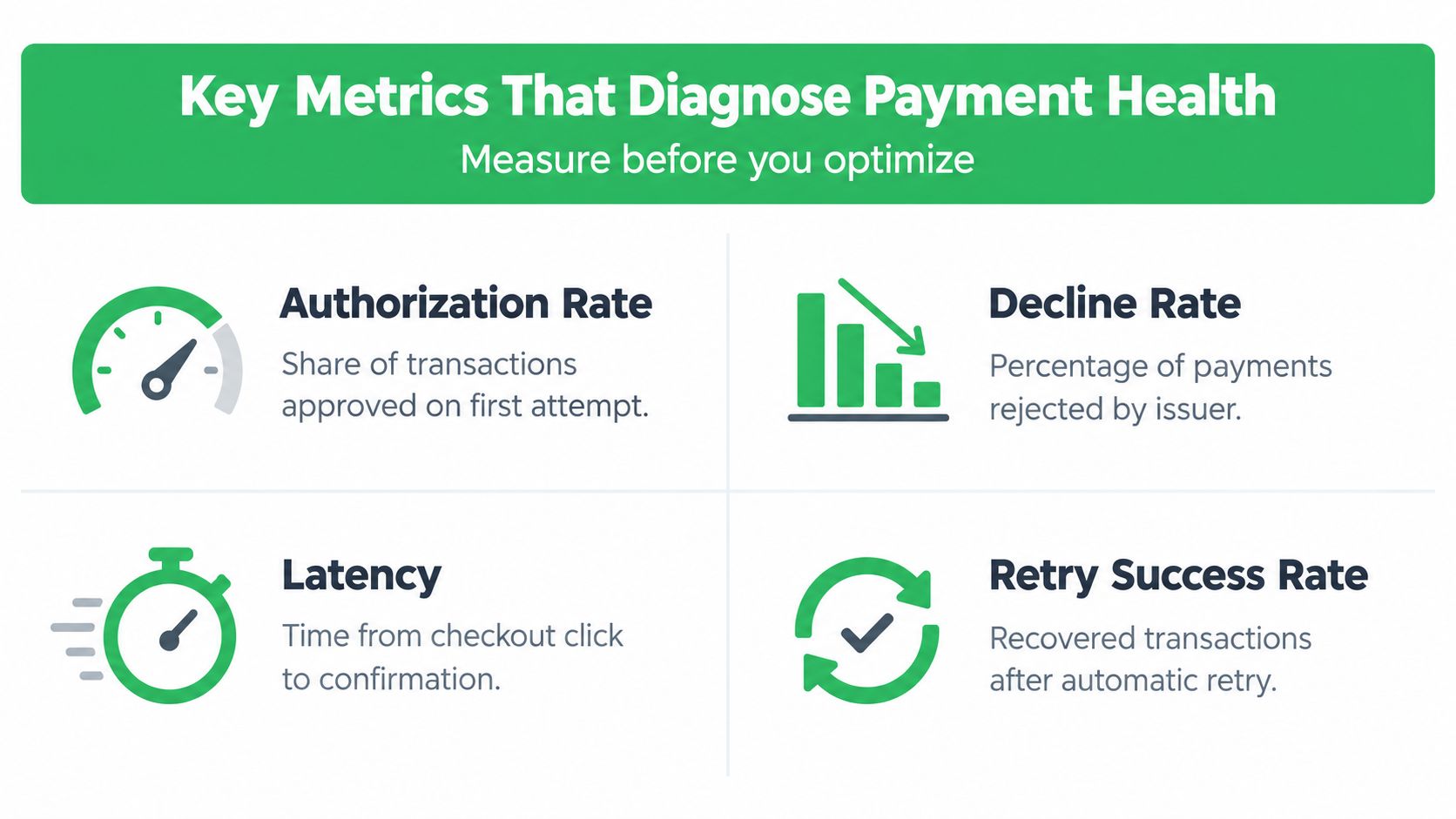
An authorization rate measures approved transactions divided by total attempted transactions. It becomes meaningful only when you segment it by processor, country, payment method, issuer response, device, product, and customer type. A blended rate can hide a weak route behind a strong one.
For subscription businesses, an industry guide identifies 90% or higher as the authorization benchmark to watch. The same guide suggests monitoring soft declines below 3% and hard declines below 2% to distinguish potentially recoverable losses from terminal failures, as described in this payment analytics guide.
The practical interpretation is more important than the threshold:
- A soft decline may indicate authentication, timing, issuer communication, or retry issues. The payment can often be recovered if the next action matches the failure reason.
- A hard decline generally requires a different instrument, customer intervention, or a decision not to retry. Repeating the same request can increase noise without improving approval.
- Latency exposes delays between the customer's payment action and confirmation. Track it by route and payment method, because a fast card flow doesn't prove that wallet or alternative-method flows are healthy.
- Retry success rate shows whether your recovery logic creates revenue or merely creates additional authorization attempts.
Build a decline taxonomy
Your dashboard should preserve the original processor response, the issuer category, authentication status, fraud decision, retry attempt, and final order outcome. Use that data to answer operational questions: Which declines are recoverable? Which processor performs better for a given market? Which retry timing works for a rebill? Where does a customer see an ambiguous error?
Chargebacks belong in the same operating view. They don't only represent lost money. They can reveal unclear recurring terms, weak customer communication, fulfilment gaps, or a fraud policy that accepts the wrong transactions.
For a broader definition of acceptance rate and its role in payments reporting, see this guide to what acceptance rate means. The objective isn't to chase a flattering number. It's to connect each failed payment to an action that has a reasonable chance of recovery.
Optimizing Authorization with Multi-PSP Routing and Smart Retries
A single PSP can be reliable and still be the wrong architecture for a growing merchant. Processors differ in acquiring relationships, geographic coverage, risk tolerance, local-method support, outage exposure, and how they interpret the same transaction signals. Sending every payment through one route removes your ability to compare or recover.
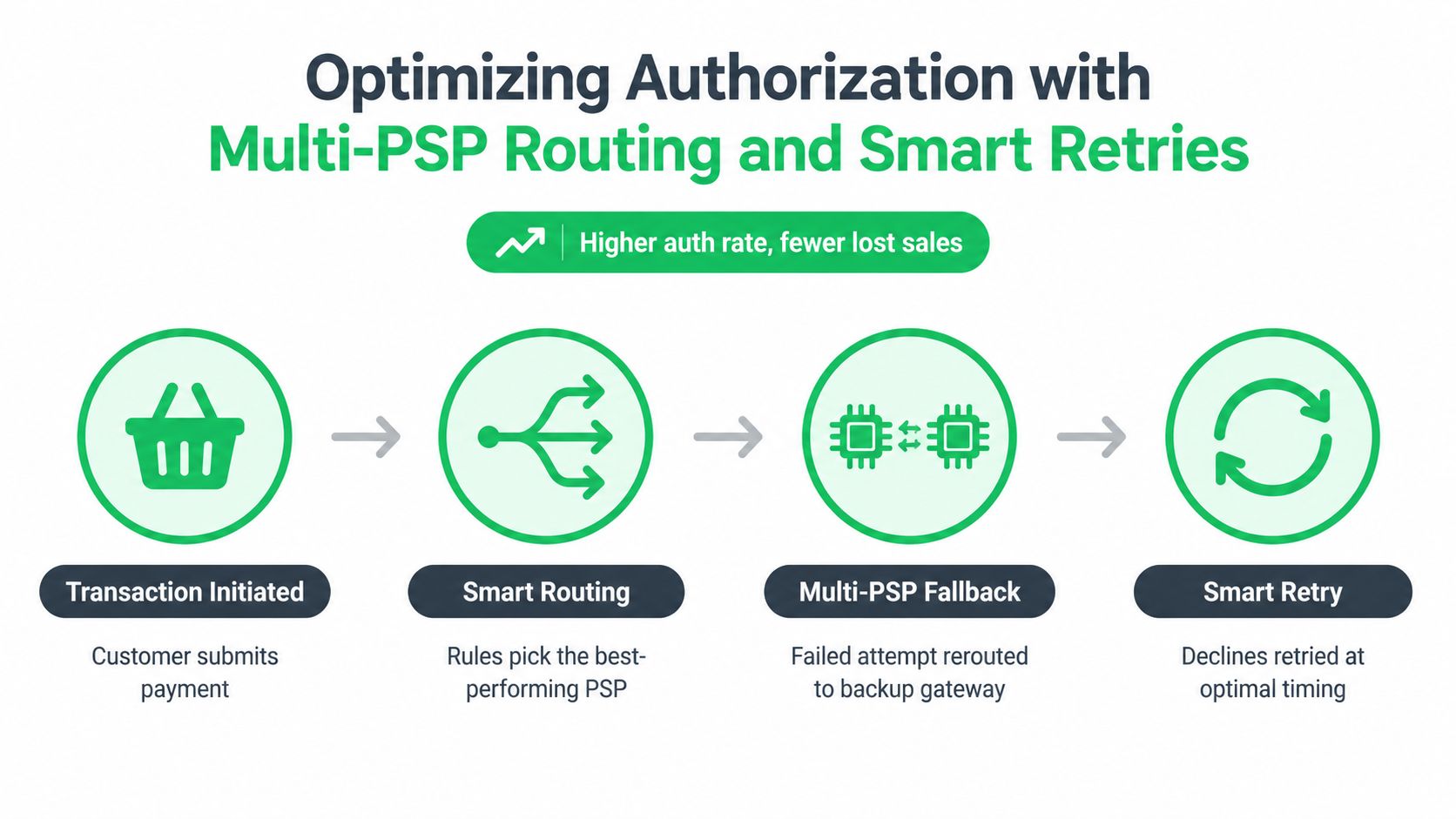
Multi-PSP routing starts with a decision layer before authorization. The orchestration service evaluates transaction attributes and selects a route based on rules such as market, currency, payment method, product category, issuer geography, risk result, and processor availability. The merchant then measures the outcome by route, not merely by total volume.
Route by evidence
A workable routing sequence looks like this:
- Classify the transaction. Identify the buyer's market, payment method, currency, order value, subscription status, and risk context.
- Select the primary PSP. Choose the processor with the strongest observed performance for that combination, while respecting compliance and commercial constraints.
- Record the complete response. Store the processor, response code, authentication state, latency, and order status.
- Apply an eligible fallback. Reroute only when the failure is potentially recoverable or the primary route is unavailable. Don't cascade every hard decline across every processor.
- Reconcile the final state. Make sure the order, payment, fulfilment, and customer message agree on whether the transaction succeeded.
The distinction between a fallback and a blind retry matters. A duplicate authorization can create customer confusion, operational reconciliation problems, or unnecessary issuer scrutiny. Idempotency controls and clear payment states should sit underneath every cascade design.
Handle SCA soft declines correctly
In the EEA and UK, an authorization submitted without prior authentication can receive an SCA-related soft decline, such as code 20154. The correct recovery sequence is not to resend the same authorization. The merchant should authenticate the cardholder with EMV 3DS, then submit a fresh authorization carrying the 3DS result, as explained in the SCA retry documentation.
That sequence preserves the issuer's expected context. A retry engine that only changes the processor or waits before resubmitting misses the underlying requirement. The customer may see repeated failures even though the merchant technically attempted recovery.
Routing principle: A retry should change the condition that caused the failure. If nothing meaningful changes, it isn't recovery logic.
Watch the accompanying walkthrough for a practical view of payment orchestration and recovery flows.
<iframe width="100%" style="aspect-ratio: 16 / 9;" src="https://www.youtube.com/embed/jFr0LIzaU6U" frameborder="0" allow="autoplay; encrypted-media" allowfullscreen></iframe>
Smart retries also need timing discipline. A transient processor error, an issuer outage, and an insufficient-funds rebill don't deserve the same schedule. For cards, wallets, and recurring payments, recovery should combine response-code rules, customer messaging, authentication state, and suppression of duplicate attempts. The right design makes the next attempt more informed, not merely more frequent.
For teams evaluating the mechanics in greater depth, dynamic payment routing describes the routing concept from an implementation perspective.
Aligning Local Payment Methods with Buyer Preferences
Payment preference is not universal. A buyer may trust a digital wallet on a mobile device, prefer a bank-based method in one country, and use a card in another. Presenting the same payment menu to every visitor creates avoidable mismatch, particularly when the customer has already chosen how they want to pay before reaching checkout.
Worldpay's 2026 Global Payments Report says digital wallets account for 56% of global ecommerce transaction value and 33% of in-store spending, based on a survey of more than 63,000 consumers across 42 markets. The figures indicate that wallets have moved beyond a secondary convenience option in many markets, as documented in Worldpay's consumer payment findings.
Availability is only the first test
Adding a local method to a checkout doesn't guarantee a better payment experience. The method must load reliably, display the correct currency and amount, return a usable status, and connect to fulfilment and refund workflows. If a buyer completes payment but the order remains pending because the integration doesn't interpret the asynchronous confirmation correctly, the merchant has traded checkout friction for support friction.
A useful method strategy considers:
- Market fit: Show methods that buyers in the target country recognise and actively use.
- Device context: Prioritize wallet options when the device supports them, without hiding a preferred desktop method.
- Commercial economics: Compare authorization performance, processing cost, settlement timing, refund handling, and dispute exposure.
- Operational readiness: Confirm that finance, customer support, fulfilment, and reconciliation can manage each method.
- Fallback clarity: Give the customer a sensible alternative when a method is unavailable, rather than presenting a generic payment error.
Localize the decision, not just the label
A good payment adapter uses geography, currency, device, customer history, and transaction context to present a relevant set of options. It shouldn't expose every possible method and force the customer to make the architecture decision. Too many choices can produce hesitation, while too few can block a willing buyer.
Merchants should also explain fees and timing before the final payment action. Hidden surcharges undermine trust at the exact moment the customer is deciding whether the displayed total is credible. Local methods work best when they feel native from selection through confirmation, including language, amount formatting, redirect behaviour, receipt content, and refund expectations.
The revenue lesson is straightforward. Payment-method coverage is not an international checkbox. It's a route-to-market decision that must be measured against completed payments, support contacts, refunds, and repeat purchase behaviour.
Managing Friction in Subscriptions and High-Risk Industries
A subscription can acquire a customer successfully and still lose the account at the first renewal. The payment experience changes after checkout because the customer may no longer be actively present, the card may have expired, the account balance may be different, or the customer may not remember the billing terms. A rebill failure then looks like churn even when the customer still values the service.
A merchant-risk industry report found that more than 32% of merchants identify subscription billing as a significant chargeback risk factor, while B2C SaaS and services disputes rose 83%, with recurring billing confusion, subscription churn, and first-party fraud identified as related patterns in the merchant risk report.
Make rebilling understandable
Consider a subscription customer whose renewal fails. A weak system just marks the invoice unpaid and sends a generic email. A stronger system identifies the failure category, uses an eligible retry schedule, gives the customer a secure way to update payment details, and explains the product access state without threatening language.
Effective dunning connects payment events to customer communication:
- Before renewal: Remind customers what will be charged and when, especially when the plan, price, or term changes.
- At failure: State whether the issue involves an expired method, authentication, insufficient funds, or another recoverable condition.
- During recovery: Offer a direct update path and avoid repeated messages that don't reflect the latest payment status.
- At cancellation: Confirm the end date, access rules, refund treatment, and any outstanding balance.
A recurring merchant should also make cancellation and plan changes easy to understand. Confusing renewal terms create disputes that a fraud model can't solve. Clear receipts and event-linked messages reduce the gap between what the merchant believes it charged and what the customer believes they agreed to.
Underwrite high-risk economics honestly
High-risk categories, including nutraceuticals, adult content, online gaming, CBD, firearms, travel, digital downloads, software, and subscription billing, may face stricter processor underwriting. A high-risk payment-service overview describes common pricing of 1.5% to 3.5% plus $0.10 to $0.30 per transaction, and rolling reserves of 5% to 10% held for 90 to 180 days, as outlined in this high-risk payment service guide.
Those terms affect cash flow, not just margin. A merchant can have strong demand and positive gross economics while struggling to fund fulfilment because a reserve delays access to settlement. Processor fit should therefore include reserve mechanics, prohibited-product rules, dispute procedures, support quality, and the provider's ability to understand the business model.
High-risk operators need payment experience controls that protect both approval and trust. Transparent billing, documented consent, clear fulfilment evidence, responsive support, and chargeback-aware routing work together. Dunning can't compensate for a misleading descriptor, and a second processor can't fix a product promise that customers don't recognise.
The Role of Orchestration Platforms in Unifying the Stack
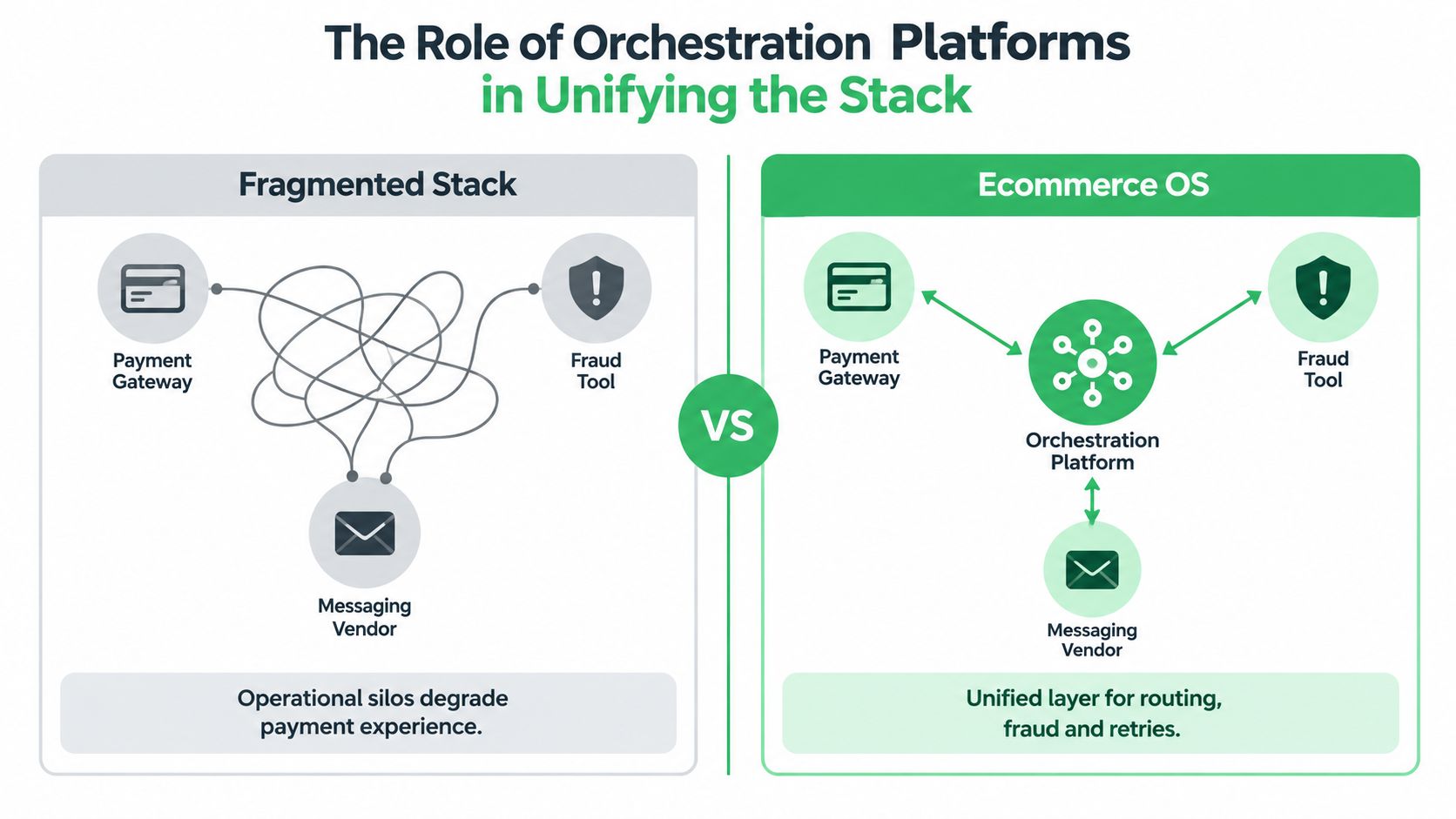
A fragmented payment stack usually grows one integration at a time. A merchant adds a gateway for a new market, a fraud tool for a new risk problem, a messaging vendor for abandoned carts, and another processor after an outage. Each tool may work independently, but the customer and finance team experience the gaps between them.
Fragmented stack versus unified layer
| Fragmented setup | Unified orchestration layer |
|---|---|
| Checkout, payment, fraud, and messaging hold separate event records | A shared transaction event can trigger routing, recovery, and communication |
| Developers maintain processor-specific logic | A common interface abstracts routes while preserving processor detail |
| Marketers infer payment status from delayed order data | Messages can respond to authorization, failure, retry, and settlement events |
| Finance reconciles disconnected reports | Payment performance and order outcomes can be viewed together |
| A decline often ends the flow | Eligible declines can enter a controlled recovery path |
The difference isn't merely fewer dashboards. A unified layer can make the payment experience adaptive. It can choose a processor, apply a fraud decision, initiate a compliant authentication path, retry a recoverable failure, and tell the customer what happened without requiring five teams to coordinate manually.
Build around events and control
An Ecommerce OS architecture should expose payment events to the systems that need them. Server-side tracking helps preserve revenue signals when browser events are incomplete. Headless SDKs let developers embed checkout and payment flows into a custom storefront without rebuilding every processor integration. A Node SDK can support server-side order and payment workflows, while a visual builder can give growth teams control over funnels, offers, and testing without changing core payment logic.
The architecture still needs boundaries. Centralization can create its own risk if a single orchestration layer becomes an opaque dependency. Merchants should demand clear logs, exportable data, idempotency, processor-level visibility, fallback controls, and the ability to test routing rules safely.
Tagada is one example of this model. Its platform combines checkout, payment routing across processors such as Stripe, Adyen, and NMI, native TagadaPay processing, local methods, subscription management, dunning, server-side tracking, and payment-triggered messaging in an orchestration layer. The right choice depends on transaction mix, technical ownership, processor relationships, compliance requirements, and how much control the merchant needs.
The operational advantage appears when teams can change one rule and observe the full effect across authorization, revenue recovery, customer communication, and reporting. That feedback loop turns payments from a collection of integrations into an improvement system.
Building a Resilient Payment Strategy for Long-Term Growth
Payment optimization isn't a redesign project with a final launch date. Issuer behaviour changes, processor performance shifts, new payment methods gain adoption, regulations affect authentication, and subscription customers respond to billing communication. A resilient merchant keeps measuring and adjusts the stack without disrupting legitimate customers.
Start the audit with transaction truth. Compare attempted payments, approvals, soft declines, hard declines, authentication outcomes, retries, captures, refunds, and chargebacks. Segment every result by PSP, market, payment method, currency, device, product, customer status, and one-time versus recurring billing.
A practical operating checklist
- Map the lifecycle: Document what happens from payment initiation through confirmation, fulfilment, rebill, refund, and dispute.
- Separate failure classes: Keep soft declines, hard declines, processor errors, fraud blocks, authentication failures, and customer cancellations distinct.
- Review routing rules: Identify where a single processor, region, currency, or product category creates unnecessary concentration.
- Test recovery paths: Confirm that eligible declines receive the right authentication, fallback, or retry action, and that duplicate authorizations are prevented.
- Audit method coverage: Compare the payment menu with buyer location, currency, device, and customer support capability.
- Examine recurring billing: Check renewal notices, account updater behaviour, dunning timing, payment-detail updates, cancellation language, and invoice state management.
- Measure disputes operationally: Connect chargebacks to descriptors, fulfilment records, consent, customer messages, and product expectations.
- Set ownership: Give payments, engineering, finance, fraud, support, and growth a shared view of payment outcomes.
The fastest improvements often come from correcting classification and recovery rather than changing the visual design. A merchant that knows which failures are recoverable can stop wasting retries on terminal declines and focus engineering effort where an informed action can restore revenue.
Senior operator's view: Approval rate is an outcome. The strategy is the system of routes, rules, authentication, communication, and evidence that produces it.
Treat payment processing as a core growth capability, especially if you sell internationally, manage subscriptions, operate in a high-risk category, or depend on digital products. The payment experience should make the right transaction easy, make the wrong transaction safe to reject, and make recoverable revenue visible enough for a team to act.
Tagada unifies checkout, multi-PSP payment routing, smart retries, subscriptions, dunning, server-side tracking, and payment-triggered messaging in one orchestration layer. Visit Tagada to assess your current payment flows, start an integration, and build a recovery strategy around the transactions your stack is currently losing.