

Most advice about Facebook pixel tracking starts with a code snippet. That's the wrong starting point for serious ecommerce. A pixel can confirm that a browser sent an event, but it can't tell you whether the payment was authorized, routed through the right processor, refunded, retried successfully, or deposited in your bank account.
For a one-time purchase, that distinction already matters. For subscriptions, rebills, international checkouts, and high-risk payment flows, it becomes the difference between useful optimization data and an attractive fiction. Reliable measurement begins by treating Meta events as signals that must be reconciled with your payment ledger, not as revenue records.
Why Ads Manager Revenue Rarely Matches Your Bank Account
Ads Manager revenue isn't your bank balance. It's a platform-attributed view built from events Meta receives and can match to advertising interactions. Your processor ledger records something else entirely, including authorized payments, captures, refunds, failed attempts, disputes, and settlements.
The browser also has plenty of ways to lose the signal. Safari tracking prevention, ad blockers, consent refusals, and mobile privacy controls can prevent a Purchase event from reaching Meta or prevent Meta from connecting it to an ad exposure. A successful card payment can therefore exist in your processor while the corresponding browser event is missing or unattributed.

The pixel is a signal, not a ledger
Independent experimental research puts the limitation into concrete terms. Under the tested configurations, Meta Pixel matched approximately 42%–61% of website visitors to Meta profiles, while Conversions API matched approximately 34%–51%. Neither method provides a complete census of conversions, as documented in the independent experimental research on Meta event matching.
That doesn't make the Pixel useless. Browser events remain valuable for PageView, ViewContent, AddToCart, InitiateCheckout, audience building, and campaign optimization. The mistake is allowing those events to become the only representation of commercial reality.
Practical rule: Use Meta to understand advertising response. Use your order database and payment processor to understand money.
A merchant reconciling marketing performance should keep separate figures for backend orders, browser events, server events, deduplicated events, and Meta-attributed conversions. A settlement report can then explain why captured revenue differs from funds received after refunds, reserves, fees, routing decisions, and payout timing. Teams dealing with multiple processors should find payment settlement guides before attempting to explain an attribution mismatch from Ads Manager alone.
Why browser-only tracking fails at scale
A browser event often fires at the wrong moment. Some implementations trigger Purchase when a customer clicks the payment button, before authorization succeeds. Others fire on a thank-you page that can be refreshed, revisited, or reached after a failed payment redirect. Subscription businesses add another layer of ambiguity because an initial trial, a rebill, a retry, and a chargeback aren't the same financial event.
Apple's privacy changes made person-level attribution harder. Apple released iOS 14.5 on April 26, 2021, and required apps to request permission before accessing the Identifier for Advertisers. Early Flurry Analytics measurement found that approximately 96% of U.S. iPhone users initially opted out of app tracking, while Meta shortened its standard attribution framework from a 28-day click window to a 7-day click and 1-day view window, as described in this account of iOS 14 attribution changes.
The browser Pixel still fires when allowed. What changed is Meta's ability to connect that website event to an earlier Facebook or Instagram interaction. That is why a resilient setup uses browser events for behavioral coverage and authoritative server events for confirmed commerce actions. Merchants that need a deeper treatment of modeled attribution can review Tagada's attribution modeling guide, but the operating principle is simple: Ads Manager informs decisions, while the payment ledger settles the argument.
Building a Resilient Dual-Event Tracking Pipeline
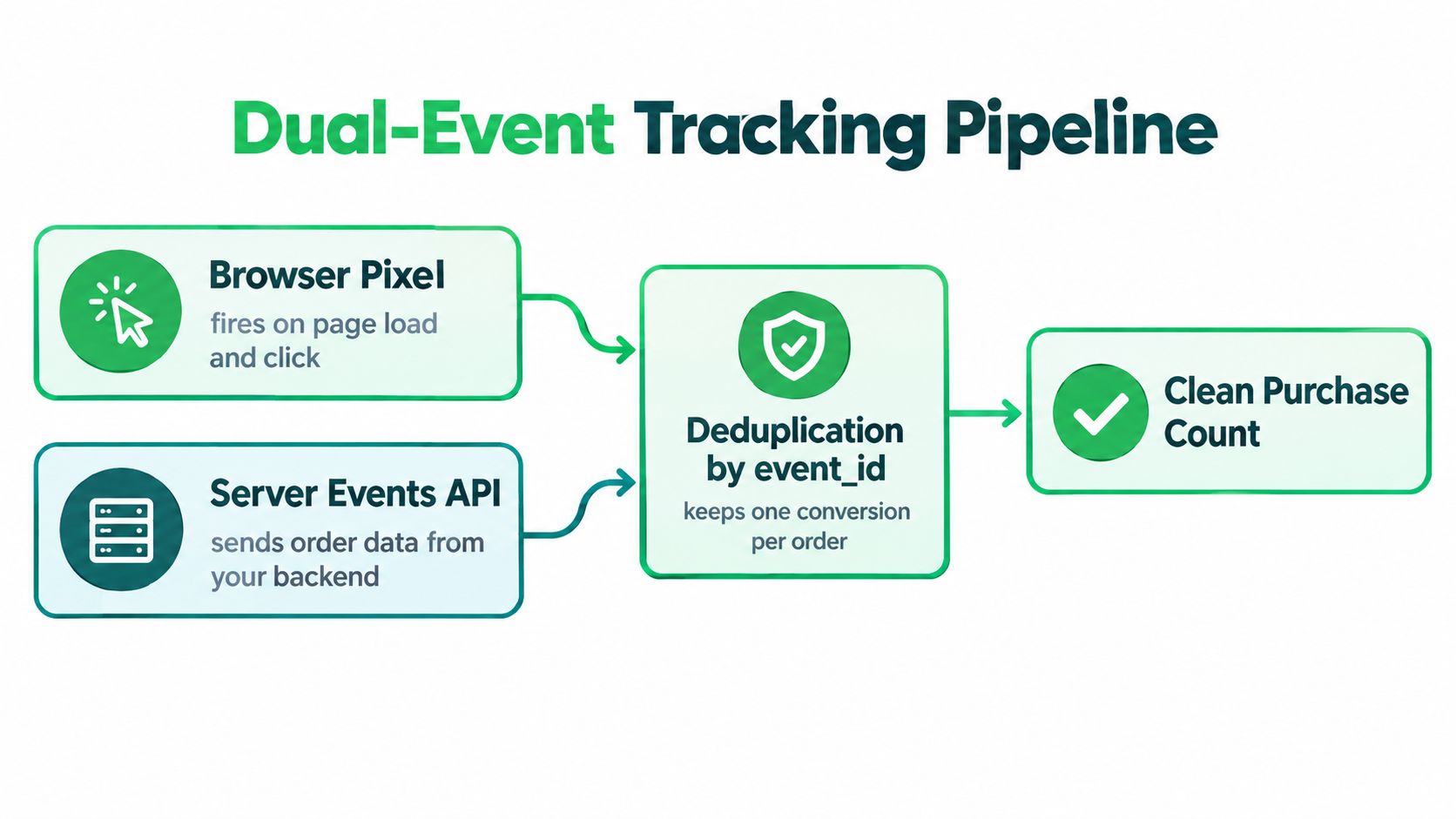
A dual-event setup is how you stop Meta from crediting revenue your payments stack never settled. The browser sees intent. The server sees confirmed transaction states. You need both, but you also need them tied to the same commercial event, or Ads Manager starts counting noise.
Meta recommends sending the same events through the Pixel and Conversions API, with the same event name and a shared event ID, so duplicate conversions can be recognized correctly, as outlined in Meta's Conversions API best practices. That sounds simple until real checkout logic gets involved, especially when one storefront routes payments across multiple PSPs or sends high-risk traffic through extra review steps.
Start with event ownership
Set event ownership before anyone touches tags or templates.
- PageView and ViewContent: fire in the browser, where page loads and product discovery happen.
- AddToCart and InitiateCheckout: fire in the browser when the shopper completes that action, while carrying cart and checkout context.
- Purchase: let the browser send a confirmation-side event, but let the server send the authoritative event only after the backend reaches your defined success state.
- Customer matching: send permitted identifiers such as normalized and hashed email or phone, external customer ID,
_fbp,_fbcorfbclid, IP address, and user agent only where consent and applicable law allow.
That ownership model prevents a common reporting mess. Teams often wire Purchase to a button click, a thank-you page, and a webhook, then wonder why attributed revenue is higher than settled revenue. Purchase should map to a payment record. If a card is challenged, routed to another PSP, or left in a pending review queue, the event is not successful yet.
For each commerce event, validate the event name, event time, event source URL, currency, value, product identifiers, and order ID. Have the backend generate the event ID when checkout is created, persist it on the order or payment object, and expose that same ID to the confirmation page. Then the browser and server can send one shared identity for one underlying transaction.
Deduplicate deliberately
Sending both channels without clean deduplication makes optimization worse. Meta can interpret one real purchase as two conversions, inflate campaign revenue, and train delivery against bad signals.
event_id is the strongest deduplication key, but the implementation fails in very ordinary ways. A common failure looks like this: the browser sends a temporary request ID created in JavaScript, while the server sends the persisted order ID from the backend. The event names match, the values match, but the IDs do not. Meta sees two separate purchases instead of one. The same problem appears when engineers regenerate a new event ID after a 3DS redirect or when each PSP adapter creates its own identifier for the same order.
Use a repeatable test sequence:
- Create a test checkout and record the event ID generated at checkout creation.
- Confirm the browser sends the expected event name, value, currency, and that exact event ID.
- Confirm the server sends the same event name and the same event ID only after payment success.
- Inspect Events Manager for missing, delayed, or duplicated Purchase events.
- Reconcile the final Purchase count against order records and payment processor records, not just the storefront database.
For a practical comparison of server-side tracking and client-side tracking, review the trade-offs directly. The collection method matters. Consistent event ownership, payment-state discipline, and one durable event identity matter more.
<iframe width="100%" style="aspect-ratio: 16 / 9;" src="https://www.youtube.com/embed/ytNnSVodsA4" frameborder="0" allow="autoplay; encrypted-media" allowfullscreen></iframe>
Solving Attribution for Subscriptions and Payment Retries
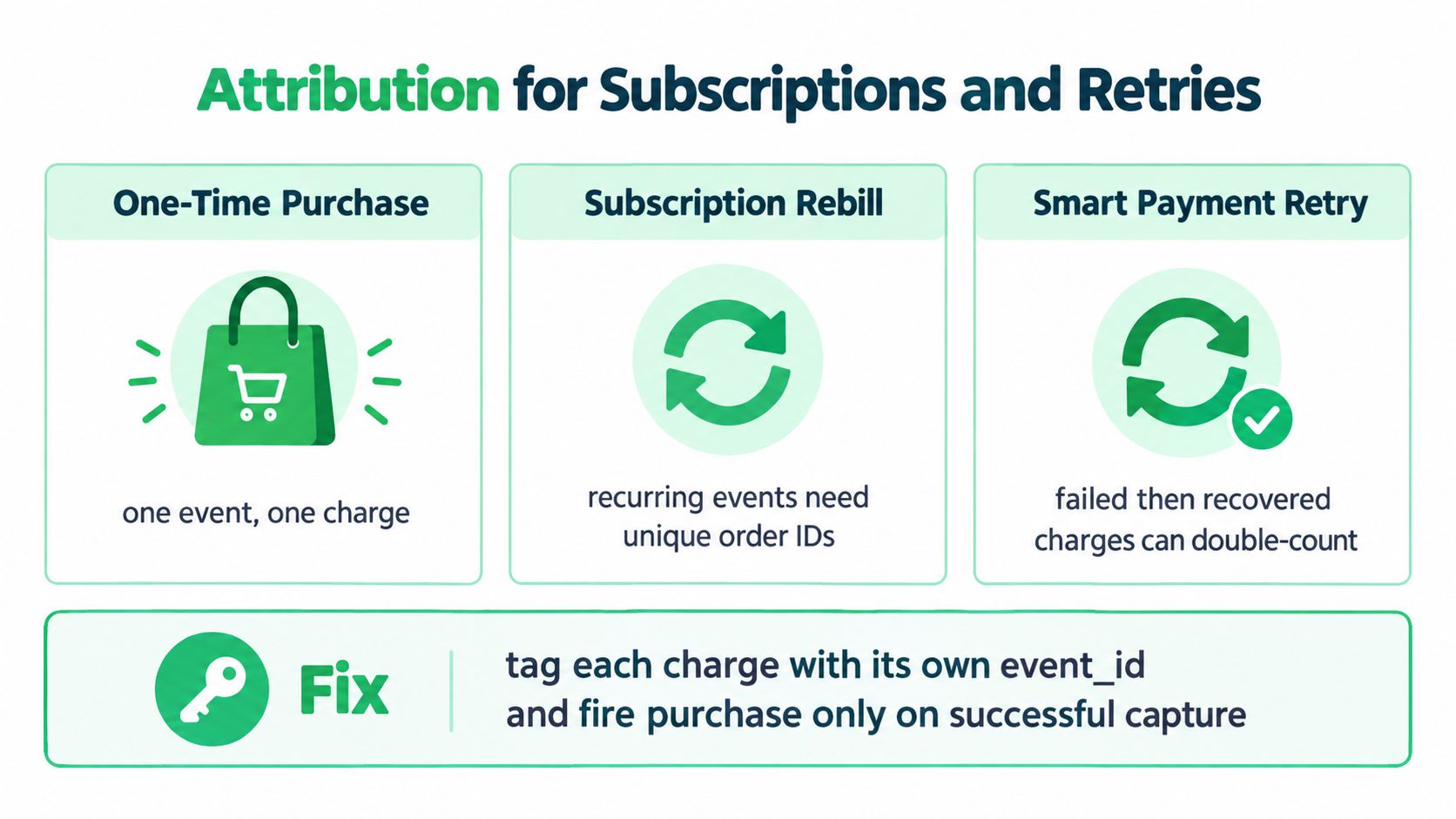
A $29 monthly plan can bill cleanly on day 1, fail on day 30, recover on day 33 through a retry, and then hit a refund later. Meta may still show a tidy line of attributed revenue while your processor ledger shows a mess of failed attempts, recovered charges, and reversals. That gap is where subscription tracking usually breaks.
Give every charge its own identity
Teams get into trouble when they model a subscription as one purchase with one lifecycle. It is a billing relationship made up of separate financial events. The initial signup, each rebill, each failed attempt, each recovered retry, and any later refund or chargeback affect revenue in different ways. One generic Purchase event cannot describe all of that without creating reporting errors.
The identity model has to reflect that reality. The subscription ID ties the customer to the ongoing contract. The order ID or charge ID identifies one billing event. The event ID joins the browser and server copies of that specific event. Payment status records whether that charge is pending, authorized, captured, failed, refunded, or disputed.
A one-time order often maps cleanly to one successful charge. Recurring billing does not. If you reuse the original event ID for every rebill, a legitimate later charge can look like a duplicate of the first payment. If your browser generates one ID and the backend creates another for the same successful rebill, Meta can count one charge twice.
Here is the practical rule I use. Give each confirmed billing event its own event identity, and keep that identity stable across browser and server copies for that event only. The subscription stays constant. The charge does not.
| Record | Purpose |
|---|---|
| Subscription ID | Connects the customer to the recurring billing relationship |
| Order or charge ID | Identifies one billing event |
| Event ID | Joins the browser and server copies of that event |
| Payment status | Distinguishes pending, authorized, captured, failed, refunded, or disputed states |
Fire Purchase only for realized revenue
The backend has to decide what counts as successful payment. In some businesses, an authorization is enough because fulfillment starts immediately. In others, especially with delayed capture, manual review, or higher fraud controls, Purchase should wait until capture. Pick one rule and keep it consistent across processors, retries, and reporting.
A retry is not a new acquisition. It is another attempt to collect an existing obligation. If the first rebill fails and the third attempt captures, send the successful payment event once, with its own stable identity. Do not send Purchase for the failed attempts. Do not create a second acquisition record because a fallback PSP, smart retry flow, or high-risk routing path handled the final capture.
Cross-domain checkout makes this harder. If fbclid or _fbp drops when the customer moves from the storefront to a hosted billing page, the payment may settle correctly while attribution context never reaches the backend. Preserve permitted attribution parameters through the handoff, then reconcile them against the actual order or charge record instead of trusting the thank-you page to rebuild context after the fact.
For recurring revenue, the core value of server-side tracking benefits is operational control. The server can wait for confirmed billing status, tie the event to the charge record, and survive browser loss. It still will not erase refunds, failed retries, or disputes. It gives you a cleaner way to report them against the ledger that pays you.
Diagnosing Signal Loss Across Devices and Consent States
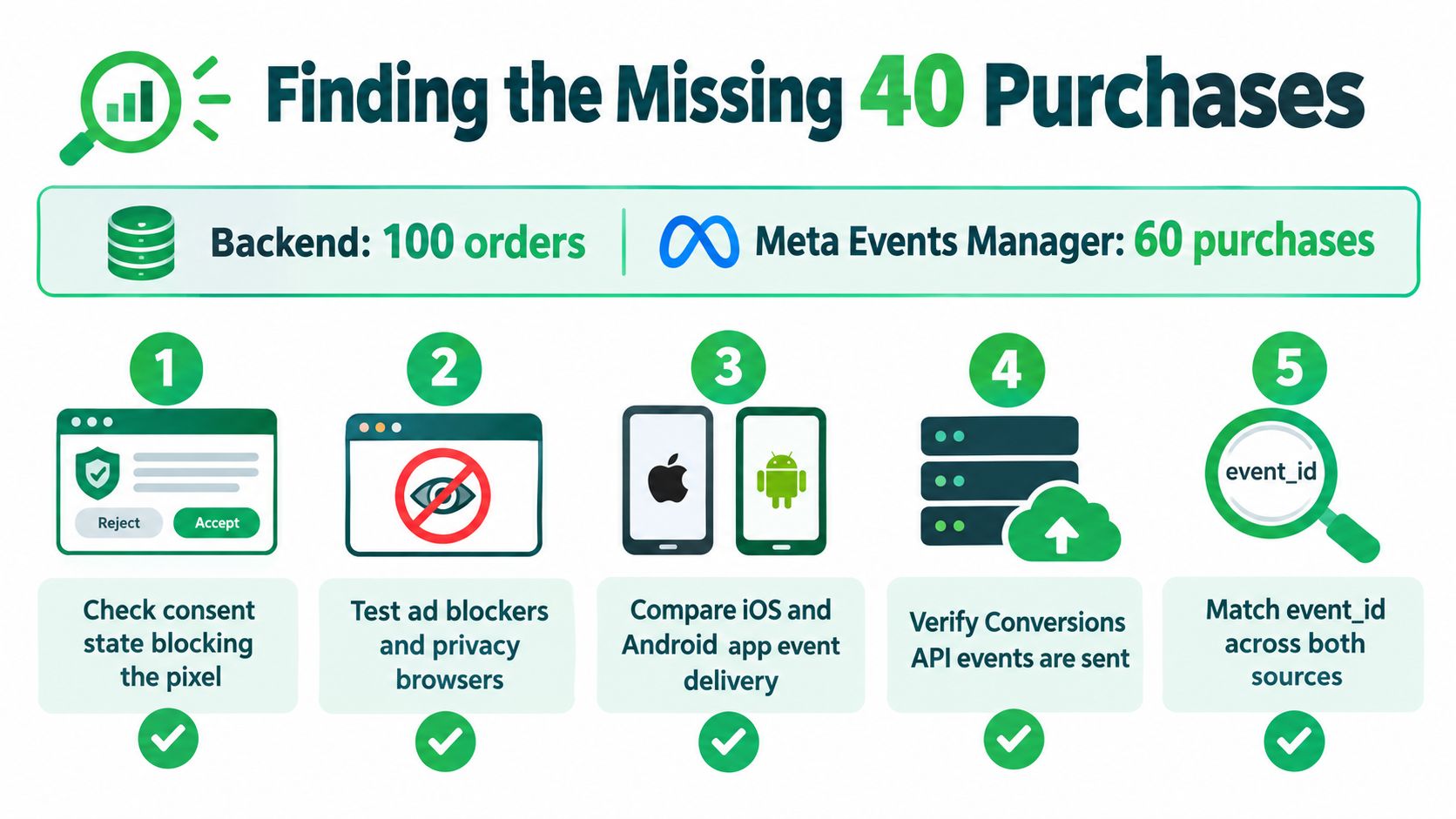
A discrepancy is useful only when you can locate the break. Start with three independent counts for the same reporting period and business definition:
- Backend payment ledger: orders or charges that meet your confirmed-payment rule.
- Browser Purchase events: events received from the Pixel, before server deduplication.
- Meta-attributed purchases: conversions Meta credits to ads under its attribution model.
Don't collapse these into one dashboard metric. Each answers a different question.
Use a reconciliation grid
Create a row for each confirmed order and record whether the browser event arrived, whether the server event arrived, whether Meta deduplicated the pair, and whether Meta attributed the event. Add the dimensions that explain operational variation:
- Device and browser: Compare iOS, Android, desktop, Safari, Chrome, and privacy-focused browsers.
- Consent state: Separate granted, denied, withdrawn, and unknown states.
- Geography: Identify markets where consent rules, payment methods, or checkout behavior differ.
- Payment outcome: Separate authorized, captured, failed, retried, refunded, and disputed transactions.
- Checkout path: Compare same-domain, cross-domain, hosted, and embedded payment journeys.
A 2025 benchmark cited a global iOS App Tracking Transparency opt-in rate of roughly 35%, implying that most iOS users don't provide the signal traditionally used for person-level attribution, according to the benchmark discussion of Facebook attribution. Treat that as a reason to segment the data, not as permission to estimate missing sales by applying one universal correction factor.
Find the failure point
If the ledger has a confirmed order and no browser event, inspect consent behavior, browser blocking, thank-you-page loading, and whether the event trigger depended on a redirect that never completed. If the browser event exists but the server event doesn't, inspect the payment webhook or internal order transition that should have generated it.
If both events exist but Meta reports a duplicate, compare event names and IDs byte for byte. If neither event exists, investigate checkout creation, payment completion, and whether the order reached the event dispatch queue. A missing fbclid, lost _fbp, inconsistent currency or value, and a Purchase emitted before authorization can each create a different symptom.
Diagnostic discipline: Report “confirmed by the ledger,” “delivered to Meta,” and “attributed by Meta” as separate statuses. Don't present the attributed total as incremental revenue.
Track latency as well. A server event that arrives after the campaign decision may still be valid for measurement but less useful for immediate optimization. Events Manager can show delivery and deduplication behavior, while your internal ledger remains responsible for financial reconciliation.
Navigating Compliance and High-Risk Industry Requirements
For high-risk merchants, tracking isn't only a media optimization concern. It sits next to consent records, billing evidence, processor decisions, refund handling, and dispute documentation. A Purchase event says that a platform received a message. It doesn't prove that the customer saw the required terms, agreed to recurring billing, received the product, or kept the charge.
The Federal Trade Commission's amended rule for negative-option programs requires sellers to disclose important information before obtaining billing information and charging consumers, obtain unambiguously affirmative consent before charging for the negative-option feature, avoid material misrepresentations, and provide a simple cancellation mechanism that immediately stops recurring charges. The Government Accountability Office summary of the FTC rule makes the central operational point clear: a Facebook Pixel Purchase event isn't a compliance record without authoritative checkout and billing evidence.
Build an event-quality policy
Define which commercial states are eligible for each event before engineering the integration:
- Eligible Purchase: A payment has reached the business-defined success state, such as confirmed capture.
- Excluded transaction: Test orders, fraudulent orders, canceled authorizations, and payments that never complete.
- Follow-up state: Refunds, chargebacks, subscription cancellations, and recovered retries are recorded against the original order or charge.
- Audit evidence: Store consent version, checkout terms, billing authorization, cancellation action, payment status, and event ID in systems controlled by the merchant.
This policy matters even more when a high-risk business routes transactions across processors. A payment may be approved by one processor, declined by another, retried through a different route, or held for review. Marketing systems shouldn't treat every processor response as realized revenue.
Teams building internal audit and consent workflows may also use visual references such as security icons for compliance, but graphics don't replace records. Keep the underlying evidence tied to the order, customer consent, billing event, and processor outcome.

The safest optimization signal is therefore not “all checkout attempts.” It is a carefully defined successful payment event, sent only when the merchant can defend its meaning. Meta can optimize against that signal, while compliance and finance teams can trace it back to the underlying transaction.
Automating Tracking with an Ecommerce Orchestration Layer
Dual-pipeline tracking becomes difficult when checkout, payment routing, subscription billing, and event delivery live in separate systems. Developers then have to pass identifiers between a storefront, a hosted checkout, a processor, a subscription scheduler, a retry service, and Meta. Every handoff creates an opportunity to lose attribution, fire too early, or send the same payment twice.
An ecommerce orchestration layer addresses the problem by making payment state the center of the event flow. The checkout creates the order and event identity. The payment layer reports authorization, capture, retry, refund, or dispute status. The server-side tracking layer emits the appropriate event from that authoritative state, while the browser continues to provide discovery and interaction signals.
What a reliable system should automate
A practical architecture should handle:
- Event identity: Generate and persist stable IDs for orders and individual recurring charges.
- Payment timing: Fire Purchase only after the configured successful payment state.
- Multi-PSP routing: Preserve one commercial identity when a transaction moves between processors.
- Subscription lifecycle: Distinguish initial charges, rebills, retries, refunds, and chargebacks.
- Consent boundaries: Send only permitted customer-matching data.
- Reconciliation: Compare delivered browser and server events with the payment ledger.
- Channel coverage: Reuse validated commerce events for Meta, TikTok, and GA4 without creating separate definitions that drift apart.
Tagada is one option for this model. Its AI-first Ecommerce OS combines checkout, payment routing, subscription management, and server-side tracking, while TagadaPay supports multi-processor routing and smart retries, and its checkout flows can automatically fire ecommerce events such as PageView, ViewContent, AddToCart, InitiateCheckout, and Purchase. The useful architectural feature isn't the pixel setting itself. It's the connection between the event and the payment state that gives the event meaning.
The core design remains vendor-independent. Keep the backend ledger authoritative, share event IDs across browser and server, distinguish each charge in recurring billing, preserve consent and matching data carefully, and treat Meta attribution as a decision signal rather than a bank statement. Automation reduces implementation debt, but it doesn't excuse weak event definitions.
A merchant that follows those rules gets cleaner campaign feedback without pretending that every reported conversion is guaranteed revenue. That is the standard pixel tracking Facebook should meet in production.
Tagada connects checkout, payment routing, subscriptions, retries, and server-side events so merchants can tie Meta Purchase signals to confirmed payment outcomes. Visit Tagada to explore an orchestration layer for cleaner attribution across ecommerce, subscription, international, and high-risk payment flows.