
Dropshipping made ecommerce accessible. But the margins got crushed, the customer experience suffered, and the model earned a reputation. Now, a new category is emerging that combines the accessibility of ecommerce with the recurring revenue of SaaS and the defensibility of healthcare: telehealth ecommerce. It's legal, ethical, and growing at 25%+ year over year. And you can launch one in a matter of hours.
The numbers are staggering. The global telehealth market is projected to grow 25% annually, reaching over $500 billion by 2030—with some estimates putting the broader digital health economy at $931.9 billion. 80% of consumers now prefer virtual consultations over in-person visits for non-urgent medical needs. Digital-first healthcare brands like Hims & Hers, Ro, and Nurx have already proven the direct-to-consumer telehealth model is highly scalable and profitable.
As Entrepreneur Magazine recently put it: entering telehealth now is like getting into ecommerce in 2010—before the gold rush. The consumer behavior shift is permanent, the demand is explosive, and the entrepreneurs who move first will build the brands that dominate for the next decade.
But until recently, building something like Hims required millions in capital, a team of compliance lawyers, and 12+ months of development. That's no longer the case. The infrastructure exists. The regulatory pathways are clear. And platforms like Tagada are making it possible for any ecommerce entrepreneur to launch a fully compliant telehealth brand—without handling a single prescription, hiring a single doctor, or building a single integration from scratch.
What Is Telehealth Ecommerce, Exactly?
Telehealth ecommerce is the intersection of direct-to-consumer retail and licensed medical services. Instead of selling generic products from AliExpress, you're offering real healthcare solutions—consultations with licensed physicians, FDA-approved treatments, and pharmacy-fulfilled prescriptions—through a branded online storefront.
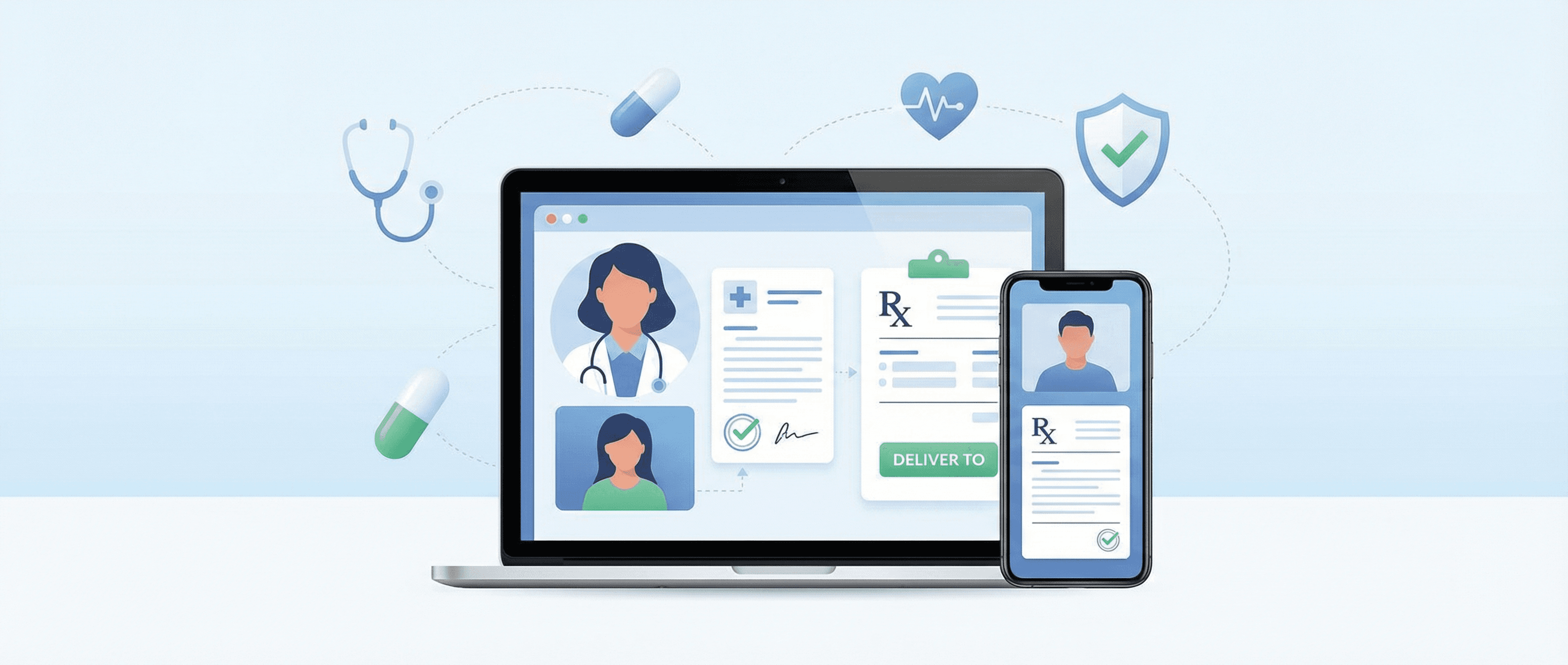
The customer journey is simple: a patient visits your website, completes a medical intake form, gets evaluated by a licensed provider, and—if clinically appropriate—receives treatment shipped directly to their door. The entire experience happens under your brand, but the medical infrastructure runs behind the scenes through established provider networks.
Patient Acquisition
You run ads and drive traffic to your branded telehealth storefront. This is the part you know—performance marketing, landing pages, conversion optimization. The same skills that work in ecommerce work here.
Medical Consultation
Licensed physicians from the connected doctor network review each case. Asynchronous consultations (intake forms reviewed by doctors) or synchronous video calls—depending on the treatment category and state requirements.
Prescription & Fulfillment
If the doctor approves treatment, the prescription is sent to a licensed pharmacy partner (like Truepill) for fulfillment. The medication ships in your branded packaging, directly to the patient. You never touch inventory.
Recurring Revenue
Most telehealth treatments are ongoing—monthly subscriptions for medication refills. This creates predictable, recurring revenue with high LTV. Average telehealth subscription retention rates are 60-70% at 12 months.
Why Telehealth Is the New Dropshipping (But Better)
The comparison isn't random. Telehealth ecommerce shares the same fundamental appeal that made dropshipping attractive: low capital requirements, no inventory, and the ability to focus on marketing while partners handle fulfillment. But it fixes everything that made dropshipping unsustainable.
The biggest headache with dropshipping and traditional ecommerce? Retention. A customer buys a product, and then they're gone—maybe forever. This creates a never-ending cycle of chasing new customers, driving up ad spend and slashing your profits. Telehealth flips this equation entirely.
Built-In Recurring Revenue
Dropshipping margins got squeezed to 10-15% as competition intensified. Telehealth subscriptions operate at 40-60% gross margins. Whether it's ongoing treatments, prescription refills, or scheduled virtual visits, telehealth services naturally foster long-term patient relationships. Monthly retention rates exceed 85%. Your customer doesn't just buy once—they subscribe for months or years. That means higher lifetime value per customer and much greater profitability over time.
A Regulatory Moat That Protects Your Business
Dropshipping's low barrier to entry means anyone can clone a successful product overnight, leading to saturated markets, razor-thin margins, and constant price wars. Telehealth operates in a completely different paradigm. Healthcare regulations create a natural barrier to entry—a moat that prevents competitors from flooding the market overnight. This allows early movers to establish strong brand loyalty and pricing power without the cutthroat competition that kills most ecommerce brands.
100% Legal and Ethical
No gray areas. No counterfeit concerns. No misleading product claims. Telehealth operates within established regulatory frameworks—licensed doctors, FDA-approved medications, HIPAA-compliant data handling. You're building a real healthcare brand that helps real people with real medical needs. This isn't selling overpriced gadgets with 3-week shipping—it's delivering genuine healthcare.
Your Ecommerce Skills Transfer Directly
If you've already mastered DTC branding, performance marketing, and conversion funnels, telehealth is a natural extension of those skills. The same playbook that works for ecommerce—influencer marketing, SEO, paid advertising, content marketing—applies directly to telehealth brands. A telehealth business in skincare can use content marketing to educate patients, influencer collaborations to showcase real results, and paid ads targeting high-intent searches. You already know how to do this.
Scalable Without Breaking
Dropshipping at scale meant quality nightmares—lost packages, 3-week shipping, angry customers. Telehealth fulfillment through licensed pharmacy networks means consistent quality, tracked shipments, and professional patient care. It gets better as you scale, not worse.
The Problem: Healthcare Infrastructure Is Hard
If telehealth ecommerce is so attractive, why isn't everyone doing it? Because until now, the infrastructure was impossibly complex to assemble.
To launch a Hims-like brand from scratch, you traditionally needed:
Doctor Network Integration
Contracts with physician networks licensed in every state you serve. Credentialing. Compliance monitoring. Medical liability coverage. This alone takes 3-6 months and significant legal cost.
Pharmacy Fulfillment
Partnerships with licensed pharmacies (like Truepill) that can compound, package, and ship medications. Integration with their systems for prescription routing, inventory management, and shipment tracking.
HIPAA-Compliant Platform
Your entire tech stack—from intake forms to patient records to communications—must be HIPAA compliant. That means encrypted storage, access controls, audit logs, and Business Associate Agreements with every vendor.
Healthcare Payment Processing
Standard payment processors often flag or decline healthcare transactions. You need a processor that understands telehealth billing, handles subscription rebills for medication refills, and manages the unique chargeback patterns in healthcare.
Each of these components required separate vendors, separate contracts, separate integrations. The total cost to launch? $200K-$500K minimum, with 6-12 months of development time. That's why the space has been dominated by well-funded startups, not ecommerce entrepreneurs.
The Tagada Approach: Everything, Handled
We built Tagada to eliminate this infrastructure barrier entirely. As a unified commerce platform, our telehealth commerce stack connects every piece of the puzzle into a single, plug-and-play platform. You don't integrate with doctor networks—we connect you directly. You don't negotiate with pharmacy fulfillment partners—we handle it. You don't build HIPAA-compliant systems—it's built in.
Here's what "everything handled" actually means:
Direct Doctor Network Connection
We maintain partnerships with licensed physician networks covering all 50 US states. When a patient completes an intake on your branded storefront, their case is routed to a licensed provider for evaluation. You don't manage doctors. You don't handle credentialing. You don't deal with medical liability. It just works.
Integrated Pharmacy Fulfillment (Truepill & More)
Prescriptions flow automatically from the doctor network to our pharmacy partners, including Truepill—one of the largest digital pharmacy fulfillment networks in the US, serving 6M+ patients. Medications are compounded, packaged, and shipped under your brand. You never see a pill.
Telehealth-Optimized Payment Processing
This is where our core strength shines. Tagada's payment orchestration is built for healthcare—smart routing that understands telehealth MCC codes, subscription billing for medication refills, intelligent retry logic for failed rebills, and multi-processor redundancy to maximize approval rates. We know which processors perform best for telehealth transactions because that's what we do.
Conversion-Optimized Checkout
Our checkout flows are designed specifically for telehealth conversion—medical intake forms that feel like a modern shopping experience, not a hospital form. One-page flows that capture medical history, treatment preferences, and payment in a single, frictionless journey.
See It Live: Kura.me — A Telehealth Brand Running on Tagada
Theory is nice. But seeing is believing. Kura.me is a live telehealth brand built entirely on the Tagada stack. It's our showcase of what's possible when all the pieces come together.
Visit us.trykura.me and walk through the experience yourself. Notice how the patient journey flows seamlessly from product selection through medical consultation to checkout. That entire stack—the storefront, the intake forms, the doctor routing, the pharmacy fulfillment, the payment processing, the subscription management—is powered by Tagada.
What Kura.me demonstrates:
- Complete telehealth patient journey from ad click to treatment delivery
- Branded storefront with medical intake seamlessly integrated
- Automated doctor network routing for asynchronous consultations
- Pharmacy fulfillment through licensed provider partnerships
- Subscription billing with intelligent payment retry
- Mobile-first, high-converting checkout optimized for telehealth
Every feature you see on Kura.me is available to any merchant on the Tagada platform. This isn't a custom build—it's the standard Tagada telehealth stack, configured and launched in a matter of days.
The Economics: Why This Model Works
Let's talk numbers. The unit economics of telehealth ecommerce are fundamentally different from traditional ecommerce—and dramatically better than dropshipping.
Customer Acquisition Cost (CAC): $30-$80
Comparable to ecommerce, but you're acquiring a subscriber, not a one-time buyer. Facebook and Google ads work the same way—you're just driving to a telehealth funnel instead of a product page.
Average Order Value: $50-$150/month
Monthly medication subscriptions typically range from $50-$150 depending on the treatment category. Compare that to the $25 average order in dropshipping.
Lifetime Value: $600-$1,800
With 60-70% 12-month retention, the average subscriber stays 8-14 months. That's $600-$1,800 in lifetime revenue per customer—10-20x higher than typical ecommerce.
Gross Margins: 40-60%
After doctor network fees, pharmacy costs, and platform fees, you're keeping 40-60% of revenue. That's 3-4x better than dropshipping margins, with far less customer service overhead.
The math is simple: if you can acquire a customer for $60 and they generate $900 in lifetime revenue at 50% margins, your return on ad spend is 7.5x. That's the kind of economics that lets you scale aggressively and profitably.
Getting Started: From Zero to Live in Hours
This is where it gets real. With Tagada, launching a telehealth brand isn't a 6-month project. Here's the actual timeline:
Hour 1-2: Configure your storefront and checkout flows Hour 2-3: Set up medical intake forms for your treatment category Hour 3-4: Connect payment processing (already telehealth-optimized) Hour 4-5: Activate doctor network and pharmacy fulfillment routing Hour 5-6: Test end-to-end patient journey
Day 2: Launch ads. Start acquiring patients.
You handle marketing. We handle literally everything else—the doctors, the pharmacy, the compliance, the payments, the subscriptions. Your job is to find patients who need help and direct them to your brand. Our job is to make sure they receive excellent care and you get paid.
Treatment Categories With High Demand
Not all telehealth verticals are created equal. Based on market data and our merchants' performance, these categories show the strongest demand and unit economics:
Weight Management
The largest and fastest-growing telehealth category. GLP-1 medications have created unprecedented consumer demand. High AOV ($150+/month), strong retention, and massive search volume make this the most attractive entry point.
Men's Health
ED treatment, hair loss, testosterone optimization. This was the category that launched Hims and Ro. Proven demand, well-established treatment protocols, and high patient retention due to the ongoing nature of treatment.
Dermatology & Skincare
Prescription acne treatment, anti-aging, and medical-grade skincare. Highly visual results drive word-of-mouth and social proof. Subscription model works naturally with ongoing treatment regimens.
Mental Health & Wellness
Anxiety, depression, sleep disorders. Massive unmet demand—70% of Americans who need mental health treatment don't receive it. Telehealth removes the biggest barriers: stigma and access. High retention, strong emotional brand connection.
Compliance and Regulations: What You Need to Know
Let's address the elephant in the room. Healthcare is regulated. That's a good thing—it protects patients and creates barriers to entry that protect your business. Here's what you need to understand:
You are not practicing medicine. You're operating a technology platform that connects patients with licensed healthcare providers. The doctors in our network hold active licenses, carry malpractice insurance, and make independent clinical decisions. Your role is patient acquisition and brand experience—not medical care.
HIPAA compliance is handled. Tagada's platform is built with HIPAA compliance at the infrastructure level. Patient data is encrypted at rest and in transit. Access controls, audit logs, and Business Associate Agreements are all standard. You don't need to become a compliance expert—you need a platform that already is one.
FDA advertising rules matter. The FDA has increased enforcement on telehealth advertising in 2025-2026, particularly around compounded medications. You can't claim your product is "the same as Ozempic" or make unsubstantiated medical claims. But with proper disclaimers and truthful marketing—which our onboarding team helps you implement—you can run high-converting ads on every major platform.
State-by-state licensing is our problem, not yours. Telehealth regulations vary by state. Our physician network maintains licenses across all 50 states and monitors regulatory changes continuously. When regulations shift, we adapt the routing—you don't have to think about it.
Why Tagada for Telehealth—Specifically
You might be wondering: why not just use Shopify with a telehealth plugin? Or build on a generic SaaS platform? Here's why Tagada is purpose-built for this:
Payment Processing That Understands Healthcare
Healthcare payments have unique challenges: higher chargeback rates, complex MCC codes, subscription billing for medication refills. Tagada's payment orchestration routes telehealth transactions to processors that specialize in healthcare, maximizing approval rates and minimizing declines.
Unified Patient & Customer Data
In telehealth, a "customer" is also a "patient." Tagada's unified data model means the checkout knows about the medical intake, the subscription engine knows about treatment adherence, and your marketing can reference the complete patient journey—all in one system.
Subscription Engine Built for Medication Refills
Medication refills aren't like subscription boxes. They require prescription renewal workflows, dosage adjustments, and compliance with pharmacy regulations. Tagada's subscription engine handles the complexity of medical subscriptions natively.
All-in-One: No Integration Hell
Storefront, checkout, medical intake, doctor routing, pharmacy fulfillment, payment processing, subscription management, patient CRM—it's all one platform. No Zapier chains. No webhook nightmares. No data sync issues. One login, one dashboard, one source of truth.
The Opportunity Window Is Now
Here's the uncomfortable truth: this window won't stay open forever. The same pattern that played out in ecommerce is playing out in telehealth—early movers build brands, capture market share, and establish the trust that becomes impossible to compete with once the market matures.
Think about it this way: the pandemic accelerated telehealth adoption at warp speed, and this shift isn't temporary—it's the new normal. Consumers now expect convenient, on-demand access to healthcare. The global telehealth market is projected to grow 25% annually through 2030. But right now, consumer awareness is high while brand loyalty is still low. Patients are actively searching for solutions. They're willing to try new brands. The cost per acquisition is still reasonable.
In 2-3 years, when the market consolidates and CACs triple, you'll wish you'd started today. As one serial ecommerce entrepreneur recently wrote in Entrepreneur: "After trying both, I'd choose building a telehealth brand over another dropshipping store any day of the week."
The entrepreneurs who are moving fastest aren't healthcare insiders. They're ecommerce operators who understand performance marketing, conversion optimization, and customer experience—and who recognized that those skills translate directly to telehealth. They're the ones who are using platforms like Tagada to launch in days instead of months, while everyone else is still researching.
Your Next Move
If you're an ecommerce entrepreneur looking for the next frontier—something with real margins, real retention, and real impact—telehealth ecommerce deserves your serious attention.
Start by exploring the live demo at us.trykura.me. Walk through the patient journey. See how the checkout flows. Understand what's possible when every piece of the stack works together.
Then take a call with our team. We'll walk you through the economics for your target treatment category, show you the infrastructure, and map out a launch plan. Most brands go from first call to live in under a week.
The ads are your job. Everything else is ours.