
You've just watched a customer click Pay. The gateway returns success, the order record updates, and your checkout page shows a confirmation. Then the customer closes the tab and waits for the text that proves the purchase went through.
That small message carries more weight than its length suggests. A reliable transactional SMS API connects payment processing, ecommerce operations, account security, and customer support. A weak implementation can leave a buyer wondering whether they were charged, send an OTP too late to use, or create a support conversation that began with a carrier filter rather than a product problem.
The Moment a Payment Triggers a Text
A buyer completes checkout for a DTC order. The payment gateway authorizes and captures the transaction, then sends a webhook to the merchant's backend. The backend validates the event, creates or updates the order, and asks the transactional SMS API to send a confirmation to the phone number attached to the purchase.
The API accepts the request, places the message into its delivery system, and routes it toward the appropriate carrier. The carrier delivers the text to the buyer's handset. The buyer sees the brand name, order reference, and confirmation, and feels confident enough to close the shopping tab.
The chain is short, but every link matters:
- Payment event: The processor reports a successful capture.
- Application event: The merchant's backend records the result and selects the correct template.
- Messaging request: The backend sends the recipient, sender identity, and message body to the SMS API.
- Carrier handoff: The provider routes the message through a supported carrier path.
- Delivery feedback: Status callbacks tell the merchant whether the message was accepted, sent, delivered, or failed.
A merchant can also lose the customer's confidence without seeing an obvious application error. The sender identity might be unsuitable for the destination, the route might be blocked, or the provider might enforce a rate limit during a checkout burst. The API call can appear successful while the handset receives nothing.
Practical rule: Treat a payment text as part of the customer's proof of purchase, not as decorative follow-up.
That's why the same event should have a durable record in the order system and an observable messaging record in the SMS system. An email confirmation can carry the full receipt and line items, while an SMS confirmation provides the fast reassurance customers look for immediately after payment. Your payment confirmation email workflow should complement the text, not compensate for an unmonitored SMS route.
What a Transactional SMS API Actually Does
Think of the API as a courier that takes a sealed envelope from your application and hands it to the phone network. Your application decides when the envelope is needed and what it contains. The SMS provider handles the carrier-facing delivery work, status tracking, sender configuration, and regional requirements.
A typical request might look conceptually like this:
POST /messages- Sender: Your registered brand or number
- Recipient: The customer's phone number
- Body: “Your order is confirmed. We'll text you when it ships.”
- Response: A provider-generated message UUID
That UUID is important. It gives your system a durable reference for delivery callbacks, troubleshooting, reconciliation, and customer-support searches. A successful API response usually means the provider accepted the request. It doesn't necessarily mean the customer's phone has received the message.
Transactional SMS is event-driven and time-sensitive. A successful checkout, login attempt, password reset, fraud alert, delivery scan, or subscription event can trigger it. The recipient expects the message because it relates to an action or account relationship already in progress.
Marketing SMS follows a different operating model. It's campaign-oriented, promotional, and usually scheduled for a broader audience. Transactional traffic prioritizes relevance and time sensitivity, while promotional traffic must follow its own consent, content, quiet-hour, and opt-out requirements.
| Dimension | Transactional SMS | Marketing SMS |
|---|---|---|
| Trigger | Customer action or system event | Scheduled campaign |
| Purpose | Confirm, verify, alert, or inform | Promote, sell, or re-engage |
| Audience | Usually one recipient tied to an event | A selected audience or segment |
| Content | Necessary service information | Commercial or promotional content |
| Routing concern | Timely delivery and event integrity | Campaign throughput and compliance |
The distinction affects more than copywriting. If a renewal reminder includes an unrelated offer, or an order confirmation becomes a product promotion, the message can move into a different compliance category. Keep the transactional body focused on what happened, what the customer needs to do, and where they can find the next useful detail.
Core Features That Decide Whether Messages Arrive
An SMS provider's send endpoint is only the visible part of the system. Deliverability depends on four separate engineering decisions, and improving one won't automatically fix the others.
Sender identity
A long code resembles a normal phone number and can suit conversational or lower-volume use cases. A short code is designed for recognizable high-throughput messaging. An alphanumeric sender ID can display a brand name in supported markets, but it may not support replies and isn't available everywhere.
The trade-off is straightforward: more recognizable or higher-throughput sender types usually bring more registration and country-specific compliance work. A U.S. 10-digit number used for application-to-person traffic is treated as A2P, so brand and campaign registration under 10DLC applies, as explained in this 10DLC registration overview.
Throughput and rate limits
Your application can receive a sudden cluster of payment events, especially during a promotion, ticket release, or recurring billing run. Carriers and providers may enforce messages-per-second limits, queues, or burst controls to prevent suspicious sending patterns.
The developer trade-off is peak speed versus route stability. A queue can delay a noncritical shipping update, but smoothing the burst may protect an OTP or payment alert from carrier filtering. Carrier-side systems consider content patterns, sending velocity, complaint rates, and message fingerprints, so a valid transactional use case can still look risky when traffic becomes repetitive or abrupt. Carrier filtering and scaling guidance describes why queueing and decoupling upstream ingestion from carrier delivery matter at scale.
Webhooks and delivery receipts
Don't collapse every status into “sent.” Your application should distinguish between:
- Accepted: The provider received the request.
- Sent: The provider handed it toward a carrier route.
- Delivered: The carrier reported handset delivery.
- Failed: The provider or carrier reported a delivery problem.
The trade-off is observability versus implementation effort. Delivery webhooks require signature validation, idempotency, storage, and alerting, but they give support and operations teams a way to investigate a missing message without guessing.
Queues and retries
A queue-backed worker separates the checkout response from the carrier's timing. The payment endpoint can finish its job while a messaging worker handles rate limits, temporary provider errors, and retry eligibility.
The trade-off is eventual delivery versus synchronous simplicity. Retry only failures that might recover, and preserve the original event ID so a repeated worker attempt doesn't create duplicate texts.
Where Merchants Use Transactional SMS in Practice
A single SMS API can serve very different moments in a merchant's operation. The trigger, variables, latency expectation, and failure consequence change from one workflow to the next.
The order confirmation
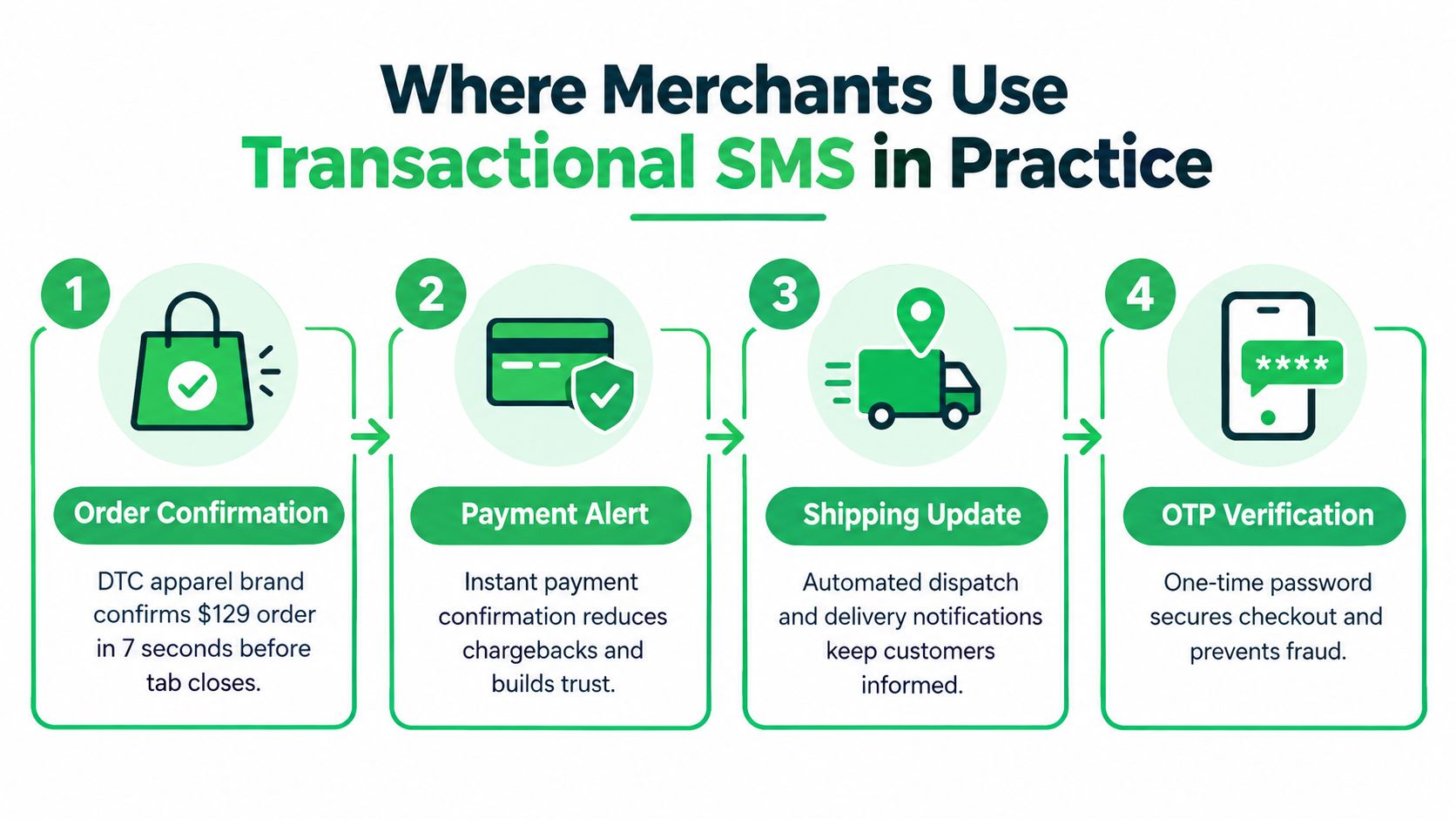
A DTC apparel brand captures payment and sends a confirmation while the buyer is still deciding whether to close the checkout tab. The message uses the order reference, item or order status, and a link to details. If it never arrives, the buyer may refresh the page, check a bank balance, or contact support even though the payment succeeded.
The payment alert
A fintech application sends a six-digit OTP when a customer attempts a sensitive account action, then sends a second alert when the transfer settles. The first message needs a very tight delivery window and a short expiry policy. A late code can trap the user in a login or authorization loop, while an unexplained settlement delay can look like a failed payment.
The subscription reminder
A subscription box sends a renewal reminder before the next charge. The template should identify the plan, the billing event, and the account-management path without adding unrelated promotion. If the reminder fails, the subscriber may miss the chance to update an expired card, and a preventable failed renewal can become involuntary churn.
The delivery update
A marketplace sends a driver an operational change while an order is in transit. The message might include a route status, pickup detail, or delivery instruction. When the text arrives, the driver can resolve the change without opening a support ticket. When it doesn't, a small logistics update can become a customer-facing delay.
The same architecture powers order confirmations, payment alerts, shipping updates, and OTP verification, but each workflow needs its own template version, event source, retry rule, and alert threshold.
Here's a short visual walkthrough of how the channel supports those moments:
<iframe width="100%" style="aspect-ratio: 16 / 9;" src="https://www.youtube.com/embed/U6agWmhyB7Q" frameborder="0" allow="autoplay; encrypted-media" allowfullscreen></iframe>
Integration Patterns for Small Teams and High-Volume Stores
Two integration patterns cover most merchant environments. The right choice usually depends more on team capacity, regional complexity, and provider count than on raw message volume.
With a direct API integration, your backend sends a JSON request to the provider, authenticates it, stores the returned message ID, and consumes delivery webhooks. This path is quick to understand and easy to debug. It also puts sender registration, country rules, template versions, retry logic, failover, and provider-specific behavior inside your codebase.
A hub-mediated integration places a notification service between business events and delivery channels. The hub can fan out one payment event to SMS, email, and push, while keeping product services independent of a particular provider. Customer.io, Braze, or an in-house event service can fill this role, although each adds configuration and operational overhead.
| Dimension | Direct API | Hub-Mediated |
|---|---|---|
| Initial build | Faster for one provider and a focused use case | More setup before the first send |
| Provider changes | Often require application changes | Usually isolated in the messaging layer |
| Channel expansion | Each new channel needs new integration work | One event can fan out to several channels |
| Regional rules | Merchant owns more implementation detail | Hub can centralize templates and routing |
| Debugging | Clear request path | More components to trace |
| Best fit | Small team with limited regions | Complex, multi-region or multi-channel operation |
A small team can start with direct integration, provided it creates an internal message record and keeps provider calls out of the checkout's critical path. A high-volume store may prefer a queue-backed worker or hub from the beginning, especially when payment events must continue flowing during carrier throttling or provider maintenance.
Developer decision: Keep payment state authoritative in the payment system, and let messaging consume that state asynchronously.
Use separate templates for payment success, payment failure, refund, shipment, and OTP events. If you're connecting email infrastructure during the same build, document credentials and secrets carefully with the same discipline used in a SendGrid API key integration, rather than scattering provider details across application services.
Compliance Fraud and the Hidden Cost of Silent Filtering
Consent is necessary, but it isn't the whole operational problem. A message can satisfy your customer's expectation and still be filtered because the sender identity, template, route, velocity, or content doesn't satisfy carrier controls.
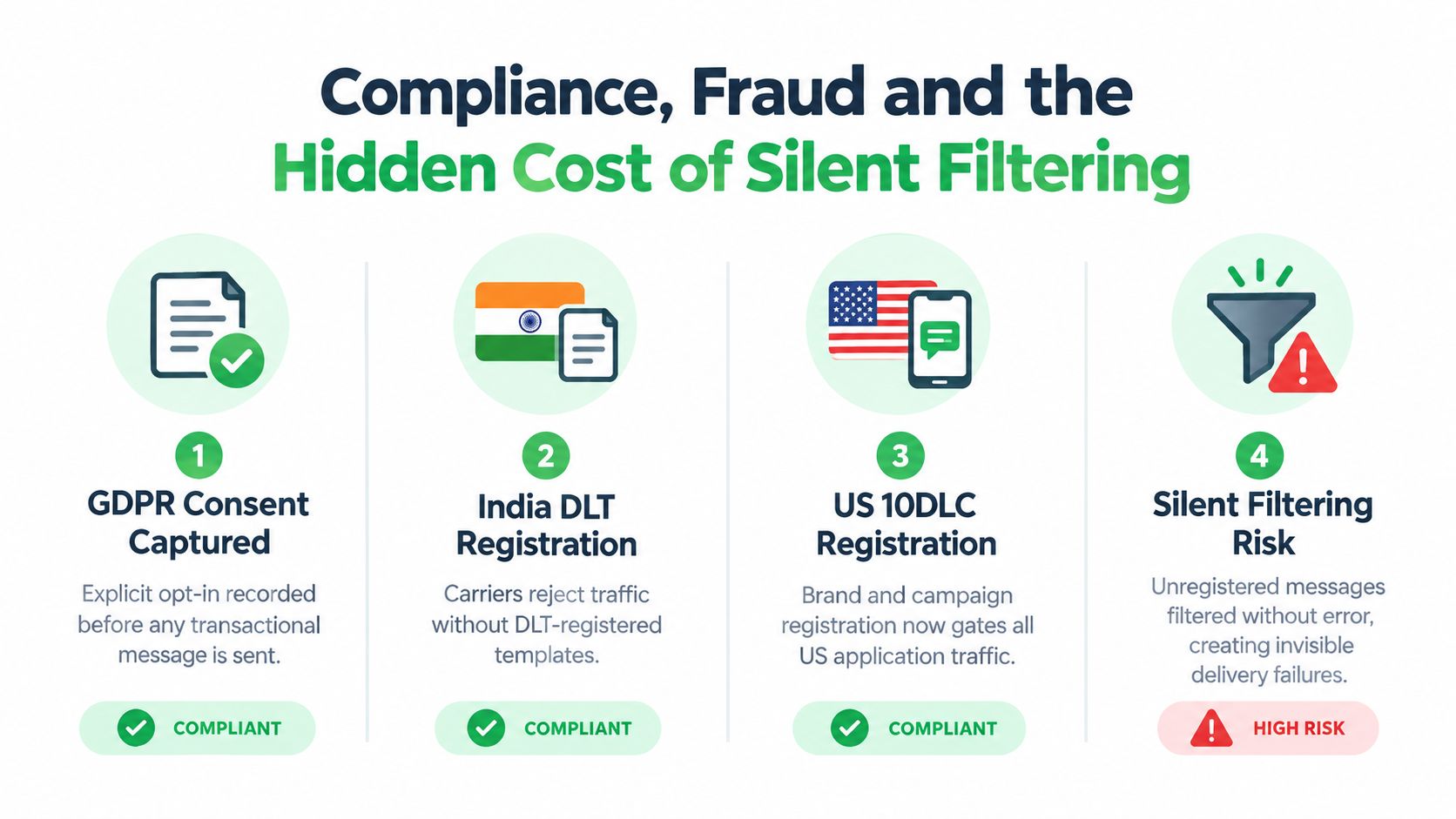
India provides a clear example. Commercial SMS traffic requires DLT registration, including transactional traffic, and messages can be blocked at the operator layer when the required registration or template metadata is missing. For every request, the API may need to carry both the Principal Entity ID and Template ID, as outlined in this India SMS compliance guide. A successful request from your application doesn't override an operator scrub.
In the United States, transactional SMS sent from a 10-digit number is A2P traffic, which makes 10DLC brand and campaign registration part of the delivery design. The sender choice and registration status can affect acceptance and filtering, so merchants shouldn't treat compliance as a one-time checkbox completed after the integration is live.
Fraud changes the economics
A2P fraud includes grey routes, artificial inflation of traffic, SMS pumping, SMS trashing, and sender-ID spoofing. Independent coverage also reports that APWG recorded a 40% rise in smishing from Q1 to Q2 2026, while an India fraud report recorded text-message scams increasing 146% year over year. Those figures come from the A2P SMS fraud and industry statistics coverage.
Fraud hurts from both sides. Spoofed sender IDs damage customer trust, while traffic pumping can make a merchant pay for messages sent to low-quality or fraudulent destinations. Measure fraud-adjusted ROI, not just delivery rate. Include OTP completion, payment conversion, complaint volume, support contacts, disputed charges, and suspicious destination patterns.
Silent filtering needs its own monitoring
A provider dashboard is useful, but it isn't proof that the handset displayed the message. Monitor delivery status by country, sender type, template, carrier, and event category. Test real devices in important markets, avoid opaque links, lock approved sender identities, and cap traffic by destination.
Operational warning: A delivery report is evidence from the route, not direct evidence of customer attention.
How to Evaluate a Transactional SMS API Provider
Price shouldn't be the first comparison. Start with the workflows that can lose money or trust when a message arrives late, then score each provider against the same evidence.
A provider evaluation should include country-level delivery reporting, OTP latency expectations, webhook behavior, sender-ID options, pricing structure, and compliance tooling. Check whether the provider supports the destinations you serve, not just the countries shown on a coverage page.
| Criterion | Weight | Provider A Score (1-5) | Provider B Score (1-5) | Notes |
|---|---|---|---|---|
| Country-level deliverability evidence | High | Review route and carrier detail | ||
| OTP latency and operational targets | High | Test the authentication workflow | ||
| Webhook reliability | High | Check signatures, retries, and replay tools | ||
| Sender ID support | Medium | Compare long codes, short codes, and alphanumeric IDs | ||
| Compliance tooling | High | Review DLT, 10DLC, and privacy workflows | ||
| Pricing transparency | Medium | Identify message, segment, and route charges | ||
| Sandbox and test coverage | Medium | Test failures, duplicates, and callbacks | ||
| SDK and support quality | Medium | Inspect documentation and escalation paths |
Give each criterion a weight based on business risk, score two or three finalists from 1 to 5, and record the evidence behind every score. A payment-heavy subscription merchant might weight webhook reliability, decline-event integration, and OTP delivery more heavily than a store that mainly sends shipping updates.
Look for an accessible sandbox, realistic error simulation, clear status callbacks, and a usable uptime history. Ask how the provider handles duplicate requests, carrier rejection, blocked content, sender registration, and regional template changes.
Red flags include opaque failover, no delivery callbacks, unclear segment billing, missing opt-out handling, and support that can't explain country-specific filtering. A provider comparison such as this SMS marketing platform guide can help frame the broader messaging decision, but transactional requirements still deserve their own test plan.
Turning Transactional Messaging Into a Revenue Lever
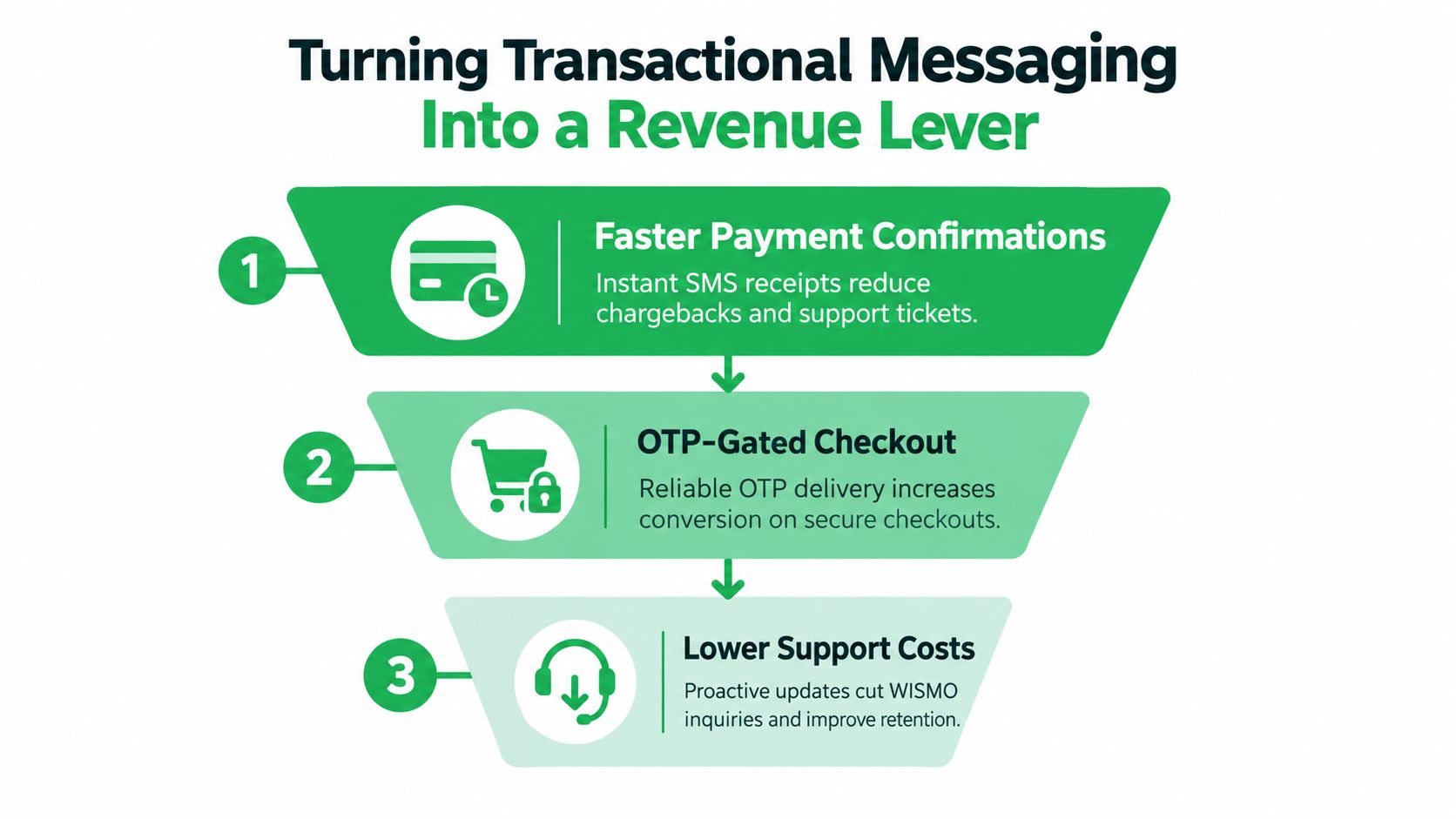
Reliable transactional messaging protects revenue because it reduces uncertainty at the moments customers are most likely to hesitate. A payment confirmation can reassure a buyer after checkout. An OTP can keep a secure payment flow moving. A shipping update can answer a status question before it becomes a support request.
The same event pipeline can support more than one notification. A captured payment can produce a receipt, a fulfillment update, a delivery message, and an account record without rebuilding the integration for every stage. The important design choice is to keep those events distinct, so a failed payment doesn't accidentally trigger a success confirmation or a promotional message.
Subscription and rebill merchants should connect messaging to payment outcomes rather than generic calendar schedules. A successful renewal, soft decline, hard decline, refund, and chargeback signal each require different customer communication and different retry behavior. That approach also gives finance and support teams a shared event history.
The next step is orchestration. An event bus can receive payment webhooks, order events, and account signals, then route each customer message to SMS, email, push, or another channel according to urgency, consent, and delivery history. SMS remains valuable for time-sensitive moments, while email can carry detail and an audit trail.
Tagada connects checkout, payment events, and revenue-aware email and SMS workflows in one orchestration layer, including payment confirmations, failed-payment alerts, and refund notifications. Visit Tagada to see how you can connect transactional messaging to payment processing, subscriptions, routing, and customer recovery without rebuilding each workflow separately.