
What Is a Closed Loop Payment System?
Closed loop payments explained: three-party networks like Amex vs Visa and Mastercard, closed-loop gift cards, and the US and EU rules that apply.

Article summary
TL;DR
Closed loop is a payment setup where one company controls both ends of the transaction. The term has two uses: card networks like American Express, which issue cards and sign merchants themselves, and gift or store cards that work only at one merchant or group. Open-loop cards run on shared networks like Visa and Mastercard.
- Closed loop has two meanings: a three-party card network (American Express) and a card accepted only by one merchant or group (a store gift card).
- In a three-party network, the network is also the issuer and the acquirer. American Express sets the merchant fee, its discount rate, in the merchant contract.
- Discover and Diners Club International now belong to Capital One, which completed its acquisition of Discover on May 18, 2025.
- US law treats closed-loop gift cards apart: they fall outside the CFPB prepaid account rules, but funds can't expire for at least five years.
- In the EU, closed-loop cards can use the PSD2 limited network exclusion, with a notification above EUR 1 million a year.
 ChatGPT
 Claude
 Perplexity
 Grok
GrokOn this page
Closed loop is a payment term with two meanings. It describes card networks that run both sides of a payment themselves, and cards that only one merchant accepts. Both share one idea: no outside bank sits between the payer and the merchant.
What does closed loop mean in payments?
| Closed-loop card network | Closed-loop card | |
|---|---|---|
| Also called | Three-party network | Store, gift or private label card |
| Who controls both ends | The network: it issues cards and signs merchants | The merchant or group that sells the card |
| Where it works | Every merchant that signs with the network | One merchant or an affiliated group |
| Examples | American Express | Store gift cards, campus cards, store credit cards |
| Open-loop opposite | Four-party networks: Visa, Mastercard | General-use prepaid cards on Visa or Mastercard |
| Main rules | The network's own contract | Regulation E in the US, PSD2 in the EU |
Outside payments, "closed loop" names unrelated ideas, such as toll roads where you pay at the exit.
Closed-loop card networks: three-party vs four-party
On Visa and Mastercard, four parties meet: the cardholder, the issuing bank, the acquirer and the merchant. The network sits in the middle and charges scheme fees, and the issuer earns interchange.
A three-party network removes the split. American Express describes it in its 2025 annual report: "We maintain direct relationships with Card Members (as a card issuer) and merchants (as an acquirer)," and its "card-issuing, merchant-acquiring and card network businesses" work as one "integrated payments platform."1American Express Company, Form 10-K for fiscal year 2025, SEC (read October 14, 2026) When the same company issues the card and acquires the payment, the transaction never crosses to another bank, much like an on-us transaction.
- The cardholder pays with a card American Express issued.
- American Express authorizes as the issuer.
- American Express pays the merchant as the acquirer, minus its fee.
- One fee, one contract. The merchant pays the discount rate agreed with American Express, with no interchange between two banks.
Source: American Express Form 10-K, fiscal year 2025.
The loop is not fully closed today. The same filing says American Express licenses "third-party banks and other institutions" to issue Amex cards, and that through its OptBlue program third-party acquirers "contract directly with small merchants for card acceptance on our network and determine merchant pricing."1American Express Company, Form 10-K for fiscal year 2025, SEC (read October 14, 2026)
Discover is the other network usually put in this group. Its card issuing and networks sat inside one company, Discover Financial Services. The Federal Reserve approved Capital One's merger with Discover on April 18, 2025,3Federal Reserve Board, approval of Capital One's application to merge with Discover Financial Services, April 18, 2025 and Capital One completed the acquisition on May 18, 2025: "The Discover, PULSE, and Diners Club International networks will join our suite of offerings."2Capital One, Capital One Completes Acquisition of Discover, press release, May 18, 2025 (SEC exhibit 99.1)
Even Visa uses the term. Its rules define a Europe "Closed Loop" as "an environment using a Visa Drive Card where the Acquirer and Issuer are the same" (Visa Core Rules, April 2026, ID# 0029707).7Visa Core Rules and Visa Product and Service Rules, April 18, 2026
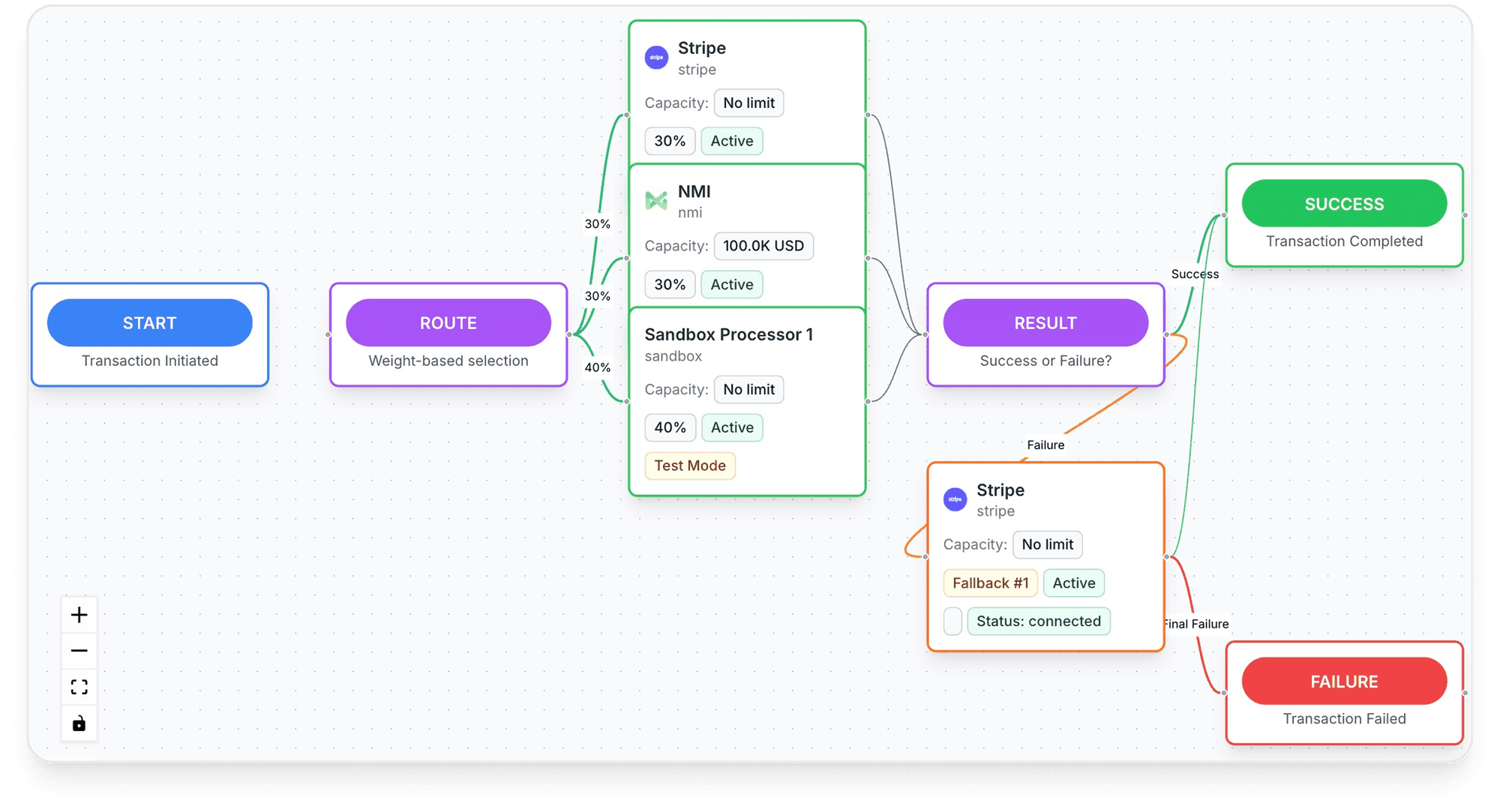
Inside Tagada
See every payment's route, processor by processor
Set the order your processors are tried in, per store, per country or per product.
Closed-loop cards: gift, store and private label cards
The second meaning is about where a card works.
Store gift cards
US law defines them as redeemable "at a single merchant or an affiliated group of merchants," reloadable or not. Single-brand gift cards sit here.
Private label cards
Visa defines one as "a merchant's proprietary card that is accepted only at its own locations." A store credit card is the closed loop credit card most people mean.
Campus and transit cards
Cards that pay inside one university, venue or transit system. Visa's rules mention "closed-loop proprietary college or university" transactions on US Campus Cards.
When a bank uses a Visa BIN for a private label program, Visa requires a "written acceptance agreement directly with each Merchant" that accepts the card (Visa Core Rules, April 2026, section 2.2.2.2).7Visa Core Rules and Visa Product and Service Rules, April 18, 2026
Compliance with regulations in closed loop
| Rule | United States | European Union |
|---|---|---|
| Law | Regulation E, 12 CFR 1005.20 (gift card rules) | PSD2, Article 3(k) |
| Status | Store gift cards are outside the "prepaid account" rules | Outside PSD2 under the limited network exclusion |
| Scope | One merchant or an affiliated group | Issuer's premises or a limited network under direct agreement |
| Key limits | Funds valid at least 5 years; inactivity fee only after 12 months, once a month | Notify the regulator above EUR 1 million in 12 months |
United States. The CFPB's prepaid account definition excludes gift certificates, store gift cards and loyalty or promotional cards (12 CFR 1005.2(b)(3)(ii)(D)).512 CFR 1005.2(b)(3), definition of prepaid account (Regulation E), eCFR The gift card rules still apply. Funds must last at least "five years after the date the gift certificate was initially issued, or the date on which funds were last loaded." A dormancy fee needs no activity "in the one-year period" before it, must be printed on the card, and can't be charged more than once a month.412 CFR 1005.20, Requirements for gift cards and gift certificates (Regulation E), eCFR
European Union. PSD2 excludes instruments that let the holder buy "only in the premises of the issuer or within a limited network of service providers under direct commercial agreement with a professional issuer." Above "EUR 1 million" in payments over the preceding 12 months, the issuer must notify its regulator, which decides whether the activity really qualifies.6Directive (EU) 2015/2366 (PSD2), Articles 3(k) and 37(2), text as adopted For the wider law, see PSD2.
What closed loop means for an online store
Accepting Amex is a separate agreement. Your Visa and Mastercard contract doesn't set your Amex price. American Express describes signing merchants as "agreeing on the discount rate (a fee charged to the merchant for accepting our cards)."1American Express Company, Form 10-K for fiscal year 2025, SEC (read October 14, 2026) Under OptBlue, the third-party acquirer sets it. Your price is in the contract. For four-party costs, see credit card interchange fees.
Selling your own gift cards makes you an issuer. You hold the balances and the rules above apply. See stored-value card.
"Closed loop card with API access and custom rules" usually means a restricted open-loop card. Stripe Issuing, for example, offers allowed_categories, blocked_categories, allowed_merchant_countries and spending limits per authorization or month.8Stripe Docs, Issuing spending controls (read October 14, 2026) The card still runs on Visa or Mastercard. See card issuing.
How Tagada helps
Payments that follow the card network rules
Tagada follows Visa and Mastercard rules and the laws that apply to payments.
Frequently asked questions
What is a closed loop payment system?
Is American Express a closed loop network?
What is a closed loop card?
Do closed-loop gift cards expire in the US?
What is the difference between open loop and closed loop payments?
Sources
Checked October 15, 2026- American Express Company, Form 10-K for fiscal year 2025, SEC (read October 14, 2026)
- Capital One, Capital One Completes Acquisition of Discover, press release, May 18, 2025 (SEC exhibit 99.1)
- Federal Reserve Board, approval of Capital One's application to merge with Discover Financial Services, April 18, 2025
- 12 CFR 1005.20, Requirements for gift cards and gift certificates (Regulation E), eCFR
- 12 CFR 1005.2(b)(3), definition of prepaid account (Regulation E), eCFR
- Directive (EU) 2015/2366 (PSD2), Articles 3(k) and 37(2), text as adopted
- Visa Core Rules and Visa Product and Service Rules, April 18, 2026
- Stripe Docs, Issuing spending controls (read October 14, 2026)
TagadaPay
Selling online with cards from every network? Run every processor from one checkout
Tell us what you sell and how you sell it. Each application is underwritten, and approval is not guaranteed.
- 01Tell us what you sell and how
- 02Underwriting reviews your business
- 03Process through TagadaPay alongside your other processors