
What Is a Stored Value Card?
Stored value card meaning: prepaid, not credit. Open vs closed loop, Visa's prepaid card definition, US and EU rules, and what merchants see at checkout.

Article summary
TL;DR
A stored value card is a payment card that holds money loaded in advance, instead of drawing on a bank account or a credit line. Gift cards, transit cards and prepaid Visa or Mastercard cards are all stored value cards. Each purchase reduces the balance, and when it reaches zero, payments are declined.
- A stored value card spends money loaded in advance. It is prepaid: not a debit card on a bank account, and not a credit card.
- Closed-loop cards work at one merchant or group. Open-loop cards carry a Visa or Mastercard brand and work wherever that brand is accepted.
- Visa defines a Prepaid Card as a Visa Card linked to a reloadable or non-reloadable pre-funded account.
- In the US, open-loop prepaid cards fall under the CFPB prepaid account rules. Store gift cards follow the separate gift card rules.
- Online, a merchant sees a prepaid card through its BIN, often shown by the processor as a funding type of prepaid.
 ChatGPT
 Claude
 Perplexity
 Grok
GrokOn this page
A stored value card holds money, not a link to it. That one fact decides which rules apply and what a merchant sees when the card pays.
What is a stored value card?
A stored value card is a payment card loaded with money before it is used. Every purchase lowers the balance. When the balance reaches zero, the card is declined. Common examples are gift cards, transit fare cards, payroll cards and prepaid cards carrying the Visa or Mastercard brand.
Stored value cards are prepaid, so a "stored value credit card" does not exist: no credit line sits behind the card. Card networks treat them as a product of their own. Visa's rulebook defines them this way:1Visa Core Rules and Visa Product and Service Rules, April 18, 2026
Prepaid Card: A Visa Card linked to a reloadable or non-reloadable pre-funded account, or a Prepaid Account or equivalent as defined under applicable laws or regulations.
A Reloadable Prepaid Card is one "that may be funded more than once" (ID# 0025059). For how prepaid compares with debit and credit cards, see debit card.
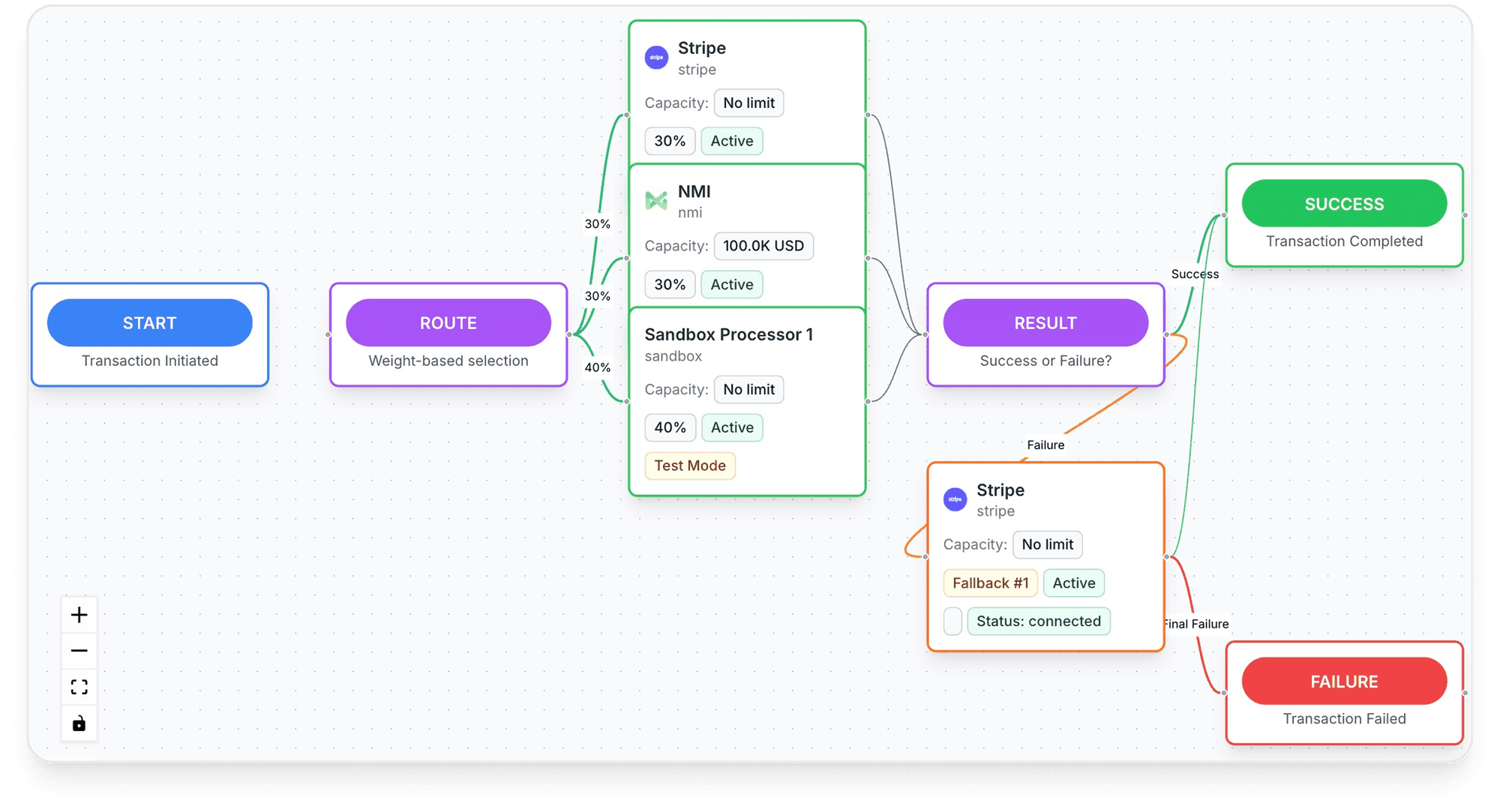
Inside Tagada
See every payment's route, processor by processor
Set the order your processors are tried in, per store, per country or per product.
Open-loop vs closed-loop stored value
| Closed-loop stored value | Open-loop stored value | |
|---|---|---|
| Examples | Store gift cards, transit cards, campus cards | Prepaid Visa or Mastercard, payroll cards |
| Where accepted | One merchant, an affiliated group or one transit system | Anywhere the card brand is accepted |
| US rule | Gift card rules, 12 CFR 1005.20 | Prepaid account rules, 12 CFR 1005.18 |
| EU rule | Can fall outside PSD2 (limited network exclusion) | Often e-money, under Directive 2009/110/EC |
United States. Regulation E counts as a "prepaid account" an account "marketed or labeled as 'prepaid'" that works "at multiple, unaffiliated merchants" or at ATMs. It excludes store gift cards and general-use prepaid cards "both marketed and labeled as a gift card" (12 CFR 1005.2(b)(3)).212 CFR 1005.2(b)(3), definition of prepaid account (Regulation E), eCFR, read October 14, 2026 Prepaid accounts get the disclosure and error rules of 1005.18.312 CFR 1005.18, requirements for financial institutions offering prepaid accounts (Regulation E), eCFR Gift cards keep their own rules, including funds valid for at least five years: see closed loop.
European Union. E-money is "electronically, including magnetically, stored monetary value" issued "on receipt of funds" and accepted by someone other than the issuer (Article 2). The holder can ask for it back "at any moment and at par value" (Article 11).4Directive 2009/110/EC (E-Money Directive), Articles 2 and 11, text as adopted For brands that add stored value to their own product, see embedded finance.
What a merchant sees when a prepaid card pays
The prepaid flag comes from the BIN. The first digits of the card number, the bank identification number, tell the processor the card type. Stripe, for example, returns card.funding as credit, debit, prepaid or unknown.5Stripe API reference, The PaymentMethod object, card.funding (read October 14, 2026)
Partial approvals are possible. Visa requires US issuers of Prepaid Cards to support partial authorization, card-present and card-absent (Visa Core Rules, April 2026, section 7.3.9.3). A merchant that opts in must clear "no more than the amount approved" and reverse the authorization if the buyer cancels (section 7.3.9.1).1Visa Core Rules and Visa Product and Service Rules, April 18, 2026
One-time cards don't fit subscriptions. When a merchant verifies a Non-Reloadable Prepaid Card for a recurring transaction, the issuer must decline with response code 57, "Transaction not permitted" (section 7.3.10.1).1Visa Core Rules and Visa Product and Service Rules, April 18, 2026 More on that check in zero-dollar authorization, and on failed renewals in subscription payment failures.
Transit stored value is closed loop. On LA Metro's TAP card, "Stored Value is a cash amount that you load on your TAP card to pay for single rides and transfers," up to $300 per card.6LA Metro TAP, TAP FAQs (read October 14, 2026) The card itself carries an expiration date (section 9.1).7LA Metro TAP, Cardholder Agreement, sections 9.1 and 9.2 (read October 14, 2026)
How Tagada helps
Payments that follow the card network rules
Tagada follows Visa and Mastercard rules and the laws that apply to payments.
Frequently asked questions
What is a stored value card?
Is a stored value card a debit card or a credit card?
What is a stored value Mastercard or Visa card?
Does TAP stored value expire?
Sources
Checked October 15, 2026- Visa Core Rules and Visa Product and Service Rules, April 18, 2026
- 12 CFR 1005.2(b)(3), definition of prepaid account (Regulation E), eCFR, read October 14, 2026
- 12 CFR 1005.18, requirements for financial institutions offering prepaid accounts (Regulation E), eCFR
- Directive 2009/110/EC (E-Money Directive), Articles 2 and 11, text as adopted
- Stripe API reference, The PaymentMethod object, card.funding (read October 14, 2026)
- LA Metro TAP, TAP FAQs (read October 14, 2026)
- LA Metro TAP, Cardholder Agreement, sections 9.1 and 9.2 (read October 14, 2026)
TagadaPay
Accept prepaid, debit and credit cards through one checkout
Tell us what you sell and how you sell it. Each application is underwritten, and approval is not guaranteed.
- 01Tell us what you sell and how
- 02Underwriting reviews your business
- 03Process through TagadaPay alongside your other processors