
What Is the Honor All Cards Rule?
The Honor All Cards rule in Visa's own words (section 1.5.4.2), where merchants may accept only some cards (US, Canada, EU), and what they can't do.

Article summary
TL;DR
The Honor All Cards rule is a card network rule that requires a merchant who accepts a network's cards to accept every valid card of that brand properly presented, whatever bank issued it. Visa states it in section 1.5.4.2 of its rules. The US, Canada, Australia and Europe let merchants limit acceptance to some card categories, such as debit only.
- Visa's rule is one line: "A Merchant must accept all Cards properly presented for payment" (Visa Core Rules, section 1.5.4.2).
- It has two sides: honor all issuers (any bank's card) and honor all products (credit, debit, prepaid). Regulators have only ever loosened the second.
- In the US you can accept Visa credit or Visa debit and not the other. In the EEA and UK, EU Regulation 2015/751 lets you refuse whole categories, if you tell customers first.
- Foreign-issued cards must always be accepted, even by a merchant that limits its acceptance.
- Steering customers to a cheaper payment method is allowed. Refusing a valid card, or setting a minimum outside the US credit exception, is not.
 ChatGPT
 Claude
 Perplexity
 Grok
GrokOn this page
If a shop shows the Visa logo, you can pay with any Visa card. That promise is the Honor All Cards rule. Here is what Visa's rules actually say, section by section, the places where merchants may accept only some cards, and what you can and can't do around it.
What is the Honor All Cards rule?
The Honor All Cards rule is a card network rule: a merchant that chooses to accept a network's cards must accept every valid card of that brand. It's set by the networks, written into the merchant agreement by the acquirer, and Visa calls it exactly that, "Honor All Cards".1Visa Core Rules and Visa Product and Service Rules, April 18, 2026
A Merchant must accept all Cards properly presented for payment. [...] A Merchant may not refuse to accept a Visa product that is properly presented for payment (for example: a Card that is foreign-issued or co-branded with the Merchant's competitor's Mark).
The Reserve Bank of Australia split the rule in two. Honor all issuers: you accept a Visa card whichever bank issued it. Honor all products: you accept credit, debit and prepaid alike. The rule began as the first part, when Visa only issued credit cards, and gained the second as Visa added debit and prepaid.3Reserve Bank of Australia, Reform of the EFTPOS and Visa Debit Systems in Australia, February 2005, chapter 3: The Honour All Cards Rule Regulators have accepted the first and loosened the second.
The rule works inside one network. Choosing not to accept a network at all is a different decision, and nothing in Visa's rules forces you to take every brand.
Not to be confused with an "honour card" in bridge: one of the five highest trumps, or the four aces with no trump.5Dictionary.com, honor (card games)
What Visa's rules say, section by section
Card acceptance sits in section 1.5.4 of the Visa Core Rules, April 2026 edition.1Visa Core Rules and Visa Product and Service Rules, April 18, 2026
| Section | What it says |
|---|---|
| 1.5.3.1 | A merchant displays the Visa marks for the cards it accepts. A limited acceptance merchant must not show a graphic meaning "all Visa cards". |
| 1.5.4.1 | Showing Visa acceptance marks means agreeing to accept the matching Visa products. |
| 1.5.4.2 | The rule itself, its exceptions, and the right to steer customers "but not in a manner that denies consumer choice". |
| 1.5.4.3 | Canada: accept any valid Visa card, unless the merchant elected to accept only Visa debit or only Visa credit. |
| 1.5.4.4 | US: accept any valid Visa card "in its category of acceptance". The merchant may encourage another payment method. |
| 1.5.4.6 | Limited acceptance in Europe and the US, and the duty to accept cards issued abroad. |
| 1.5.4.7 | The acquirer registers each limited acceptance merchant with Visa. |
| 1.5.4.10 | Process every cardholder the same way, except discounts and promotions offered to a subset of Visa cards. |
Section 1.5.4.2 lists the exceptions: contactless-only terminals, merchants that only take mobile push payments, certain categories of domestic cards in Australia, Canada and the US, and certain product categories in the EEA and UK. It also lets a merchant weigh "undue risk", for example a high-value sale on an unsigned card with no other ID.1Visa Core Rules and Visa Product and Service Rules, April 18, 2026
Where you may accept only some cards
| Region | What you can limit | What you must still accept |
|---|---|---|
| United States | Accept Visa credit (with business cards) or Visa debit, not both (1.5.4.6 and Visa's definition of Limited Acceptance) | Every card in the category you chose, and any valid card issued outside the US |
| Canada | Elect to be a Visa Debit Acceptor or a Visa Credit Acceptor (1.5.4.3) | All other valid Visa cards, including cards issued outside Canada (5.4.1.1) |
| Australia | Certain categories of domestically issued cards (1.5.4.2) | Foreign-issued cards |
| EEA and UK | Accept some product categories only: credit, debit, prepaid. Commercial cards are optional (1.5.4.6) | Every card of the categories you accept, whatever the issuer, and any valid card issued outside the EEA (or outside the UK) |
The US split dates from the litigation led by Wal-Mart. The networks settled by paying $3 billion, lowering debit interchange and untying debit from credit. US debit cards then became "subject to separate acceptance decisions by US merchants".3Reserve Bank of Australia, Reform of the EFTPOS and Visa Debit Systems in Australia, February 2005, chapter 3: The Honour All Cards Rule
In the EU, the split is the law. Article 10 of Regulation 2015/751 forbids scheme rules that oblige a merchant accepting one card to accept the scheme's other cards, except consumer cards of the same brand and the same category (prepaid, debit or credit). Networks can still require that no card is refused because of who issued it. The article has applied since June 9, 2016.2Regulation (EU) 2015/751 on interchange fees for card-based payment transactions, Articles 10, 11 and 18
EU: tell customers before they buy
A merchant that doesn't accept all cards of a scheme must say so clearly, at the same time as it shows the cards it accepts. Online, that means on the website, in good time before the customer commits to buy (Regulation 2015/751, Article 10(4)).2Regulation (EU) 2015/751 on interchange fees for card-based payment transactions, Articles 10, 11 and 18
How limited acceptance works
- Choose with your acquirer. Limited acceptance is an option in your merchant agreement, not a setting you switch on alone.
- Your acquirer registers you. In Europe and the US, the acquirer registers each limited acceptance merchant with Visa. In the US it also reports on them.
- Show only what you take. Display the marks of the categories you accept, never a Visa graphic meaning "all cards".
- Inform customers early. In the EEA, on your site before checkout, next to the cards you do accept.
- Keep foreign cards on. A card issued outside your region must still be accepted.
Visa Core Rules, April 2026, sections 1.5.3.1, 1.5.4.6 and 1.5.4.7; Regulation (EU) 2015/751, Article 10.
Inside Tagada
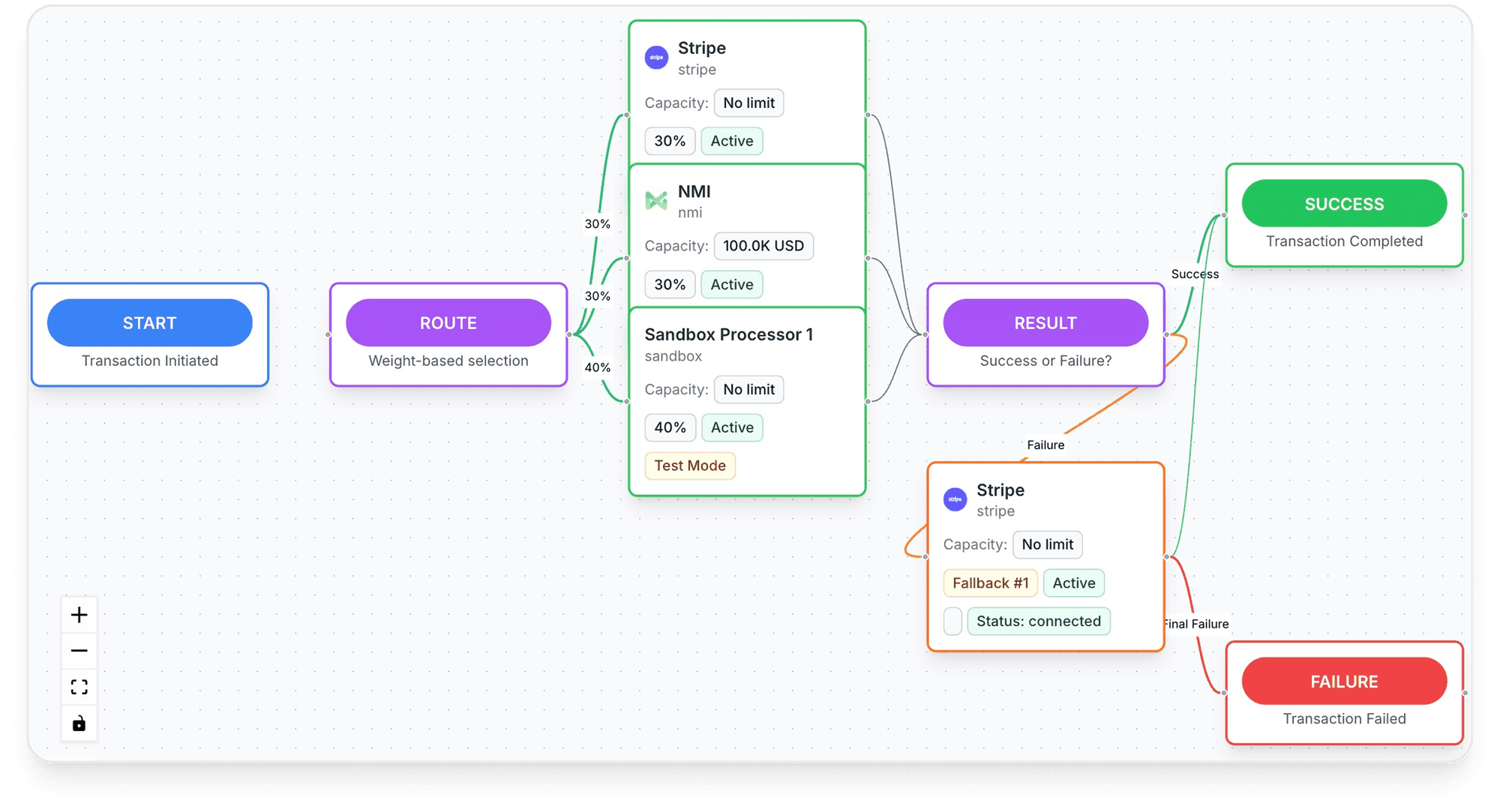
See every payment's route, processor by processor
Set the order your processors are tried in, per store, per country or per product.
What merchants can and can't do
| Practice | Under Visa's rules |
|---|---|
| Refuse a foreign card or a card co-branded with a competitor | ProhibitedVisa gives both as examples (1.5.4.2) |
| Refuse a premium rewards card while accepting other Visa credit cards | ProhibitedUnder current rules. The US settlement would change this once final |
| Steer customers to another payment method, offer a discount | AllowedAs long as the customer keeps the choice (1.5.4.2, and 1.5.4.11 in the US) |
| Set a minimum purchase | ProhibitedExcept up to $10 on US-issued credit cards (1.5.5.1, 5.4.2.4). EEA and domestic UK sales are outside the rule |
| Set a maximum purchase | ProhibitedExcept on US-issued credit cards at US federal agencies and schools: MCC 8220, 8244, 8249 (5.4.2.3) |
| Add a surcharge | ConditionalOnly where the law requires it to be permitted, plus regional exceptions such as US credit cards (1.5.5.2) |
| Decline a sale that carries undue risk | ConditionalVisa lets merchants weigh undue risk (1.5.4.2) |
In the EU, Article 11 of Regulation 2015/751 also bans any scheme or acquirer rule that stops merchants from steering customers to the payment method they prefer.2Regulation (EU) 2015/751 on interchange fees for card-based payment transactions, Articles 10, 11 and 18 Surcharging has its own rules in each country and network: see our guide to credit card surcharges.
What's changing in the US
Visa and Mastercard's settlement with US merchants would loosen the rule for credit cards. According to Visa, merchants "will be able to choose whether to accept U.S. credit cards in distinct categories": commercial, premium consumer and standard consumer. They would also get more room to surcharge.4Visa, Statement on preliminary approval of the MDL settlement, June 9, 2026
The court granted preliminary approval on June 9, 2026. The settlement is still subject to final approval, so Visa's April 2026 rules above still apply.4Visa, Statement on preliminary approval of the MDL settlement, June 9, 2026 The other terms, including a cap on standard credit interchange, are in our guide to interchange fees.
What it means for an online store
Honoring all cards doesn't mean approving every payment. The rule covers your decision to accept a card. The issuer can still decline, and your fraud checks can still stop a risky order. What you can't do is turn away a valid card because of its type or its bank, outside the limited acceptance options above.
Check three things: your checkout shows only the card marks you accept; any rule that blocks cards by BIN, country or card level is a fraud rule, not a cost rule; and if you limit acceptance, your acquirer has registered it.
Where Tagada fits
How Tagada helps
Every card, routed to the right processor
Tagada's checkout takes cards, Apple Pay and Google Pay, and routes payments across Stripe, Adyen and Tagada's own TagadaPay processor with one logic, with a cascade on decline. Routing decides which processor handles a card, not whether you honor it. Native 3DS2, device intelligence and a rules engine stop risky orders, not card types. Tagada follows Visa and Mastercard rules and the laws that apply to payments.
Frequently asked questions
What is the Honor All Cards rule?
What are honor cards, and what does "honour card" mean?
How does Mastercard ensure global acceptance for premium cards?
Can a merchant refuse a premium or rewards card?
Can I set a minimum purchase for card payments?
Why does TagadaPay appear on my card statement?
Sources
Checked October 15, 2026- Visa Core Rules and Visa Product and Service Rules, April 18, 2026
- Regulation (EU) 2015/751 on interchange fees for card-based payment transactions, Articles 10, 11 and 18
- Reserve Bank of Australia, Reform of the EFTPOS and Visa Debit Systems in Australia, February 2005, chapter 3: The Honour All Cards Rule
- Visa, Statement on preliminary approval of the MDL settlement, June 9, 2026
- Dictionary.com, honor (card games)
TagadaPay
Take every card your customers bring, across several processors
Tell us what you sell and how you sell it. Each application is underwritten, and approval is not guaranteed.
- 01Tell us what you sell and how
- 02Underwriting reviews your business
- 03Process through TagadaPay alongside your other processors