

The most popular A/B testing advice starts with a page, a button, and a conversion rate. That's a useful introduction to experimentation, but it's a weak operating model for ecommerce. A checkout variant isn't a commercial winner just because more shoppers reach the confirmation screen.
A useful A/B testing guide starts with a harder question: does the change produce more profitable, successfully collected revenue? Answering that requires connecting customer behavior to payment authorization, refunds, disputes, and, for subscriptions, subsequent rebills.
Why Most A/B Tests in Ecommerce Don't Move Revenue
The wrong primary metric can turn a technically valid experiment into a bad business decision. A significant increase in completed checkouts tells you about that outcome, not automatically about payment quality or profitability.
Conventional A/B testing compares a control with a treatment through random allocation. That design supports causal interpretation when assignment and measurement remain sound, as explained in this analysis of A/B testing methodology. But randomization can't rescue a metric that doesn't answer the business question.
When a conversion win becomes a revenue loss
Consider these hypothetical scenarios, not reported case studies:
- DTC supplement brand: A prominent upsell increases order completion, but shifts purchases toward lower-margin bundles. The merchant needs contribution profit, not merely more orders.
- Subscription box: A shorter checkout increases initial signups while making recurring terms less clear. Later cancellations or disputes could erase the apparent benefit.
- High-risk merchandise seller: A less restrictive payment flow produces more completed orders but also more disputed transactions. Gross conversion improves while collectible revenue deteriorates.
The distinction between surface changes and payment-funnel changes is useful when prioritizing work.
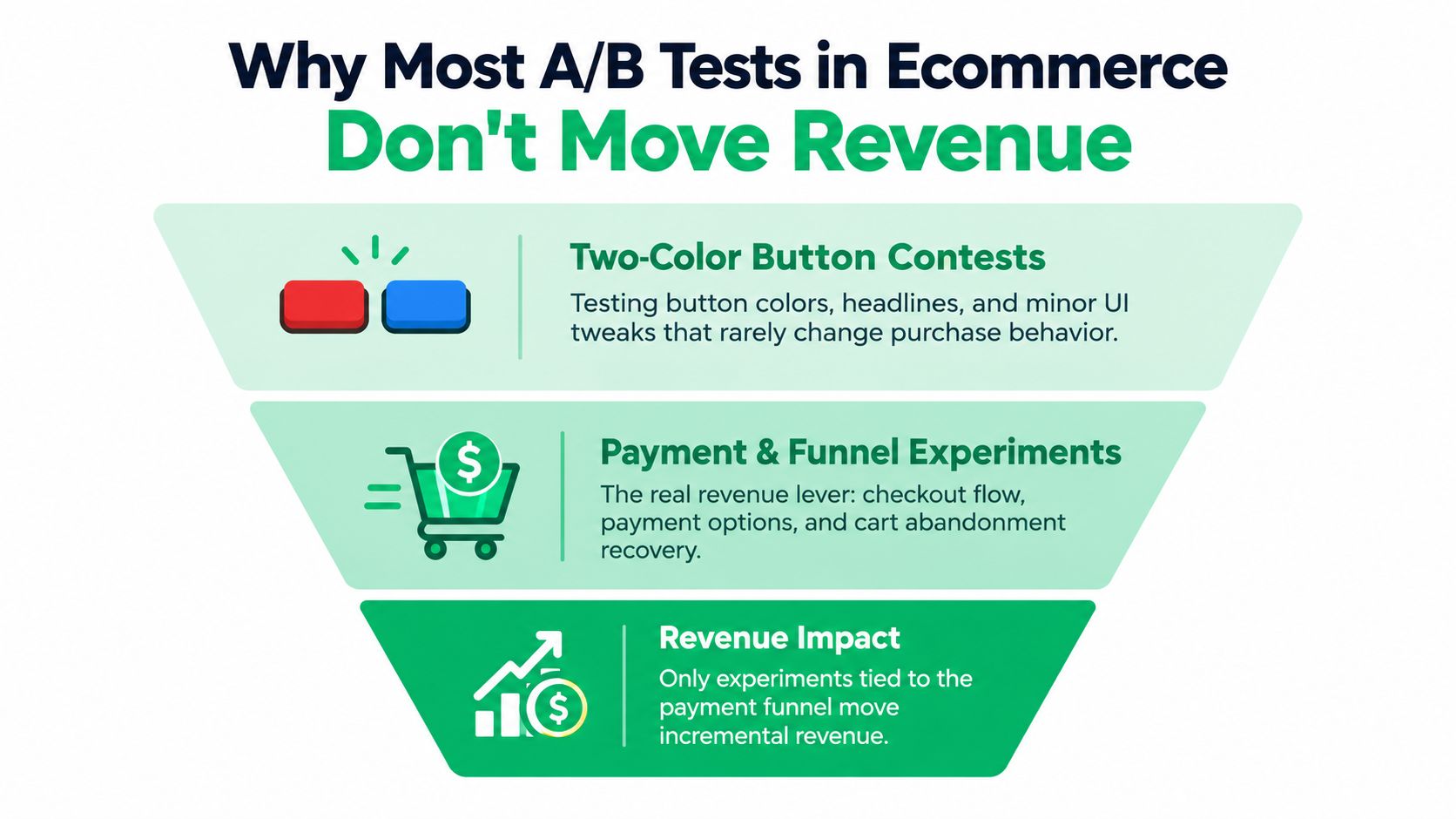
Don't interpret that prioritization as a ban on design tests. A headline or button can matter when it addresses a real purchasing obstacle. MD TECH TEAM's A/B testing tips for your site can complement the commercial framework when you're developing website-level ideas.
Choose outcomes that survive collection
My recommended starting point is incremental approved revenue per eligible shopper, with payment fees, refunds, disputes, and fulfillment costs incorporated when contribution data is available. Accompany it with authorization rate, completed orders, payment-method mix, retry recovery, refunds, chargebacks, and subscription retention.
There's meaningful opportunity beyond the initial purchase. A subscription payment-recovery benchmark puts involuntary churn at 20%–40% of total subscription churn, with approximately 6% of monthly recurring revenue lost without active recovery versus about 1% with smart retries and dunning.
Practical rule: Optimize the transaction lifecycle, not just the screen where the customer clicks.
That means treating hypothesis design, sample sizing, instrumentation, financial interpretation, rollout, and the final decision checklist as parts of the same revenue process.
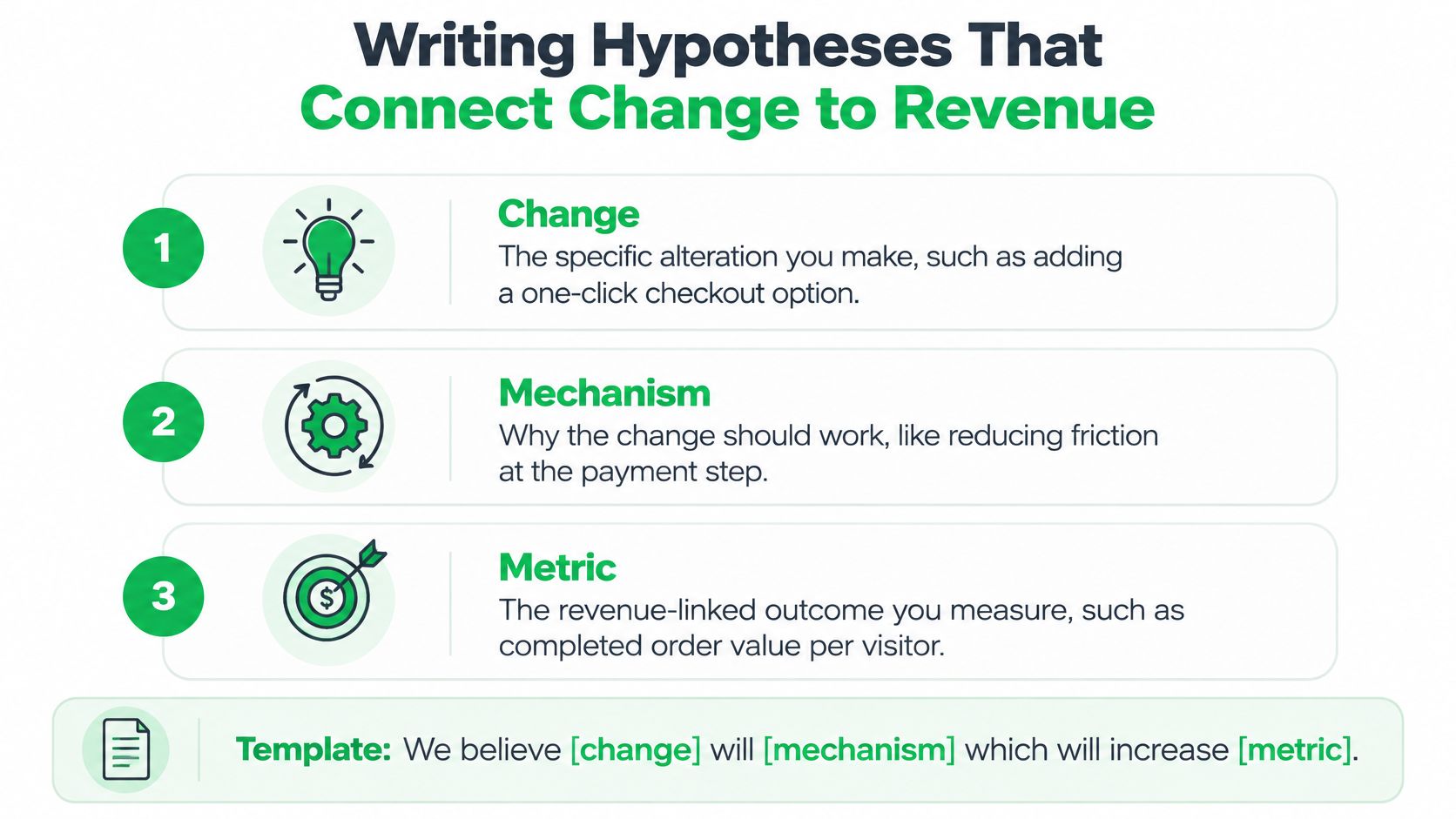
Writing Hypotheses That Connect Change to Revenue
“Test a new checkout” describes a project. It doesn't identify what you expect to learn.
A useful hypothesis specifies change, mechanism, and metric. The change defines the treatment. The mechanism explains why a shopper or payment system should respond differently. The metric identifies the observable consequence that would support the hypothesis.
Use this template to separate those elements before anyone starts building.
Write the commercial mechanism explicitly
A buy now, pay later upsell at the cart might reduce the immediate affordability barrier. The hypothesis should predict higher contribution per eligible shopper after financing costs, not just higher payment-method adoption.
An express-checkout button on the product detail page might remove unnecessary navigation for returning buyers. Measure approved revenue across everyone assigned to the experience, including people who don't click the button.
A trust-badge redesign at payment might reduce uncertainty about security or fulfillment. Keep the claim narrow: you're testing that presentation, not proving that badges universally increase trust.
For failed rebills, a revised dunning email cadence might help customers update payment details before canceling. Evaluate recovered net revenue and subsequent retention rather than email clicks. These ecommerce A/B testing examples provide additional starting points for framing candidate experiments.
Turn the hypothesis into a decision contract
Record these fields in the experimentation tool:
- Treatment boundary: What changes, and what must remain unchanged?
- Eligible population: Which shoppers, transactions, or failed invoices qualify?
- Primary outcome: What business metric determines success?
- Economic hurdle: What improvement would justify implementation and maintenance?
- Decision conditions: What evidence supports launch, rejection, or further investigation?
Pre-register the primary metric, minimum detectable effect, allocation, duration, and decision rule. A commonly used design target is 80% power with a 5% two-sided Type-I error rate, as described in SAS guidance on experiment sizing.
A visual walkthrough can help teams discuss the experiment before implementation.
<iframe width="100%" style="aspect-ratio: 16 / 9;" src="https://www.youtube.com/embed/ZNoERrM8uoI" frameborder="0" allow="autoplay; encrypted-media" allowfullscreen></iframe>
The hypothesis should also define a useful failure. If customers adopt the new payment method but profit doesn't improve, you've learned that adoption wasn't the commercial bottleneck. That's more actionable than recording an unexplained losing variant.
Sample Sizing, Duration, and Randomization That Hold Up
Ecommerce teams often size tests backward. They look at weekly traffic, decide the experiment can run for two weeks, and treat whatever effect that window can detect as the target. The logic should run the other way: the question sets the sample size, and the sample size sets the calendar.
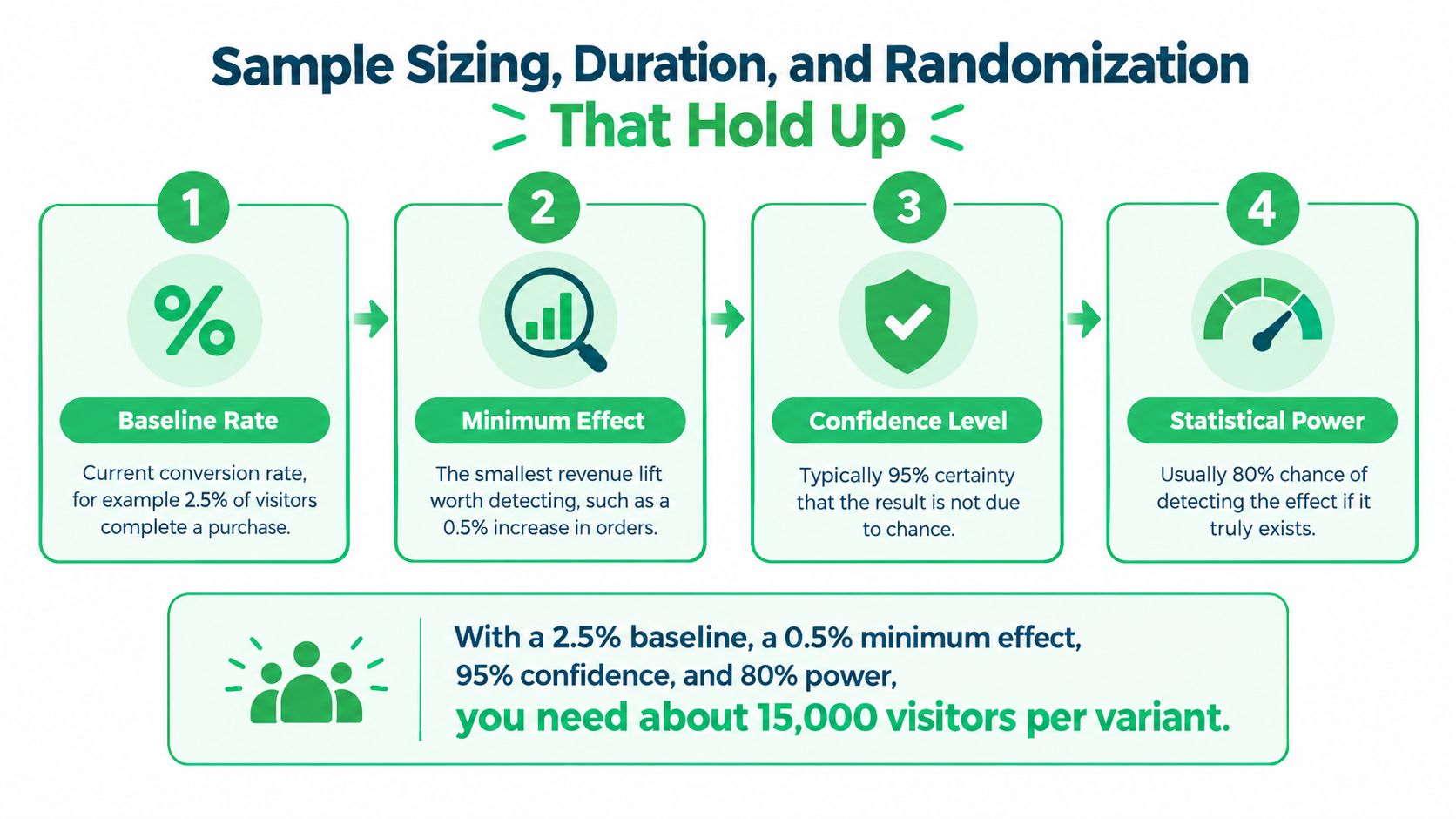
For a binary outcome, specify the baseline rate, minimum detectable effect, significance level, and statistical power. Pull the baseline from the eligible population, not the whole storefront. A payment-authorization experiment and a visitor-to-purchase experiment have different denominators, so they need separate calculations.
The inputs fit together as follows.
Choose an effect worth detecting
Minimum detectable effect isn't your forecast. It's the smallest improvement your design is intended to detect reliably, and you set it from implementation cost, operating expense, and commercial upside before looking at any results.
For a concrete sizing benchmark, the SAS example discussed above required 12,744 visitors per variant for 85% power to detect a 0.6-percentage-point response-rate improvement. That's a response-rate example, not a reusable requirement for every checkout.
Revenue and profit outcomes need an analysis appropriate to their distributions. Feeding a conversion-rate baseline into a calculator and assuming the output also powers revenue per visitor is a common way to underpower the metric that actually matters. Have the analyst account for transaction-value variation and the possibility of unusually large orders.
Assignment has to survive the funnel
Randomize at the user or session level according to the treatment's scope. For persistent checkout experiences, a stable shopper identifier is preferable where feasible; page-view randomization lets the same customer meet conflicting versions of the flow. Carry the experiment identifier into checkout, payment attempts, and subsequent order records so assignment survives the steps that produce revenue. Before interpreting outcomes, compare planned against observed group sizes, and define bot and internal-traffic exclusions before launch rather than after a suspicious result. Schedule the run to cover relevant business cycles, and document how promotions or seasonal campaigns change eligibility.
An A/B testing plan from Netco Design is a useful planning reference when turning these decisions into a launch document.
A longer experiment doesn't fix broken assignment, and additional traffic doesn't fix the wrong outcome.
Launching an evergreen-flow test immediately before a promotion only makes sense if promotional traffic belongs in the question. If a campaign changes eligibility midway, preserve the original analysis population and document the interruption.
One more rule worth stating plainly. Don't extend a weak experiment until it becomes favorable. Any extension should follow a documented conditional-power or sequential design, not a stakeholder's preference for a positive result.
Server-Side Versus Client-Side Tracking for Funnel Tests
A checkout treatment once looked like a winner on the experiment dashboard. Browser events showed more shoppers reaching the "Pay" click. The processor ledger told a different story: authorized revenue was flat, retries were up, and the winning variant had merely made a slow payment attempt look like progress.
Intent lives in the browser. Money lives in the backend.
That split is the instrumentation model I'd recommend for any funnel experiment: client-side events to explain what shoppers experienced, server-side records to establish what the business collected. A click on "Pay" signals intent, and a confirmation-page view is a rendering event. Neither substitutes for an order record when deciding whether a payment change worked.
Split the layers by the question each can answer
| Dimension | Client-Side | Server-Side |
|---|---|---|
| Collection point | Browser scripts and pixels | Application backend and payment-event handlers |
| Best role | Interaction and presentation diagnostics | Payment and order outcome measurement |
| Privacy and delivery considerations | Design around browser restrictions, iOS privacy settings, ad blockers, and navigation | Still requires consent controls, identity handling, and reliable delivery |
| Attribution | Useful browser context, potentially incomplete journeys | Can preserve experiment-to-order joins when identifiers are implemented correctly |
| Engineering effort | Often convenient for interface work | Requires event contracts, deduplication, and reconciliation |
| Latency | Useful for immediate interaction feedback | Must accommodate asynchronous processor notifications |
Server-side collection is not automatically complete. A backend integration can drop events, duplicate processor notifications, or join a transaction to the wrong assignment, so read the table as a division of labor rather than a verdict.
Wire the payment chain so finance can audit it
Wherever the application owns a transition, record it on the backend: checkout_start, payment_attempted, payment_authorized, order_confirmed, refund, and chargeback. Element visibility, field interactions, and presentation errors stay client-side as diagnostics.
Four disciplines keep that chain trustworthy. Attach the experiment assignment to the shopper, the order, and each payment attempt so the join survives retries. Separate a retried processor notification from a genuinely new payment attempt, since deduplication failures inflate both volume and approval rates. Reconcile experiment totals against processor and order-system records before calling a result. Preserve permitted acquisition context, but never confuse ad-platform attribution with randomized assignment; the two answer different questions.
This server-side versus client-side tracking comparison is useful when scoping the implementation. For a separate post-purchase workflow, the Bragly review funnel calculator can support review-funnel planning, though it doesn't replace payment reconciliation.
Payment credentials deserve their own treatment definition. An authorization-optimization benchmark reports acceptance improvements of up to 15% for network-tokenized transactions versus non-tokenized transactions from the same card cohort, an upper benchmark rather than an expected lift. To isolate credential effects, hold processor, currency, fraud controls, and retry policy constant. If routing also changes, describe the treatment as a combined payment strategy rather than claiming the token alone caused the result.
Reading Results the Way a CFO Would
A checkout variant ships, the experiment platform flags it a winner on approved orders, and finance asks the one question the dashboard never answered: how much of that money survives refunds, disputes, and the cost of running the new flow. Plenty of ecommerce readouts fall apart in that gap between a green arrow and a bank statement.
The review therefore starts with reconciliation rather than the platform's winner label. Assignments, eligible shoppers, payment records, and observation windows all have to match the design before any estimate deserves attention. Only then does the harder question apply: is the effect large enough to matter after the business pays for it? Statistical evidence and economic value are separate requirements, and a result can pass the first while failing the second.
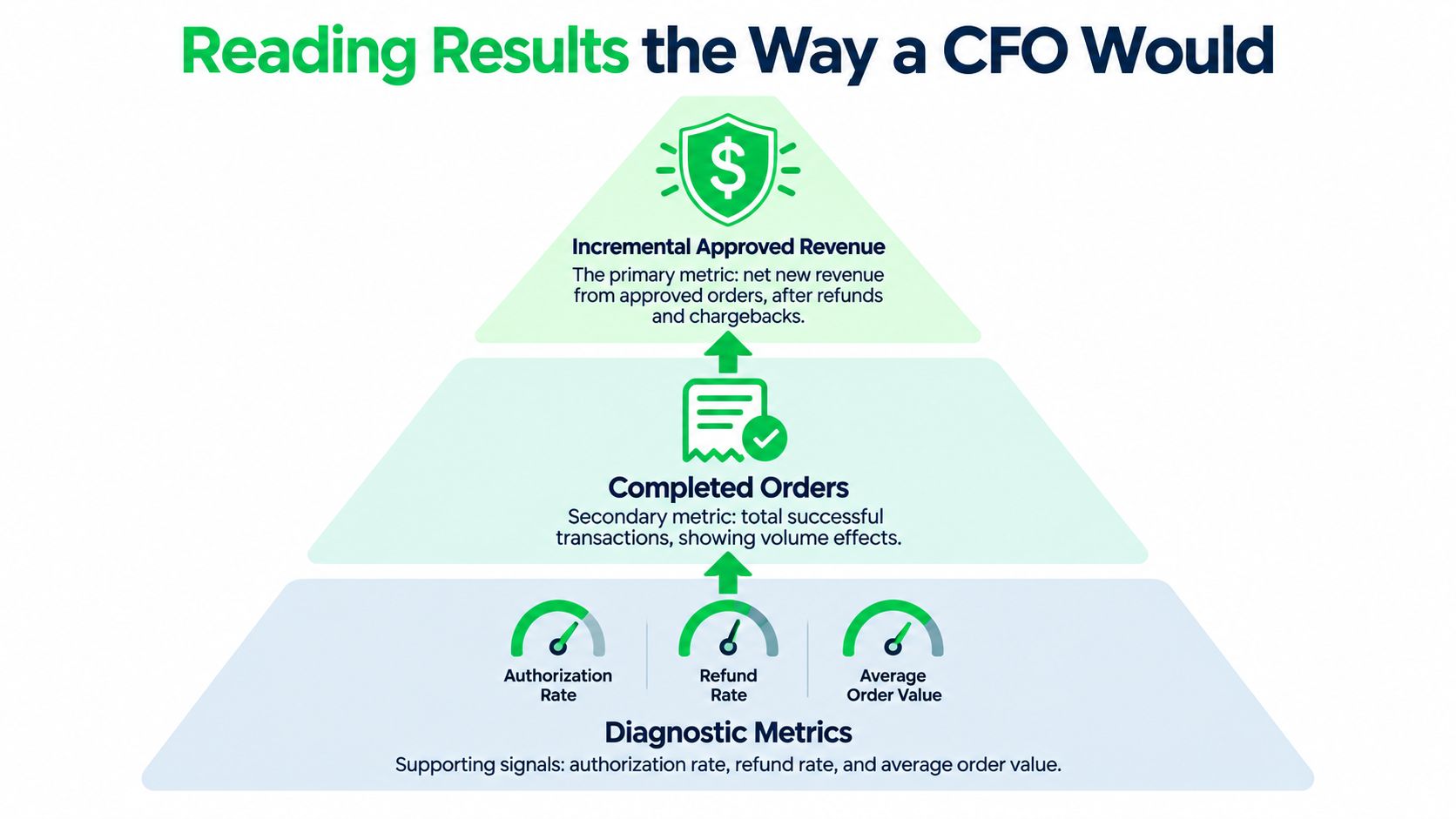
Approved revenue is only the first financial outcome in that hierarchy. Net revenue incorporates subsequent reversals, while contribution profit also accounts for relevant variable costs. Using the labels interchangeably, or letting a dashboard treat immature orders as if they had already survived refunds and disputes, overstates whatever the treatment earned. For subscriptions, compare cohorts at the same age; an older control cohort accumulates more cancellations because it has been observed longer, so provisional and mature outcomes belong in separate rows.
A written decision record keeps the review honest:
| Evidence | Decision question |
|---|---|
| Primary effect estimate | Is the expected improvement commercially worthwhile? |
| Confidence interval | Does uncertainty still include materially harmful outcomes? |
| Operational guardrails | Did the treatment violate an agreed safety constraint? |
| Outcome maturity | Have relevant reversals and rebills had time to appear? |
| Implementation burden | Does the benefit justify ongoing complexity? |
The confidence-interval row does most of the work in practice. A nominally positive result whose interval still includes meaningful downside is a case for more data or a holdback, not a launch decision. A binary significant-or-not flag hides exactly the information a CFO would ask for first.
Treat alerts and decisions as different jobs
Microsoft researchers catalog repeated significance checks, metric-selection errors, Simpson's paradox, and interacting experiments among common online-experiment interpretation pitfalls. Stopping a test whenever p < 0.05 inflates the Type-I error rate, which is why peeking produces so many winners that revert after rollout.
Monitoring deserves its own thresholds, set before launch rather than negotiated after a bad week. Payment safety means pausing on severe deterioration in authorization or failed-payment outcomes. Experience safety means investigating checkout errors and latency against predefined limits. Financial safety means escalating adverse movement in refunds, fraud reports, or chargebacks. Any one of those can halt a test regardless of what the primary metric is doing.
Subgroup reads play a different role again. Inspecting processor, country, device, acquisition source, and customer tenure explains behavior; it does not produce a winner. Declare a targeted effect only when the interaction was pre-specified and adequately powered, and label everything else exploratory. The same discipline belongs in broader ecommerce analytics, where diagnostics clarify a result without replacing the primary decision rule. An indeterminate outcome is a legitimate conclusion, and treating it as an invitation to pick a more flattering metric is how test programs lose credibility with the people who approve rollout budgets.
Rolling Out Winners Without Killing a Good Idea
Shipping a treatment changes its operating conditions. A variant that looked healthy under limited exposure still needs an operational release plan.
Use a controlled ramp to verify functionality before increasing exposure. Name the person who can pause the release, the engineer who can restore the previous flow, and the analyst responsible for confirming that records remain comparable.
Make the ramp a release contract
- Begin with limited exposure: Verify assignment persistence, payment callbacks, event joins, and checkout behavior.
- Expand toward the planned allocation: Proceed only after operational checks pass, rather than reacting to an encouraging revenue chart.
- Document dependencies: Record processor configuration, fraud rules, messaging, and concurrent checkout changes.
- Keep a holdback where justified: Preserve a randomized comparison for downstream outcomes, with its own analysis plan and maintenance owner.
For subscription businesses, maintain assignment through recovery and rebilling. A checkout treatment may produce different credentials, consent quality, or payment-method choices whose economic consequences appear later.
A subscription payment-failure benchmark reports that failure rates can peak at 14% and that 63% of failed initial charges are recoverable through retry logic. The practical implication is to distinguish the first decline from the final collected outcome.
Roll back on explicit operational evidence
Configure release triggers around severe payment failures, duplicate charges, broken consent capture, unexpected refunds, and dispute deterioration. Document the measurement window and escalation owner for each trigger; “watch the dashboard” isn't an operating procedure.
High-risk merchants need especially conservative constraints. A summary of Mastercard's Excessive Chargeback Program describes the Excessive Chargeback Merchant tier as 100 chargebacks per month combined with a 1.5% ratio, and the High Excessive tier as more than 300 chargebacks with a 3.0% ratio. Verify applicable program terms with your acquirer, and don't treat those thresholds as safe experimentation targets.
Release discipline: A commercially promising idea can still need a technical rollback. Preserve the hypothesis while fixing the implementation.
After a rollback, separate treatment failure from delivery failure. Broken callbacks don't prove the payment proposition was wrong. Conversely, a technically flawless release doesn't justify continuing a treatment that produces worse-quality revenue.
Archive the decision, configuration, unresolved risks, and downstream follow-up date so the next team doesn't repeat the same uncertainty.
Quick-Reference Checklist and Common Questions
An experiment is ready when the team can describe not just what it will launch, but how it will recognize a trustworthy answer. Use this checklist as a release review, not an administrative form.
Before launch
- Hypothesis registered: The change, mechanism, eligible population, and commercial outcome are explicit.
- Design approved: The randomization unit, assignment persistence, sample requirements, and analysis method fit the question.
- Measurement reconciled: The primary event joins reliably to payment and order records.
- Safety limits assigned: Every guardrail has an owner and an escalation action.
- Decision rule written: Launch, rejection, and indeterminate outcomes are defined before exposure.
During and after the experiment
- Data quality checked: Allocation, identifiers, exclusions, and event delivery behave as expected.
- Changes logged: Promotions, processor changes, incidents, and overlapping releases remain visible.
- Results matured: Cohorts receive comparable observation windows for relevant financial outcomes.
- Release documented: The ramp, rollback path, holdback, and follow-up analysis have named owners.
- Learning preserved: Record what the result supports, what it doesn't establish, and the next decision.
Is sequential testing acceptable when frequent monitoring is necessary?
Yes, if you choose a sequential method before launch and follow its decision boundaries. It's not equivalent to repeatedly reading an ordinary fixed-horizon p-value.
Keep operational monitoring separate from efficacy decisions. The statistical process described under results interpretation governs when you can claim improvement; incident procedures govern when you must protect customers and revenue.
What should a low-traffic merchant do?
Change the decision design instead of lowering the evidence standard. An Adobe discussion of A/B testing pitfalls gives an example where detecting a 10% relative improvement, from 2.0% to 2.2%, may require about 38,000 visitors per variant.
Prioritize larger, evidence-backed changes, extend observation across relevant business cycles, and use customer research or staged releases when a conventional experiment is impractical. Revenue or profit may better express the business question, but switching metrics doesn't automatically solve inadequate power. Label underpowered findings directional.
What if the result is significant but the revenue impact is tiny?
Compare the estimated benefit with the economic hurdle established in the hypothesis. Include payment expense, implementation effort, operational risk, and maintenance.
A small effect can be worthwhile at sufficient scale, but significance alone doesn't justify complexity. If the expected commercial gain doesn't clear the hurdle, retain the simpler experience and record the learning.
Tagada offers an experimentation layer connecting checkout, payment routing, messaging, A/B testing, and server-side tracking. If you're evaluating tools alongside your current experimentation stack, visit Tagada to explore how to test a checkout or rebill hypothesis against payment outcomes and downstream revenue.