
A global cart-abandonment rate of approximately 81% sounds like a checkout crisis. It isn't: the figure includes shoppers who added a product but never began checkout, as well as people who left after encountering friction near payment. Treating both groups as one metric can steer merchants toward reminder campaigns when the underlying issue is a failed or unreliable transaction.
The distinction in abandoned cart vs abandoned checkout is more than terminology. It determines which behavior you measure, which denominator you use, and whether the next action should be a product reminder, a checkout fix, or payment recovery.
Why the Headline Abandonment Rate Misleads Most Merchants
Statista's figures put global online cart abandonment at approximately 81% in Q4 2024, with Canada at 87%. These are cart-abandonment rates, not checkout-failure rates. A shopper can leave after adding a product without entering an address or selecting a payment method, so the headline combines browsing and comparison shopping with exits closer to purchase. Statista's Q4 2024 cart-abandonment figures
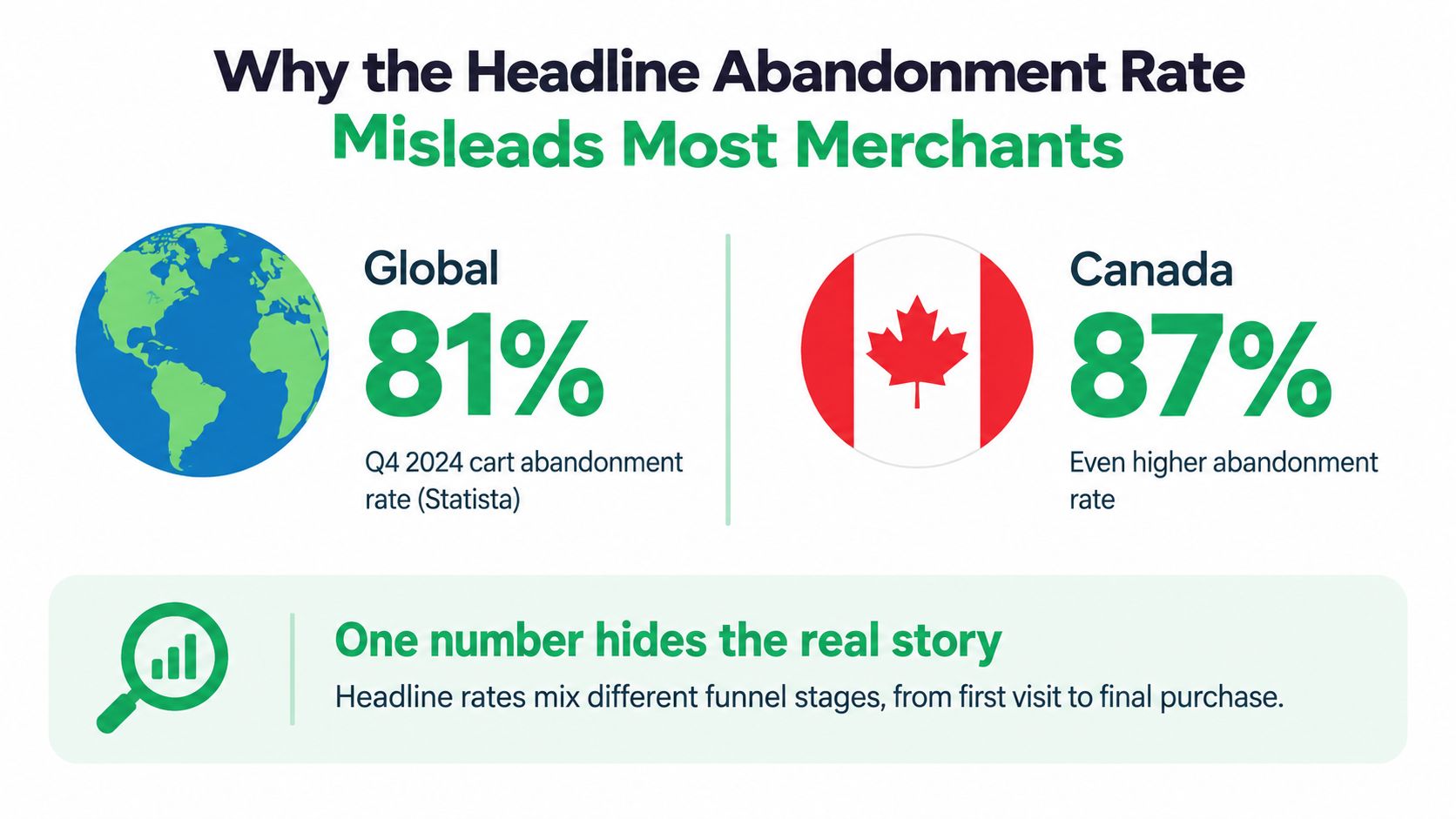
The distinction matters because an abandoned cart does not prove that a buyer reached payment and struggled to complete a transaction. Some shoppers save an item for later; others compare prices or check delivery costs before deciding. Those actions may inform marketing, but they are not evidence that checkout failed.
An aggregate rate can also hide a payment reliability problem. A store may have a typical overall abandonment rate while losing high-intent customers to a payment error, an unsupported method, or a broken mobile checkout. The headline cannot separate those failures from visits where the shopper never intended to buy.
| Attribute | Cart Abandonment | Checkout Abandonment |
|---|---|---|
| Funnel position | After adding a product, before meaningfully starting checkout | After entering checkout, before an authorized transaction or confirmed order |
| What it signals | Uncertain intent, comparison shopping, price or delivery questions | Greater purchase intent, with possible friction, trust concerns, payment issues, or technical failure |
| Best first response | Clarify product value and total cost; consider a reminder | Diagnose checkout and payment events; restore or repair the transaction |
| Measurement denominator | Carts created | Checkouts started |
A headline abandonment rate is a benchmark, not a diagnosis. Use event-level tracking to distinguish cart exits from checkout exits, then inspect whether payment was submitted, authorized, or interrupted. Reminder volume cannot explain a failed authorization or a checkout error. Each event calls for its own recovery path: address uncertainty earlier in the funnel, and investigate transaction reliability when shoppers leave after checkout begins.
Defining Each Funnel Event Clearly
Cart abandonment occurs when a shopper adds a product and leaves before starting checkout. The event records an exit, not a firm decision against buying. The shopper may be browsing, comparing options, delaying a decision, or responding to a total cost that remains unclear.
Checkout abandonment occurs after the shopper enters the checkout flow, often by submitting contact, shipping, or payment details, but leaves before the transaction is authorized or the order is confirmed. This indicates greater purchase intent, yet it does not identify the cause. A long form, unavailable payment method, trust concern, technical error, or declined authorization can all produce the same recorded exit.
| Distinguishing question | Cart abandonment | Checkout abandonment |
|---|---|---|
| Where did the shopper stop? | Before meaningful checkout initiation | After checkout initiation |
| What can the event suggest? | Deliberation or unanswered purchase questions | Friction or failure closer to purchase |
| What should analytics confirm? | Whether checkout started | Whether payment was submitted and authorized |
Baymard Institute reports that 14 years of usability testing found checkout design and flow to be a frequent, and sometimes sole, reason users abandon purchases during checkout. Its checkout-usability research supports a distinct operational diagnosis: an exit after checkout begins may reflect a flow problem, even when the shopper had already chosen to attempt a purchase. That makes payment-event telemetry more informative than reminder volume alone.
To understand what an analytics tool means by “abandonment,” trace the events behind its label. Check whether measurement starts at add-to-cart, checkout initiation, or payment submission. Then establish whether an order is counted after authorization or at another point in the process. If those boundaries are unclear, the reported rate may combine different behaviors and obscure whether shoppers left before checkout or encountered trouble during payment.
Practical rule: Define each metric by its start event, end event, and denominator before comparing performance across teams or reporting periods.
The Business Impact Depends on Where the Shopper Stopped
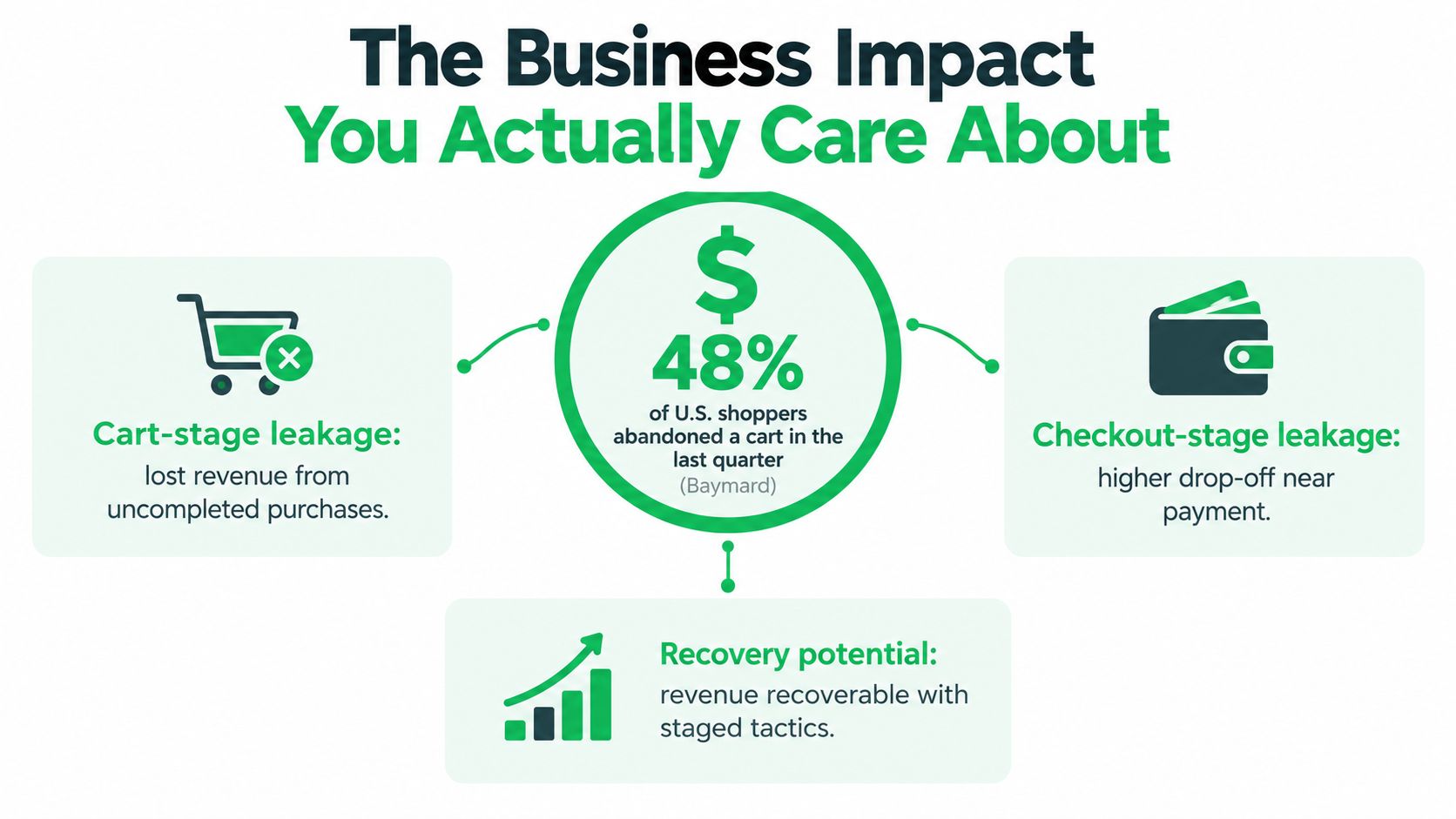
48% of U.S. shoppers who abandoned a cart cited browsing or not being ready to buy, while another 48% cited extra costs such as shipping, taxes, and fees. These findings from a 2024 Baymard study, cited in industry reporting on cart abandonment, point to different causes. The first reflects unsettled purchase intent; the second signals a price barrier. Neither establishes that checkout processing failed. Merchants should treat these reasons as separate lines of investigation, not combine them into a single estimate of lost revenue.
Abandonment benchmarks depend on their source and method. Baymard's aggregation of 49 studies places average cart abandonment near 70%. Separately, Dynamic Yield data cited by eMarketer reports a worldwide rate of 73.9% for the 12 months ending July 2024. These figures are reference points, not equivalent measurements or targets for an individual store. Baymard's research summary describes the study aggregation, while the Dynamic Yield figure reflects a separate dataset.
Why sessions aren't a revenue estimate
An overall abandonment rate cannot show revenue lost per 1,000 sessions without store-specific inputs: how many sessions create carts, how many carts proceed to checkout, and the value of completed orders. The benchmarks above do not provide those values. Valuing every abandoned cart as a completed order would therefore overstate the evidence.
Separate the cohorts to make the numbers useful. Cart-stage reporting measures purchase consideration that did not progress and can help identify barriers such as unclear costs. Checkout-stage reporting isolates shoppers who began a transaction but did not complete it. That cohort gives analysts a more direct place to test payment authorization, form issues, and checkout errors. An incomplete transaction still does not prove a lost sale; event-level payment records are needed to establish where the process stopped and whether a payment request failed.
The useful question isn't “How many carts were abandoned?” It's “At which event did high-intent shoppers stop, and what prevented the next event?”
Tracking the Two Events Separately
A session-based dashboard can show that a shopper visited, added a product, and left. It may not show whether checkout started, a payment option was selected, or an authorization failed. Those details matter: a behavioral exit and a failed payment request aren't the same event, even when both end without an order.
Build the funnel around timestamped events, then calculate each metric with its own denominator. For example, cart abandonment can compare product-added events with checkout starts. Checkout abandonment can compare checkout starts with authorized payments or order creation, provided the business defines that endpoint consistently.
| Event | Captures | Feeds Metric |
|---|---|---|
add_to_cart | Product added and cart context | Cart creation and cart-stage cohort |
checkout_started | Shopper entered checkout | Checkout-start denominator |
address_completed | Shipping or billing details submitted | Checkout progression |
payment_method_selected | Chosen payment option | Payment-method analysis |
payment_submitted | Payment request sent | Payment attempt volume |
authorization_failed | Failed payment response and available reason code | Failed-authorization reporting |
checkout_expired | Checkout ended or timed out without completion | Incomplete checkout reporting |
purchase | Order confirmed under the merchant's defined rule | Checkout completion |
Baymard's synthesis places overall cart abandonment at approximately 70.22% across 50 studies. Its reported in-checkout breakdown also includes 17% abandoning because checkout was too long or complicated and 17% because the site had errors or crashed. These are different potential causes within checkout, not a reason to merge them into one operational category. Baymard's checkout usability report and benchmark supports looking beyond the final abandonment label to the events preceding it.
Send a consistent event stream
For Meta, TikTok, and GA4, align browser and server-side events with the same event definitions and transaction identifiers where your implementation supports them. Keep payment submission, authorization failure, and purchase distinct; don't record a failed authorization as a completed order or treat a checkout start as proof that the shopper tried to pay. A shared event specification also gives product, marketing, and payments teams a common basis for examining drop-off.
Use Tagada's guide to GA4 ecommerce events as a reference when aligning ecommerce event names and reporting. The core requirement isn't a particular analytics platform. It's a traceable sequence that shows where the shopper stopped and whether the payment system returned a result.
Recovery Strategies That Match the Stage
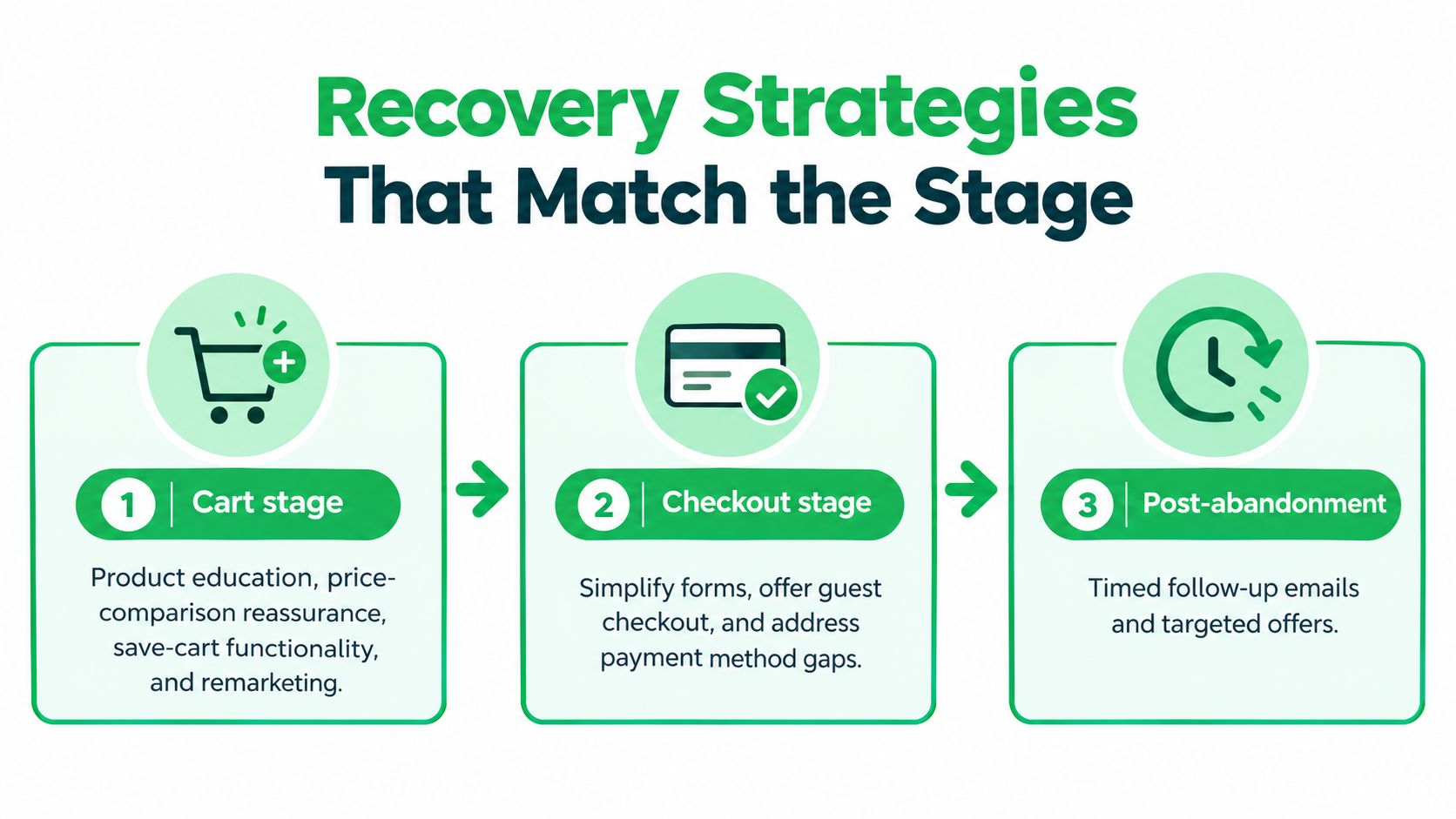
A reminder can help a shopper resume a decision. It can't fix a checkout that loses entered information or a payment method that isn't available. Match the recovery action to the last reliable event, then confirm that the shopper can complete the transaction after returning.
At the cart stage, use product details, clear landed-cost information, and a way to save the cart for later. A reminder can bring a shopper back, but aggressive discounting may be a poor first response when the person was still comparing products or hadn't decided to buy. If you need a practical walkthrough of how to recover lost Shopify sales, use it as a reference for recovery mechanics, then tailor the message to your own event data.
At checkout, prioritize transaction continuity. Restore the shopper's exact checkout where possible, preserve information they already entered, and make the total cost visible before payment submission. Keep guest checkout easy to find, and offer an eligible alternative payment method when the selected option can't complete the transaction.
Baymard reports that shoppers abandoned because extra costs were too high (40%), they didn't trust the site with card information (19%), they were required to create an account (18%), or checkout felt too long or complicated (17%). Baymard's cart-abandonment findings are diagnostic signals, not additive conversion-loss rates. Each suggests a different fix: clarify cost, strengthen trust cues, provide guest checkout, or simplify the flow.
Use payment events to time recovery
A smart retry should respond to a recoverable payment outcome, not just a timer that fires after a shopper leaves. Use the processor response and your retry rules to decide whether another attempt is appropriate. Don't trigger an email on a hard decline if the next system action already addresses the outcome; that can confuse the customer and duplicate the recovery process.
For a customer who leaves before submitting payment, a return-to-checkout message may be appropriate. For a customer whose payment fails, explain the next step and provide a valid route to completion. TagadaSend is one option for coordinating email and SMS around payment events, while lifecycle email marketing offers a broader framework for matching messages to customer behavior. The sequence should follow the evidence, not a competitor's schedule.
Use the video below as a practical companion to the recovery-flow discussion.
<iframe width="100%" style="aspect-ratio: 16 / 9;" src="https://www.youtube.com/embed/nDTFQveDnLc" frameborder="0" allow="autoplay; encrypted-media" allowfullscreen></iframe>
When the Real Problem Is Payment or Trust, Not Persuasion
Not every checkout exit means a customer needs convincing. Some shoppers can't use the payment method they expect, hit an outage, or see a decline. Sending a discount or reminder without identifying the event may bring them back to the same obstacle.
A 2025 survey of senior U.S. executives identified customer abandonment concerns at 29%, unsupported payment methods at 28%, network or service downtime at 17%, and outdated card credentials at 12%. These findings point to payment coverage and reliability alongside customer behavior, rather than a messaging-only explanation. Spreedly's State of Checkout 2025 report provides the survey context.
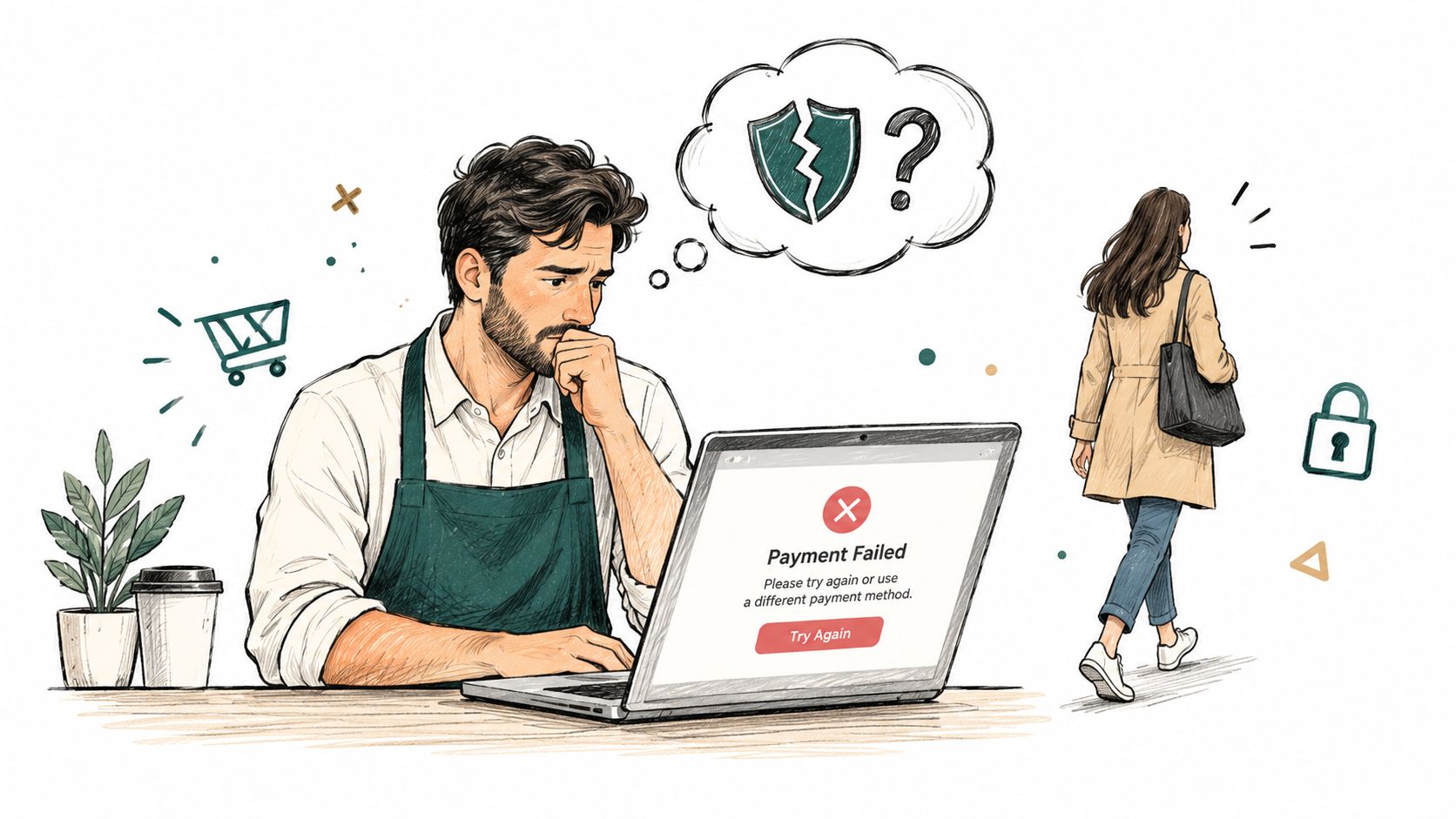
A trust concern and a declined card need different owners and remedies. Baymard-related findings report that 19% of shoppers abandoned because they didn't trust the site with card information, while 10% abandoned because their card was declined. The cited ecommerce conversion statistics distinguish a confidence issue from an authorization outcome. Clear security communication and consistent payment presentation can address trust; a decline calls for transaction-level investigation.
Classify exits before choosing a remedy
- Voluntary abandonment: The shopper leaves without a recorded payment failure. Consider whether price, intent, or interruption is the likely issue.
- Payment decline: Authorization fails. Preserve the response reason, payment method, and processor so the payments team can decide whether a safe retry or alternative route makes sense.
- Authentication failure: The shopper can't complete a required verification step. Examine the authentication result and the path offered to continue.
- Timeout: The checkout or payment process expires. Check whether the flow can be resumed without forcing the customer to re-enter information.
- Technical error: A page, integration, or service fails. Repair the fault before relying on a reminder to bring shoppers back.
This classification matters for DTC, subscription, international, and high-risk merchants because a payment decline can reflect issuer decisions, unsupported cards, billing-data issues, or processor behavior. A single “abandoned checkout” label hides which team should act. A focused payment-experience review can help teams assess how payment choices and transaction flow affect completion.
One 2025 meta-analysis reported mobile abandonment at 85.65%, compared with 73.76% on desktop. Its methodology and future-dated publication details warrant caution, so the figures shouldn't be treated as a clean comparison for every store. The practical takeaway is to segment mobile checkout outcomes rather than assume a recovery message will solve a device-specific payment or usability problem.
Choosing the Right Playbook for Your Business
The right priority depends on what you sell and how customers pay. A DTC brand, a subscription merchant, and a cross-border seller can all report checkout abandonment while facing entirely different barriers. Segmenting by business model turns the metric into an operating decision.
| Business model | Priority to investigate | Why it matters |
|---|---|---|
| DTC brands | Total-cost visibility and checkout form friction | A shopper may leave when the full price appears late or the flow takes too much effort. |
| Subscription and rebill merchants | Recurring-payment eligibility and dunning | A method that accepts an initial purchase may not support later merchant-initiated charges under the same conditions. |
| International sellers | Local payment methods, currency, and retry eligibility | The shopper's preferred option must be available for the country and transaction, not merely displayed. |
| High-risk merchants | Decline-reason analytics and processor outcomes | A generic recovery sequence can't explain whether an issuer, processor, or risk decision blocked payment. |
Baymard-related research found that 13% of online shoppers abandoned when their preferred payment method wasn't available. For cross-border transactions, availability means more than showing a payment logo: the method must work for the shopper's location, currency, and transaction type. Subscription teams should also verify whether the method supports recurring merchant-initiated transactions and whether later charges require separate consent or tokenization. The research on payment-method availability explains why payment coverage can affect more than the first order.
Build the reporting around decisions
Start with separate event streams for carts, checkout progression, payment attempts, authorization outcomes, and completed orders. Add server-side tracking for the payment events that browser-only analytics may miss, and reconcile those events with the order record. Then review results by payment method, geography, currency, device, and subscription versus one-time purchase where those dimensions are available.
From there, assign each failure a response. Use multi-processor routing or a suitable local method when the transaction is eligible, and trigger smart retries only when the payment outcome supports them. Trigger recovery messages from the shopper's actual payment and checkout state, not from a cart timestamp.
The clearest operating principle is to improve measurement before increasing reminder volume. A merchant who can tell a browsing exit from a failed authorization can choose a more relevant fix, protect customer trust, and make recovery reporting more meaningful.
Tagada brings checkout, payment routing, subscription management, and event-triggered email and SMS into an ecommerce orchestration layer, helping merchants connect recovery actions to real payment outcomes. If you're ready to measure abandonment by funnel event and build recovery around what happened, visit Tagada.