

A merchant can lose money without a single obvious fraud attack. A shopper reaches checkout, a legitimate card is declined, a renewal fails because the stored credential is stale, or a customer disputes a charge they don't recognize. Then a processor asks difficult questions because dispute activity has risen, while the team searches across separate dashboards for an explanation. The problem isn't always fraud. It's unmanaged risk across the revenue cycle.
The best practices for risk management in ecommerce connect checkout decisions, authentication, payment routing, subscriptions, data protection, disputes, and cash flow. They also force a practical question for every control: what can the team check this week, and which KPI shows whether the control works? That discipline matters for DTC brands, digital products, high-risk industries, international sellers, and any business dependent on recurring billing. Teams comparing broader financial resilience options can also compare small business financing options alongside payment controls.
The ten practices below follow the customer and payment journey from the first checkout signal through authorization, renewal, dispute handling, and processor review. Each one includes a concrete operating check, a trade-off, and a metric worth watching.
1. Layered, Risk-Based Fraud Screening Before Authorization
Fraud screening should happen before the authorization request, not only after a payment has been approved. A useful decision combines several signals, including address verification, card security-code results, device information, IP geography, email and phone reputation, order history, and basket characteristics. No single signal is reliable enough for every market or product.
A first-time purchase of a high-value digital product deserves different treatment from a repeat order placed by a customer with a clean payment history. A subscription brand might send only higher-risk first orders to manual review while approving established customers automatically. A digital-goods seller might block a known proxy pattern for a first card purchase but allow it for a returning, verified buyer.
Start with signals you can explain
Build a small rule set first. Add complexity only when loss data shows that another signal changes the decision. A system nobody can explain creates operational risk of its own, especially when support teams need to tell a legitimate customer why an order was held.
Practical rule: Track approval rate and fraud rate together. A fraud model that blocks too many good customers can reduce contribution margin even while its fraud metric looks better.
Review false positives weekly. Compare outcomes by customer type, country, product, acquisition source, and payment method. A chargeback-aware risk engine can feed dispute outcomes back into future routing and approval decisions, so the system learns which patterns created downstream loss instead of treating every authorization as an isolated event.
The KPI to watch is approved-payment fraud rate alongside approval rate. Tagada's payment layer is relevant when a merchant wants those decisions connected to checkout, routing, and later chargeback signals rather than split across disconnected tools.
For a visual walkthrough of the operating concept, this guide to protecting store revenue from fraud offers additional context.
<iframe width="100%" style="aspect-ratio: 16 / 9;" src="https://www.youtube.com/embed/jKg8QiLfRaY" frameborder="0" allow="autoplay; encrypted-media" allowfullscreen></iframe>
2. Risk-Based 3D Secure Authentication with Liability Shift
3D Secure should be a targeted control, not a reflex that challenges every shopper. Modern implementations can pass lower-risk transactions with little visible friction and request an extra authentication step for orders that need stronger evidence. The challenge may involve a biometric prompt, a one-time code, or another issuer-led verification step.
The trade-off is straightforward. More challenges can reduce certain fraud exposure, but abandoned challenges can also remove legitimate revenue. A repeat customer buying a familiar product shouldn't necessarily face the same journey as a new customer placing an unusually large international order.
Test the authentication handoff
Set challenge thresholds using order value, customer history, geography, product risk, and account signals. For each authorization, confirm that the processor passes the authentication result correctly, including the relevant ECI and CAVV values. Missing or malformed authentication data can undermine the protection the team expected to receive.
For subscriptions, authenticate the initial payment and use a merchant-initiated transaction for later renewals where the applicable network rules allow. That approach can reduce unnecessary friction, but it requires accurate consent records, payment credentials, and transaction indicators.
Track these measures together:
- Challenge abandonment: Identify how many shoppers leave during authentication.
- Authenticated approval rate: Compare successful authorization after authentication by segment.
- Fraud-related disputes: Review whether challenged and frictionless traffic produces different downstream outcomes.
A European DTC brand might apply 3DS only above a risk threshold, while a software seller could request an available exemption for eligible low-value recurring charges after the first authenticated payment. The right policy depends on the product, market, issuer behavior, and dispute profile.
Authentication is a control in the payment journey, not a substitute for customer history, transaction monitoring, or clear billing.
3. Proactive Chargeback Monitoring and Dispute Alerts
A dispute becomes more expensive when the merchant first learns about it through a formal chargeback. Monitor dispute volume and the chargeback ratio continuously, and connect alert services to the team that can make a fast decision. In some cases, issuing a timely refund is cheaper than allowing a clearly unwanted transaction to become a network dispute.
Start with a weekly review of disputes by processor, product, country, traffic source, customer cohort, and reason code. Visa's enhanced Visa Acquirer Monitoring Program, introduced in April 2025, combines earlier dispute and fraud monitoring structures. The cited program summary identifies a 1% chargeback ratio monitoring threshold in that card-network framework, so merchants should treat the threshold as an operating warning rather than a number to approach casually. Visa's monitoring summary provides the relevant program context.
Build evidence before the dispute
Evidence is strongest when it comes from normal product operations, not a last-minute reconstruction. For digital products and subscriptions, retain login events, downloads, usage, delivery records, consent history, cancellation attempts, support conversations, and the exact terms shown at purchase.
Use recognizable billing descriptors and include a customer support path. “I don't recognize this charge” disputes often begin with a statement descriptor that makes sense internally but not in a customer's banking app.
The check is simple: select recent disputes and ask whether another team could assemble the evidence without contacting engineering. If the answer is no, define the missing event and start logging it.
Track chargebacks as a percentage of prior-month payment volume, segmented by processor and cohort. Tagada's chargeback management workflow connects dispute signals to payment operations, which helps risk teams act on emerging patterns before they spread through checkout or renewal traffic.
4. Multi-Processor Routing and Failover
A checkout outage becomes a revenue outage when every payment depends on one processor. Issuer connectivity, regional coverage, underwriting decisions, and sudden approval changes can all interrupt sales. A second processor creates an operating option, but only if routing rules, data ownership, and fallback actions are defined before an incident.
Start with the revenue path. Assign each route by card type, country, currency, transaction size, payment method, product category, or observed approval performance. A high-volume merchant could send domestic cards to its primary acquirer and reserve a secondary route for overflow or selected technical declines. An international seller could use a European acquirer for euro transactions if it offers better local coverage and settlement.
Set the exception rules in writing:
- Which processor handles the transaction first?
- Which decline codes permit another route?
- Which conditions require the payment to stop?
- Who can change routing, and how is that change logged?
Test the map in a sandbox, then run a controlled outage exercise. Include webhooks, refunds, subscription references, settlement files, and reconciliation. A fallback that works only on paper will not protect revenue during a live incident. Review processor redundancy and failover guidance against these dependencies.
Watch each processor separately, using comparable traffic:
- Approval rate: Compare the same countries, payment methods, and transaction types.
- Cost per transaction: Include processor, routing, and operational costs.
- Dispute rate: Check whether higher approvals create more downstream exposure.
- Recovery rate: Record how often an approved fallback recovers a failed payment.
Do not send every decline to another processor. A technical or issuer decline may justify a different route. A fraud-related decline should usually hold or reject the transaction instead.
TagadaPay can route through processors such as Stripe, Adyen, and NMI, or process payments natively. The practical check is direct: can the team change routing rules without replacing the customer-facing payment form? If not, the supposed redundancy may still depend on a single checkout implementation.
5. Smart Retries and Dunning for Subscription Revenue
A failed renewal can signal insufficient funds, an expired credential, a temporary issuer issue, or a customer who needs a clear prompt to update payment details. Each cause needs a different response. Smart retries use decline context and previous success patterns to select the next attempt, while dunning gives the customer a structured recovery path.
Start by separating temporary declines from payment-method and fraud-related failures. Retrying a reported stolen card will not resolve the issue and can frustrate the customer. A temporary issuer problem may justify a later attempt, while an expired credential calls for an account update or customer action.
Match the recovery path to the failure
Use network account updater services where available, and refresh stored credentials before the scheduled renewal. Send the first message soon after a failed payment, while the customer still recognizes the purchase. Later messages should state the next action, explain any access impact, and show cancellation or pause options without pressure that could generate complaints.
A subscription box brand could pair retry timing with card-update messages. A SaaS business could pause access after the final attempt, then offer one-click reactivation instead of cancelling immediately. Test each path with a small customer cohort and compare recovery against support contacts.
Track these checks:
- Recovery rate by decline category
- Revenue recovered after the first message
- Retry success by timing and payment method
- Cancellation and support-contact rate during dunning
Review the dunning management software workflow by tracing one failed renewal from the payment event through the retry, message, customer action, and final status. Tagada's subscription management, dunning, and TagadaSend tools can trigger email and SMS from real payment events. The practical KPI is synchronized recovery, meaning the retry and customer prompt support the same next action rather than sending messages disconnected from payment status.
6. Transparent Billing Descriptors and Compliant Subscription Terms
A customer should know what they're agreeing to, when they'll be charged, how much the charge will be, and how to stop future billing. Clear terms reduce confusion, but they also create evidence that the merchant can produce when a customer or processor questions a recurring payment.
The FTC's final rule on recurring subscriptions and other negative-option programs requires clear and conspicuous disclosure of material terms before billing information is obtained or a charge is imposed, express informed consent before the recurring charge, and a simple cancellation mechanism that immediately stops future recurring charges. The FTC announced the rule on October 16, 2024, with an effective date of January 14, 2025, while subsequent regulatory action deferred compliance timing for specified provisions. These dates and requirements are described in the FTC announcement on the click-to-cancel rule.
Test the customer's view, not the merchant's view
Place the product name or recognizable business name in the descriptor. Then make a small purchase and inspect the charge in a banking app. If the descriptor doesn't match the storefront, product, or support contact, change it before scaling acquisition.
Store the enrollment timestamp, terms version, IP address, displayed price, renewal timing, consent event, notification event, cancellation event, refund, and subsequent charge. A simple cancellation flow may increase immediate cancellations, but that is preferable to retaining customers through confusion and generating disputes that are harder to defend.
Review automatic-renewal requirements in every market. California's automatic renewal law, for example, has been amended to require easier online cancellation. Legal review still matters, but the operational check belongs to product and payments teams: can a customer cancel without contacting support, and does the billing system stop the next charge immediately?
Watch subscription dispute rate by descriptor and cohort, plus cancellation completion time. A pause or downgrade option can retain customers who need a break without obstructing cancellation.
7. Network Tokenization and Account Updater Services
Stored payment credentials create a renewal risk when the underlying card expires, is replaced, or changes for another reason. Network tokenization replaces the primary account number with a network-issued token associated with a merchant or device. Account updater services refresh eligible stored credentials when the card details change.
These controls serve two purposes. They reduce dependence on stale card data for recurring payments, and they reduce the number of systems that need access to raw card numbers. They're especially useful for subscriptions, memberships, SaaS plans, and other businesses where customer value depends on continuity rather than a single order.
Check the credential lifecycle
Ask each processor which network tokenization, updater, and cross-processor credential services it supports. Confirm how tokens are represented when a customer changes processor, how recurring transaction indicators are preserved, and how the system handles refunds, cancellations, and account merges.
Run updater requests before the renewal date. Waiting until a payment fails creates avoidable interruption and pushes the recovery burden onto the customer. Store tokens and processor references, not raw card data, wherever the architecture allows.
A subscription brand can compare expired-card declines during its renewal cycle before and after enabling an updater service. A high-volume merchant can also compare recurring approval behavior for tokenized and non-tokenized credentials across regions, while controlling for product and issuer mix.
Track renewal approval rate by credential type, along with updater success, expired-card decline rate, and involuntary churn. Don't judge the program only by first-payment conversion. Its value appears in the recurring lifecycle.
Tagada's checkout and payment layer supports stored credentials and recurring billing across processor relationships. The implementation check is whether a merchant can maintain a stable customer payment relationship even when routing changes underneath it.
8. PCI DSS Compliance and Cardholder Data Minimization
A checkout can expose card data through more than its payment form. Hosted fields, iframes, and redirect-based payment pages send sensitive input directly to a payment provider for tokenization, so storefront servers do not handle raw card numbers.
That design reduces the applications, logs, analytics tools, and employees that could expose payment information. It does not remove the merchant's responsibilities. Document the payment flow, confirm the provider's responsibilities, secure integrations, and control access to payment systems.
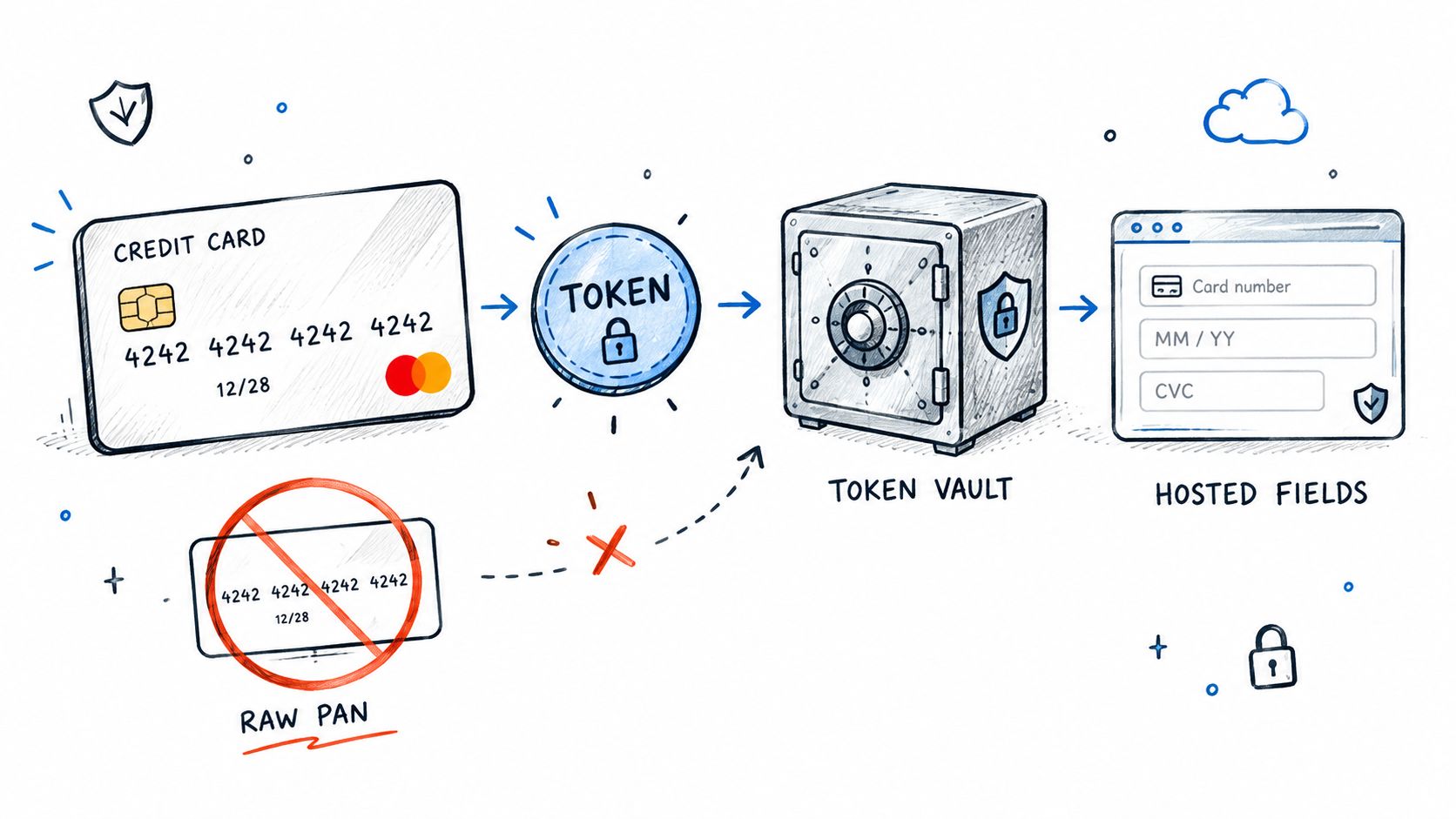
Audit the checkout perimeter
Start with a technical inventory of every script running on checkout and payment pages. Marketing pixels, session replay tools, tag managers, custom JavaScript, and third-party widgets can expand the attack surface without a payment team seeing the change.
Run four checks:
- Log inspection: Search application logs, error reports, and analytics events for full card numbers, security codes, or magnetic-stripe data.
- Access review: Confirm role-based access and multi-factor authentication for systems that can view payment information or change checkout code.
- Integration review: Record which provider collects card data, which service stores tokens, and which systems receive payment events.
- Change review: Require approval and testing before adding scripts to checkout.
A DTC brand moving from a custom card form to hosted fields may simplify its PCI DSS validation obligations. A development agency building tokenized storefronts can keep client sites from handling raw card numbers, provided it documents the responsibility split with the payment provider.
Track the number of systems and people with access to raw card data. The operational check is simple: compare that list with the previous review, investigate every new entry, and remove access that no longer has a business need. TagadaCheckout can support tokenization at payment entry while giving merchants visibility into payment activity and revenue reporting.
9. Velocity Limits and Customer Identity Checks
Velocity controls stop a payment attack from scaling across cards, accounts, devices, or addresses. They can limit the number of attempts, declines, new accounts, trial starts, or coupon redemptions connected to an identifier within a rolling window. Identity checks add context by asking whether the buyer behaves consistently across those signals.
This combination is effective against card testing, account takeover, and promotion abuse. A fraudster may rotate cards but reuse an IP range, device pattern, email structure, shipping address, or account behavior. A genuine customer may share a network or device with others, so blunt limits can block legitimate demand.
Put limits on the paths attackers abuse
Start with login, card entry, free-trial activation, and coupon redemption. Use separate thresholds for new and returning customers, and use rolling windows instead of one fixed daily reset. Review blocked-transaction logs during promotions, product launches, and seasonal demand spikes.
A digital-download store might limit repeated authorization attempts from one IP pattern and require a stronger check when the same device tests multiple cards. A course platform might verify an email before allowing a free-trial card authorization. Neither control should operate alone. Customer history can reduce friction for established buyers who have successful purchases and normal usage.
Track blocked attempts that later prove legitimate, blocked attempts associated with confirmed abuse, and attack velocity over time. The first measure exposes false positives. The second shows whether the rule is useful. The third shows whether attackers are moving to another path.
A practical review asks whether the rule blocks the attack before authorization costs accumulate, or merely creates support tickets afterward. It also asks whether support can release a legitimate customer without disabling the rule for everyone.
10. Reserve and Cash-Flow Readiness Planning and Continuous Risk KPI Monitoring
High-risk merchants can face rolling reserves, delayed payouts, enhanced underwriting, or stricter processor terms. Those conditions become dangerous when the business has no cash-flow plan and no evidence to show that its controls work. Risk readiness is therefore a finance discipline as much as a payments discipline.
Model cash flow with an explicit reserve assumption before signing a processing contract. For example, a merchant can test the effect of holding a percentage of monthly volume for 90 to 180 days, then compare payroll, inventory, refunds, advertising, and processor obligations under that scenario. The assumption is a planning tool, not a forecast of what every processor will require.
Make processor reviews evidence-based
Publish refund, cancellation, delivery, and support policies on every relevant product page. Underwriters may review those policies, and customers need them before purchase. Track chargebacks and refunds by product, campaign, country, processor, and subscription cohort, not only at the account level.
A digital-course seller can maintain dispute evidence and a ratio dashboard before renewal discussions. A nutraceutical subscription brand can diversify acquiring relationships and rebuild its cash buffer while payment terms are stable. A weekly review can also reveal that one advertising campaign is producing unusual disputes, allowing marketing to pause it before losses spread.
Choose five to seven core KPIs and review them weekly with finance, support, payments, and marketing. Useful measures include approval rate, fraud rate, chargeback ratio, refund ratio, renewal recovery, processor concentration, and cash held for reserves. Set internal alerts below processor warning levels so the team has time to respond.
Operational rule: Write a one-page risk policy before the product mix becomes complicated. Name the owner, threshold, escalation path, refund authority, and evidence required for each major risk.
NIST's Risk Management Framework provides a repeatable lifecycle of seven stages, prepare, categorize, select, implement, assess, authorize, and monitor. Its practical value for ecommerce is the insistence that controls are selected, tested, authorized, and monitored as risk conditions change. The same principle applies to payment routing, processor dependencies, renewal logic, merchant credentials, webhooks, and customer data.
10-Point Risk Management Best Practices Comparison
| Approach | 🔄 Implementation complexity | ⚡ Resource requirements | 📊 Expected outcomes | ⭐ Ideal use cases | 💡 Key advantages |
|---|---|---|---|---|---|
| Layered, Risk-Based Fraud Screening Before Authorization | Moderate–High: multiple signal integrations, ML models, ongoing tuning | Data pipelines, fraud tools/subscriptions, engineers, manual review staff | Lower fraud and chargebacks; fewer false declines; improved approval rates | High-volume merchants, subscriptions, international sellers | Stops fraud pre-fulfillment; balances risk vs. revenue; audit trail for disputes |
| Risk-Based 3D Secure Authentication with Liability Shift | Medium: 3DS flows, issuer integrations, challenge tuning | Payment provider support, engineering, UX work | Liability shift on authenticated transactions; reduced fraud exposure; possible conversion impact | EU/UK SCA contexts, high-value orders, chargeback-prone merchants | Issuer-backed liability shift; frictionless for low-risk customers |
| Proactive Chargeback Monitoring and Dispute Alerts | Low–Medium: integrate alert networks and analytics | Alert service subscriptions, CRM/ops integration, support staff | Fewer formal chargebacks; improved dispute outcomes; pattern visibility | Merchants with rising chargebacks, digital goods, subscriptions | Prevents chargebacks via early refunds; improves evidence and ratios |
| Multi-Processor Routing and Failover | High: many integrations, routing logic, reconciliation | Multiple merchant accounts, engineering, reconciliation and ops | Higher authorization rates; uptime protection; reduced lost sales | High-volume and international merchants, uptime-critical businesses | Revenue protection during outages; optimize approvals; reduce single-provider risk |
| Smart Retries and Dunning for Subscription Revenue | Medium: decline-code logic, timing rules, dunning flows | Billing platform, email/SMS systems, analytics | Recovered renewals; lower involuntary churn; fewer issuer blocks | Subscription and rebill businesses, SaaS | High ROI recovering failed renewals; preserves card-on-file relationships |
| Transparent Billing Descriptors and Compliant Subscription Terms | Low–Medium: policy updates, descriptor testing, UX changes | Legal/product coordination, communications, testing | Fewer "unrecognized charge" disputes; lower regulatory risk; better retention trust | All subscription merchants; regulated markets; marketplaces | Reduces friendly fraud; strengthens dispute evidence; ensures compliance |
| Network Tokenization and Account Updater Services | Medium: token lifecycle and updater integration, testing | Processor/token service support, engineering, QA | Fewer expired/reissued-card declines; reduced PCI scope; uninterrupted subscriptions | Merchants with stored credentials or high subscription volume | Improves approvals; lowers PCI exposure; auto-refreshes card data |
| PCI DSS Compliance and Cardholder Data Minimization | Medium–High: security controls, assessments, vendor choices | Security tooling, assessor/QA, hosted payment vendors | Lower breach/exposure risk; reduced compliance scope/cost; trusted processors | Any merchant processing payments, especially custom integrations | Shrinks PCI scope; reduces breach liability; required by card networks |
| Velocity Limits and Customer Identity Checks | Low–Medium: rule-based limits and identity validation | Rule engine, identity/email/phone validators, monitoring | Stops card-testing and bots; reduces promo and trial abuse | Digital goods, promotional campaigns, trial-heavy products | Cheap, effective mitigation of automated abuse; simple to implement |
| Reserve & Cash-Flow Readiness Planning and Continuous Risk KPI Monitoring | Medium: policy writing, dashboards, cross-team workflows | Finance/analytics, reporting tools, time for reviews | Improved cash resilience; early detection of risk; better processor negotiations | High-risk verticals, merchants facing rolling reserves/underwriting | Protects cash flow; institutionalizes risk controls; negotiation leverage |
Turn These Ten Practices Into a Weekly Risk Routine
Risk control works best as a routine, not a one-time project. Start with the two or three practices connected to your largest losses. Give each one an owner, an alert threshold, and a recurring review time. If nobody owns the metric, the control will eventually become a dashboard that people glance at after the damage is done.
A useful weekly meeting doesn't need every possible risk metric. It needs consistent segmentation and clear decisions. Review payment approval by processor and country, fraud outcomes by customer type, disputes by product and cohort, renewal recovery by decline category, and cash exposure by payout relationship. Bring finance, support, payments, marketing, and engineering into the same conversation when the risk crosses team boundaries.
The foundational logic is broader than fraud prevention. Research examining ISO 31000:2009 surveyed 291 engineering and product-development practitioners, with 215 completing the final portion, and evaluated all 11 ISO 31000 principles. The analysis found that the complete set of principles significantly explained risk-management outcomes, with whole-model tests reporting p-values below 0.05. Each principle contributed significantly to at least one measured outcome, while no individual principle was significant across every outcome. The ISO 31000 research paper supports a practical conclusion for ecommerce: no single fraud rule, risk register, committee, approval flow, or insurance policy can cover every outcome.
Build your operating model around that reality. Connect risk ownership to checkout, payment routing, fraud, subscriptions, data, customer communications, support, and processor relationships. Review not only whether a control exists, but whether it operated at the moment the transaction or customer decision required it.
Use a control register, not scattered reminders
For each major risk, record:
- Risk owner: Name the person accountable for the decision.
- Control: Describe the rule, workflow, or technical safeguard.
- Trigger: Define the event that starts review or escalation.
- Evidence: State which log, report, or record proves the control operated.
- KPI: Choose the measure that shows whether the control reduces loss without creating excessive friction.
- Fallback: Document what happens when the primary processor, tool, or team is unavailable.
A 2025 CompTIA survey of 1,026 U.S. business and IT professionals found that 56% of organizations used a formal framework such as the NIST Risk Management Framework or IRGC Risk Governance Framework, while roughly one-third assessed risk informally. The source is U.S.-focused, so treat it as a directional benchmark rather than a global estimate. Its practical lesson is still useful: replace ad hoc payment decisions with a documented system that assigns ownership and records risk acceptance. The same survey found that 49% specifically viewed cybersecurity as responsible for identified risks, which highlights why payment, fraud, reliability, growth, and security teams need shared accountability. See the CompTIA State of Cybersecurity research for the survey context.
Test resilience, not just prevention
Prevention controls will fail sometimes. A processor can go offline, a webhook can arrive late, an issuer can reject a familiar card, or a customer can dispute a transaction despite clear terms. Run tabletop exercises for processor outages, delayed webhooks, account takeover, refund abuse, sudden dispute growth, and failed renewal campaigns.
The U.S. Government Accountability Office reported that all 12 critical-infrastructure organizations it reviewed used the NIST Cybersecurity Framework fully or partially and reported benefits such as better risk identification and common standards. Its review also cited an average 42% improvement in associated cybersecurity practices among Department of Defense entities conducting multiple cyber-resilience analyses. That figure isn't a guaranteed causal uplift for an ecommerce business, but it supports repeated resilience analysis as a maturity practice. The GAO review of cybersecurity practices provides the source context.
Map the exercise to revenue systems. Identify processors, APIs, webhooks, SDKs, pixels, merchant credentials, customer data, and reconciliation jobs. Define recovery objectives, test the fallback, and retest controls that failed. A failover that recovers authorization but loses the subscription reference or refund record isn't a complete recovery.
Add AI decisions to the same control system
AI-enabled ecommerce creates a newer version of an old governance problem. A model may influence storefront content, checkout decisions, payment routing, fraud screening, customer messaging, or support escalation, yet the business may not know who owns the decision or how to reverse it.
EY's 2025 survey reported that 70% of organizations lacked a well-defined AI governance model, only 18% had clearly assigned data-governance responsibilities, and just 10% had systematic processes for updating AI models. Those figures appear in the EY AI governance, risk, and compliance survey. For merchants, the operational answer is to attach every AI decision to an owner, input data, permitted action, financial limit, audit log, rollback trigger, and customer-redress process.
That approach matters because automation can multiply undocumented dependencies. A model that improves conversion in one cohort may increase dispute exposure in another. A messaging agent may create a promise that the fulfillment team can't honor. A routing model may favor approval rate while overlooking processor concentration or future dispute cost.
Optimize contribution margin, not one risk score
Payment risk management is a balancing problem. Sift reported that average chargeback rates moved from 0.22% in Q1 2025 to 0.17%, then to 0.26% in Q3, which it described as a 53% increase from Q1. Its reported chargeback value reached $361.31, up 48% year over year. Marsh reported that first-party fraud represented 38% of global reported fraud in 2025, up from 15% in 2023. These figures appear in the Sift disputes report, while the first-party fraud comparison is included in the cited research.
The lesson isn't to block more transactions. It's to measure approval, fraud loss, disputes, support cost, retry recovery, and customer value together. A high-value subscription, digital delivery, or recurring rebill may be legitimate today but carry heightened future dispute risk. Use clear descriptors, consent records, evidence capture, adaptive authentication, smart retries, cancellation clarity, and processor-routing experiments to manage that exposure.
Review the ten practices weekly, but don't treat them as ten isolated projects. A layered fraud decision should inform authentication. Authentication results should travel with authorization. Processor routing should preserve recurring credentials and dispute evidence. Dunning should respect cancellation events. Reserve planning should use the same dispute and refund data that payments teams already monitor.
If you operate a subscription, DTC, international, digital-product, or high-risk business, begin with one revenue path. Map every payment event from checkout through renewal and dispute. Then choose the first control where a missing signal, unclear owner, or delayed alert is already costing you money. Improve that path, measure the result, and extend the routine to the next one.
Tagada connects checkout, payment routing, subscriptions, dunning, messaging, and chargeback-aware risk handling in one orchestration layer. Visit Tagada to review how your team can monitor payment risk, route transactions across processors, and turn real payment events into faster recovery and clearer control.