

Retention starts before the cancellation request. A customer can leave because they chose to, or because a payment failed, a checkout rejected the right method, a renewal notification arrived too late, or a billing problem made continuing inconvenient. Those are different problems, and treating them as one churn category hides revenue you could have protected.
Customer retention is an operating system across the full revenue lifecycle. It begins with checkout approval and continues through payment routing, subscription rebills, customer communication, support, product usage, loyalty, and community. A foundational finding widely cited in Harvard Business Review's retention analysis says that a 5% increase in customer retention can raise profits by 25% to 95%. The commercial lesson is straightforward: retention deserves operational attention, not just another promotional campaign.
Before changing workflows, baseline voluntary churn, involuntary churn, payment approval, recovered revenue, repeat purchase rate, and customer lifetime value. Then improve the journey in priority order, starting with the points where a sale or rebill can fail. These customer retention strategies are designed for ecommerce, subscriptions, payment processing, and high-risk businesses where payment continuity directly affects the customer relationship. For a broader retention-marketing perspective, see this customer retention boost with Crescade.
1. Smart Payment Routing & Processor Diversification
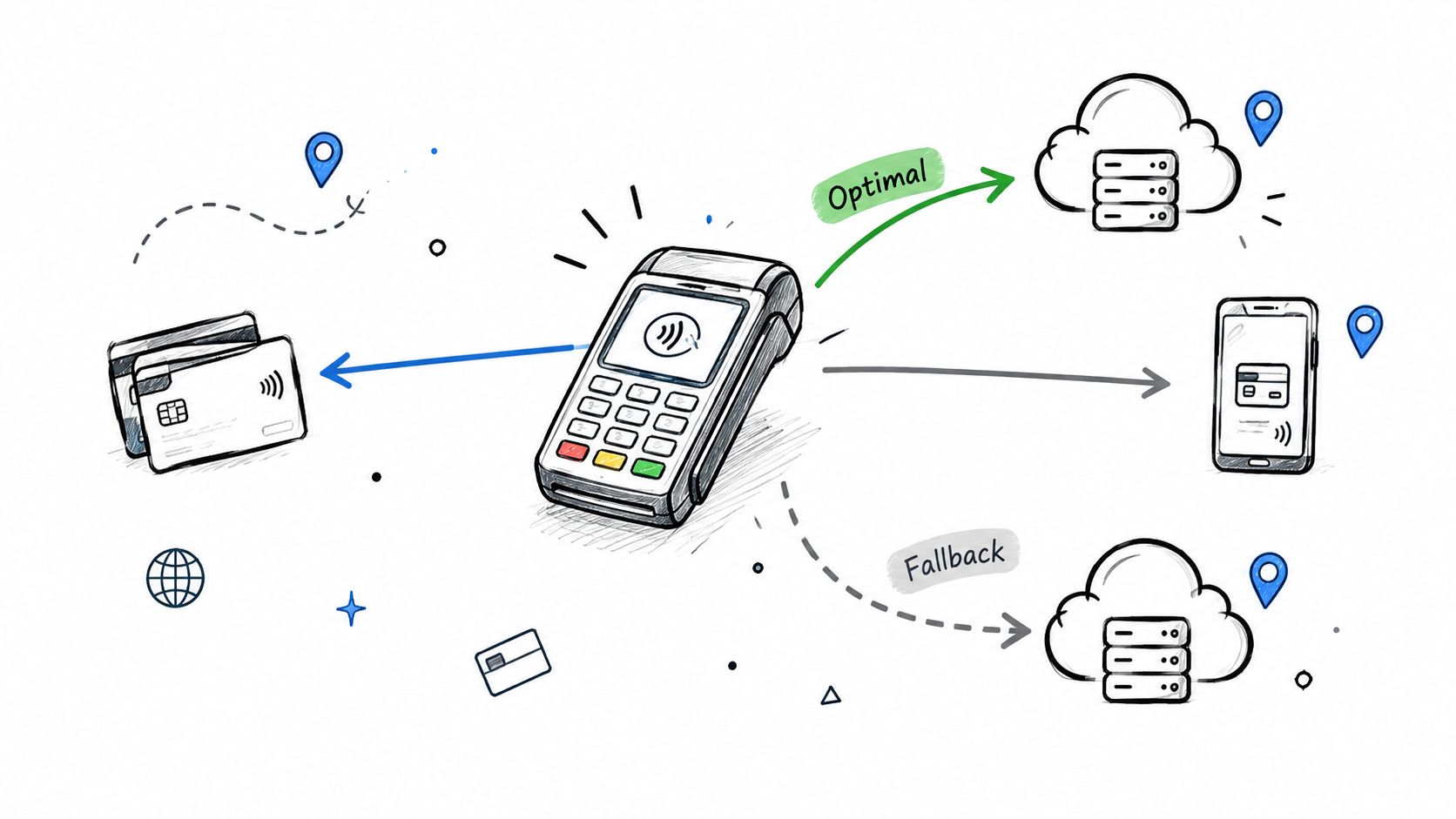
A declined transaction can look like customer disinterest in your analytics even when the buyer still wants the product. Multi-processor routing gives merchants a way to direct transactions toward the payment route most likely to approve them, based on factors such as geography, card type, payment method, and prior payment behavior.
This matters most for subscription merchants, international DTC brands, and high-risk businesses. A subscription box service may find that one processor handles recurring billing more consistently for a particular card segment. An international seller may present Alipay in Asian markets or iDEAL in the Netherlands, rather than forcing every customer through the same card flow. A high-risk merchant can use processor coverage and risk-aware routing to protect approval performance without removing necessary fraud controls.
Build routing from evidence
Start by mapping approval rates by BIN, card type, geography, currency, and payment method. Put those rules in a unified orchestration layer so the team can see processor performance in real time instead of reconciling disconnected dashboards.
Add decline-code-aware retries, with timing based on the failure reason. A soft decline may justify a relatively prompt retry, while a hard decline may require a card update or alternate payment route.
Practical rule: Optimize for approved, successfully settled revenue and downstream retention, not approval rate in isolation.
Test routing logic with controlled experiments before applying it across the entire customer base. A route that improves checkout approval but increases disputes, refunds, or failed renewals isn't a retention win. Connect processor results to customer lifetime value so payment operations remain tied to commercial outcomes.
2. Adaptive Checkout Optimization & Real-Time Personalization
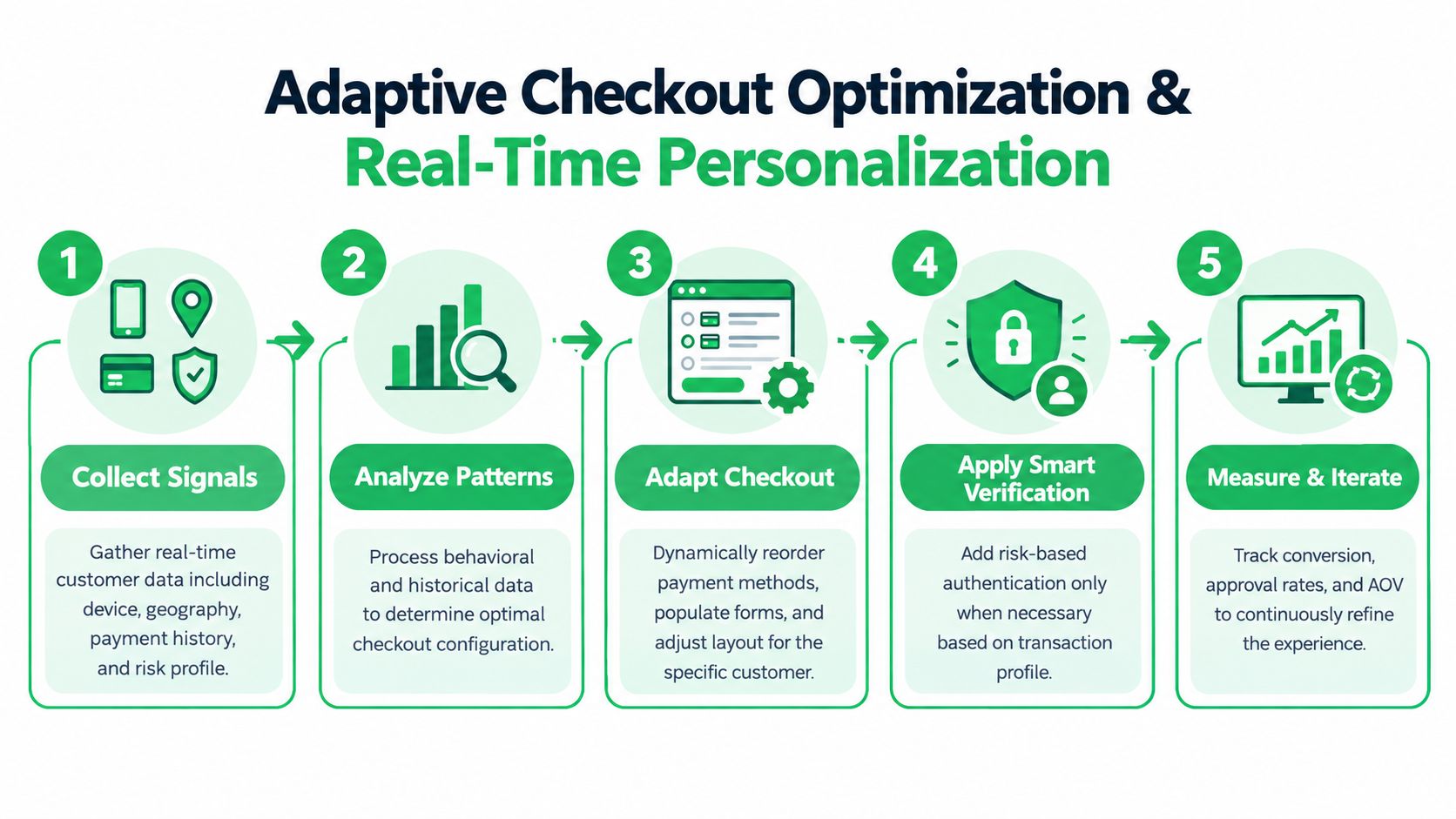
Checkout should respond to the customer rather than making every buyer complete the same form. Device, geography, payment history, product type, and risk profile can all inform which payment methods appear first, which fields are necessary, and when additional verification is appropriate.
A digital product creator doesn't need to collect a shipping address for a downloadable purchase. An international subscription box should adapt language and local payment methods based on the buyer's location. A high-risk merchant can reserve extra verification for high-value or suspicious transactions instead of adding friction to every order.
Remove friction without removing control
Use checkout heat maps to identify abandonment by device, payment method, field, and step. Then test one variable at a time, such as payment-method ordering, form-field presentation, or upsell placement. Progressive profiling can collect useful customer information after the initial purchase rather than making the first transaction carry every data requirement.
Measure the experiment server side. A higher front-end conversion rate can conceal lower payment success, increased refunds, or poor-quality orders. Segment results by customer type so personalization doesn't improve one audience while degrading another.
Useful implementation checks include:
- Payment ordering: Place methods with stronger historical performance for each segment where buyers can see them first.
- Form design: Hide fields that aren't relevant to the product or transaction.
- Risk controls: Apply verification proportionally to transaction risk.
- Revenue measurement: Track completed and settled revenue, not clicks alone.
A personalized checkout should feel simpler, not more obviously personalized. If customers have to explain why the experience keeps changing, the system has probably added complexity instead of removing it.
<iframe width="100%" style="aspect-ratio: 16 / 9;" src="https://www.youtube.com/embed/JcfBFSES99Y" frameborder="0" allow="autoplay; encrypted-media" allowfullscreen></iframe>
3. Dunning & Failed Payment Recovery Systems
Subscription churn often begins inside the billing system. An expired card, insufficient funds, issuer decline, or authentication problem can cancel an otherwise healthy customer without any deliberate decision to leave. That's involuntary churn, and it requires a payment workflow rather than a generic win-back email.
Separate soft dunning from hard dunning. Soft dunning preserves the account while asking the customer to resolve payment. Hard dunning cancels access or terminates the subscription after the recovery path has been exhausted. For a membership site, preserving account history while suspending access can be less damaging than deleting the relationship immediately.
Match recovery to the failure reason
Build retry logic around decline codes. A soft decline may warrant a retry after a short interval, while a hard decline should usually trigger a direct request to update the payment method. Don't keep retrying blindly. In high-risk subscriptions, excessive retries can increase dispute exposure and create a poor customer experience.
Every message should include a direct card-update path and, where appropriate, an alternative payment method. Segment the workflow by customer value, but don't use customer lifetime value as permission to ignore lower-value customers. Use it to prioritize human outreach, testing effort, and recovery options.
Monitor:
- Recovery by failure reason, so the team knows which declines respond to retries.
- Recovery by sequence, so cadence decisions use revenue rather than intuition.
- Disputes by retry pattern, so recovery doesn't create avoidable chargeback risk.
- Access outcomes, so soft dunning protects customers who later resolve payment.
An effective dunning system makes the correct action easy and the cancellation action deliberate. It shouldn't shame customers for a payment problem or force support to repair a preventable billing workflow.
4. Revenue-Triggered Email & SMS Automation
Payment events are more useful than calendar dates because they reveal what just happened in the commercial relationship. A successful charge, failed renewal, refund, payment hold, or cancellation should trigger a communication appropriate to that event.
A SaaS company can send a payment confirmation with invoice details and the next billing date. A course creator should deliver access only after payment has been confirmed. A subscription box can warn customers before a likely payment failure and follow up with a recovery sequence if the renewal fails. For high-risk merchants, a clear message about a fraud-review hold can prevent confusion before the customer contacts support.
Connect the event to the next action
Create separate sequences for declined payments, expired cards, insufficient funds, refunds, and confirmed renewals. Combine email with SMS when the customer needs to act quickly, but respect consent and communication preferences. Every failed-payment message should offer a direct update-card flow, an alternate processor where available, or another suitable billing option.
Don't optimize these campaigns around open rate alone. Attribute recovered revenue to the specific message and sequence, then compare downstream retention. A message that earns clicks but produces no successful payment isn't doing its commercial job.
Keep copy factual and calm. Customers respond better to a clear explanation of what happened, what access is affected, and how to fix it than to artificial urgency. Revenue-aware messaging is a retention workflow because it turns payment data into timely customer support.
5. Transparent Pricing & Flexible Billing Options
Price-related churn isn't always a demand for a lower price. It can reflect a mismatch between the customer's cash flow and your billing structure, uncertainty about what the charge includes, or the difficulty of changing plans. Clear invoices and flexible billing reduce those avoidable points of friction.
Offer billing frequencies that match different buying contexts. A SaaS business may present monthly, annual, and multi-year choices. A course creator can use a payment plan for a high-ticket program. A subscription box can let a customer downgrade, skip, swap, or delay before cancellation becomes the only visible option. High-risk merchants selling expensive products can use structured payment plans to make the purchase more accessible.
Make flexibility self-service
A plan change shouldn't require a support ticket. Put downgrade, pause, payment-method update, and billing-frequency controls inside the customer account. Explain what the customer receives, when the next charge occurs, and how the change affects access.
Annual billing can improve revenue predictability, but discounts should be tested against margin and retention rather than copied from another business. The customer retention benchmark discussion identifies 2% to 4% annual churn as a benchmark zone for subscription businesses, while churn above 5% warrants investigation. It also reports 1.78% annual churn or lower for top-quartile SaaS, compared with a 3.22% category median. These figures aren't universal targets. They reinforce the need to compare cohorts within the same model.
Track retention by billing frequency, acquisition source, plan, and customer segment. Offer a lower-commitment option before the cancellation screen, and explain value in terms customers recognize, such as usage, access, delivery, or outcomes.

6. Data-Driven Churn Prediction & Prevention
Churn prediction earns its place when it triggers a specific action. Start with explainable signals, including repeated payment failures, falling usage, unresolved support complaints, refund activity, or an approaching cancellation window. Connect each signal to an owner, message, and deadline so the score changes a workflow rather than filling a dashboard.
Separate voluntary from involuntary churn. A customer leaving after low usage needs a different response from an engaged customer whose card failed. Combining both outcomes into one label creates an average risk score that is easy to report but difficult to act on.
Start simple, then earn complexity
Build the first model from payment, product, and support events before investing in machine learning. Segment results by cohort, acquisition channel, product, geography, and billing model. A risk pattern in a monthly subscription may have little relevance to a one-time ecommerce buyer.
For each high-risk segment, define the intervention: retry or update payment details after a failure, send onboarding help after declining usage, or route unresolved complaints to support. Test these actions against a holdout group where appropriate. Otherwise, the team may credit an intervention for customers who would have stayed. Track recovered payments, continued usage, repeat purchase, and customer lifetime value, not message delivery alone.
A 2025 retention report found that budget limitations accounted for 32.97% of stated voluntary churn, while infrequent usage accounted for 30.6% State of Retention 2025 report. Budget pressure can also signal disappointment with the product, so another discount may fail when customers rarely use what they bought.
Use this churn reduction framework to turn event data into recovery steps. Review model performance as behavior changes, then send findings to onboarding, billing, product, and support teams. Retention improves when payment events and behavioral signals reach the right team before cancellation becomes the customer's next action.
7. Personalized Upsell & Cross-Sell Strategies
An upsell can strengthen retention when it helps a customer get more value from a product they already understand. It can damage retention when it interrupts checkout, ignores purchase history, or makes every interaction feel like another sales pitch.
Use the customer's context to decide both what to offer and when to offer it. A course creator can recommend a complementary course after purchase. A SaaS company can present an annual plan before renewal when the customer has demonstrated ongoing usage. An apparel brand can suggest a compatible item at checkout. A subscription business can offer a premium tier when the customer has outgrown the current package, not merely because the calendar says it's time to sell.
Protect relevance first
Test placement across checkout, post-purchase, account usage, and renewal. Change the offer, copy, and presentation separately so the team can identify what caused the result. Measure acceptance alongside refunds, support contacts, satisfaction, and retention after exposure.
The post-checkout upsell guide is useful for designing offers after the core transaction, when the buyer's immediate purchase intent is already established. That placement can be less disruptive than adding more decisions before payment.
Use conservative frequency limits. Segment by cohort, product, and customer value, then increase exposure only when the data supports it. A relevant cross-sell should make the original purchase more useful. If it merely raises the order total while creating buyer regret, it has weakened the relationship.
8. Loyalty Programs & Incentive Structures
Loyalty programs work best when they reward behavior customers already want to repeat. Points, tiers, exclusive access, referral benefits, and early product access can all create reasons to return, but complexity quickly turns a program into an accounting exercise customers don't understand.
Sephora's tiered beauty program, Starbucks Rewards, DTC subscription points, and creator referral programs illustrate different forms of the same principle. The reward can be monetary, experiential, social, or educational. A subscription box may offer points toward free months or exclusive products. A digital creator may reward referrals with access or useful resources instead of a generic coupon.
Design the reward around the customer
Make redemption easy and immediately understandable. Long redemption cycles weaken motivation, particularly for lower-frequency ecommerce customers. Use tiers only when each level has a visible benefit and the next milestone feels attainable.
Integrate loyalty data with checkout and lifecycle messaging. A customer close to a useful reward should see that information at a relevant moment, not have to search for it. High-lifetime-value customers may value priority support or exclusive access more than another small discount.
Measure retention and revenue per customer by loyalty status, but watch for margin erosion. A program that subsidizes purchases customers would have made anyway may not create incremental value. For customers who have already lapsed, a targeted win-back campaign should use the reason for inactivity rather than sending the same offer to everyone.
Loyalty should increase perceived value, not trap customers in a maze of rules. If customers can't explain how they earn and use rewards, simplify the program.
9. Proactive Customer Support & Accessibility
Support often sees churn risk before the growth team does. A payment failure, repeated complaint, unresolved delivery issue, or confusing fraud hold can appear in tickets long before the customer submits a cancellation request.
Provide support across the channels customers use, while preserving context between them. Live chat can resolve a checkout concern before abandonment. Proactive outreach can warn a subscription customer about a failed payment. A high-risk merchant can explain a review or hold clearly instead of allowing silence to create suspicion.
Turn support data into operating feedback
Track first response time, resolution time, satisfaction, repeat contacts, and retention by support channel. The point isn't to reward speed at the expense of quality. A fast response that sends the customer through several unconnected agents may be worse than a slightly slower response that resolves the issue properly.
Create self-service resources for recurring problems, then use ticket data to improve the product and payment flow. Give support limited authority to provide credits or discounts when that action is cheaper than losing a customer, but define the conditions clearly.
Set alerts for payment failures, chargeback history, and other risk signals that justify personal outreach. Support teams should know whether a customer is highly engaged, newly subscribed, or already trying to update a card.
A points system can complement loyalty when it is simple enough to explain. BonusQR's points system provides one reference model for structuring rewards, but the right design still depends on purchase frequency, margin, and customer motivation.
10. Community Building & User Engagement
A customer community gives people a reason to remain connected beyond the transaction. Forums, Discord groups, Slack spaces, events, and creator-led groups can provide education, peer support, recognition, and identity around the product.
Peloton's community model shows how shared activity can reinforce engagement. Slack communities can help users learn from peers and discover workflows. DTC apparel brands can build groups around lifestyle and values rather than product announcements alone. Course creators can connect participants so customers support each other's progress instead of consuming content in isolation.
Start with a useful small group
Choose one focused audience and one clear purpose. A Discord or Slack space might serve customers using a particular product line or trying to achieve a specific outcome. Set community norms early, moderate actively, and remove promotional noise that makes members stop participating.
Recognize useful contributions through status, access, benefits, or affiliate opportunities. Recognition often works better than constant discounts because it reinforces expertise and belonging. Invite members to give product feedback, then close the loop by showing what changed.
Measure activity against customer behavior carefully. Compare engaged and unengaged cohorts while accounting for the fact that highly motivated customers may be more likely to join a community in the first place. Useful signals include participation, support deflection, repeat purchases, subscription continuity, and customer lifetime value.
Community isn't a substitute for a reliable product or payment system. It amplifies a good experience and exposes a bad one quickly. Build it around genuine customer utility, not a broadcast channel disguised as a group.
10-Point Customer Retention Strategy Comparison
| Strategy | 🔄 Implementation Complexity | ⚡ Resource Requirements & Efficiency | ⭐ Key Advantages | 📊 Expected Outcomes | 💡 Ideal Use Cases / Quick Tip |
|---|---|---|---|---|---|
| Smart Payment Routing & Processor Diversification | High, multi-PSP integrations and real‑time routing logic | Engineering effort + PSP integrations, ongoing monitoring; moderate latency overhead | Increases approvals, redundancy, optimized processing costs | ↑ Approval rates ~5–15%; reduced involuntary churn | Subscription, international, high‑risk merchants; map BIN/geography & A/B test routing |
| Adaptive Checkout Optimization & Real‑Time Personalization | High, real‑time UI changes and complex rule engine | Data integration, UX engineering, analytics, privacy controls | Reduces friction, improves conversion and targeted verification | ↓ Abandonment 8–25%; ↑ conversion and AOV | DTC and digital sellers; A/B test payment ordering, use progressive profiling |
| Dunning & Failed Payment Recovery Systems | Medium, scheduling, retry rules and notification flows | Payment orchestration, comms automation, legal/compliance oversight | Recovers failed payments while preserving customer relationships | Recover 30–50% of failed recurring payments; ↓ involuntary churn 10–20% | Recurring revenue businesses; use soft dunning, time retries by failure reason |
| Revenue‑Triggered Email & SMS Automation | Medium, event wiring and workflow design | Messaging platform, templates, event tracking; tight payment integration | Timely, payment‑aware touchpoints that improve engagement and recovery | Recovers 10–25% of failed subscriptions via dunning; ↑ open/CTR | Subscription/rebill merchants; combine email+SMS and track revenue recovery |
| Transparent Pricing & Flexible Billing Options | Medium, billing rules, proration, revenue recognition | Finance systems, billing engine, compliance/legal support | Lowers price churn, increases accessibility and trust | ↓ Price-related churn 10–20%; better conversion for high-ticket via plans | SaaS & high-ticket sellers; offer annual discount (~15–20%) and self‑serve plan changes |
| Data‑Driven Churn Prediction & Prevention | High, ML models, cohort tracking and continuous retraining | Data engineers, data scientists, rich historical data and monitoring | Enables proactive, targeted retention spend and early issue detection | ↑ Retention 10–20% when well executed; focused intervention ROI | Firms with sufficient history; start with simple indicators then iterate ML models |
| Personalized Upsell & Cross‑Sell Strategies | Medium, recommendation logic and UX placement | Product, analytics, A/B testing and content operations | Increases AOV/LTV with relevant, timely offers | ↑ AOV/LTV 20–40% (depends on execution) | Checkout/post‑purchase/renewal moments; test placement and limit frequency |
| Loyalty Programs & Incentive Structures | Medium–High, program rules, accounting and integrations | Marketing ops, platform integration, budget for rewards | Raises LTV, encourages repeat purchase, first‑party data capture | ↑ LTV 25–40%; improved repeat purchase rates | DTC/subscription brands; make redemption easy and use tiered benefits |
| Proactive Customer Support & Accessibility | Variable, staffing, systems and operational processes | High OPEX: support staff, training, tooling; scalable tooling needed | Strong support drives satisfaction and prevents avoidable churn | Large retention gains (4–5x effect in engaged cohorts); improved NPS | High‑touch SaaS and high‑value accounts; empower reps to retain customers |
| Community Building & User Engagement | Medium, content strategy, moderation and events | Community managers, platform tooling, ongoing time investment | Builds emotional loyalty, referrals and UGC for organic growth | Retention 2–3x among engaged users; lower CAC via referrals | DTC and creator brands; start small, moderate actively and reward top contributors |
Build the Retention Loop Around Revenue Events
The strongest customer retention strategies don't sit in separate departments. Checkout, payments, subscriptions, messaging, support, loyalty, and community should share enough event data to recognize what happened and trigger the right next action.
Start with a baseline. Separate voluntary churn from involuntary churn, then measure payment approval, failed-payment recovery, recovered revenue, repeat purchase rate, cohort retention, and customer lifetime value. Ecommerce brands should pay particular attention to the first repeat-purchase window rather than relying only on annual measures. Independent 2026 reporting places average Day-30 retention for ecommerce apps at 7%, while average ecommerce retention is reported at 25% to 31% annually. A 2025 study of more than 3,000 ecommerce shops found that only about 14.77% of shoppers returned for a second purchase. These figures come from different models and measurement approaches, so don't blend them into one benchmark. Use them to ask whether your early lifecycle and repeat-purchase measurement are fit for purpose.
Traditional renewal metrics can also miss customer health in hybrid models. TSIA's 2025 customer growth and renewal analysis argues that gross and net renewal rates alone are losing relevance as hybrid business models become more common. For ecommerce, the equivalent mistake is judging loyalty only through long-term repeat behavior while ignoring checkout failures, payment timing, and the narrow period after the first order.
Use a phased operating plan
First, fix measurement. Create one event taxonomy for checkout attempts, approvals, declines, renewals, retries, refunds, disputes, cancellations, plan changes, and usage milestones. Give every event a customer and cohort context.
Next, fix payment coverage. Improve checkout method relevance, route transactions across suitable processors, and monitor approval and settlement outcomes by geography, card segment, and product. For subscriptions, add decline-reason-aware retries before assuming the customer wants to leave.
Then, connect communication to payment reality. Send confirmations, failure notices, card-update prompts, and renewal messages from actual payment events. Test email and SMS sequences using recovered revenue and continued retention, not opens or clicks alone.
Finally, add behavioral and relationship layers. Introduce flexible billing, predictive interventions, loyalty, proactive support, and community programs after the foundation is reliable. Test one workflow at a time. Hold out a comparable group where possible, and measure whether the intervention changes downstream behavior.
An orchestration layer such as Tagada can be relevant when checkout, payment processors, subscriptions, and messaging need to share event data. Tagada combines checkout flows, multi-PSP routing, smart retries, subscription management, dunning, and revenue-aware email and SMS, so merchants can evaluate the full retention loop rather than isolated campaign metrics.
Retention improves when the business removes reasons customers fail to pay, fail to understand value, fail to use the product, or fail to get help. Treat payment operations as part of customer experience, and your retention program will reflect how revenue is won and lost.
Tagada brings checkout, payment routing, subscription recovery, and event-triggered email and SMS into one orchestration layer for ecommerce, subscription, DTC, and high-risk merchants. Visit Tagada to explore how you can connect payment events to retention workflows and start building a more reliable revenue lifecycle.