
You've got traffic, but the economics still feel stuck. Paid acquisition costs keep pressuring margin, shoppers leave during checkout, support teams are buried under refund requests, and recurring revenue leaks through failed renewals and quiet churn. Adding another chatbot won't fix that system.
The practical benefits of AI in ecommerce appear when each capability is attached to a specific revenue leak. AI can improve acquisition efficiency, product relevance, checkout completion, payment approval, fraud control, and subscription recovery. The right question isn't whether AI is useful. It's which layer of your revenue stack should receive budget first, and which KPI will prove the investment worked.
Why AI Has Become a Core Revenue Lever in 2026
AI now belongs in the same operating conversation as media buying, payment processing, merchandising, and retention. The technology matters because it can intervene at several points in the customer journey instead of producing isolated content or answering support questions after the sale is already at risk.
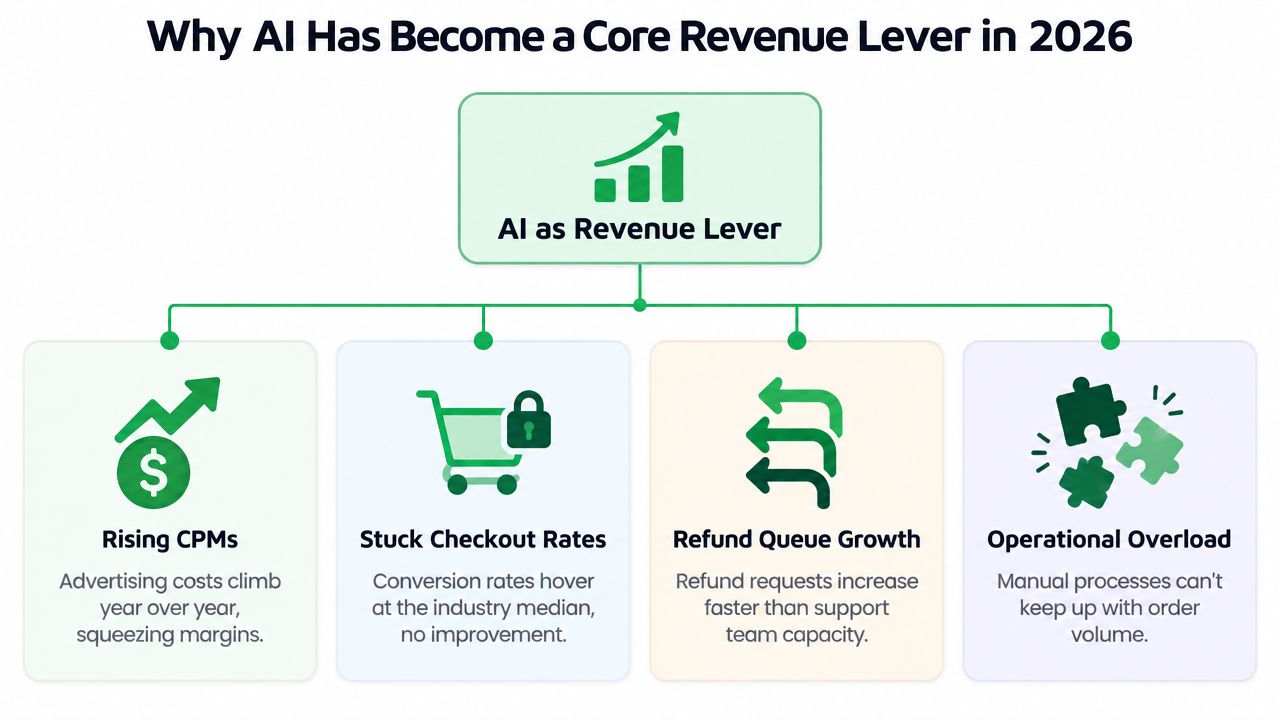
The four pressure points
Acquisition efficiency is the first layer. AI can help rank audiences, prepare creative variations, and match product feeds to shopper intent. The KPI is ROAS, but the operator's real concern is contribution margin after media and discounts. For merchants scaling catalog advertising, resources on batch product catalog ads can help clarify how automation fits into creative production.
On-site conversion is the second layer. Search, recommendations, merchandising, and conversational guidance should increase revenue per session, not merely clicks. A relevant recommendation that protects margin is more valuable than a popular product that creates a low-value order.
Checkout and payment completion form the third layer. AI can identify friction, select payment paths, and support retry or routing decisions. The KPIs are checkout completion, payment success rate, and time to purchase.
Retention and risk complete the stack. Churn prediction, renewal messaging, fraud scoring, and dispute evidence affect 90-day retention, recovered recurring revenue, and chargeback rate. NVIDIA's 2024 retail and CPG report found that among respondents already using AI, 69% believed it increased annual revenue and 72% said it reduced operating costs (source details). Those were reported experiences from adopters, not forecasts.
Operator rule: Fund AI where the data already exists, the failure is expensive, and the KPI can be measured without interpretation.
This guide ranks the benefits by speed to payback and control over revenue, not by which product demo looks most impressive. A useful overview of the broader category is available in Tagada's AI ecommerce platform guide.
What AI in Ecommerce Actually Means
Most ecommerce automation starts with rules. If the cart exceeds a threshold, show a shipping message. If a customer viewed a product, send a reminder. If an order comes from a flagged location, send it to review. Rules are useful because they're simple, visible, and easy to audit.
They break when the business adds more products, markets, payment methods, customer types, and exceptions. A rules engine doesn't learn that a returning subscriber prefers a particular wallet, that a new SKU has no purchase history, or that the same customer has already received several recovery messages across email and SMS. Teams then add more conditions until the system becomes difficult to maintain and still treats too many shoppers alike.
Three layers of decision-making
Predictive models add scoring. They estimate the likelihood that a shopper will buy, return an item, churn, respond to an offer, or represent fraud. The model can combine session behavior, purchase history, device information, payment context, and other approved signals.
Orchestration decides what happens next. It selects the message, offer, product, payment route, or escalation path, then delivers that decision on the appropriate surface. The surface may be the storefront, checkout, email, SMS, advertising creative, or an internal workflow.
A practical analogy helps:
- Rules are a static store directory. They tell every visitor where a department is located.
- A predictive model is a salesperson who remembers the last visit. It uses context to estimate what the shopper needs.
- An orchestration layer is the store manager. It routes that shopper to the right product, offer, and employee at the right moment.
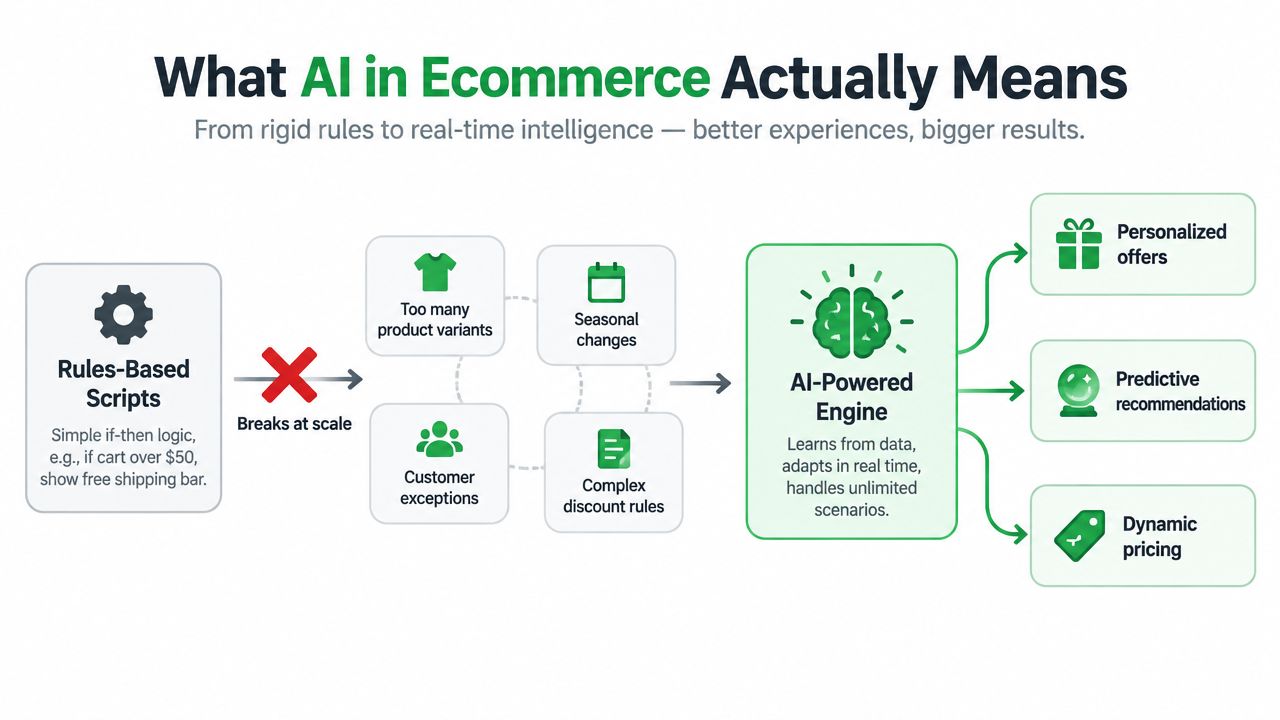
That distinction prevents a common buying mistake. A chatbot alone may answer questions, while a connected system can use those answers to rank products, preserve context, select a payment method, and trigger a retention action after purchase. Merchants evaluating conversational tools can also review how to boost ecommerce sales with AI chatbot, provided the assistant connects to the transaction path rather than operating as a support island.
The capabilities that matter most are personalization, merchandising, pricing, fraud detection, checkout optimization, payment routing, retention, and workflow automation. Each has a place in the revenue stack. None should be deployed without a measurable job.
Personalization and Smarter Merchandising
Personalization and merchandising are the same commercial problem viewed from two sides. Personalization asks what this shopper is likely to value. Merchandising asks which products, placements, and messages should appear. A strong relevance engine answers both questions at the session level.
Instead of showing one default category order, the system can recompute product ranking from browsing behavior, purchase history, cart contents, and current context. Recommendation slots, search results, category pages, and promotional modules then reflect the visitor's likely intent. The commercial objective isn't a higher click-through rate by itself. It's more revenue per session with acceptable margin.
An independent 2026 analysis reported that revenue per session from personalized experiences rose from $1.12 to $2.64 across 10,000 brands between December 2025 and March 2026 (analysis and source context). The same analysis cites typical personalization lifts of 5% to 15% in revenue, with gains of up to 25% for top performers. Treat those figures as directional benchmarks, not a promise for an unprepared catalog.
The controls that protect the experience
Personalization fails when the model optimizes one narrow signal. Put guardrails around it:
- Cold-start coverage: New products need fallback rankings based on category, attributes, margin, and human merchandising input.
- Catalog diversity: Limit repetitive recommendations so the page doesn't collapse into a bestseller loop.
- Merchandising control: Give the buyer team the ability to reserve hero placements, launch products, and protect seasonal narratives.
- Margin awareness: Rank products by expected commercial value, not just predicted clicks.
| KPI | Conservative Lift | Aggressive Lift | Driver |
|---|---|---|---|
| Revenue per session | 5% to 15% | Up to 25% for top performers | More relevant product ranking and discovery |
| Personalization revenue per session | Qualitative improvement | $1.12 to $2.64 benchmark in one 2026 analysis | Session-level recommendations |
| Average order value | Qualitative improvement | Up to 50% in a cited benchmark | Cross-sell and bundle relevance |
The broader benefits of AI in ecommerce become easier to manage when merchants treat personalization as a controlled merchandising system rather than a black box. Teams looking to compare implementation options can use AI ecommerce tools from Tagada as one reference point while defining their own event, margin, and experimentation requirements.
Faster Checkout and Higher Conversion Rates
Checkout friction usually appears as a collection of small failures: a missing local payment method, an address field that rejects a valid format, an unsupported currency, or a wallet error with no recovery path. Each interruption increases abandonment and weakens the checkout KPI that matters most, completed orders.
Treat AI assistance, guided checkout, and payment routing as one conversion system. An assistant can answer fit, delivery, compatibility, and product questions before payment. Passing that context into checkout prevents shoppers from repeating information and gives the funnel a better chance to convert existing demand.
Independent ecommerce research cited in 2026 found that shoppers who engaged with AI chat converted at 12.3%, compared with 3.1% for those who did not. The same research reported that AI-assisted shoppers completed purchases 47% faster (benchmark source). Use that result as a testing hypothesis, not a forecast. A generic pop-up interrupts intent. Guidance tied to a real objection can remove it.
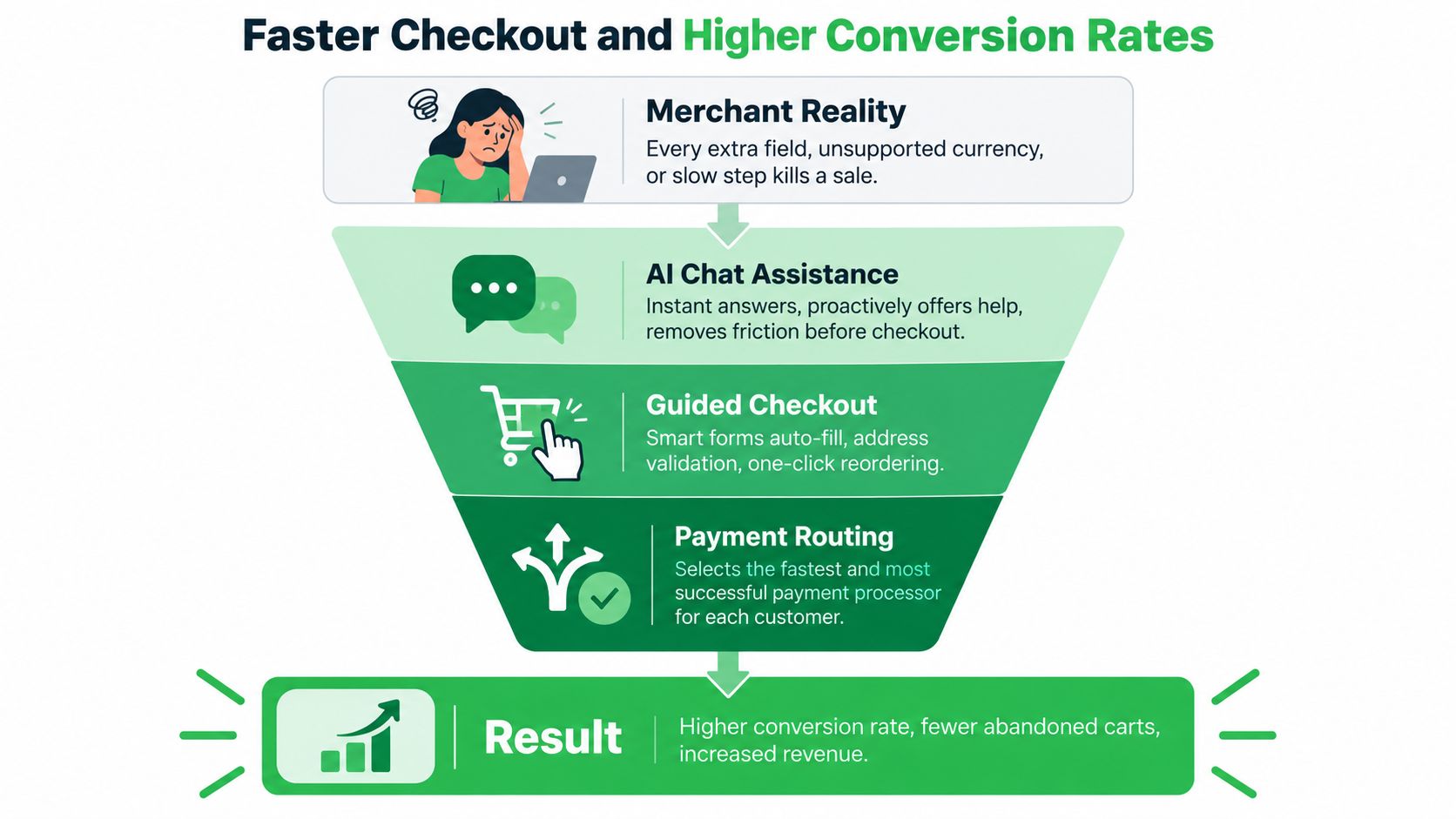
What the system should optimize
AI assistance should resolve uncertainty and hand off the conversation with its context intact. Guided checkout should reduce unnecessary input through address validation, remembered preferences, and forms that adapt to the shopper. Payment routing should select a processor, payment method, or retry path using location, device, currency, issuer response, and risk signals.
Track three operational KPIs:
- Checkout abandonment rate: Identify the exact step where shoppers leave.
- Payment success rate: Measure approvals for legitimate attempts by route.
- Time to purchase: Compare completion time for assisted and unassisted shoppers.
The architecture affects the result. Copy-and-paste widgets often duplicate tracking, lose conversation context, and delay handoffs. Native orchestration lets the storefront, payment layer, customer profile, and experiment framework act on the same event stream.
The accompanying video provides another visual way to think about AI-assisted checkout:
<iframe width="100%" style="aspect-ratio: 16 / 9;" src="https://www.youtube.com/embed/Mljd2UsicAY" frameborder="0" allow="autoplay; encrypted-media" allowfullscreen></iframe>
A cited benchmark reports potential campaign or site-level gains of up to 300% in revenue, 150% in conversions, and 50% in average order value. Treat those as upper-bound claims. Run holdout tests and judge the system by conversion rate, payment success, time to purchase, and revenue per session before expanding it.
Dynamic Pricing and Margin Optimization
Dynamic pricing should protect contribution margin, not turn your storefront into a permanent discount machine. The model can ingest competitor pricing, inventory depth, sales velocity, and demand signals, then recommend or apply price changes where the commercial risk is acceptable.
That makes repricing useful for slow-moving products, marketplace catalogs, and time-bound categories. It can help a merchant remain competitive on long-tail items without forcing the entire assortment into a blanket promotion. The KPI to watch is margin per session, not average selling price. A higher selling price means little if it lowers conversion and leaves inventory idle.
The main failure mode is overreach. Repricing hero products can weaken brand perception. In a brand-sensitive category, constant price movement can train customers to wait for discounts. Low repeat purchase behavior also makes aggressive elasticity testing more dangerous because the merchant has fewer future orders to recover the cost of a poor first interaction.
| Catalog Segment | Pricing Pressure | AI Repricing Impact | Watchouts |
|---|---|---|---|
| Long-tail products | Competitive and inconsistent | Can maintain relevance while protecting margin | Bad product data can produce poor comparisons |
| Slow-moving SKUs | Excess inventory and weak velocity | Can support clearance decisions | Avoid racing competitors to the bottom |
| Hero products | Brand and positioning pressure | Usually limited upside from automation | Keep human approval in the loop |
| Time-bound categories | Demand changes quickly | Can respond to changing context | Define price floors and review windows |
Margin rule: Start with the bottom 60% of the catalog, hold the top 20% for human review, and scale only after margin per session improves.
That operating rule creates a controlled test, not an open-ended pricing experiment. AI should recommend where uncertainty is high, while commercial owners retain authority over products that define the brand.
Fraud Detection and Chargeback Reduction
Fraud prevention belongs inside the revenue stack because every approved fraudulent order creates a cost, while every false decline removes legitimate revenue. Static rules tend to create both problems. They block good customers who resemble risky traffic and miss coordinated behavior that changes faster than a rulebook.
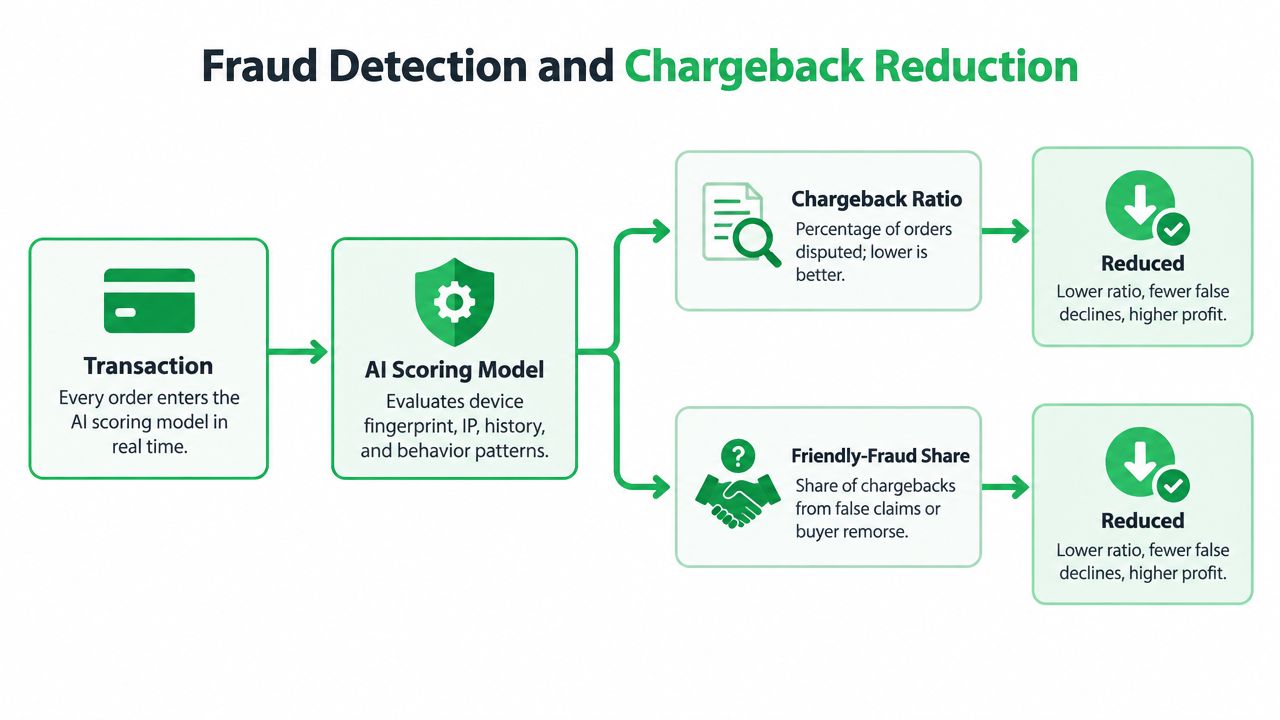
AI scoring models can evaluate device fingerprints, behavioral signals, transaction history, shipping information, and other permitted context in milliseconds. Mastercard reports that embedding generative AI into commerce tools has improved some fraud detection models by as much as 300% (Mastercard's explanation of AI in commerce).
The operational target is not “block more orders.” It's a healthier chargeback ratio, stronger legitimate approval, and a lower share of friendly fraud. Friendly fraud is especially relevant to subscriptions and recurring billing. One industry summary says it accounts for 61% of chargeback disputes, and recommends preserving subscription disclosures, charge confirmations, and accessible cancellation records (ecommerce fraud prevention guidance).
Screen the payment and defend the dispute
The best systems connect pre-authorization scoring to post-purchase evidence. When a dispute arrives, the platform should be able to assemble order metadata, delivery confirmation, customer communications, billing descriptors, subscription terms, and cancellation history into a review-ready package.
Merchants also need to understand processor tolerance. Industry guidance commonly classifies merchants as high risk when chargeback ratios exceed 1% of total transactions (payment risk guidance). That threshold can affect reserves, processing terms, and acquiring access.
Use fraud detection for signups when evaluating account creation risk, but don't stop there. Screen login, checkout, payment, fulfillment, and refund behavior as connected events. A practical implementation guide is available through ecommerce fraud prevention with Tagada, with the caveat that every model should be back-tested on a holdout set before live rules change.
Retention Messaging and Subscription Recovery
Acquisition gets attention because it's visible. Retention often pays back faster because the customer already knows the product, the brand owns the relationship, and the next purchase doesn't require the same level of persuasion.
AI can act across four post-purchase moments:
- Shipping and usage nudges: Adjust timing when delivery or consumption signals suggest the next order may arrive too early or too late.
- Predicted churn flows: Trigger a win-back message when cancellation likelihood rises, rather than waiting for the customer to leave.
- Subscriber dunning: Match the recovery sequence to the payment failure, customer history, and prior response.
- Replenishment reminders: Send a prompt when actual consumption suggests the customer is ready, not when a fixed calendar interval expires.
Consider a coffee subscription. A revenue-aware model might choose a discount for a high-value customer with strong cancellation intent, a skip option for someone whose order timing has shifted, or a downgrade prompt for a subscriber showing budget pressure. The objective isn't to send more messages. It's to make the next action fit the customer's state.
Measure recovered revenue, not engagement theater
Open rate and click rate can help diagnose a campaign, but subscription operators should prioritize recovered MRR per send, involuntary churn reduction, renewal completion, and save rate. Advanced dunning with smart retries, timed around payment method, bank patterns, and card-network feedback, reportedly recovers 55% to 65% of failed payments (subscription billing benchmark).
| Retention Moment | AI Trigger | Action | KPI Moved |
|---|---|---|---|
| Payment failure | Failure type and customer history | Smart retry or payment-method update prompt | Recovered MRR |
| Cancellation intent | Reduced engagement or cancellation behavior | Skip, downgrade, or save offer | Involuntary and voluntary churn |
| Replenishment window | Purchase and usage pattern | Timed reminder with relevant product | Repeat purchase rate |
| Post-delivery period | Delivery and product lifecycle event | Education or next-use message | 90-day retention |
Data hygiene determines whether these workflows help or annoy. Keep subscription state, customer identity, payment events, consent records, and communication history unified. Without that foundation, AI retention becomes automated spam with a CRM price tag.
Putting It All Together With a 90 Day Rollout Plan
Don't launch seven AI features at once. Roll them out according to the distance between the problem, the available data, and the measurable financial outcome.
Days 1 to 30 build the foundation
Start with event tracking and identity resolution. Capture product views, search behavior, cart changes, payment attempts, authorization responses, refunds, disputes, renewals, skips, cancellations, and consent status. Create a unified customer profile that can connect the storefront to payment and lifecycle events.
Choose two high-friction surfaces, usually checkout and fraud, where the path to measurement is short. Define the baseline before changing behavior. If the team can't agree on the existing checkout completion rate or chargeback ratio, it isn't ready to evaluate an AI intervention.
Days 31 to 60 test relevance and margin
Put personalization, merchandising, and pricing behind feature flags. Start with recommendations or category ranking before allowing automated price changes. Run controlled experiments with clear success metrics, including revenue per session, margin per session, payment success, and false-decline review outcomes.
Keep a human approval path for pricing and account actions. Model predictions should be visible enough for finance, risk, and merchandising teams to understand why the system made a recommendation.
Days 61 to 90 connect retention and orchestration
Use the event data from the first phase to activate churn, replenishment, and dunning workflows. Connect the actions across email, SMS, checkout, and payment recovery so one customer doesn't receive contradictory offers from separate tools.
Ship three controls alongside every phase:
- Model monitoring: Watch for drift, changing approval patterns, and degraded recommendation quality.
- Human override: Let authorized staff stop pricing, fraud, account, or messaging actions.
- Fallback behavior: Define what happens when the AI service is unavailable, delayed, or wrong.
Before signing a vendor agreement, ask about data residency, latency service levels, audit logs, model explainability, consent handling, processor coverage, and export rights. Tagada is one platform option that combines storefront orchestration, checkout, payment routing, subscriptions, messaging, server-side tracking, and risk-aware payment workflows in a single commerce layer. Evaluate it against your event architecture and operating requirements, not against a feature checklist.
A practical rollout succeeds when each phase produces a decision. Keep the use case if the KPI improves without unacceptable risk. Change the implementation if the model is useful but the experience is weak. Stop the feature when it adds complexity without measurable commercial value.
If checkout friction, payment failures, chargebacks, or subscription recovery are limiting growth, visit Tagada to see how its checkout, payment routing, dunning, messaging, and ecommerce orchestration capabilities fit together. Start by mapping your highest-value revenue leak, then use Tagada's platform to test a controlled intervention against a KPI your finance team already trusts.