

A digital product can be delivered perfectly and still be one of the hardest ecommerce transactions to defend. A physical retailer can produce a carrier record, delivery confirmation, and signature. A digital goods merchant has to prove access through a chain of timestamps, delivery records, usage events, and customer identity signals. That difference turns payment processing into a revenue system, not a checkout plug-in.
The market opportunity is substantial. One industry report estimates the digital goods market at USD 124.32 billion in 2025, rising to USD 157.39 billion in 2026 and potentially reaching USD 511.43 billion by 2031, a projected 26.6% CAGR from 2026 to 2031 (Mordor Intelligence's digital goods market analysis). The merchants positioned to capture that growth won't be the ones that only add card acceptance. They'll build routing, fraud controls, subscription operations, and chargeback evidence into the product experience from the first transaction.
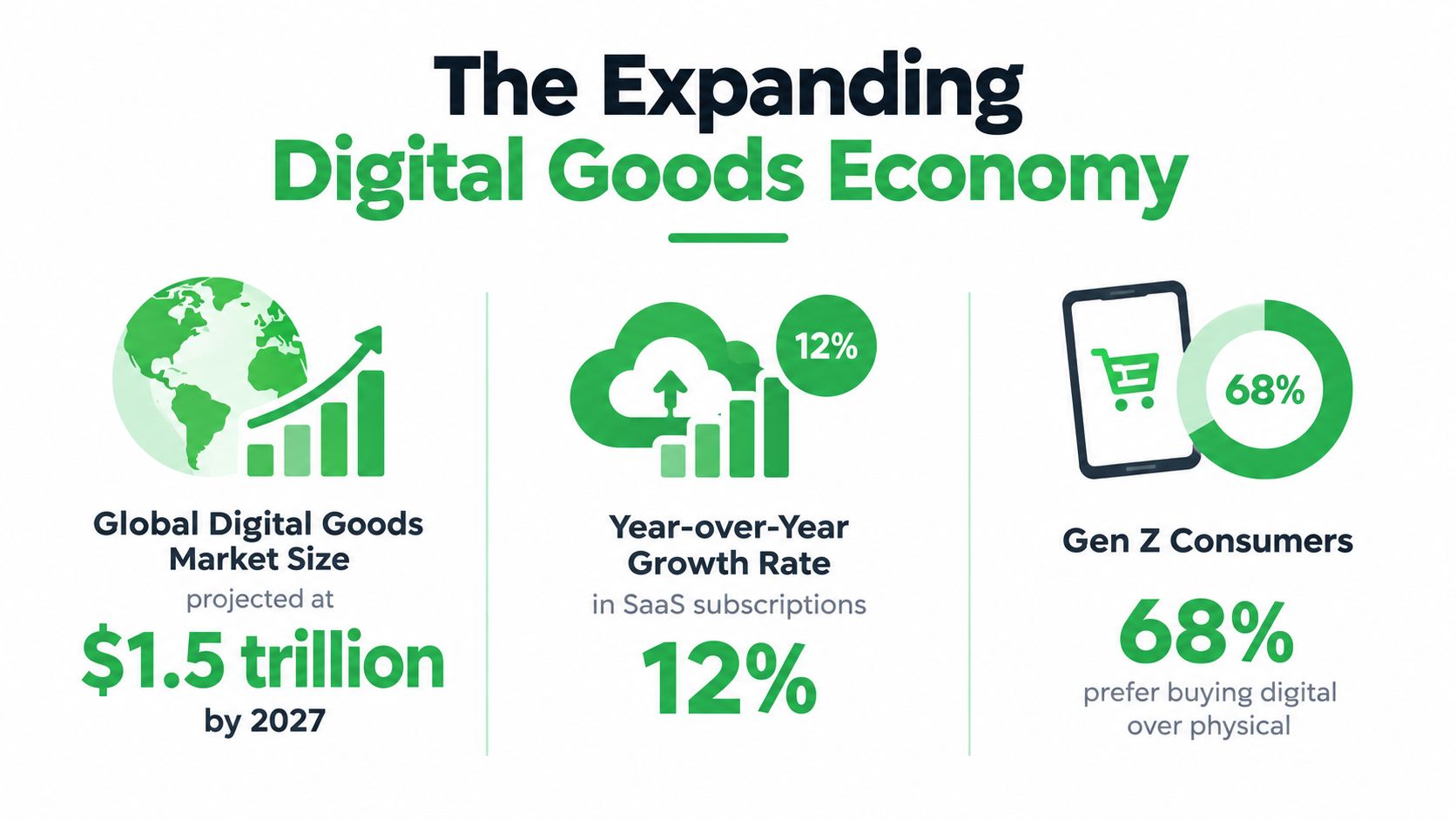
The Expanding Digital Goods Economy
Digital product growth creates merchant revenue only when payment operations keep pace with demand. Ebooks, courses, software licenses, templates, memberships, downloadable media, app purchases, and subscription access share a useful operating model: delivery is immediate and inventory can be reproduced without physical fulfillment. That supports international selling, but it also places authorization, fraud screening, access control, and customer communication inside the same checkout and account system.
Market expansion alone does not guarantee completed transactions. An issuer can decline a legitimate purchase, a customer may fail to recognize the billing descriptor, or a processor may flag an abrupt cross-border pattern. A digital merchant cannot rely on shipping records or physical returns to support recovery. Payment orchestration therefore needs to connect routing, risk decisions, account signals, and delivery events rather than treating card acceptance as a standalone feature.
Demand is broad, but payment expectations are local
Customers expect payment choices that match their market and device. Someone buying a course, software subscription, or music-related download may prefer a wallet, a familiar local method, or a mobile-first form. A specialist marketplace can also serve a defined community, including customers who want to find music gear and merch. Relevance and trust influence conversion alongside the payment button.
The product model determines the operational burden. A one-time template sale requires clear delivery and refund handling. A subscription adds renewal consent, card lifecycle management, dunning, and dispute exposure. A high-value course may receive greater fraud scrutiny and requires records that show what the customer purchased and used. Map those payment behaviors before increasing acquisition.
A practical guide to selling digital products online can help frame the broader storefront model. The operating principle is straightforward: checkout, access control, customer messaging, and payment records should function as one revenue system. That system should recover legitimate sales where possible while blocking transactions whose risk exceeds their expected value.
Why Intangible Fulfillment Creates Unique Risk
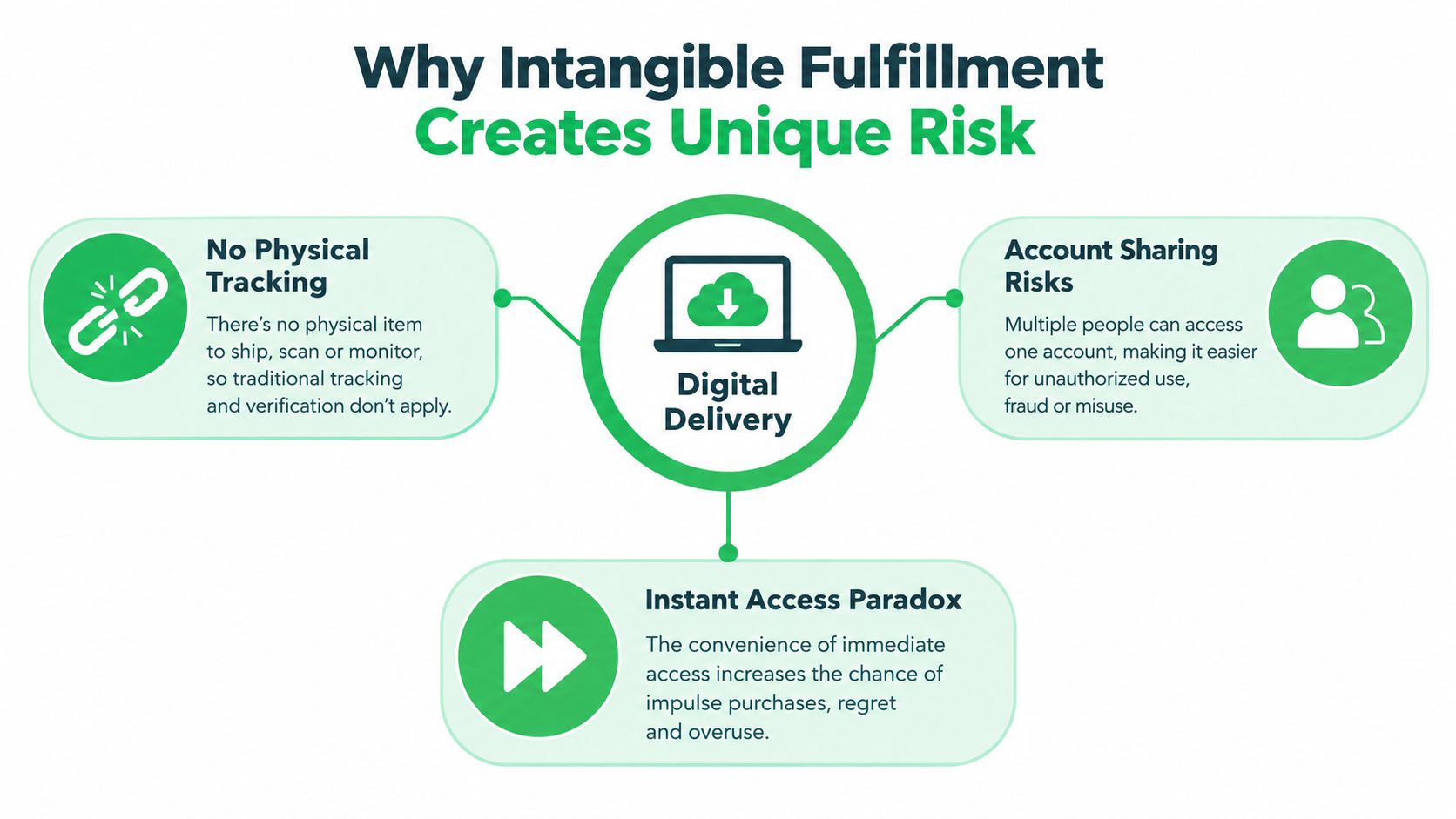
Digital fulfillment looks easy because there's no warehouse, carrier, or delivery delay. From a dispute perspective, that apparent simplicity is a weakness. If a physical buyer says an order never arrived, the merchant can usually present a shipping record. If a digital buyer says a download or course wasn't received, the merchant needs to reconstruct what happened inside the account and delivery systems.
The strongest evidence usually combines a timestamped download or access log, the delivery email and its open record, and continuity between the purchase IP or device and later use. Visa guidance also emphasizes order confirmations, delivery records, communication logs, and usage data when merchants need to show that a transaction was legitimate. Without these records, the merchant can't recover the delivered service, so a lost dispute generally represents the full transaction value.
The instant access paradox
Instant delivery improves the customer experience while shrinking the merchant's recovery options. A buyer can consume a file, view a course, activate software, or use a virtual item before the merchant has any opportunity to verify intent manually. Account sharing makes the evidence harder to interpret because one purchase may generate activity across unfamiliar devices or locations.
That doesn't mean every unusual login is fraud. It means the merchant needs context. A new device after a normal purchase may be harmless. Repeated access patterns, rapid account changes, failed identity checks, and mismatched payment signals deserve a different treatment from a consistent customer journey.
Practical rule: If your system can't show what was delivered, when it was accessed, and which account or device used it, your dispute strategy starts after the evidence has already disappeared.
Capture evidence before the dispute
Evidence collection should begin at checkout, not when a bank sends a retrieval request. Store the product identifier, entitlement granted, delivery destination, access timestamp, device continuity, and relevant customer communications in a format your dispute team can retrieve quickly.
Clear customer-facing information also reduces preventable disputes. Show what the buyer receives, when access begins, how the charge will appear on a statement, and where to request support. A recognizable billing descriptor and an accessible refund path can prevent confusion from becoming a bank-filed dispute.
The best digital goods operations make fulfillment measurable without turning the product into a surveillance exercise. Log the minimum information needed to prove a legitimate transaction, protect it appropriately, and connect it to the order record.
Architecting Resilience with Payment Orchestration
A single gateway can process payments successfully for a while, then become a bottleneck when volume, geography, product mix, or issuer behavior changes. Digital goods merchants feel that weakness quickly because they often sell internationally and promise immediate delivery. If one processor declines a legitimate transaction or suffers an outage, the customer experiences a failed purchase rather than a recoverable routing event.
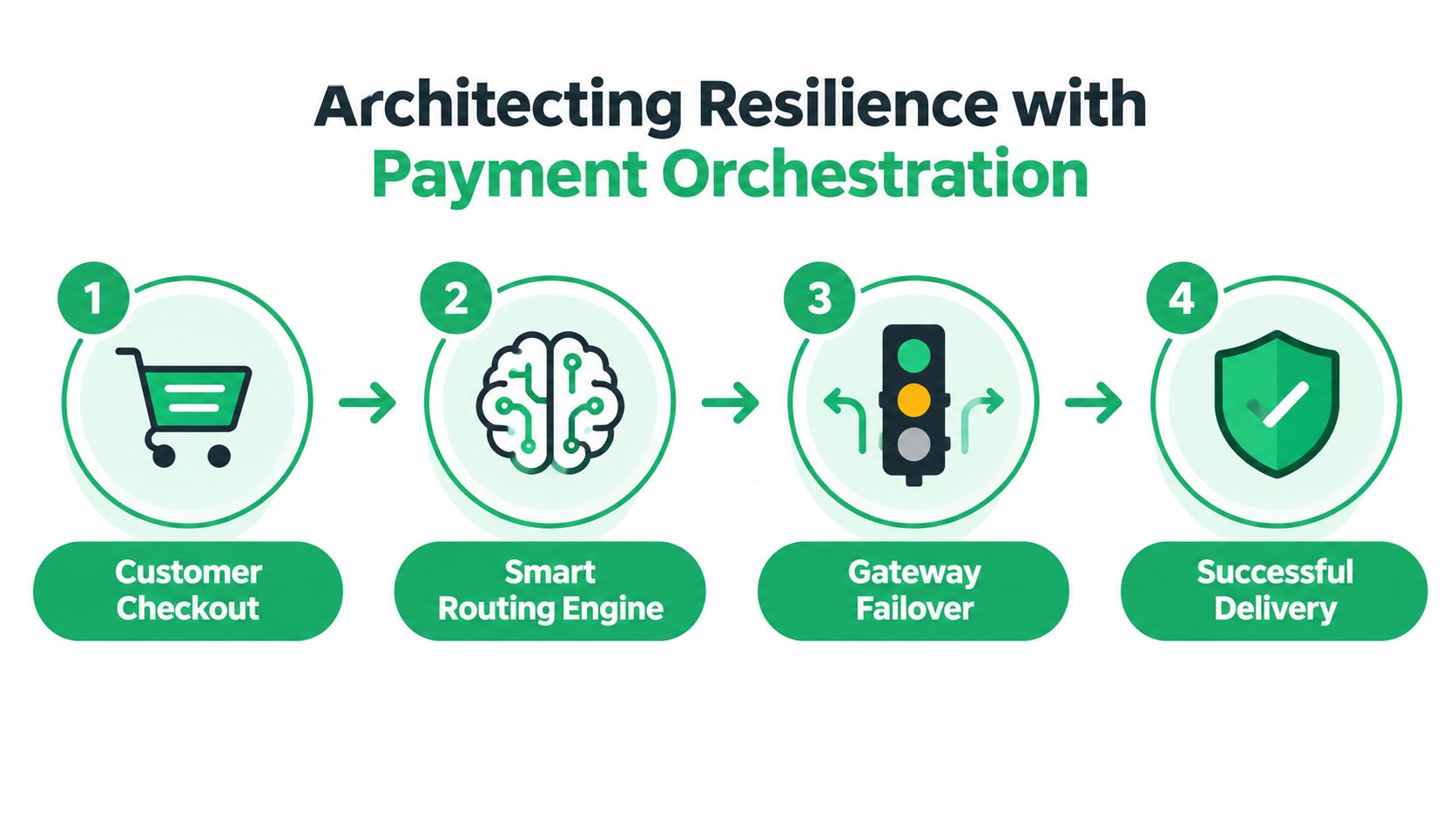
Payment orchestration separates the customer-facing checkout from the decision about where and how to process the payment. The orchestration layer can evaluate region, currency, payment method, issuer response, risk signals, processor health, and retry eligibility before selecting a route. The customer sees one purchase experience, while the merchant manages a network of processing paths.
McKinsey's Global Payments Report describes a payments environment shaped by regional fragmentation, wider use of digital assets for payment purposes, and the potential impact of AI. For a digital goods merchant, those forces translate into an operational question: which payment rail gives this buyer the best chance of an approved, compliant transaction right now?
Build routing around decisions, not logos
A multi-PSP setup isn't valuable merely because it contains several processor logos. It works when the routing policy reflects actual payment behavior.
Start with the buyer context. Route based on market, currency, method, product type, and subscription status. A domestic card purchase and an international recurring rebill shouldn't automatically follow the same path.
Use local methods where intent is strong. Local wallets and bank-based methods can remove unnecessary card friction, but they also introduce different settlement, refund, and reconciliation requirements. Add them where customer demand and operational capacity justify the complexity.
Apply smart retries selectively. Retry a soft decline when the response and timing support another attempt. Don't blindly resubmit every failure, because repeated attempts can increase issuer suspicion and frustrate the buyer.
Keep failover controlled. A secondary processor should be available when the primary route is unavailable or unsuitable, but the merchant must preserve consistent descriptors, customer records, and evidence across the transaction lifecycle.
Stripe, Adyen, and NMI can each play different roles in a broader processing strategy, depending on geography, underwriting, methods, and commercial terms. The right choice isn't the processor with the longest feature list. It's the combination that gives the merchant visibility, recoverability, and acceptable risk control.
For a deeper explanation of the architecture, this overview of payment orchestration describes how routing can sit between checkout and processors. The design should remain observable: record the route, response, retry decision, and final fulfillment result so finance and risk teams can explain every outcome.
Optimizing Authorization Rates Without Inviting Fraud
Approval optimization isn't the same as approving more transactions at any cost. A digital goods merchant needs to recover legitimate demand while keeping fraud, disputes, and processor risk within tolerable limits. Excessively aggressive filters create false declines. Weak controls create losses and may damage the account's long-term processing position.
Industry benchmarks cited for digital goods and software place approval rates around 85–92%, while other commentary describes downloadable products at 80–86% when fraud pressure is higher (MyPayAdvisor's approval rate analysis). The spread is a reminder that authorization depends on how the transaction is presented, not just on the buyer's card.
Treat AVS and CVV as signals
AVS, or Address Verification Service, compares address information supplied during checkout with issuer records. CVV matching adds another identity signal for card-not-present transactions. These checks can help fight more than 80% of digital goods chargebacks, according to the same industry source, but they shouldn't be interpreted as an automatic verdict.
A mismatch may reflect a legitimate customer using a different billing address, an international formatting issue, or a wallet flow that doesn't expose the expected data. Block every mismatch and you'll reject good buyers. Ignore every mismatch and you'll accept avoidable risk.
Use layered decisions instead:
- Low-friction approval: Consistent identity signals, familiar device behavior, sensible purchase velocity, and a supported region can qualify for immediate delivery.
- Step-up verification: Conflicting signals can trigger an additional verification step, manual review, or delayed entitlement rather than an immediate hard decline.
- Hard block: Repeated payment failures, abusive account behavior, suspicious velocity, and clear identity conflicts justify refusing the transaction.
Retry with intent
A processor response should inform the next action. Soft declines may justify a carefully timed retry or another route. Hard declines, clear fraud signals, and repeated attempts should not enter an automatic retry loop.
Review authorization by market, product, method, issuer response, and processor. A blended approval number can hide a profitable segment that one route handles well and a high-risk segment that needs stronger controls. The architect's job is to find those differences, then adjust routing and verification without making every customer pay for the riskiest traffic.
Navigating Subscription Compliance and Network Thresholds
Recurring digital access changes the merchant's obligations. The customer must understand the renewal terms, the amount or pricing basis, the timing, and the cancellation process. A stored card alone doesn't establish durable consent, especially when the customer sees a charge much later and no longer remembers the original purchase.
The FTC's Negative Option Rule, cited alongside the ROSCA framework by industry compliance guidance, creates disclosure and consent considerations for automatic renewal programs (subscription risk guidance from 2Accept). Annual renewals are particularly exposed to what the industry describes as a long memory gap between signup and billing. Clear consent records, renewal notices, cancellation access, and consistent descriptors are operating controls, not decorative legal text.
Network monitoring is a financial constraint
Card networks monitor dispute ratios, and high-risk classifications make that monitoring especially important. The thresholds below come from the cited industry source and should be confirmed with your acquiring partners because program rules and assessment methods can change.
| Card Network | Program | Threshold | Consequence |
|---|---|---|---|
| Visa | VDMP | 0.9% chargebacks-to-transactions | Monitoring exposure and remediation requirements |
| Mastercard | ECM | 1.5% chargebacks-to-transactions | Escalation risk, including monitoring and possible penalties |
Staying above 1.5% for four months can escalate an account into monitoring programs, with possible fines of $25,000–$200,000 (2Accept's high-risk business guidance). Those figures make dispute prevention a treasury issue as much as a support issue. A merchant can grow gross sales while weakening the account that processes them.
Engineer the rebill lifecycle
Subscription operations should connect billing events to customer communication and entitlement controls.
- Before renewal: Remind the customer what will renew, when it will happen, and how to cancel.
- At failure: Route eligible retries intelligently and send a clear payment-update path.
- After failure: Avoid confusing access, refunds, and account status. Give the customer a defined grace process.
- After cancellation: Stop future billing and retain the consent and cancellation record.
Measure disputes by billing age, plan type, acquisition source, descriptor, and renewal event. If disputes cluster around a specific offer or renewal interval, fix the offer and communication rather than adding a blanket fraud rule to every subscription.
Building an Ironclad Chargeback Defense Strategy
Representment starts with triage. Not every dispute deserves the same response, and a weak evidence packet can waste more time than the transaction is worth. For the cases you do contest, the packet should tell a coherent story from purchase authorization through delivery and use.
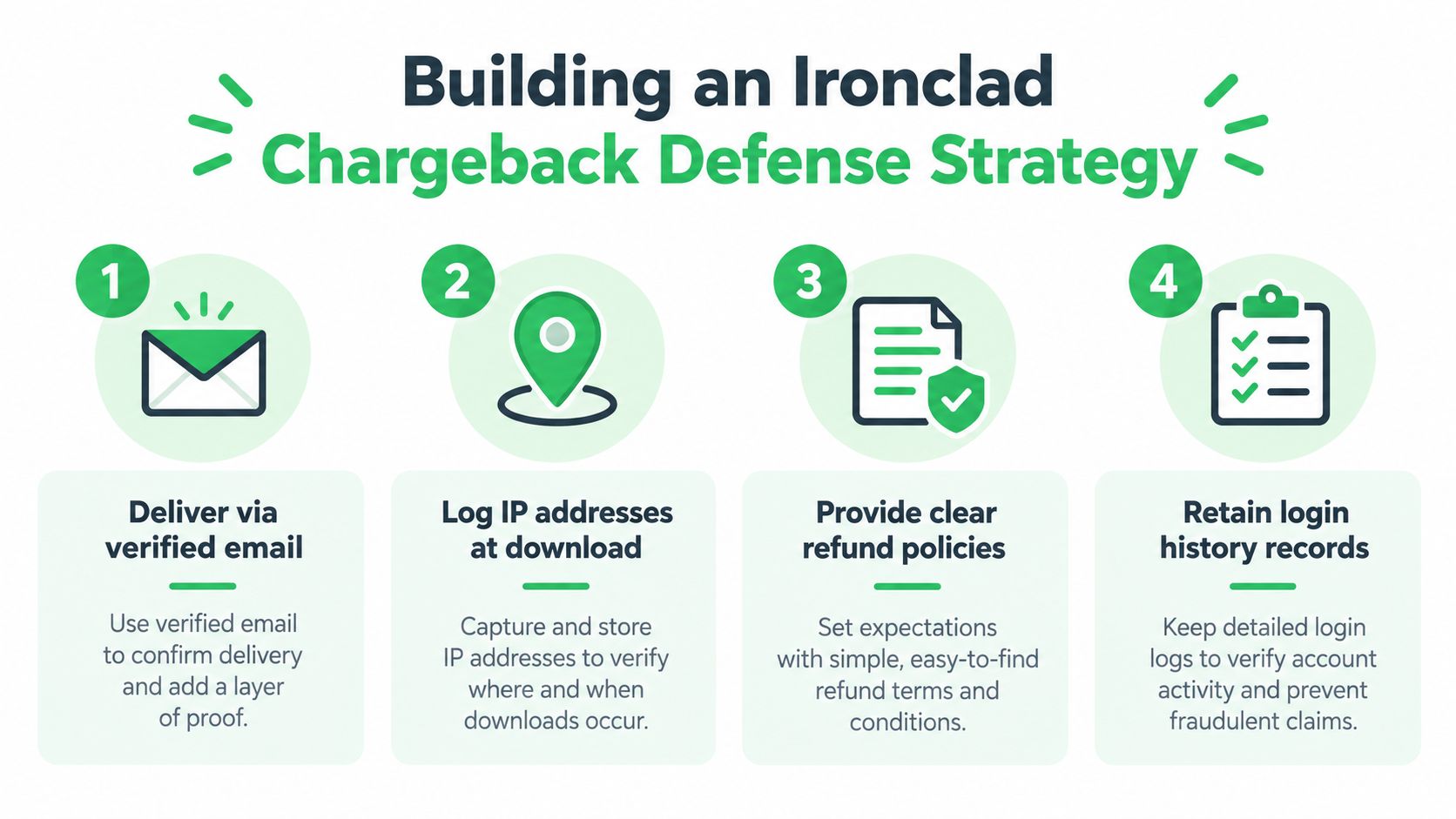
Start with the transaction record, then add evidence in chronological order:
- Identify the purchase. Include the order identifier, product, amount, currency, descriptor, checkout timestamp, and consent record.
- Prove delivery. Show the delivery email, destination, delivery result, and the time access became available.
- Show consumption. Add download events, login history, course progress, software activation, or other product-specific usage.
- Connect the user to the payment. Present IP or device continuity, account details, and relevant authentication signals without exposing unnecessary personal data.
- Address the customer's claim. Match the evidence to the dispute reason. A delivery dispute needs delivery and access evidence. A recurring billing dispute needs consent, renewal communication, and cancellation records.
- Submit on time. Keep the packet concise, legible, and mapped to the issuer's requirements.
The operational rules are strict. Disputes must be answered within the assigned deadline, and merchants should refund the original card if they decide a refund is appropriate. A refund shouldn't be sent by cash, bank transfer, or another card, because that can leave the original payment dispute unresolved and create a second financial exposure.
Merchants typically have a response window of about 45 days in Visa and Mastercard-related disputes to provide evidence such as usage logs (Elavon's ecommerce chargeback guidance). Treat that period as a maximum operational boundary, not a planning target. Evidence should be assembled as events occur, so the team isn't reconstructing a customer's activity under pressure.
A dispute team also needs a decision rule. Contest cases with strong evidence and meaningful value. Accept cases where the product was never delivered, consent is absent, or the records are too incomplete to support a credible response.
Here is a practical view of the evidence chain:
Evidence should answer four questions: Who paid, what did they buy, when did they receive access, and what did they do with it?
Use the following video as a visual aid for the mechanics of dispute handling:
<iframe width="100%" style="aspect-ratio: 16 / 9;" src="https://www.youtube.com/embed/nRJMAiqAjYU" frameborder="0" allow="autoplay; encrypted-media" allowfullscreen></iframe>
Unifying Checkout and Messaging for Maximum Retention
A payment failure becomes expensive when the checkout, billing system, access service, and messaging platform don't share the same event history. The customer sees a failed renewal, support sees an angry ticket, and the finance team sees an unpaid invoice. Each team reacts separately because no system owns the full revenue event.
A unified flow works differently. The checkout creates the customer and payment context, the routing layer selects a processor, the subscription service records the rebill, and the messaging system reacts to the actual payment result. If a renewal fails, the merchant can attempt an eligible retry, send a payment-update message, preserve access according to policy, and escalate only when the recovery path is exhausted.
Design around payment events
Revenue-aware messaging should respond to events rather than calendar assumptions.
- Successful purchase: Send the receipt, access instructions, support path, and statement descriptor context.
- Failed initial payment: Explain the issue without granting access prematurely, then offer a secure recovery path.
- Failed renewal: Provide the amount, renewal context, update method, and cancellation option in one message.
- Recovered payment: Confirm continued access and stop further dunning messages.
- Dispute or refund: Synchronize entitlement and customer communication so the account status matches the financial outcome.
This architecture matters as digital commerce expands. Juniper Research projects digital commerce spend to reach $34 trillion by 2029, with growth increasingly associated with knowledge products and subscriptions, while buyers expect instant, local, and mobile-first payment experiences (Juniper Research's digital commerce forecast). More demand doesn't compensate for disconnected systems. A failed rebill that nobody owns remains lost revenue.
A practical stack can combine a visual storefront builder, a headless checkout, multi-processor routing, subscription management, dunning, server-side event tracking, and email or SMS triggered by payment outcomes. Tagada provides these functions through TagadaCheckout, TagadaPay, and TagadaSend, with routing across processors such as Stripe, Adyen, and NMI, smart retries, local methods, subscription workflows, and payment-event messaging. The right implementation should remain modular, so a merchant can change processors or front-end experiences without rebuilding its customer and evidence model.
If your digital goods operation needs more than basic card acceptance, Tagada can unify checkout, payment routing, subscription billing, dunning, and revenue-aware messaging in one orchestration layer. Visit Tagada to assess a resilient payment flow that recovers legitimate transactions while preserving the evidence and controls your business needs to scale.