
E-commerce Marketing Strategies: 20 Levers, Mapped by Funnel Stage
20 e-commerce marketing strategies sorted by funnel stage: acquisition, checkout, order value, retention, measurement. Which to pull first, and the rules.

Article summary
TL;DR
The best e-commerce marketing strategies are the ones that fix your weakest funnel stage. Sort them in five groups: acquisition (funnel, landing page, attribution), conversion (checkout, payment methods), order value (upsells, bundles, tiers), retention (triggered email, SMS, subscriptions, segments) and measurement (analytics, margin per order). Fix the lowest leaking stage first, because every channel flows through it.
- Group strategies by funnel stage, not by channel. A channel brings traffic; the stages after the click decide whether it pays.
- Start at the bottom. A checkout or payment fix improves every channel at once, while a new channel only adds one more source of traffic.
- Your margin per order and your customer lifetime value set how much you can pay for a customer. Measure both before raising ad spend.
- Influencer posts, reviews, emails and texts all fall under US rules: FTC Endorsement Guides, the Consumer Reviews Rule, CAN-SPAM and the TCPA.
- Measure each lever with one metric, on settled orders, against a holdout when you can.
 ChatGPT
 Claude
 Perplexity
 Grok
GrokOn this page
Most lists of e-commerce marketing strategies are lists of channels: SEO, ads, social, email. Channels bring traffic. Whether that traffic turns into profit depends on everything that happens after the click: the page, the checkout, the payment, the second order. This guide maps 20 strategies to the funnel stage they fix, tells you which to pull first, and links each one to a detailed guide. By industry: advertising rules for supplement brands, advertising rules for skincare brands, starting and scaling a supplement brand and starting and scaling a skincare brand.
What an e-commerce marketing strategy covers
An e-commerce marketing strategy is the set of choices that brings shoppers to your store, gets them to buy, raises what each order is worth, and brings them back. It has five stages, and each one has its own levers and its own metric.
Fig. 1The e-commerce marketing map
- AcquisitionFunnel, landing page, sales page, VSL, attribution
- ConversionFunnel leaks, checkout, wallets, local payment methods
- Order valuePost-purchase upsell, cart drawer, bundles, pack tiers
- RetentionTriggered email, SMS, subscriptions, segments, CLTV
- MeasurementAnalytics by stage, margin per order
each stage feeds the next
The order matters. A shopper you paid for passes through every stage below the ad. A fix at checkout improves the return on every channel at once. A new channel only adds one more stream of visitors into the same leaks.
Which strategy to pull first
Start from the symptom, not from the tactic everyone is talking about this quarter. Find the row that matches your store, pull that lever, and watch the metric in the third column.
| If this is your problem | Pull this lever first | Measure it with | Go deeper |
|---|---|---|---|
| Ads get clicks, few add to cart | A landing page that repeats the ad's promise | Landing page conversion rate, by ad set | Product landing pages |
| Carts are started, checkouts are not finished | Upfront total, guest checkout, shorter form | Completion rate by checkout step | Checkout optimization |
| Buyers reach the pay button and fail | Wallets, local methods, decline handling | Payment success rate by method and country | Alternative payment methods |
| Sales come in but margin per order is thin | Upsells, bundles, pack tiers | Average order value and contribution margin | Profitability analysis |
| Ads cost more every month | Raise what a customer is worth before buying more | CLTV against acquisition cost | What is CLTV |
| Buyers order once and never return | Post-purchase and replenishment flows, subscription | Repeat rate by monthly cohort | Triggered email campaigns |
| Nobody agrees on what works | Server-side events and lift tests | Incremental sales against a holdout | Attribution modeling |
If several rows match, start with the lowest stage in the funnel. Fixing payment failures before scaling ads means the extra traffic lands on a checkout that can take its money.
Where the traffic comes from
Most guides start here, so a short word on channels before the strategies. Each one brings a different kind of visitor, and each one depends on the stages after it.
| Channel | What it's good for | What it needs after the click | Rule that applies |
|---|---|---|---|
| Search (SEO) and content | Shoppers who already look for the problem you solve | Pages that answer the query and lead to the product | Truthful claims, as in any ad |
| Paid search and shopping ads | High-intent buyers, fast to test | A product page matching the ad and a quick checkout | Platform ad policies |
| Paid social | New audiences, new offers | A landing page built for the ad, and clean conversion events | Platform ad policies |
| Influencers and creators | Trust borrowed from someone the audience follows | A page that continues the creator's message | FTC Endorsement Guides |
| Affiliates | Pay only for sales | Tracking that credits the right partner, settled orders only | FTC Endorsement Guides |
| Reviews and user content | Proof on the page | Genuine reviews, all of them, not only the good ones | FTC Consumer Reviews Rule |
| Email and SMS | Buyers you already have, at almost no media cost | Consent, segments and triggers | CAN-SPAM, TCPA |
The rules in the last column are covered at the end of this guide. What decides whether any of these channels pays is the rest of this map.
Acquisition: turn clicks into qualified visitors
Acquisition isn't only buying traffic. It's making sure each visitor lands on something built for them, and that you can tell which source actually produced the sale.
1. Build a funnel around one offer
Ad, landing page, checkout with an order bump, post-purchase upsell, thank-you page, follow-up. One metric and one tracked event per step. See building a funnel.
2. Send each ad to its own landing page
One offer, one audience, the ad's promise repeated above the fold, the full price shown, one button to checkout. See product landing pages.
3. Use a long sales page for considered buys
Higher prices and new categories need more argument: problem, mechanism, proof, offer, guarantee, objections. See sales page examples.
4. Test a video sales letter
A sales video in a fixed order (hook, problem, mechanism, proof, offer, call to action) on a page made for it. See video sales letter.
5. Attribute with tests, not only platform credit
Every ad platform claims the sale. Send purchase events from your server, compare models, and confirm with lift tests. See attribution modeling and server-side tracking.
Two habits make acquisition cheaper over time. First, keep the promise consistent from ad to checkout: a shopper who sees a different price or offer on the page leaves. Second, judge channels on settled orders, after refunds and chargebacks, not on the purchase event a pixel fired.
Conversion: get the ready buyer to pay
Conversion is where acquisition spend is won or lost. The shopper has already decided; the store now has to stay out of the way.
70.22%
Average documented cart abandonment rate, across 50 studies (Baymard Institute, updated September 2025)
10%
Share of US shoppers who abandoned because their card was declined, among those not just browsing (Baymard)
29%
Share of euro area online payments made with wallets and other e-payment solutions in 2024 (ECB)
The Baymard figures come from its cart abandonment page;1Baymard Institute, Cart abandonment rate statistics, updated September 22, 2025 the abandonment rate measures carts, not checkouts, and includes people who were only browsing. The euro area figure comes from the European Central Bank's 2024 SPACE study, where cards were still 48% of online payments.2European Central Bank, Study on the payment attitudes of consumers in the euro area (SPACE), 2024
6. Fix the funnel step where buyers drop. Split your conversion rate by traffic source, device and new or returning visitors, then by step: product page, cart, checkout, payment. Fix the step that loses the most buyers, and prove the change with a clean A/B test. See increase ecommerce conversion rates.
7. Optimize the checkout. Among US shoppers who abandoned for a reason other than browsing, Baymard found 40% cited extra costs, 18% a forced account and 17% a checkout that was too long or complicated.1Baymard Institute, Cart abandonment rate statistics, updated September 22, 2025 Show the total early, allow guest checkout, cut fields, and handle declined cards with messages the shopper can act on. The ranked list is in ecommerce checkout optimization.
8. Offer the wallets your buyers use. In the same survey, 9% cited too few payment methods.1Baymard Institute, Cart abandonment rate statistics, updated September 22, 2025 Express buttons like Apple Pay and Google Pay skip most of the form on mobile. Costs, refund and dispute rules for each method are in alternative payment methods.
9. Add local payment methods per market. In the Netherlands, e-payment solutions, a category that includes iDEAL, made up 76% of online payments in 2024.2European Central Bank, Study on the payment attitudes of consumers in the euro area (SPACE), 2024 Selling there with cards only means asking most buyers to pay in a way they rarely use. The country-by-country guide is in local payment methods.
Shoppers who still leave can be reminded, if you hold their consent. Fix the cause first, then follow up: see how to reduce cart abandonment.
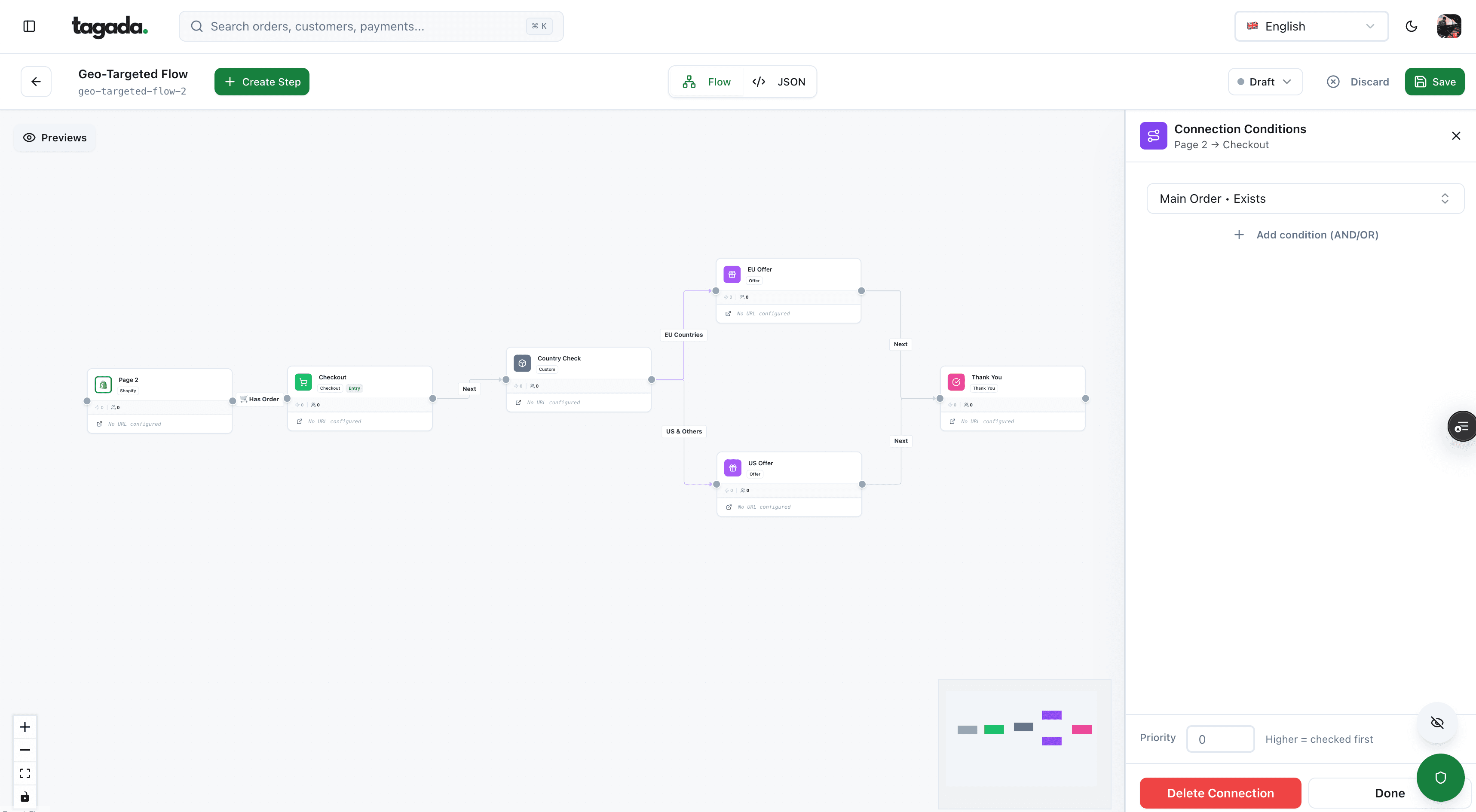
Inside Tagada
Build the funnel once, route every customer to the right offer
Checkout, upsells and subscriptions on one flow, with conditions per country, order or customer.
Order value: earn more from each buyer you already paid for
Raising average order value is the closest thing to free growth: the acquisition cost is already spent. The offers differ by where they appear and what the payment needs.
| Lever | Where the buyer sees it | What the payment needs | Watch out for |
|---|---|---|---|
| 10. Post-purchase 1-click upsell | After payment, before the thank-you page | A card stored with the buyer's consent | Wallet and installment payments often can't be charged again in one click |
| 11. Cart drawer upsell | In the slide-out cart, before checkout | Nothing extra: it's in the same order | Hiding the checkout button behind offers |
| 12. Bundle pricing | Product page or cart | Nothing extra | Discounting buyers who would have paid full price for both |
| 13. Tiered pricing and pack sizes | Product page: buy 1, 3 or 6 | Nothing extra, or a subscription option | A tier that earns less per order than the sale it replaces |
Price every offer from contribution margin, not from the discount field. A bundle that lifts order value while cutting margin per order is a loss you've scaled. In the EEA and UK, a one-click upsell is a new payment the customer starts, so it can trigger a second 3D Secure check: design the upsell page for that case.
Retention: bring the buyer back
You already paid to acquire this buyer. A second order needs no new click, only their attention and, with consent, their email or phone number. Retention runs on events: something happens, a message goes out.
Fig. 2Retention messages along the customer's life
- SignupWelcome, with the offer that brought them
- Order placedConfirmation, then shipping updates
- Product deliveredHow to use it, review request to every buyer
- Product running outReplenishment reminder, subscription offer
- Trial or renewal aheadNotice with amount, date and cancel link
- Payment failedCard update request, retries
- No order in a long timeWin-back, then stop
each one starts from an event
14. Triggered email campaigns. One message, one customer, because something just happened. Each trigger needs an event source, a wait, a goal and a stop condition. See triggered email campaigns, and for consent at signup, opt-in forms.
15. SMS marketing. Short, timely messages for shipping, restock, refill and renewal alerts. In the US, automated marketing texts need prior express written consent, and that consent can't be a condition of purchase.847 CFR 64.1200, Delivery restrictions (TCPA rules) See SMS marketing for ecommerce.
16. Subscriptions. For products that get used up, a subscription turns the second order into a schedule. It comes with its own rules: clear terms before the card is taken, and under Visa's rules a notice at least 7 days before a trial or promotional period ends and paid billing starts, with the amount, the date and a simple way to cancel.10Visa Core Rules and Visa Product and Service Rules, April 18, 2026 See subscription-based ecommerce and, for failed renewals, what is dunning.
17. Segment customers. Not every customer should get the same message. Start from a business question, split customers with a rule (RFM is the usual first model), and test each segment against a holdout. See how to segment customers.
18. Use CLTV as your spending ceiling. Customer lifetime value says what a customer is worth over the whole relationship. Multiplied by your gross margin, it tells you what you can afford to pay to acquire one. See what is CLTV, and track it by cohort.
Measurement: know which lever paid
Every lever above needs a number to prove it worked. Two strategies make the rest of the map measurable.
19. Build analytics around five questions: what a customer costs, where shoppers drop, what each order earns, who comes back, and how much revenue the payment layer actually collects. See analytics in ecommerce.
20. Measure margin per order, not revenue. Subtract product cost, shipping, payment fees, expected refunds and chargebacks, then marketing. What's left is the contribution margin, and it gives your break-even ROAS. See profitability analysis.
- ROAS looks good, bank balance doesn'tPlatform credit counts sales that were refunded, disputed or would have happened anywayReport on settled orders, run a lift test
- Conversion rate fell, traffic grewNew traffic is colder or lands on the wrong pageSplit by source before touching the site
- Order value up, margin downDiscounts or bundles give away more than they addPrice offers from contribution margin
- Repeat rate falls with each new cohortAcquisition is bringing less loyal buyers, or the product disappointsCompare cohorts by channel and offer
- Payment success rate dips in one countryA missing local method or an issuer declining moreCheck by method and decline code
Build the plan in five steps
A strategy is a sequence, not a list. This is the order that keeps each step measurable.
- Measure the funnel by stage. Conversion by step, payment success, order value, repeat rate. Find the weakest stage.
- Set the spending ceiling. Contribution margin per order and CLTV tell you what a customer is worth.
- Fix from the bottom up. Payment and checkout first, then order value, then retention, then acquisition volume.
- Scale the channels that pay on settled revenue. Add budget where margin after marketing stays positive.
- Review monthly by cohort. Check that new customers keep buying at least as well as the ones before them.
Run one change per stage at a time, and keep a holdout where you can.
Legal guardrails that bite marketing
Some marketing tactics are regulated, and the brand stays responsible even when an agency, an affiliate or a tool does the work. The main US rules:
| Rule | What it covers | What it requires |
|---|---|---|
| FTC Endorsement Guides, 16 CFR Part 255 (revised 2023) | Influencers, affiliates, employees, testimonials | Disclose payment, free products and family or employment ties clearly, where viewers will see them. Train and monitor endorsers. Results shown must be honest |
| FTC Consumer Reviews and Testimonials Rule, 16 CFR Part 465 (in effect since October 21, 2024) | Reviews and testimonials | Bans fake reviews, incentives tied to a positive or negative review, undisclosed insider reviews, intimidation to remove reviews, and bought fake followers or views |
| CAN-SPAM Act | Marketing email | Honest headers and subject lines, a valid postal address, a working opt-out honored within 10 business days |
| TCPA, 47 CFR 64.1200 | Marketing texts and calls | Prior express written consent for automated marketing texts, not required as a condition of purchase |
| ROSCA, 15 U.S.C. § 8403 | Subscriptions and trials sold online | Clear terms before billing details are collected, express informed consent, a simple way to cancel |
Sources: FTC and the regulations themselves.3FTC, FTC's Endorsement Guides: What People Are Asking416 CFR Part 255, Guides Concerning the Use of Endorsements and Testimonials in Advertising5FTC, Consumer Reviews and Testimonials Rule: Questions and Answers616 CFR Part 465, Trade Regulation Rule on the Use of Consumer Reviews and Testimonials7FTC, CAN-SPAM Act: A Compliance Guide for Business847 CFR 64.1200, Delivery restrictions (TCPA rules)9Restore Online Shoppers' Confidence Act, 15 U.S.C. § 8403
A few points marketers often miss:
- The Endorsement Guides aren't law themselves, the FTC says, but practices that contradict them can lead to enforcement under the FTC Act. Hashtags carry no special status: a vague "#partner" or "Gifted" alone may not be clear enough.3FTC, FTC's Endorsement Guides: What People Are Asking
- The Reviews Rule allows civil penalties for knowing violations. A business can be liable for reviews it bought if it knew or should have known they were fake. A review from someone who doesn't exist counts as a fake review.5FTC, Consumer Reviews and Testimonials Rule: Questions and Answers
- Asking only happy customers for reviews isn't banned by the Reviews Rule itself, but the FTC says it can still be deceptive under the FTC Act.5FTC, Consumer Reviews and Testimonials Rule: Questions and Answers Sorting reviews is fine; hiding the negative ones is not.
- Each non-compliant email can cost up to $53,088 under CAN-SPAM, and hiring a sending company doesn't move the responsibility.7FTC, CAN-SPAM Act: A Compliance Guide for Business Deliverability rules from Google and Yahoo come on top: see how to avoid emails going to spam.
Subscription rules, including California's automatic renewal law and Visa's requirements, are detailed in negative option billing.
Not legal advice
These texts were read at the source on October 14, 2026. EU and UK consumer law, data protection rules and each US state add their own requirements. Have your campaigns, review program and checkout reviewed for the markets you sell to.
Where Tagada fits
How Tagada helps
Checkout, upsells, subscriptions and tracking in one place
Tagada covers several levers on this map in one system. The checkout comes with one-click upsells, order bumps, A/B tests, Apple Pay and Google Pay. Subscriptions handle trials, billing cycles, retries and automatic resumption. Purchases are tracked server-side to Meta, Google and TikTok. Payments route across Stripe, Adyen and Tagada's own processor, TagadaPay, with a cascade on decline. It runs standalone, on Shopify or WooCommerce, or headless. Pricing is on the pricing page. Tagada follows Visa and Mastercard rules and the laws that apply to payments.
Whatever you use, keep the order: measure each stage, fix the lowest leak first, and judge every strategy on the margin it leaves after marketing.
Frequently asked questions
What are the best e-commerce marketing strategies?
How can an ecommerce store grow without paid ads?
How much should I spend on ecommerce marketing?
What metrics should an ecommerce marketer track?
Do I have to disclose influencer and affiliate partnerships?
Can I offer a discount in exchange for a review?
Sources
Checked October 14, 2026- Baymard Institute, Cart abandonment rate statistics, updated September 22, 2025
- European Central Bank, Study on the payment attitudes of consumers in the euro area (SPACE), 2024
- FTC, FTC's Endorsement Guides: What People Are Asking
- 16 CFR Part 255, Guides Concerning the Use of Endorsements and Testimonials in Advertising
- FTC, Consumer Reviews and Testimonials Rule: Questions and Answers
- 16 CFR Part 465, Trade Regulation Rule on the Use of Consumer Reviews and Testimonials
- FTC, CAN-SPAM Act: A Compliance Guide for Business
- 47 CFR 64.1200, Delivery restrictions (TCPA rules)
- Restore Online Shoppers' Confidence Act, 15 U.S.C. § 8403
- Visa Core Rules and Visa Product and Service Rules, April 18, 2026
Tagada
Checkout, upsells, subscriptions and tracking in one place
Funnels, one-click upsells, subscription billing and payment routing, on one customer record.
- 01Create your free account
- 02Connect your store or build a checkout
- 03Launch funnels, upsells and subscriptions