
A chargeback typically takes 30 to 90 days from the customer's initial claim to the final ruling, but the merchant's actual response window is usually just 7 to 21 days. There isn't one fixed answer to “how long does chargeback take” because filing, evidence submission, and bank review run on different clocks.
Why does a customer get months to raise a dispute while a merchant may have only days to defend a legitimate transaction? That gap is the practical detail that catches businesses off guard, especially in ecommerce, subscriptions, rebills, and high-risk industries where payment records, delivery evidence, and customer communications may sit across several systems.
The process doesn't finish when you submit your evidence. Your response may be complete while the issuing bank is still reviewing the case, which creates a long wait for your cash flow and accounting team. A reliable chargeback operation therefore measures two things separately: how long the cardholder can file and how quickly the merchant must act.
The Two Clocks of a Chargeback
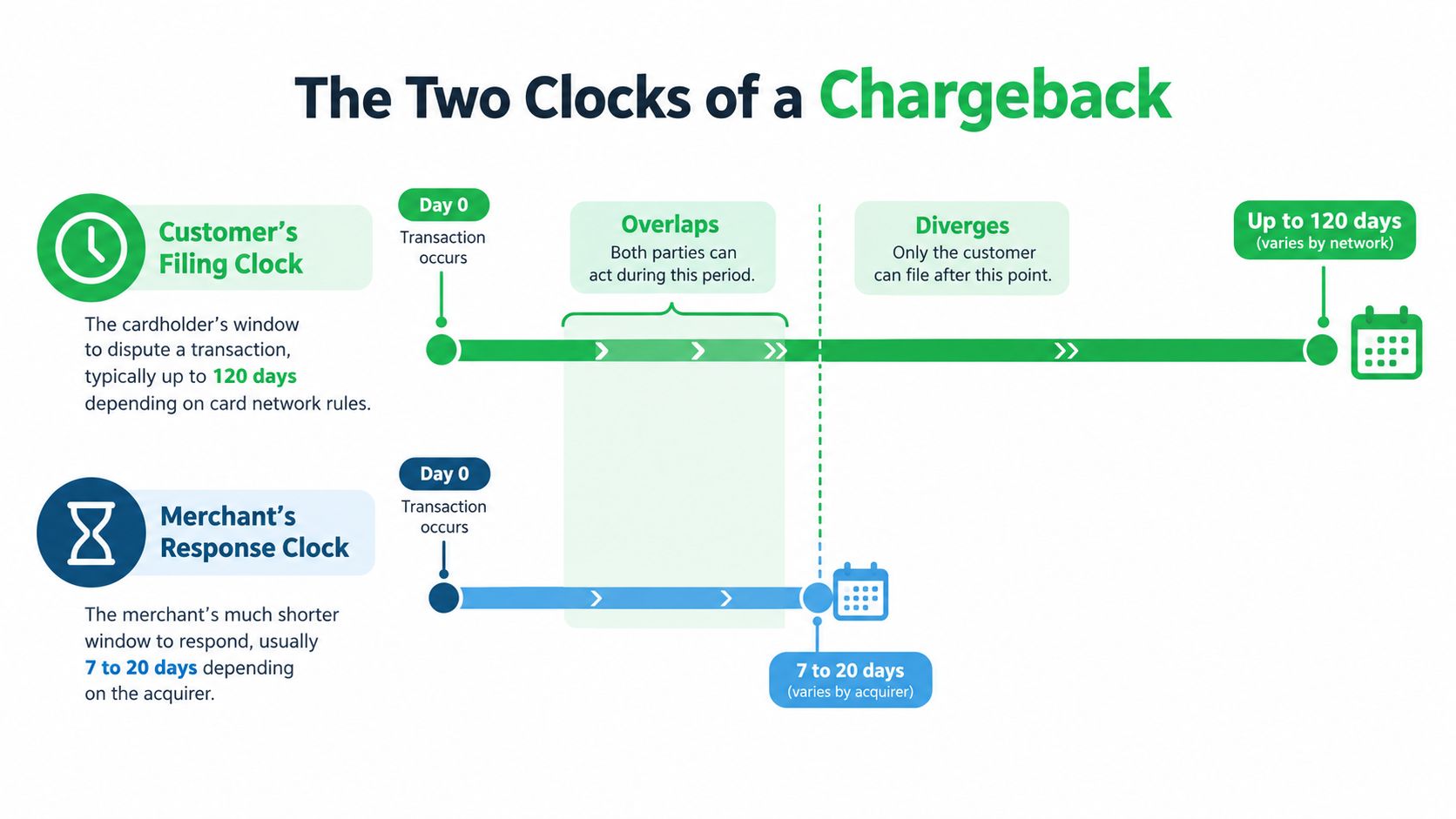
A chargeback has three operational stages: filing, defense, and review. The customer's filing clock controls when a dispute can begin. The merchant's response clock controls how long you have to challenge it after the acquirer or processor sends notice. Issuer review then determines how long the case remains unresolved.
The first clock is usually much longer. In major card networks, a cardholder typically has about 120 calendar days from the transaction date to initiate a chargeback. For non-delivery or service disputes, the clock may begin later, and some delivery-related cases can extend to a maximum of 540 days, depending on the network rules and reason code. See the chargeback filing time-limit guidance from Redo for the distinction between transaction dates and later delivery or service dates.
The second clock starts at a different point. It generally begins when your acquirer or processor notifies you, not when the customer first contacted the bank. Your business may therefore know nothing about the dispute while the customer's filing window is still open, then face a short evidence deadline once the processor creates the case.
What each clock controls
Think of the timeline as two parallel tracks rather than one countdown:
- Customer filing clock: The period in which a cardholder can ask the issuer to investigate a transaction.
- Merchant response clock: The processor's deadline for sending representment evidence and a rebuttal.
- Issuer review clock: The period the issuing bank and network use to assess the merchant's response and issue a ruling.
Those clocks overlap, but they don't measure the same event. A customer's ability to file says nothing about how much time your team has to respond. Likewise, submitting evidence doesn't mean the issuer will decide immediately.
Practical rule: Track the processor's stated response deadline as the controlling date. Don't calculate your available defense time from the customer's filing window.
This distinction matters most for subscriptions and rebills. A customer may dispute a recurring payment after cancellation, while your team must quickly show the cancellation request, billing authorization, service access, refund policy, and relevant communications. Treating the case as a single long process leads to late evidence and preventable losses.
Stage by Stage Timeline Breakdown
Separate the lifecycle into events controlled by different parties. The cardholder opens the dispute, the issuer assesses the claim, the processor sets your working deadline, and the merchant supplies the evidence that can change the outcome. These events overlap, so the customer's filing window does not tell you how long your business has to respond.
Filing and notification
The cardholder contacts the issuing bank to report an unauthorized, duplicated, undelivered, misdescribed, or otherwise disputed transaction. The issuer reviews the claim under the applicable network rules and may issue provisional credit while the investigation continues.
The processor or acquirer notifies you after the case reaches the acquiring side. That notice starts your operational clock, even though the customer may have filed earlier. Record the case status, reason code, transaction identifier, requested evidence, and response deadline as soon as the notice arrives.
Representment and evidence
Shopify's chargeback timeline overview places customer filing windows at roughly 60 to 120 days, merchant evidence windows at 7 to 21 days at the processor level, and network review at roughly 30 to 75 days. A case commonly lasts 30 to 90 days overall and may extend beyond 120 days if it reaches arbitration. The filing window belongs to the customer. The shorter response deadline belongs to your operations team.
Evidence should answer the reason code directly. A physical-goods case may require the order record, delivery confirmation, address match, customer messages, and refund-policy disclosure. Digital-goods disputes may turn on access logs, download records, login history, and support correspondence. Subscription cases need signup terms, rebill authorization, cancellation history, usage records, and attempts to resolve the complaint directly.
Timing can change the result even when the evidence is strong. For example, a merchant may have delivery confirmation and a clear policy, but uploading those records after the processor's deadline can leave the issuer with no admissible response. Submit a focused package before the cutoff, then retain the submission receipt and timestamp.
Issuer review and final ruling
After representment, the issuer reviews the package and may reverse the chargeback, uphold it, or escalate the case. This stage often takes longer because the merchant has completed its work while the bank's internal review remains pending. Experian's explanation of chargeback resolution stages describes the process as potentially lasting roughly 30 to 90 days, or up to 120 days depending on the network and complexity.
Cash may remain unsettled until the ruling. In 2026, recent network fee hikes also raise the cost of prolonged disputes, so record whether the expected recovery justifies the staff time and possible escalation expense before fighting every case.
Reconcile processor activity with the merchant account and accounting system. Track open, won, lost, refunded, and escalated cases separately so the final ruling does not disappear inside ordinary transaction reporting.
The Critical Merchant Response Window
How quickly can your team turn a dispute notice into a defensible case? The merchant response window is short and operational. After the processor sends the notice, staff must identify the transaction, confirm the reason code, retrieve the right records, and submit a clear representment package before the stated deadline.
Processor-level response periods commonly run 7 to 21 days, while network rules may allow different periods. The customer's filing clock can remain open for 60 to 120 days, followed by the merchant's much shorter evidence clock and the issuer's review. This two-clock structure creates a practical risk: a business may have valid evidence but discover the dispute only after the team has too little time to retrieve, check, and explain it. The process is described in Experian's chargeback process guidance.
Build evidence before the case exists
Store transaction records so staff can retrieve them by order ID, payment ID, customer email, and subscription profile. Each evidence record should answer four questions:
- What did the customer authorize? Keep checkout terms, billing consent, product details, and the payment record.
- What did the business deliver? Save shipping confirmation, delivery status, fulfillment records, account access, or download activity.
- What did the customer communicate? Retain support tickets, cancellation requests, refund discussions, and replies.
- Why does the evidence match the reason code? Arrange the submission around the allegation instead of attaching every available file.
Duplicate billing often creates confusion for both customers and internal reviewers. Teams can use guidance to identify recurring double charges, then separate genuine duplicates from rebills, authorizations, installments, or similar statement descriptors.
Use a representment package checklist
A practical package can follow this order:
- Requested outcome: “Please reverse the chargeback because the evidence addresses the stated reason code.”
- Transaction summary: order ID, payment ID, amount, purchase date, and customer identifier.
- Reason-code response: one or two sentences linking the allegation to the relevant record.
- Evidence index: file name, date, and the fact each attachment proves.
- Customer-contact record: support exchanges, cancellation history, and refund handling.
- Submission proof: processor case number, deadline, upload timestamp, and the employee responsible.
A clear chargeback rebuttal letter can serve as the index and argument, while the attachments supply the proof. Keep the explanation concise, use transaction identifiers, and state why the customer's claim does not fit the records.
Evidence beats volume. A short, reason-code-specific package is easier to verify than a folder of unrelated attachments.
Recent network fee hikes make this decision more expensive in 2026. Set an internal rule for high-value orders, repeated subscription disputes, delivery exceptions, or fraud allegations, and compare likely recovery with staff time and escalation costs. Assign one person to own the deadline and another to verify that every attachment answers the bank's question.
Network Differences and Visa vs Mastercard
Visa and Mastercard don't use one identical dispute schedule. Their rules, reason codes, settlement references, and processor workflows can change the date your team must use. The network shown in your payment records matters, but the processor's deadline remains the date your operations team should follow.
Mastercard's merchant guide generally describes a response deadline of 45 calendar days from the settlement date or central site business date. Mastercard's merchant-facing guidance also says network timeframes commonly range from 20 to 45 days after the merchant is notified, and that the overall process can run for up to 120 days. These are not interchangeable dates, so a team should use the deadline displayed in the acquirer's case notice rather than rely on a generic calendar calculation.
Visa is commonly associated with a 120-day consumer filing window, although the applicable start date and duration can vary by dispute type and region. Visa-related evidence review also varies by context. A fraud case, a canceled recurring transaction, and a non-delivery complaint may require different records and follow different procedural steps.
Visa and Mastercard timeline comparison
| Network | Consumer filing window | Merchant evidence window |
|---|---|---|
| Visa | Commonly up to 120 days, depending on dispute type and region | Processor and network deadlines vary, so use the acquirer's stated deadline |
| Mastercard | Commonly up to 120 days, depending on dispute type and region | Network timeframes commonly range from 20 to 45 days after notification |
The Mastercard figures in the table come from the Mastercard chargeback guide. The guide's settlement-date language is important because a merchant that counts only from the day it sees the email may assume it has more time than it does under the processor's schedule.
Why one workflow fails
A single response template for every network and reason code creates unnecessary risk. The same delivery confirmation may help with a non-receipt dispute but do little for a recurring billing complaint. Likewise, an authorization record may support a fraud response without proving that the merchant honored a cancellation request.
Use network-specific fields in your case intake: card brand, reason code, processor deadline, settlement reference, notification date, and escalation status. That small amount of structure prevents the common error of applying Mastercard assumptions to Visa cases, or treating a customer filing deadline as the merchant's evidence deadline.
Fight or Settle and the Cost Benefit Analysis
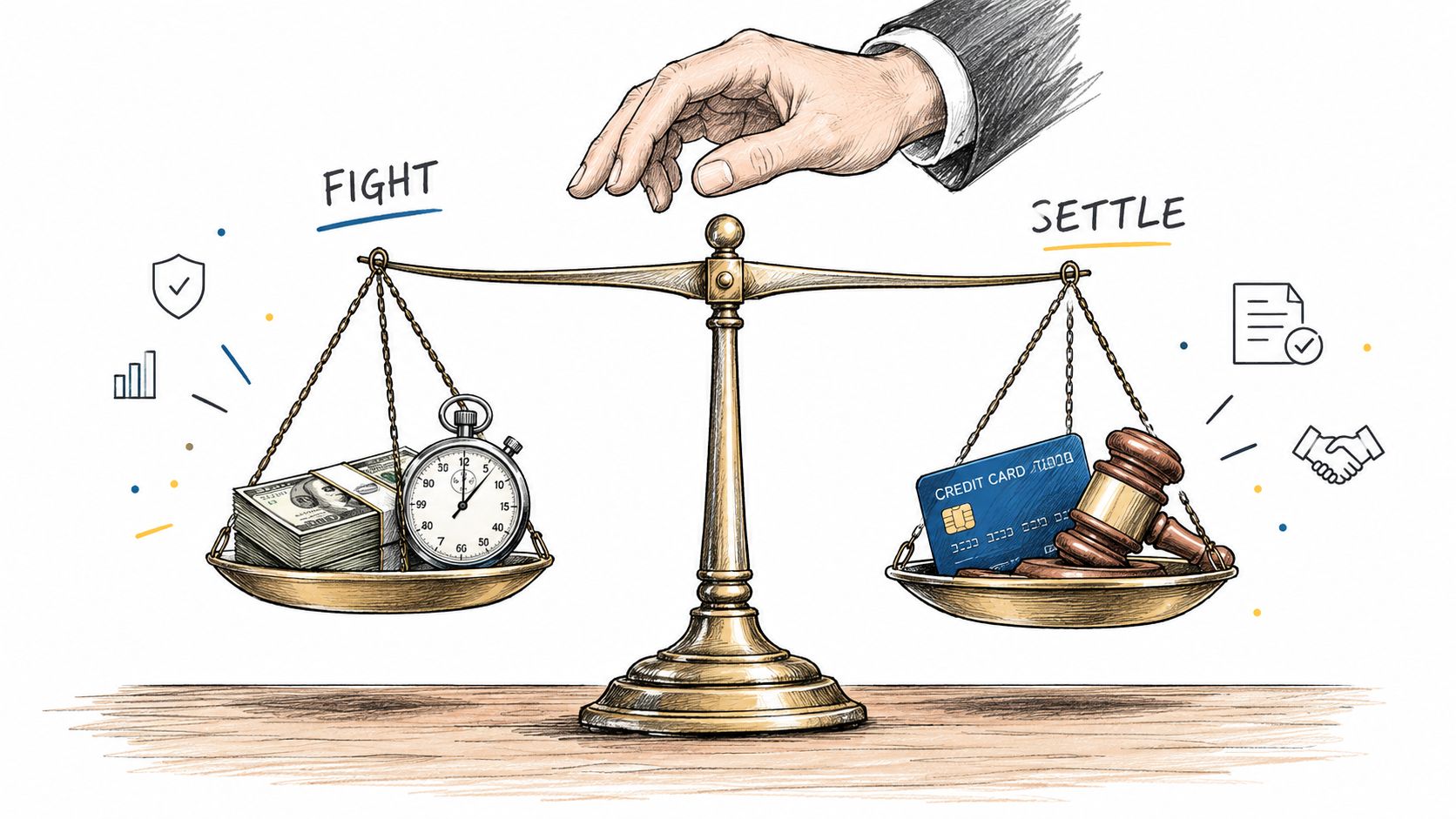
Time isn't the only cost in a chargeback. A merchant also spends staff hours, processor fees, operational attention, and sometimes escalation costs. Fighting every dispute can waste resources, while accepting every dispute teaches customers that a chargeback is easier than contacting support.
The right decision depends on the strength of the evidence, the disputed amount, the customer relationship, the likelihood of repeat abuse, and the cost of escalation. A clear delivery record and a documented cancellation policy may justify representment. A transaction with incomplete fulfillment records and contradictory support messages may not.
Make the decision before escalation
Recent network rule changes and fee increases make the decision more strategic. Independent summaries report that network arbitration fees rose during 2024 to 2026, with Visa case ruling fees rising to $600 and Mastercard's to $575. The Xero guide to chargebacks explains why those costs can make escalation slower, more complex, and less attractive when the disputed amount is small.
That doesn't mean merchants should surrender valid claims. It means the business should distinguish between representment and arbitration. Preparing evidence within the initial response window may be sensible when the records are strong. Escalating after an unfavorable review requires a separate financial decision.
Use a simple decision screen:
- Strong evidence: Fight when the records directly answer the reason code and show delivery, authorization, fulfillment, or cancellation handling.
- Weak evidence: Accept or seek a customer resolution when the business can't prove the key event.
- Low-value dispute: Compare staff time and possible escalation costs with the amount at stake.
- High-risk pattern: Investigate the customer, product, descriptor, and billing flow even if you accept the individual loss.
A settlement can be rational when it prevents additional cost and closes a customer issue quickly. It isn't rational when the same billing defect continues generating disputes. Review the broader pattern, not just the individual case, and use this explanation of chargeback fees and their operational impact when setting internal approval rules.
A case that reaches arbitration may take longer than the standard lifecycle, so the choice affects both money and calendar time. The goal isn't to maximize the number of disputes you fight. The goal is to submit strong defenses quickly and avoid paying to prolong weak ones.
Here's a short visual explanation of the commercial trade-off between response time, evidence quality, and escalation cost:
<iframe width="100%" style="aspect-ratio: 16 / 9;" src="https://www.youtube.com/embed/DkZYYAdkQmk" frameborder="0" allow="autoplay; encrypted-media" allowfullscreen></iframe>
Real World Scenario and Subscription Ecommerce
A direct-to-consumer subscription brand receives a chargeback for a customer's first subscription box. The customer says the package never arrived. The cardholder files with the issuing bank, which opens the dispute and sends the merchant notification through its acquirer.
The important date for the merchant is the notification and processor deadline, not the day the customer decided to complain. Mastercard describes acquirer timeframes as averaging 10 to 35 days, with deadlines commonly set 20 to 45 days after notification. The Mastercard explanation of merchant chargeback responses emphasizes why the response team must start assembling evidence immediately.
What the merchant submits
The brand retrieves the order record, delivery address, tracking history, carrier result, subscription terms, customer messages, and any delivery investigation. It checks whether the tracking record supports delivery to the address used at checkout and whether the customer contacted support before filing.
If the evidence shows confirmed delivery, the merchant submits a focused representment package. If tracking is inconclusive, the customer reported a problem before the dispute, or the business missed a promised refund, the evidence may not justify a fight. In that case, accepting the loss can be preferable to escalating a weak defense.
Why the wait continues
After submission, the merchant's work may be complete while the issuer reviews the package. The provisional credit and disputed amount can remain part of the business's reconciliation queue until the bank issues its ruling. Finance should therefore separate pending disputes from realized losses and avoid treating an open case as final revenue.
For subscription businesses, the case also exposes a prevention opportunity. Clear renewal reminders, accessible cancellation controls, accurate statement descriptors, and fast support responses can resolve confusion before it becomes a bank dispute. The evidence needed to win a case often reveals the customer experience problem that caused it.
Strategies to Manage and Prevent Delays
Merchants can't control the issuer's review queue, but they can control how quickly a case becomes actionable. Route every notice into one queue, assign an owner, capture the processor deadline, and connect the case to the full transaction record.
Use automation to gather order data, payment details, delivery events, subscription status, customer messages, and account activity. Keep a human review for reason-code matching, especially in high-risk products, digital goods, rebills, and unusual fulfillment cases.
Three habits make the biggest operational difference:
- Prepare continuously: Preserve evidence when the transaction occurs, not after the dispute arrives.
- Resolve early: Make refunds, cancellations, and descriptor questions easy for customers to address directly.
- Measure the queue: Track pending, submitted, won, lost, refunded, and escalated cases separately.
A dispute-management workflow such as chargeback management can centralize status tracking and response work. Review the data monthly for recurring causes, then fix the checkout, billing, fulfillment, or support step that creates those disputes.
The practical answer to “how long does chargeback take” is a range, but the practical answer to “what can a merchant control” is much shorter: identify the case immediately, submit relevant evidence before the processor deadline, and decide on escalation with both recovery value and cost in view.
Tagada helps ecommerce, subscription, and high-risk merchants coordinate payment records, dispute status, representment work, and chargeback-aware risk handling in one operating layer. Visit Tagada to see how you can make dispute response faster, keep evidence connected to each transaction, and manage payment operations with less manual handoff.