

You already know the feeling. You've got traffic coming in, the catalog is live, paid spend is running, email flows exist, and subscriptions are technically “set up.” But the numbers still feel blunt. New visitors see the same offer as repeat buyers. A lapsed subscriber gets the same reminder as a customer whose card just soft-declined. High-intent shoppers hit checkout and disappear, while your team keeps building more campaigns instead of fixing the targeting underneath them.
That's usually not a creative problem. It's a segmentation problem.
In ecommerce, knowing how to segment customers isn't about making prettier persona slides. It's about deciding who should see which offer, in which channel, at which moment, with which payment path. For DTC and subscription brands, the practical version of segmentation sits much closer to checkout, approval rates, retries, churn prevention, and customer lifetime value than most marketing guides admit.
Why Customer Segmentation Still Decides Revenue
A customer adds a subscription product, reaches the payment step, gets a soft decline, and leaves. Another customer with three clean orders and no refund history hits the same checkout and sees the same flow, same payment options, and same follow-up email. That is revenue lost to blunt segmentation.
A lot of ecommerce teams still group people too broadly. “All subscribers.” “All paid social customers.” “Anyone who purchased in the last 12 months.” Those segments are easy to build and hard to use well. They hide the differences that change conversion, approval rate, churn, and margin.
Segmentation has been around for decades. The shift away from age-and-income-only targeting toward needs and behavior is often tied to Daniel Yankelovich's 1964 work on nondemographic segmentation in Harvard Business Review, as summarized in the market segmentation history overview. What changed is the amount of operational data stores now collect. Ecommerce teams can see session behavior, order history, subscription events, decline patterns, support issues, and refund risk. Static audience buckets fall apart in that environment.
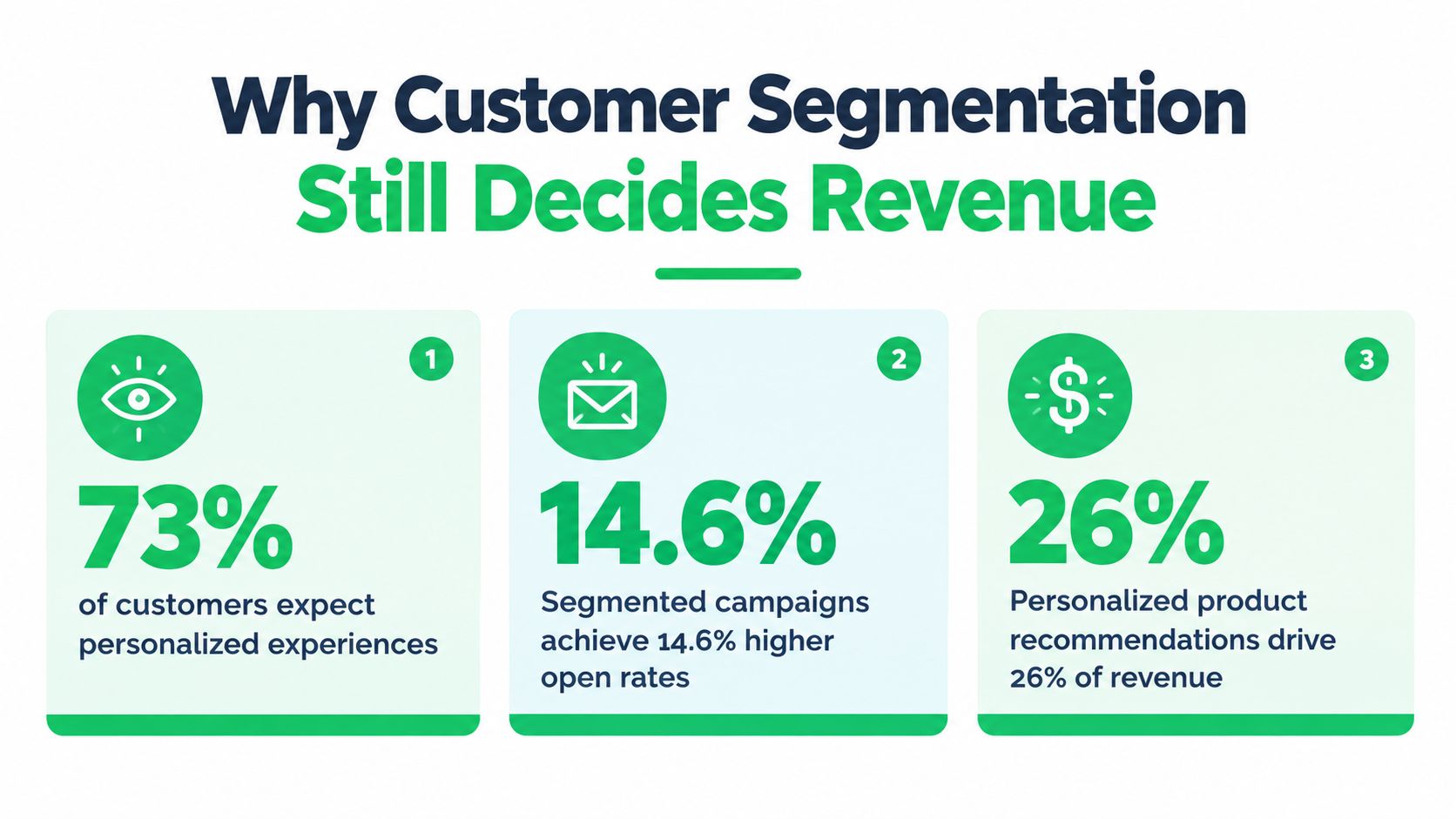
One industry roundup in customer segmentation statistics reports that 65% of companies say their segmentation is basic or incomplete, while 86% say customer segmentation matters for growth. That gap shows up in the day-to-day work. Teams collect enough data to build useful segments, but they still send the same discount, same retry logic, and same dunning path to customers with very different economics.
Behavior beats identity alone
Demographics still help with merchandising, localization, and creative direction. They rarely explain why a shopper stalls at shipping, why a subscriber ignores a card update request, or why one cohort creates far more chargebacks than another. Those answers usually sit in behavior and transaction history.
Noibu's ecommerce segmentation guide draws a useful line between attribute-based and behavioral segmentation. In practice, that distinction matters because behavioral segments can change operations. If a customer repeatedly exits after seeing shipping costs, the fix is not a new persona. It might be a threshold test, a different shipping promise, or a checkout change. If a rebill fails after several successful cycles, the next best action may be a smart retry sequence or a payment method update prompt, not a generic win-back email.
A simple rule helps keep segment work honest.
Practical rule: If a segment cannot change checkout logic, payment routing, retry timing, offer structure, or message sequencing, it is probably too abstract to drive revenue.
Operators usually understand this faster than brand or acquisition teams because the trade-offs are concrete. Every extra segment adds maintenance overhead. Every missing segment leaves money on the table. If you want a concise outside perspective, a solution by Reddog Consulting Group is worth reading because it treats segmentation as something teams act on inside the business, not just document in a strategy deck.
Segmentation pays when it reaches revenue systems
The best segments are tied to decisions, not descriptions.
For a DTC brand, that can mean separating high-intent first-time shoppers from low-intent traffic before they hit a one-size-fits-all checkout. For a subscription brand, it can mean treating a customer with a temporary issuer decline very differently from a customer who has disengaged for months. For payments, it can mean using risk signals, prior approval history, geography, and order value to decide which payment methods to show, when to trigger step-up checks, and how aggressively to retry.
RFM segments help decide who deserves a premium upsell or a save offer. Behavioral segments help identify where checkout friction is happening. Risk-based segments help reduce false declines, fraud exposure, and unnecessary dunning. Used together, they turn segmentation from a campaign planning exercise into revenue infrastructure.
That is why customer segmentation still decides revenue. It shapes who converts, who gets approved, who renews, and who slips out of the funnel without a second chance.
Define Your Segmentation Goal and Audit Your Data
A brand sees checkout abandonment rising, so the team starts pulling every field available. Email engagement, age bands, quiz answers, device type, product tags, support tickets, discount usage, issuer responses. Two weeks later they have a model, six segment names, and no clear rule for what changes at checkout, in dunning, or in retention offers.
That failure starts with the goal, not the model.
Start with a revenue decision
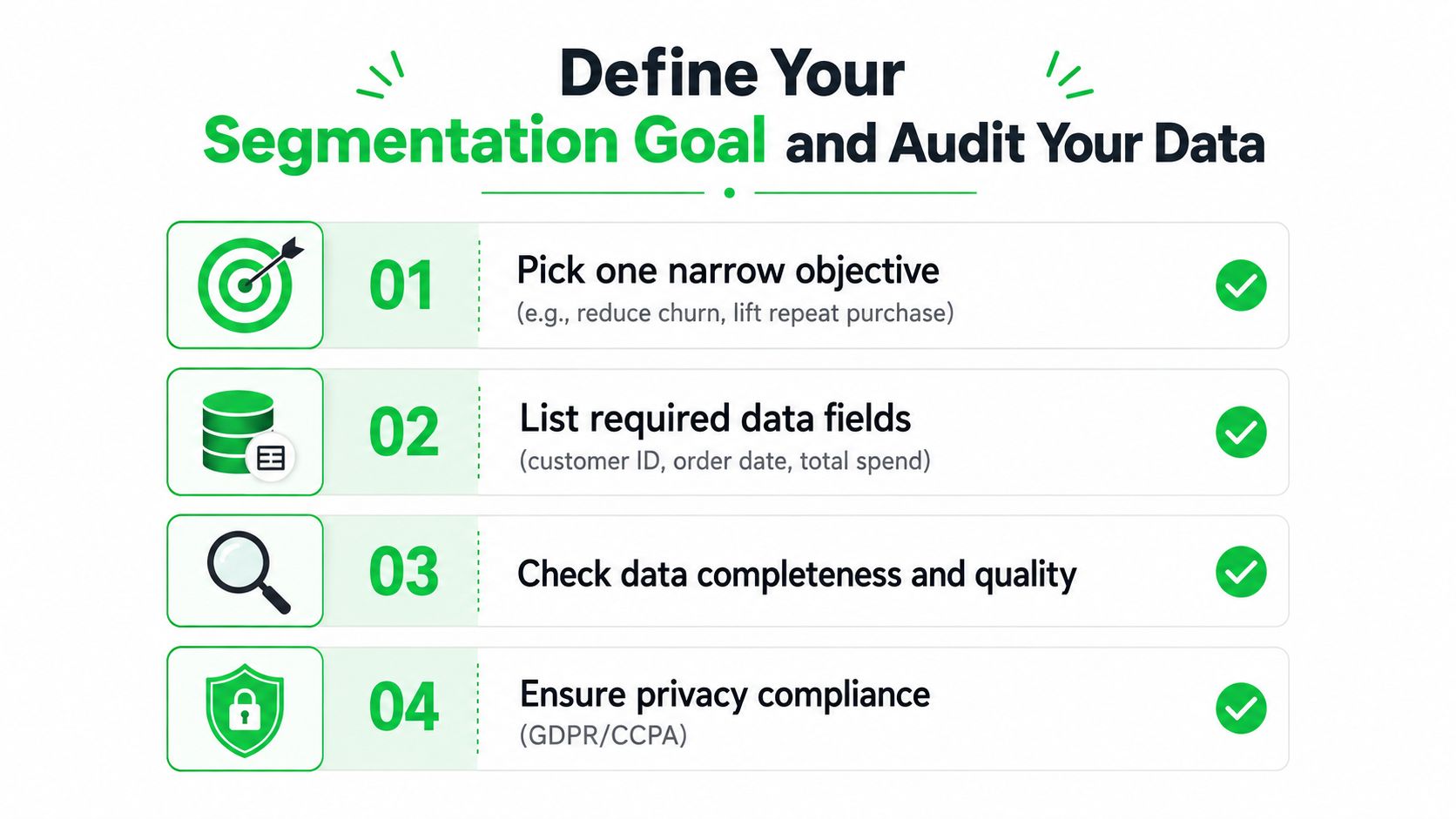
A useful segmentation goal names the commercial decision the team will make differently once the segment exists. For DTC and subscription brands, the decision often sits closer to revenue operations than to persona work.
Common examples:
- Reduce subscriber churn: segment by failed payment patterns, rebill timing, pause history, product usage, and support friction so retention offers and retry logic are not applied the same way to every account.
- Raise repeat purchase rate: segment by recency, order cadence, category affinity, bundle behavior, and return visits so post-purchase flows and onsite offers match actual buying patterns.
- Improve payment approval rate: segment by payment method, issuer decline history, geography, order value, and prior approval outcomes so checkout presentation and fraud controls can be tuned by cohort.
- Recover abandoned checkout: segment by step-level drop-off, shipping cost sensitivity, coupon behavior, traffic source quality, and payment selection so the recovery path fits the reason the shopper left.
Keep the first pass narrow. A segment built to improve renewals usually will not help much with first-order authorization or checkout drop-off.
It also helps to anchor the goal to customer economics before you build anything. If you need that framing, this breakdown of customer lifetime value and how teams use CLTV is a practical reference.
Choose variables that match the decision
Teams either stay disciplined or waste a month.
If the goal is churn reduction, payment failure codes, billing retries, skip behavior, product consumption, and recent engagement usually matter more than broad demographic fields. If the goal is approval rate, issuer response patterns and payment method behavior carry more weight than email clicks. For checkout abandonment, session loops, shipping option exits, and form friction are often more useful than static profile traits.
The Koji guide to cluster analysis for customer segmentation gets the workflow right. Define the objective, pick variables that can explain it, clean and standardize the dataset, test an exploratory clustering approach, then validate whether the groups are distinct enough to use.
The practical rule is simpler. If a variable cannot change a decision in checkout, lifecycle messaging, payment recovery, or CX handling, it probably does not belong in the first model.
Demographic-only segments are easy to present and hard to operationalize.
Audit the data like an operator
Bad segmentation usually comes from bad joins, stale fields, and event definitions that changed three times across tools.
Run a short audit before anyone clusters anything:
- Check identity resolution: one customer record should map across storefront, checkout, ESP, subscription platform, CRM, and payment system.
- Confirm event definitions: “checkout started,” “payment failed,” “active subscriber,” and “churned” need one shared definition across teams.
- Standardize dates, currencies, and refund treatment: recency, frequency, and net revenue calculations break fast when these are inconsistent.
- Remove weak fields: drop variables that are sparse, stale, duplicated, or defined differently between systems.
- Review missing values by cohort: missingness often tracks to one channel, region, device type, or payment method, which can skew the segment.
- Verify consent and usage rules: if the segment will trigger messaging, only use data you can legally and operationally activate.
- Check volume before modeling: tiny cohorts produce unstable segments that look smart in a deck and collapse in production.
I have seen more segment projects fail on identity stitching than on analytics. A customer checks out with Shop Pay, updates the subscription with a different email, and opens support under a third identifier. If those records do not resolve cleanly, your “high churn risk” segment can end up mixing healthy subscribers with temporary card issues and one-time buyers who were never meant to rebill.
Write the brief on one page
A usable brief fits on one page and answers a few plain questions. What decision will change? Which systems need the segment? Which fields are required? Who owns refresh logic? What exclusions apply? How often will the segment update?
That constraint is useful because it forces trade-offs. It also exposes whether the segment will reach the places that matter. Email alone is not enough if gain depends on showing the right payment method, suppressing an unnecessary risk check, or changing retry treatment after a soft decline.
Clean inputs beat clever segmentation every time.
Choosing the Right Segmentation Method for Your Store
A customer hits your checkout for the third time in a month. Same person, different outcome each visit. On the first attempt they browsed, added to cart, and left at shipping. On the second they tried a card that soft-declined. On the third they came back through SMS and converted on PayPal. If your segmentation method only labels that customer as "female, 25 to 34" or "paid social," it misses the decisions that move revenue.
Choose the method that matches the action you want to take inside marketing, checkout, or subscription billing.
For many ecommerce brands, RFM and lifecycle are still the best starting point. As noted earlier from Caspa's ecommerce segmentation guidance, starting with RFM and lifecycle buckets before adding predictive scores is usually the right order. In practice, these models survive messy data better than custom clustering, and teams can use them across email, paid audiences, onsite experiences, and retention programs.
Behavioral segmentation matters when conversion friction is the problem. Session depth, repeat product views, checkout exits, coupon use, payment selection, and subscription plan changes often explain more than broad persona work. I use these segments when the goal is to remove friction, not just tailor copy.
Demographic and acquisition-source segments still have a place. They help with creative, landing pages, and merchandising. They rarely tell you how to handle retries after a soft decline, whether to show a local payment method first, or which subscribers need a card update flow instead of a win-back discount.
That is why payment and risk-based segmentation deserves its own lane. It is not just for fraud teams. Stores with subscriptions, cross-border volume, higher decline rates, or multiple processors should segment by payment method preference, decline history, chargeback exposure, refund behavior, and approval consistency. Those segments can change routing rules, 3DS treatment, retry timing, dunning copy, and offer logic. That is money, not labeling.
Which Segmentation Method Fits Your Goal
| Goal | Best Method | Key Inputs | Activation Example |
|---|---|---|---|
| Increase repeat purchase | RFM | Last order date, order count, total spend | Send replenishment timing by recency band |
| Recover churned subscribers | Lifecycle segmentation | Subscription status, failed rebills, inactivity window | Trigger win-back or card-update sequence |
| Improve conversion rate | Behavioral segmentation | Session paths, exit steps, engagement events, device | Change checkout friction and message timing |
| Improve approval rate | Payment and risk-based segmentation | Decline patterns, payment method, geography, processor outcomes | Route payments differently or surface local methods |
| Personalize creative | Demographic plus acquisition source | Country, language, channel, first-touch source | Tailor landing pages and offers by source quality |
Hybrid models usually outperform pure ones because stores do not have pure problems.
A useful stack looks like this:
- Base layer: Lifecycle status such as New, Active, Lapsed, or Champion
- Value layer: RFM score or CLV band
- Intent layer: Recent browse, cart, or checkout behavior
- Commerce layer: Payment method, decline history, refund pattern, subscription status
- Risk layer: Chargeback tendency, billing mismatches, or unstable approval patterns
Teams often get more practical. A customer can be Active in lifecycle, high-value in RFM, and risky to rebill because their last two subscription attempts soft-declined. That combination should not only trigger a retention email. It should change retry cadence, payment messaging, and in some cases the processor or method shown first at checkout.
audience segmentation strategies 2025 offers a useful outside view of the main segmentation approaches. The operator version is narrower and more commercial. Pick methods that can change flows, approvals, and retention revenue, not just audience names in a dashboard.
A simple rule works well.
For a DTC store with moderate order volume, start with RFM plus lifecycle. For a subscription brand, start with lifecycle plus payment outcome data. For cross-border or higher-risk stores, bring payment preference, approval patterns, and fraud-review behavior in earlier than generic segmentation playbooks suggest.
The right method is the one your team can refresh reliably and act on inside checkout, billing, and lifecycle campaigns.
Build Segments With Real Examples and Queries
A good segment should change what the customer sees, what you send, or how you collect money.
That standard keeps the first build small. Start with 3 to 5 segments you can route into email, checkout, subscription billing, or support workflows. Recent segmentation trend coverage makes the same practical point. Teams lose momentum when they create too many audiences before they have a clear use for them.
A clean starting set for ecommerce
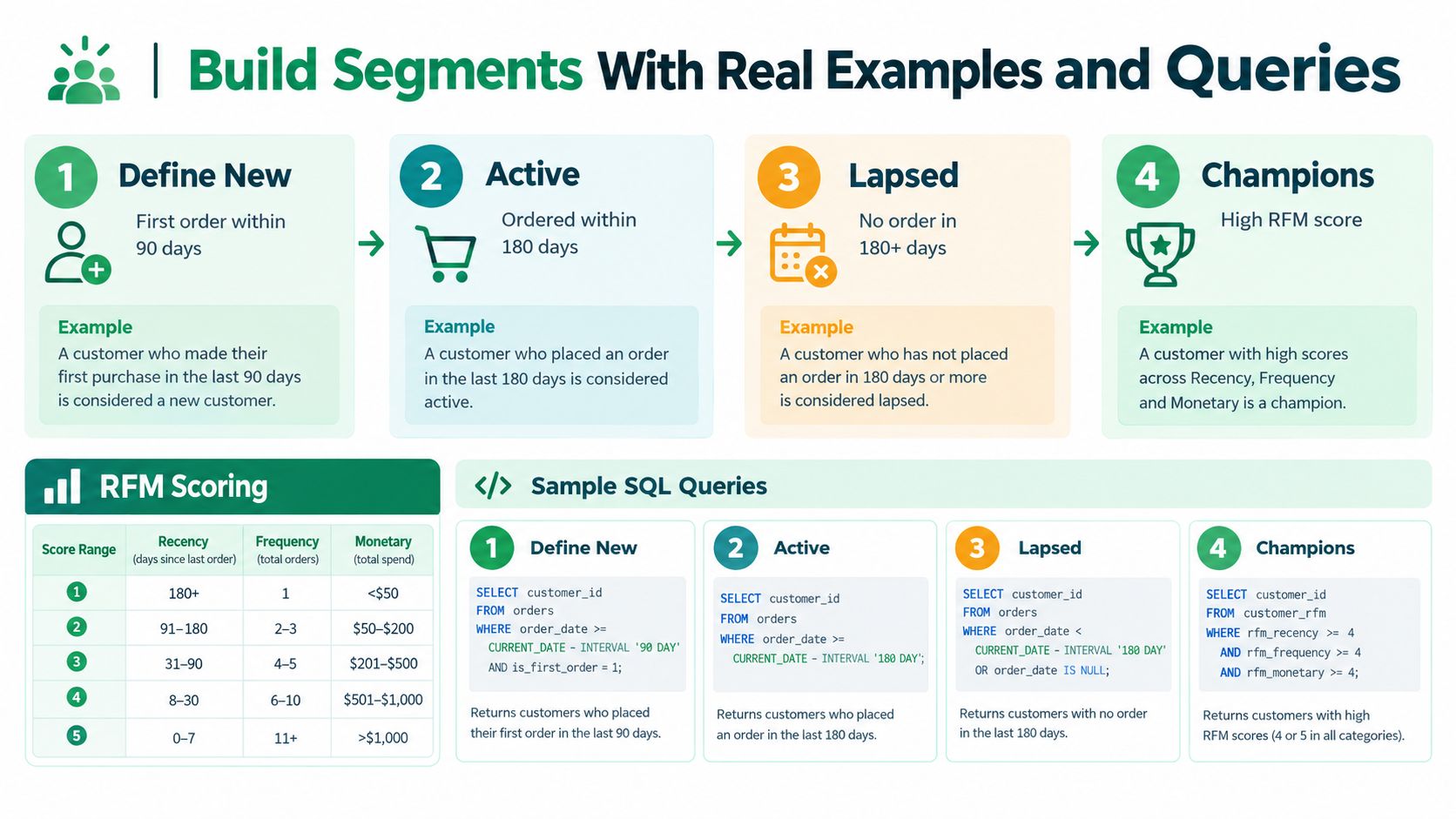
For most ecommerce brands, four base groups are enough to get useful action in market: New, Active, Lapsed, and Champions. One ecommerce segmentation source shows the pattern many operators already see in their own store data. Lapsed buyers often make up a large share of the file but a much smaller share of current revenue, while Champions are a small group with outsized revenue contribution.
Use simple definitions first.
- New: First order placed recently, no repeat order yet.
- Active: Ordered recently and still buying at expected cadence.
- Lapsed: Past buyer with no recent order inside your inactivity window.
- Champions: High recency, high frequency, high monetary value.
Then add the commercial layer that generic persona work usually misses. Did they hit checkout and fail? Are they in an active subscription with soft declines? Do they always choose wallets, or do they churn when only cards are offered? Those details are often more actionable than demographic labels.
Example logic you can actually adapt
These examples are intentionally plain. They work as a first pass in a warehouse, CDP, or BI tool, and they map cleanly to real flows.
New customers
SELECT customer_id
FROM customer_summary
WHERE first_order_date >= CURRENT_DATE - INTERVAL '90 days'
  AND order_count = 1;
Active customers
SELECT customer_id
FROM customer_summary
WHERE last_order_date >= CURRENT_DATE - INTERVAL '180 days'
  AND order_count >= 2;
Lapsed customers
SELECT customer_id
FROM customer_summary
WHERE last_order_date < CURRENT_DATE - INTERVAL '180 days';
Champions
SELECT customer_id
FROM customer_scores
WHERE recency_score >= 4
  AND frequency_score >= 4
  AND monetary_score >= 4;
That covers lifecycle and value. For revenue work, add segments tied to payment friction and buying intent.
Active but payment-frictioned
SELECT customer_id
FROM subscription_events
WHERE lifecycle_status = 'active'
  AND failed_rebill_count >= 1
  AND card_updated = false;
This group should not get the same treatment as a normal active subscriber. Use it for card update prompts, retries spaced around issuer behavior, and billing-page messaging that explains the failure clearly.
High-intent checkout abandoners
SELECT customer_id
FROM session_events
WHERE reached_checkout = true
  AND purchase_completed = false
  AND payment_method_selected IS NOT NULL;
This segment is useful because it separates casual browsers from people who got close enough to expose friction. In practice, I usually split it one level further. Abandoned before payment selection is a merchandising or trust problem. Abandoned after payment selection is often a method fit, decline, or form-flow problem.
You can also add a risk control segment early if the store has chargeback or fraud pressure.
High-value with elevated risk
SELECT customer_id
FROM customer_risk_summary
WHERE lifetime_value > 500
  AND chargeback_count >= 1
   OR billing_mismatch_rate > 0.3;
That audience is not for blanket suppression. It is for stricter review rules, clearer post-purchase comms, and sometimes a different payment mix at checkout so good orders still get through without inviting unnecessary loss.
Cohort analysis for retention and repurchase behavior is useful here because it shows whether these segments diverge over time. A checkout-abandoner segment that converts on the next session behaves very differently from one that keeps failing on rebill or churns after the first decline.
Keep RFM practical
RFM works because it gives teams a usable value layer fast. Score recency, frequency, and monetary value on a 1 to 5 scale, combine the scores, and use that output to prioritize service levels, offers, and win-back spend.
This walkthrough helps make the mechanics visual:
<iframe width="100%" style="aspect-ratio: 16 / 9;" src="https://www.youtube.com/embed/g-h4Faao77M" frameborder="0" allow="autoplay; encrypted-media" allowfullscreen></iframe>
For subscription brands, RFM is only part of the picture. A customer can score high on historical value and still be one failed rebill away from churn. Keep them in your VIP logic if you want, but also put them in a save segment with payment recovery treatment. That distinction matters because revenue ops and lifecycle marketing need different instructions for the same person.
Validate before activation
Rule-based segments need a sanity check before launch. Pull a sample. Read real customer records. Compare segment size, overlap, and edge cases. Stores often find basic problems here, like wholesale accounts mixed into DTC, refunded orders inflating value, or subscription retries counted as separate purchase intent.
If you move beyond rules and use clustering, validate whether the groups are distinct and stable enough to act on. A recent customer segmentation study in Springer reported a silhouette score that indicated reasonable separation in its model. Use that kind of benchmark as a technical check, then do the operator check after it. Can your team write different flows, assign different payment logic, or show a different retention offer for each group?
If nobody can write a different email, show a different offer, or change a retry path for a segment, the segment is still a label, not an operating tool.
Activate Test and Measure Segments Across Channels
A customer places a second order, then hits a failed subscription renewal ten days later. If your systems still treat them as "active and loyal" everywhere, the email is wrong, the offer is wrong, and the payment path is wrong too.
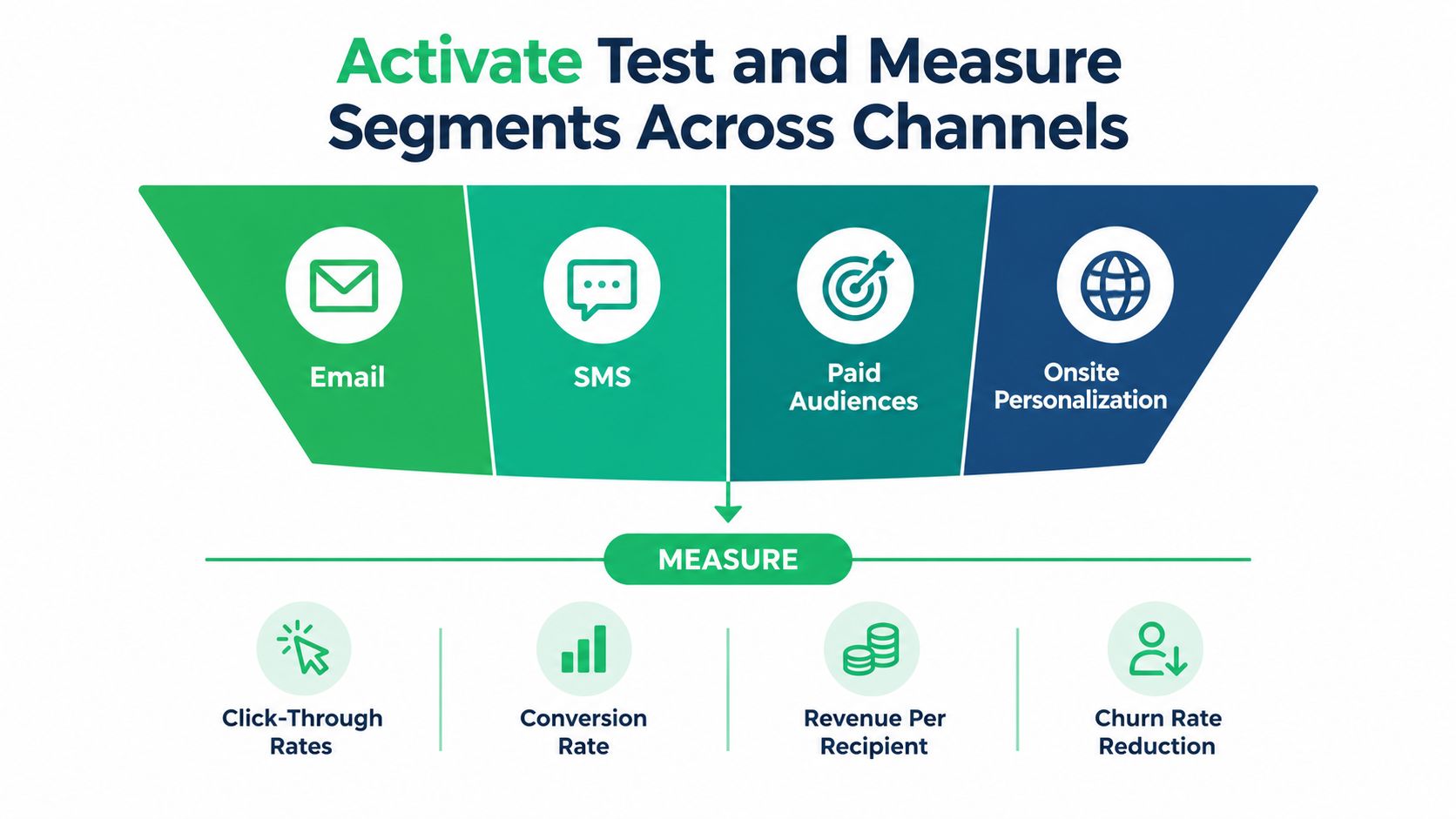
Activation starts when a segment changes what the customer sees and what your stack does next. That can mean a different message, but it can also mean a different payment method mix, a different retry sequence, a different checkout nudge, or a different save offer for subscriptions.
Map segments to channel behavior
Useful segments carry an instruction set. Teams should be able to answer four questions fast: what do we want this group to do, which channel fits that job, what friction is blocking the action, and what metric proves the play worked?
A few practical mappings:
- New customers: Use post-purchase email and SMS to drive product adoption, reorder intent, and account creation. Avoid training them to wait for the first discount.
- Active repeat buyers: Time replenishment prompts, cross-sells, and subscription conversion asks around actual purchase cadence.
- Lapsed customers: Start with the product or category they cared about before. A coupon is one option, not the default.
- Champions: Give early access, bundles, loyalty treatment, or higher-tier subscription options.
- Payment-friction segments: Send card update prompts, trigger smart retries, surface wallet or local payment alternatives, and suppress generic win-back until payment recovery has had a chance to work.
Channel choice should follow customer behavior, not team org charts. Brands comparing retention channels usually get better results when they tie sends to commerce events and response windows. text and email for ecommerce retention is a useful reference if you need to pressure-test cadence and role by channel.
Bring checkout and payment into the segmentation layer
This is the part many ecommerce teams miss. They segment for campaigns, then leave checkout, payment routing, and subscription recovery untouched.
That leaves money on the table.
A shopper who clicked three emails and abandoned at payment does not need more awareness messaging. They may need a different payment method shown first, fewer fields, stronger authorization routing, or a reminder that lands while purchase intent is still warm. A subscriber with a failed renewal should hit dunning logic and recovery messaging before they enter a broad churn journey. A high-value international segment may convert better if checkout presents local methods earlier instead of forcing cards first.
Supermetrics' ecommerce segmentation summary points to a simple operational lesson: segmented campaigns outperform generalized ones when the segmentation changes the customer experience. For operators, the useful extension is obvious. Apply that same logic to the transaction itself, not just to creative.
Tools matter here because the segment has to reach the systems that control revenue outcomes. In a stack that includes checkout, payments, and lifecycle messaging, Tagada can apply customer tags, payment events, and lifecycle logic across checkout flows, routing, retries, and triggered messages. That gives the segment an operational job instead of leaving it as a CRM label.
Test the action, not just the audience
The question is not whether the segment looks sensible in a dashboard. The question is whether the action changed revenue, recovery, retention, or approval outcomes.
Use a testing discipline like this:
- Assign one primary intervention per segment: Example, failed-renewal subscribers enter card update and retry recovery before any discount offer.
- Test inside the segment: Compare message timing, payment prompt, offer type, retry window, payment method order, or landing page friction.
- Keep a holdout group: Some customers would have converted or recovered anyway. Without a holdout, teams often over-credit the segment play.
- Measure the outcome that matches the job: Use revenue per recipient, checkout conversion, payment approval rate, rebill recovery, save rate, churn movement, or CLV trend.
- Review fast enough to catch behavior shifts: Weekly or biweekly checks usually work better than waiting for a full campaign cycle to end.
Strong segment testing usually changes operations first. Retry timing, payment recovery sequence, and checkout presentation often move more revenue than a new subject line.
The best teams treat segmentation like checkout optimization and merch testing. They ship a controlled change, measure the lift, keep the winners, and retire the segments that never produce a different outcome.
Keep Segments Fresh and Turn Them Into Growth
A segment is stale the moment a customer changes payment behavior and your system does not catch up.
That happens constantly in ecommerce. A shopper who looked low value last month places a high-AOV order. A subscriber who always renewed on time starts failing because their card expired. A checkout visitor who looked risky on a first order becomes reliable after two clean payments. If those changes do not flow back into your segment logic quickly, the next action is wrong. You send a winback offer to an active buyer, push a risky payment path on a trusted customer, or keep hammering discounts when the fix is card update and retry timing.
The teams that keep segmentation useful usually keep it small. For most DTC and subscription brands, 3 to 5 segments are enough if each one changes a real revenue lever such as payment routing, retry rules, checkout treatment, or lifecycle offers.
What keeps segmentation usable
A setup holds up in production when a few operating rules are clear:
- Clear ownership: CRM should not manage segments alone if the logic affects authorization rates, failed renewals, or fraud review. Someone needs authority across lifecycle, checkout, and payments.
- Fast refreshes: RFM, engagement, decline history, and subscription status move fast. Weekly refreshes are often the minimum. For failed payment or high-intent checkout segments, daily updates are better.
- One customer record: If Shopify, your subscription app, PSP, and ESP disagree on who the customer is, teams stop trusting the segment within a week.
- Rules people can explain: If support, retention, and paid teams cannot explain why a customer landed in a segment, edge cases pile up and execution slows down.
- Defined plays per segment: Each segment needs a short list of actions tied to channels and systems. Email is one. So are payment method order, dunning sequence, fraud review path, and onsite offer logic.
A good test is simple. Ask what changes when a customer enters the segment. If the answer is vague, the segment is just labeling.
Where teams usually break this
Overbuilt segmentation fails first in operations, not in strategy docs.
I have seen brands create ten or twelve audience groups with nice names and weak business rules, then discover no one can maintain them once refunds, retries, prepaid subscriptions, duplicate profiles, and guest checkout orders start muddying the data. The result is predictable. The segments stay in the CRM, while the checkout team, retention team, and payments team keep running blunt rules that ignore them.
Privacy limits can help here. Less data often forces better choices. Consent-based, first-party fields such as recency, order count, subscription state, payment success history, and discount dependence are usually more useful than a long list of soft attributes that never change execution.
Keep the bar high. A segment should be easy to audit, easy to refresh, and tied to an action that can move revenue or reduce payment failure.
Start narrow. Keep the segments that change routing, retries, offers, or save flows. Retire the ones that never lead to a different decision.
Tagada brings checkout, payments, messaging, and growth orchestration into one layer, which makes segmented execution much easier when your logic needs to span onsite flows, payment routing, smart retries, and triggered lifecycle campaigns. If you want your customer segments to influence real revenue events instead of sitting in separate tools, visit Tagada.