
A shopper reaches checkout on a phone, but the saved card has expired. Instead of abandoning the cart, they choose Pay by Bank, verify their account, and authorize a debit without leaving the mobile flow. The merchant keeps the order, but the operational work has only started. That payment still needs verification, status tracking, settlement monitoring, retry logic, and a recovery path if the bank returns it.
That distinction separates a working mobile ACH payment from a merely connected ACH processor. ACH has become a mainstream U.S. payment utility. In 2025, the ACH Network processed 35.2 billion payments valued at $93 trillion, while Same Day ACH reached 1.4 billion payments worth $3.9 trillion. Nacha's ACH Network volume and value statistics also show 11.41 billion internet-originated payments and 804.94 million phone-originated payments in 2025. Mobile initiation is no longer an edge case.
The practical question for ecommerce, high-risk, and subscription merchants isn't whether a customer can enter a bank account. It's whether the payment orchestration layer can manage the slower, more stateful behavior of a bank rail. This guide covers verification latency, WEB classification, settlement expectations, recurring authorization, retries, fallback routing, and the implementation controls a payments team can apply this week.
Why Mobile ACH Payments Matter for Modern Merchants
The customer with the expired card is a familiar recovery moment. A card updater failed, the issuer declined the replacement attempt, or the buyer doesn't want to use a card for a recurring bill. A mobile ACH option gives that customer another route, provided the merchant presents it at the right moment and explains when the debit will settle.
For a low-average-order-value product, bank payments can also change the margin calculation because they avoid card interchange economics. That doesn't make ACH universally cheaper. Verification, returns, support, compliance, and delayed access to funds all carry operational costs. It means the merchant should compare the total cost of recovered revenue, not just the processor line item.
Consumer behavior supports the channel. The Federal Reserve's 2023 Survey and Diary of Consumer Payment Choice reported that 73% of consumers used mobile banking, 70% made a mobile phone or tablet payment during the prior 12 months, and 72% used online or mobile payment accounts such as PayPal, Zelle, Venmo, and Cash App. The same research found that 42% of payment value was made electronically from a bank account using ACH-authorizing methods.
Where merchants see the value
Mobile ACH fits naturally into several flows:
- Checkout recovery: Offer a bank debit after a card decline or when a customer prefers not to use a card.
- Subscription rebills: Use a bank account for customers who want recurring payments insulated from card expiration.
- Bill pay: Let customers authorize a one-time or recurring debit from a mobile account portal.
- High-risk commerce: Add a bank rail where card acceptance is constrained, while applying stronger verification and review rules.
- Account-to-account purchases: Present Pay by Bank as a deliberate alternative rather than burying it under an “other methods” menu.
A useful example is the way mission-driven organizations frame mobile payment access for donors and account holders. A resource on mobile payments for Church Extension Funds provides relevant context for organizations that need convenient digital payment experiences without assuming cards are the only viable route.
Operator's rule: Treat mobile ACH as a managed payment lifecycle, not as a button beside Apple Pay and card entry.
The best results usually come from pairing ACH with cards. Cards handle immediacy and familiar authorization. ACH can protect margin, support recurring relationships, and recover customers who don't want to use a card. The merchant wins when routing, verification, and exception handling are coordinated across both rails.
What a Mobile ACH Payment Actually Is
A mobile ACH payment is a one-time or recurring debit from a U.S. bank account, initiated through a phone-based app or website. The customer may enter routing and account numbers directly, or link a bank account through an account-verification provider. The merchant then authorizes an ACH originator or processor to submit the debit through the ACH Network.
The customer experience is short. The underlying flow is not.
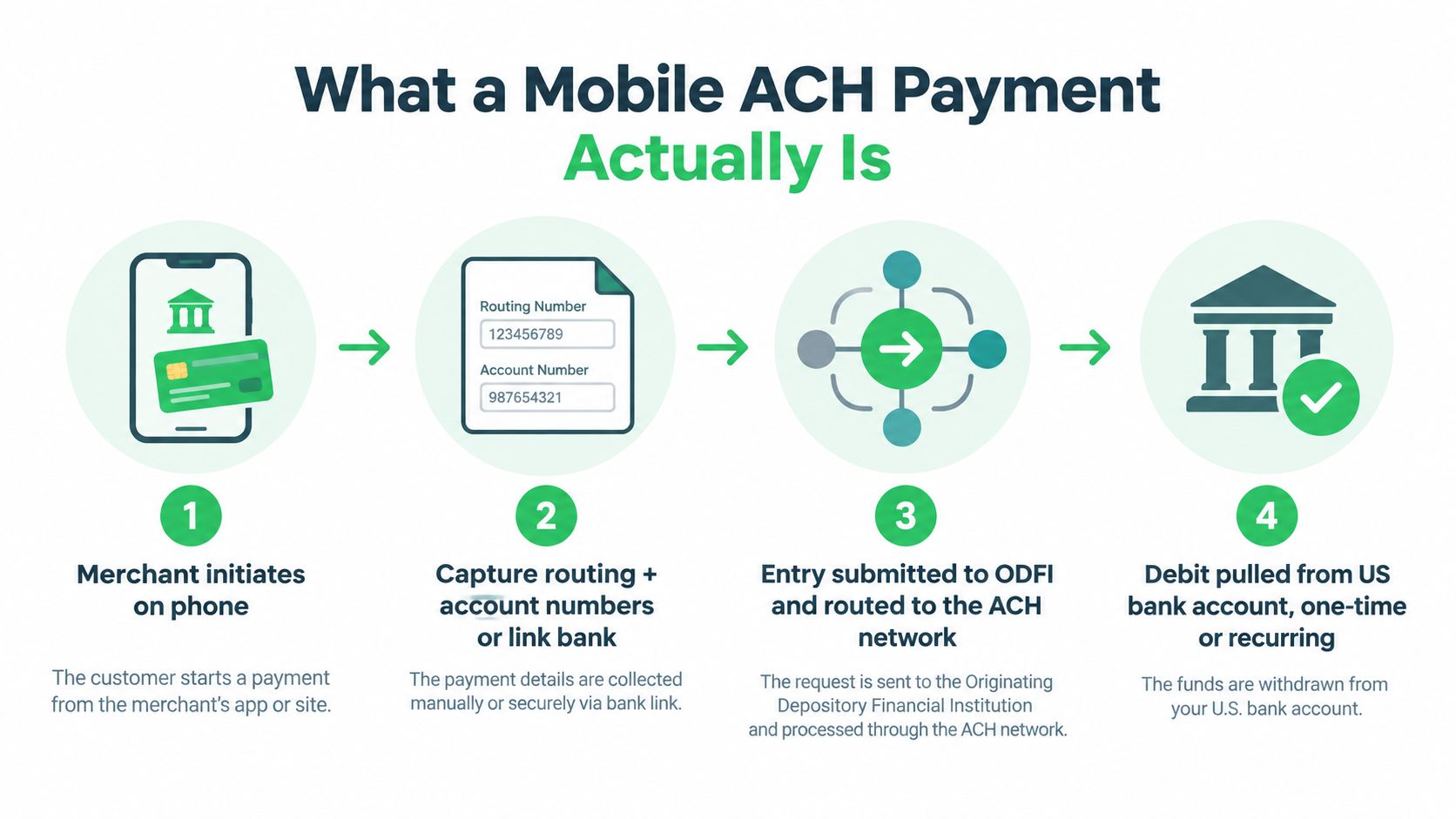
The payment path
- The customer chooses Pay by Bank. The mobile checkout or app displays the bank-payment option and explains the debit, timing, and authorization.
- The merchant captures bank details. The customer enters routing and account numbers or connects a bank account through a supported verification flow.
- The originator submits the entry. The merchant's processor or originating depository financial institution, known as the ODFI, formats and submits the ACH entry. The ACH Network routes it toward the customer's receiving depository financial institution, or RDFI.
- The RDFI posts the debit. The customer's bank processes the withdrawal, and the funds move through settlement to the merchant's account.
A helpful analogy is a signed, stamped envelope containing a withdrawal slip. The customer signs it on a phone, the merchant sends the payment file through the banking system, and the customer's bank pulls the money from the account. The envelope is digital, but it still follows bank-rail processing rather than a card network's immediate authorization model.
Mobile ACH is a push-pull bank debit. It isn't a wire transfer, a card payment, RTP, or FedNow. A wire generally involves a different bank-transfer process and cost structure. RTP and FedNow are instant payment rails with distinct operating models. ACH can support faster processing through Same Day ACH, but merchants still need to design for cutoffs, bank availability, returns, and posting delays.
The historical acceleration point was the launch of Same Day ACH on September 23, 2016, which made ACH more practical for digital checkout and app-based money movement. Nacha states that virtually all ACH payments, including credits and debits, are eligible for same-day processing, subject to defined exclusions and value rules. That eligibility improves the rail, but it doesn't turn every mobile debit into a card-style instant flow.
How Mobile ACH Is Classified and Settled
A consumer debit authorized or initiated through a mobile website or app is generally treated as a WEB debit under Nacha's Standard Entry Class framework. Nacha's mobile ACH guidance says ACH payments authorized or initiated over wireless networks must use the WEB code.
That classification matters because the merchant owns more of the authorization and fraud-control burden than it might expect from a card integration. The payment record needs to support the consumer's authorization, the account information needs validation, and the merchant needs a process for returns and unauthorized claims. A mobile screen is not just a card form with different fields.
WEB, PPD, and TEL are not interchangeable
WEB is associated with electronic authorization through an internet or mobile channel. PPD is commonly used for consumer entries based on a standing authorization, including recurring arrangements. TEL applies to telephone-authorized entries and has specific documentation requirements. The correct code depends on how authorization occurs and how the entry is originated, so merchants shouldn't choose a code solely because it appears in a processor dashboard.
Settlement also needs a clear internal promise. Same Day ACH can shorten the movement window when the entry reaches an eligible processing window, but cutoff times, weekends, holidays, account availability, and return handling affect the customer's actual experience. Many merchants should communicate a practical expectation of one to two business days rather than promise immediate access to funds.
Nacha's Same Day ACH rules originally limited entries to $25,000 or less, with international transactions excluded. The value ceiling later rose from $25,000 to $100,000, then to $1 million per payment effective March 18, 2022. Nacha has approved a further increase to $10 million effective September 17, 2027, which is a future-dated rule change rather than a current limit. These changes make ACH increasingly relevant to larger-ticket commerce and recurring billing.
| Dimension | Mobile ACH (WEB) | Card Payment |
|---|---|---|
| Funding source | U.S. bank account | Card account |
| Authorization | Electronic bank-debit authorization | Card-network authorization |
| Initial response | May confirm submission before final settlement | Usually provides an immediate authorization response |
| Main failure modes | Insufficient funds, invalid account data, unauthorized claims | Issuer declines, expired cards, fraud controls |
| Recovery model | Verification, status monitoring, eligible re-presentment, fallback routing | Retry, updater, alternate card, wallet, or bank method |
| Merchant obligation | Preserve authorization and manage returns | Manage authorization, disputes, and card security controls |
For a deeper treatment of processor roles and bank-rail mechanics, merchants can review ACH payment processing fundamentals. The key operational point is simple: WEB classification shifts validation and evidence responsibility toward the merchant. Clean capture, durable authorization records, and return handling aren't optional extras.
Verifying Bank Accounts on a Mobile Device
Verification is where mobile ACH conversion often succeeds or fails. The merchant is balancing two competing outcomes: let a legitimate customer pay without delay, and avoid pulling from an account that can't be verified or won't support the debit.
Two broad paths dominate. Instant verification uses a connected banking experience or account and routing lookup to establish account ownership quickly. Microdeposit verification sends small test deposits and asks the customer to confirm them later. Stripe's mobile ACH direct debit documentation describes instant verification support and notes that fallback microdeposit verification can take up to 10 days.
Instant verification
Instant methods reduce friction because the customer can authenticate through a bank connection rather than wait for deposits. They work well for first purchases, mobile checkout recovery, and subscriptions where a merchant needs the initial mandate established before the next billing event.
The trade-off is dependency. The merchant relies on the verification provider's bank coverage, authentication flow, account ownership signals, and token lifecycle. A customer may be asked to re-authenticate when a connection expires or the provider needs refreshed consent. The merchant also needs to understand what “verified” means in its risk policy. Account ownership isn't the same as guaranteed funds or guaranteed settlement.
Microdeposits
Microdeposits avoid requiring the customer to share online-banking credentials with an aggregator. They can provide a clear audit trail, but they add a separate confirmation step and delay the first successful debit. Stripe documents two patterns, one using a unique six-digit descriptor code, and another using two non-unique deposit amounts. Those paths create different support and user-experience requirements.
| Dimension | Instant Verification | Microdeposit Verification |
|---|---|---|
| Customer effort | Bank authentication or account lookup | Wait for deposits, then confirm details |
| First-payment speed | Fast when the institution is supported | Delayed until confirmation |
| Coverage risk | Depends on provider and bank connectivity | Works without live aggregator coverage |
| Privacy posture | May involve a bank-connection experience | Doesn't require online-banking credentials |
| Support burden | Connection failures and re-authentication | Missing deposits, incorrect confirmation, abandoned setup |
| Best use | Checkout, recovery, and time-sensitive onboarding | Fallback, unsupported banks, and cautious risk policies |
A hybrid flow usually performs better than choosing one method universally. Offer instant verification first, then route unsupported or low-confidence cases to microdeposits. For a practical explanation of the first path, see instant account verification.
The cutoff decision belongs in the payment state machine. If a customer verifies after a same-day processing window, the merchant should show the actual expected debit date and avoid treating “account linked” as “funds settled.” That distinction prevents support teams from promising a shipment or subscription activation before the bank rail has earned that confidence.
Reducing Failed and Returned Mobile ACH Payments
A failed mobile ACH payment isn't one problem. It may be a bad account number, insufficient funds, a closed account, an unauthorized claim, a timing mismatch, or a merchant retry that ignored the original return reason. The orchestration layer should turn each outcome into a deliberate next action.
The most useful design starts before submission. Validate the routing number, capture the account type correctly, use available aggregator signals for closed or unsupported accounts, and store the evidence needed to explain how the customer authorized the debit. Nacha's return-code framework gives the operations team a vocabulary for that decisioning. R01 generally indicates insufficient funds, R03 and R04 point toward invalid account information, and R10 and R11 involve unauthorized claims.
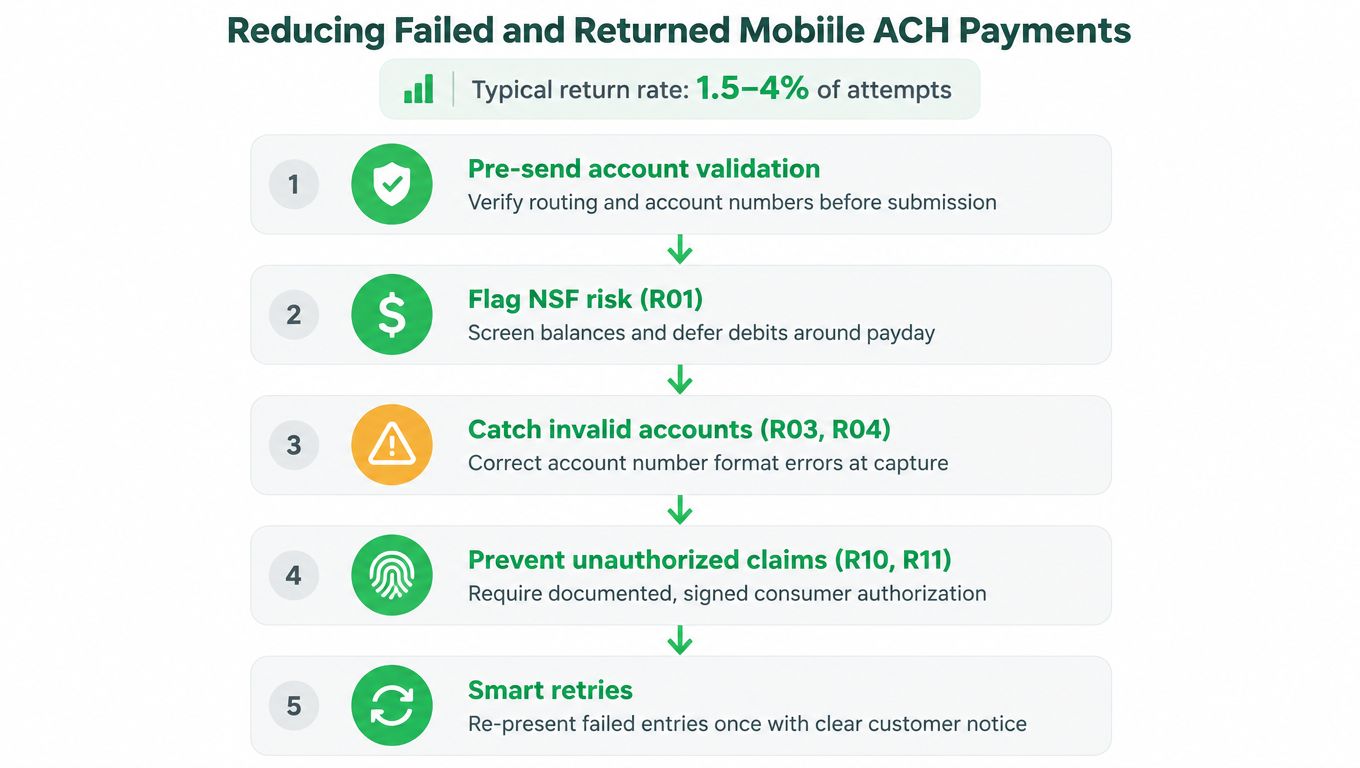
Build recovery around the return reason
R01 needs timing intelligence. A merchant can offer the customer a chance to retry around an expected payday window, but it shouldn't repeatedly submit blindly. The retry should include customer notice, a controlled schedule, and a fallback payment option if the customer needs the order immediately.
R03 and R04 need data correction. Re-presenting an invalid account won't fix the underlying problem. Send the customer back through account verification or request corrected routing and account details. Keep the original failed entry visible in the customer timeline so support doesn't mistake a replacement authorization for the first attempt.
R10 and R11 need a trust reset. Treat an unauthorized return as a signal to stop automatic debits until the merchant has reviewed the authorization record and, where appropriate, captured a new authorization. The next action may be microdeposit verification, step-up authentication, or a card fallback.
Nacha permits re-presentment for eligible return codes within its rules and limits. The merchant's platform should enforce those limits rather than leave retry counts to ad hoc support actions.
Practical rule: A return code should produce a state transition, not just an error message.
Use explicit states such as originated, pending, settled, returned, and pending review. Publish those states to the checkout, subscription portal, CRM, and support tooling through webhooks or normalized events. A customer who sees “bank payment processing” needs a different message from one whose debit was returned for invalid account information.
The return-rate figure shown in the accompanying visual, 1.5% to 4% of attempts, comes from the supplied operational benchmark rather than a cited public statistic. Treat it as a planning range, not a promise about your own portfolio.
Make fallback routing intentional
A card fallback can recover an order, but the merchant should not switch rails without explaining the change and collecting the required authorization. For a subscription, a returned ACH debit may trigger a message that asks the customer to verify the account, update the mandate, or choose a card. For high-risk products, the platform may route the account to manual review instead of allowing an immediate replacement attempt.
<iframe width="100%" style="aspect-ratio: 16 / 9;" src="https://www.youtube.com/embed/wVj8NC0m0AI" frameborder="0" allow="autoplay; encrypted-media" allowfullscreen></iframe>
A good recovery system measures recovery by reason code, customer segment, payment rail, and retry outcome. It also records whether the customer received notice. Without that context, a merchant sees only a processor-level failure rate and misses the operational pattern causing lost revenue.
Recurring Mobile ACH and Subscription Compliance
Recurring mobile ACH requires more than a checkbox and a stored bank token. The merchant needs an authorization record that explains who will debit the account, which account is involved, how the amount is determined, when debits occur, and how the customer can revoke permission.
For a subscription, the mobile authorization should identify the merchant as originator, describe the recurring schedule, state the amount or calculation method, and provide a clear cancellation path. Capture the consent event with a timestamp, the relevant screen or authorization text, and the account reference used for the debit. A Boolean value such as consent=true doesn't show what the customer authorized.
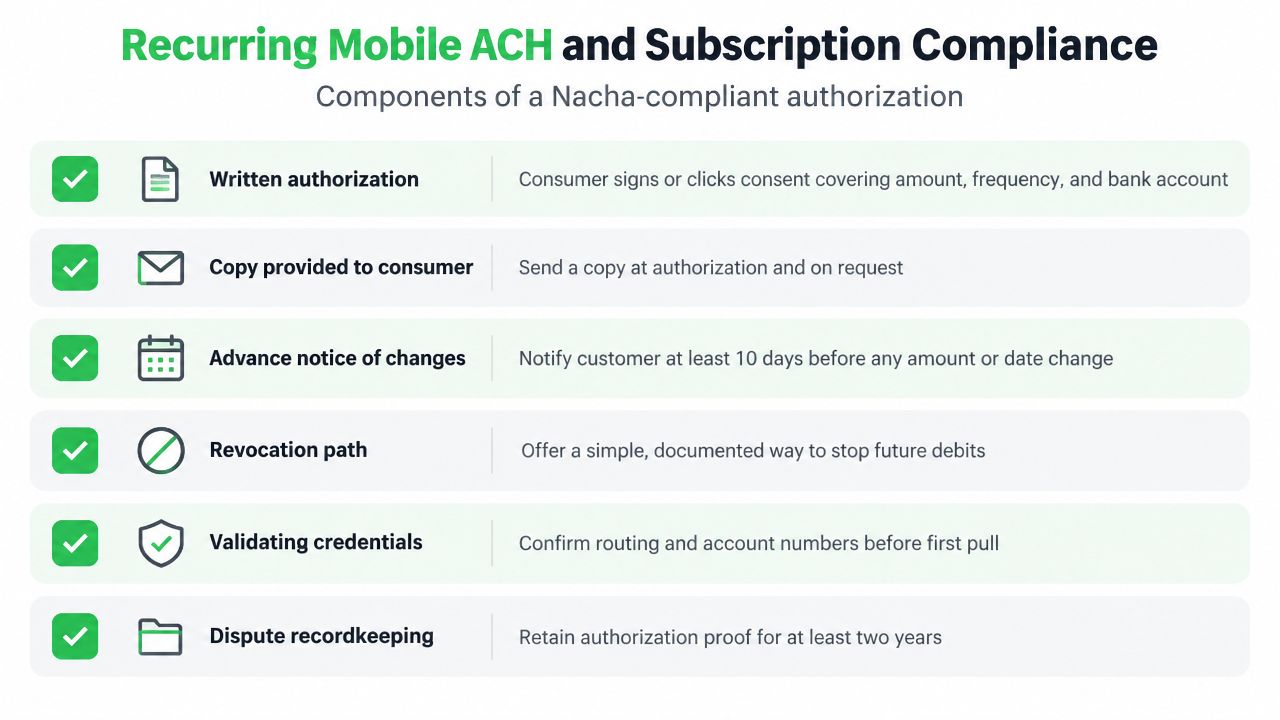
Match the entry to the authorization channel
PPD entries commonly support consumer-originated recurring arrangements with standing authorization. CCD entries apply to business-to-business arrangements, not ordinary consumer subscriptions. TEL entries have separate telephone-authorization expectations. The merchant should document why its Standard Entry Class code matches the actual collection method, rather than letting a processor default determine compliance.
Variable subscriptions need notice logic. The authorization should state the amount or how it will be calculated, along with the timing and frequency. If the amount changes, the payer must receive written notice at least 10 calendar days before the different amount is initiated. If the debit date changes, written notice must be provided at least 7 calendar days in advance. A recurring authorization may use a range or ceiling when the amount is expected to vary regularly, which can reduce unnecessary notices while still giving the customer meaningful terms. These requirements are summarized in the recurring ACH authorization guidance.
Telephone authorization has its own trap. A recurring telephone authorization requires an audio recording plus a written copy, and records must be retained for two years after authorization is terminated or revoked. An unrecorded phone line can't establish that recurring authorization by itself, as explained in this guide to ACH payment compliance.
Audit question: Could a reviewer reconstruct the customer's consent, schedule, account, notices, and revocation history from your records?
Common failures include omitting the debit schedule, storing only a checkbox, failing to send a copy of the authorization, and continuing automatic pulls after an unauthorized return without a fresh review. Subscription teams can use subscription payment processing guidance to connect authorization controls with billing, dunning, and payment-state operations. Bank leaders and payment teams may also find this guide for bank leaders on Nacha useful when aligning internal policy with network requirements.
Best Practices and a Quick Implementation Checklist
Mobile ACH works best when the merchant treats it as one component of a broader routing system. Cards remain useful for immediate confirmation and familiar checkout. ACH can serve margin-sensitive orders, recurring relationships, and customers who prefer bank-account payments. The platform's job is to choose, verify, monitor, and recover rather than force every transaction through one rail.
The following checklist is practical for a current sprint.
Five controls to ship first
- Instrument return-code dashboards. Break results down by R01, R03, R04, R10, and R11, then connect each code to the next permitted action. A single aggregate “ACH failed” metric isn't enough for recovery decisions.
- Choose verification by risk. Use instant verification where speed and coverage support the use case. Keep microdeposit verification available for unsupported or low-confidence accounts, and explain the delay before the customer commits.
- Configure controlled retries. Apply customer notice, return-code eligibility, and re-presentment limits. Never retry an invalid account as if it were an insufficient-funds event.
- Capture durable recurring authorization. Store the amount or formula, frequency, debit date, revocation method, authorization copy, and timestamp. Automate notices when the amount or date changes.
- Publish payment states through webhooks. Make originated, pending, settled, returned, and review states available to customer support, subscription billing, fulfillment, and messaging systems.
A monthly recovery audit should examine the original authorization, verification method, return reason, retry timing, customer notice, and final outcome. That review is especially valuable for high-risk and subscription portfolios, where a poorly configured retry can create repeat returns, customer complaints, and avoidable dispute exposure.
Same Day ACH continues to expand the set of use cases merchants can consider. Nacha reported that ACH volume grew 4.8% year over year in Q1 2026 to 8.9 million transactions, while same-day ACH recorded a 15% increase in Q3 2025. Those figures indicate growing activity, but they don't remove the need for cut-off management and exception handling. Merchants should also monitor instant-rail pilots without confusing faster settlement with better authorization evidence or lower fraud risk.
Implementation test: For every mobile ACH attempt, answer three questions immediately. Was the account verified, what state is the entry in, and what will happen if the bank returns it?
Tagada provides a payment orchestration layer that can route ACH alongside processors and card rails, normalize payment events, and apply retry or fallback rules across integrations. For merchants shipping DTC checkout, subscriptions, or higher-risk payment flows, the valuable capability is not just adding bank debits. It's coordinating verification, status, recovery, and customer communication in one operating model.
Visit Tagada to evaluate an orchestration layer for mobile ACH, card fallback routing, subscription dunning, and normalized payment events. Start by mapping your current return codes and verification gaps, then use that baseline to design a bank-payment flow that recovers more revenue without hiding settlement and authorization risk.