

Most advice about a page builder funnel builder starts with templates, drag-and-drop controls, and design freedom. Those features matter, but they don't determine whether a DTC funnel makes money. A beautiful landing page can still lose revenue through a declined card, an unavailable local payment method, a hidden delivery charge, or a renewal that fails weeks after the first purchase.
The useful comparison is architectural. A page builder helps you publish a persuasive page. A funnel builder should connect that page to checkout, payment routing, upsells, tracking, and post-purchase recovery. For subscription brands and merchants in high-risk categories, the difference between those two approaches often appears after the visitor clicks the primary CTA.
By 2023, approximately 570,000 websites used at least one sales-funnel tool, indicating that funnel technology had moved beyond a niche practice into a widely deployed part of digital commerce and lead generation. The same sales-funnel benchmark compilation reports an average funnel or landing-page conversion rate of 2.35%, compared with at least 5.31% for the top 25% of landing pages. Those figures are directional, not universal standards, but they show why controlled pages, offers, and checkout paths deserve operational attention.
The Hidden Cost of Treating Funnels as Visual Projects
Visual design isn't the conversion system. It is the part shoppers see.
A page can have a strong headline, clean spacing, persuasive product photography, and a prominent button, yet fail when the payment step loads a generic form that doesn't support the shopper's preferred wallet. The same page can underperform when a processor declines a legitimate transaction, when a customer has to re-enter details after an error, or when the checkout doesn't explain the final cost until too late.
Mobile exposes these weaknesses quickly. One analysis of 90 billion sessions found mobile conversion at roughly 2%, compared with nearly 4% on desktop, while mobile users face disproportionate friction from typing, unclear errors, and missing wallets. The mobile checkout analysis supports a practical conclusion: the builder must optimize the payment journey, not just the responsive layout.
The gap after the landing-page click
Merchants often celebrate landing-page conversion while ignoring what happens next. A visitor may submit a form, begin checkout, or click an offer without producing completed revenue. Each event represents a different level of intent and a different operational problem.
A useful funnel separates these stages:
- Landing-page action: A shopper submits a form, selects an offer, or begins checkout.
- Checkout initiation: The shopper reaches a payment-ready state with cart and customer data preserved.
- Authorization: The payment processor or routing layer accepts the transaction.
- Completed payment: The merchant receives a confirmed successful payment event.
- Post-purchase value: The shopper accepts an upsell, renews a subscription, or returns for another purchase.
A page builder usually excels at the first stage. It may pass the shopper to a platform checkout for the rest. That handoff creates blind spots around decline reasons, processor performance, payment-method availability, and recovery messaging.
Practical rule: Judge a funnel by completed revenue and payment outcomes, not by the number of attractive pages it can publish.
Why fragmented systems erode margin
A typical stack can contain a visual editor, a cart, a checkout app, a payment processor, a subscription manager, an email platform, a pixel layer, and a reporting tool. Every connection introduces state-management risk. The offer selected on the landing page may not match the checkout, an upsell may create a second customer record, or a failed rebill may never trigger the correct recovery sequence.
This matters especially for international and high-risk merchants. They may need multiple processors, local payment methods, routing rules, and decline-aware retries. A visual editor that cannot expose or preserve those decisions is only controlling the top of the funnel.
The strategic question is therefore simple: does the tool own the revenue path, or does it merely decorate the entry point?
Core Differences Between Page Builders and Funnel Builders
A standard page builder and a dedicated funnel builder may share the same drag-and-drop interface, but they solve different problems. The page builder creates an asset. The funnel builder coordinates a sequence of commercial events.
A page builder is well suited to a homepage, editorial landing page, product education page, or SEO content hub. It gives teams control over layout, copy, metadata, reusable sections, and brand presentation. It usually treats checkout as an external destination.
A dedicated funnel builder starts with a conversion journey. It can connect an ad or email click to a focused offer, capture the selected product and customer context, present checkout, add an order bump, trigger a post-purchase upsell, and pass payment events to messaging and analytics systems.
Page Builder vs Funnel Builder Architecture
| Feature | Standard Page Builder | Dedicated Funnel Builder |
|---|---|---|
| Primary purpose | Publish pages, content, and static landing experiences | Orchestrate the path from acquisition through payment and post-purchase |
| Traffic routing | Usually sends visitors to a page or external checkout | Can route visitors by offer, audience, market, device, or funnel state |
| Checkout integration | Often hands off to a platform-hosted or third-party checkout | Treats checkout as a native, configurable funnel step |
| Conditional logic | Commonly requires custom code or add-ons | Supports conditional offers, paths, and step logic within the journey |
| Order bumps | Often depend on plugins or checkout integrations | Can be embedded into the checkout architecture |
| One-click upsells | Usually require separate cart or post-purchase tools | Designed to preserve purchase context for post-purchase offers |
| Session data | Primarily stores page and form interactions | Maintains cart, offer, customer, and payment state across steps |
| Tracking | Relies heavily on browser pixels and page events | Can connect client-side behavior with server-side payment events |
| Best fit | Content-led commerce, brand sites, blogs, and simple lead capture | Paid acquisition, direct response, subscriptions, and complex checkout paths |
The distinction becomes clear with conditional logic. A page builder might show the same CTA to every visitor, while a funnel builder can present a different offer after a quiz response, preserve the chosen variation at checkout, and trigger the appropriate follow-up after payment confirmation.
Where each approach works
A page builder works when the purchase path is simple and the merchant already has reliable checkout infrastructure. A one-product DTC brand may need little more than a focused landing page connected to a proven cart. A service business may prefer a landing page with a booking form rather than a full commerce funnel.
A funnel builder earns its complexity when the merchant needs order bumps, one-click upsells, payment plans, subscription rebills, or market-specific payment methods. Those features shouldn't be bolted on casually. Each plugin can affect cart state, attribution, customer records, and webhook timing.
The practical test is whether the merchant can inspect the complete journey in one event model. If the system sees a page view but not a failed authorization, it cannot distinguish weak merchandising from payment friction. That distinction determines the next optimization.
Checkout UX and Payment Routing as Conversion Levers
A high-converting landing page creates intent. Checkout UX and payment routing turn intent into revenue.
Baymard's benchmark reviewed more than 6,000 checkout elements across 60 major ecommerce sites and 380 annotated checkout steps. Its research estimates that the average ecommerce site could improve conversion by 35% through checkout-design improvements alone, as documented in the Baymard checkout usability benchmark.
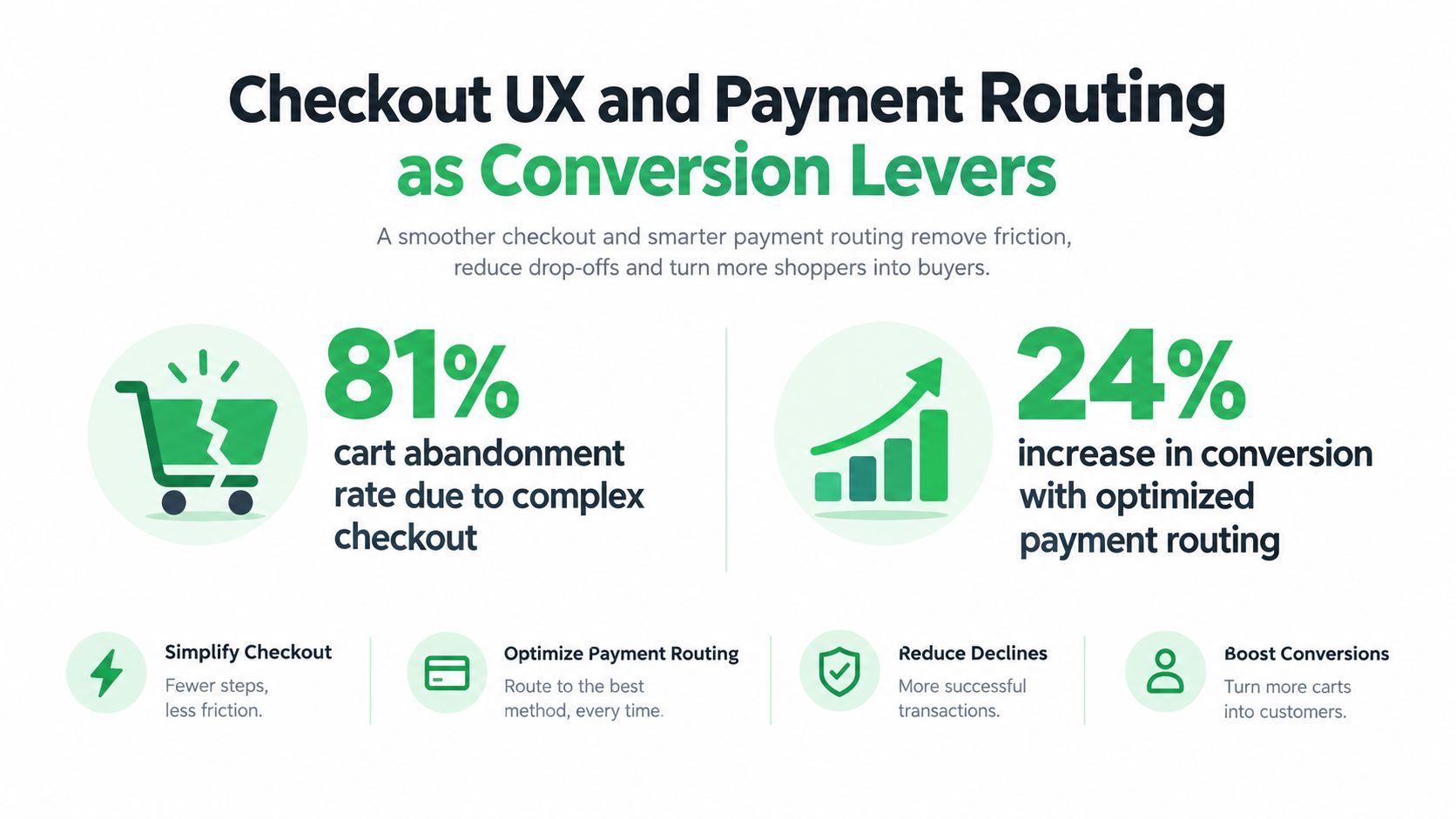
Baymard's broader checkout research identifies the operational reasons shoppers leave. 48% abandoned because extra costs such as shipping, taxes, or fees were too high, 24% left when forced to create an account, and 18% didn't trust the site with their card information. A further 17% found the checkout too complicated or too long, 16% couldn't see the total order cost before starting checkout, and 9% cited insufficient payment methods, according to Baymard's checkout UX statistics.
Requirements for the payment step
A builder should let the merchant expose total cost early, support guest checkout, preserve entered data after errors, and present payment methods that make sense for the shopper's country and device. Those aren't cosmetic preferences. They reduce uncertainty and prevent avoidable exits.
The payment layer must also distinguish between a soft decline, a hard decline, a processor timeout, and an unsupported method. Sending every failure through the same retry sequence creates poor customer experiences and can increase unnecessary payment attempts.
For higher-volume merchants, routing across processors such as Stripe, Adyen, or NMI can provide operational flexibility. The correct route may depend on geography, currency, product category, transaction history, processor availability, or risk rules. Smart retries should respond to the decline context rather than blindly resubmitting the same request.
Measure the handoff, not only the page
Track the full chain:
- Offer selection: Which product, price, and variation did the visitor choose?
- Checkout initiation: Did the cart preserve the selection and customer details?
- Payment-method selection: Which wallet, card route, or local method was available?
- Authorization outcome: Did the processor approve, decline, or time out?
- Payment completion: Did the system receive a confirmed event?
- Post-purchase action: Did an upsell or order bump increase value without creating a second payment problem?
For merchants evaluating dynamic payment routing for ecommerce, this event chain is more useful than a dashboard that reports only landing-page conversion. It reveals whether a lift came from better merchandising, fewer fields, improved routing, or stronger payment recovery.
A funnel builder should also test accessibility and error recovery. A template that performs well for desktop card users may fail for mobile shoppers, wallet users, customers using assistive technology, or buyers whose local payment method isn't supported.
<iframe width="100%" style="aspect-ratio: 16 / 9;" src="https://www.youtube.com/embed/U61nnFPLTsk" frameborder="0" allow="autoplay; encrypted-media" allowfullscreen></iframe>
The visual editor still matters, but it should serve this operating model. The best-looking funnel isn't necessarily the strongest funnel. The strongest funnel makes it easy to complete a legitimate payment.
Designing Funnels for Subscription Retention and Compliance
A subscription funnel doesn't end on the confirmation page. The first successful charge proves that the offer was accepted once. It doesn't prove that the customer will renew, that the payment method will remain valid, or that the cancellation experience meets regulatory requirements.
Industry analyses estimate that failed payments cost subscription businesses about $129 billion in 2025, while payment failures may represent 20% to 40% of subscription churn. These are industry estimates rather than audited global totals, but the subscription dunning analysis highlights a serious measurement error: many teams optimize acquisition conversion while ignoring involuntary churn.
Build the recovery path into the funnel
The post-purchase architecture should distinguish customer intent from payment failure. A customer who actively cancels needs a clear cancellation flow. A customer whose card expires needs a secure update path. A temporary issuer decline may justify a later retry, while a hard decline should trigger a different message or payment-method request.
Useful controls include:
- Decline-aware retries: Schedule retries according to decline type, issuer behavior, geography, and customer history.
- Card updates: Give customers a direct way to replace expired or unusable payment credentials.
- Grace periods: Preserve access according to the merchant's policy while the system attempts recovery.
- Event-triggered messaging: Send email or SMS after confirmed payment events, not merely because a customer reached a funnel step.
- Lifecycle reporting: Measure renewal success, recovered revenue, cancellation recovery, and net revenue retention alongside initial conversion.
Aggressive retries aren't automatically beneficial. A payment orchestration layer should know when another attempt is likely to help and when it may create customer frustration or unnecessary processor risk.
Treat compliance as a product requirement
The FTC's Negative Option Rule applies broadly to automatic renewals and free trials across online, phone, and in-person offers. Before collecting billing information or charging a customer, sellers must disclose material terms, including the amount and frequency of charges, when a trial or promotion ends, and how cancellation works. They must also obtain unambiguously affirmative consent.
The FTC guidance on the amended Negative Option Rule states that businesses must provide a simple cancellation mechanism that can immediately stop recurring charges and retain proof of consent for at least three years. That means the funnel needs timestamped offer terms, consent records, renewal details, and cancellation status.
The negative-option billing operational guide is useful when translating those requirements into product behavior. A prechecked box, buried renewal disclosure, or cancellation path that adds unnecessary friction can create compliance risk and damage trust at the same time.
A subscription funnel should optimize continuity, not just acquisition.
Choosing the Right Tool for Your Business Model
The right tool depends on the complexity of the payment journey, not on how many templates the vendor advertises.
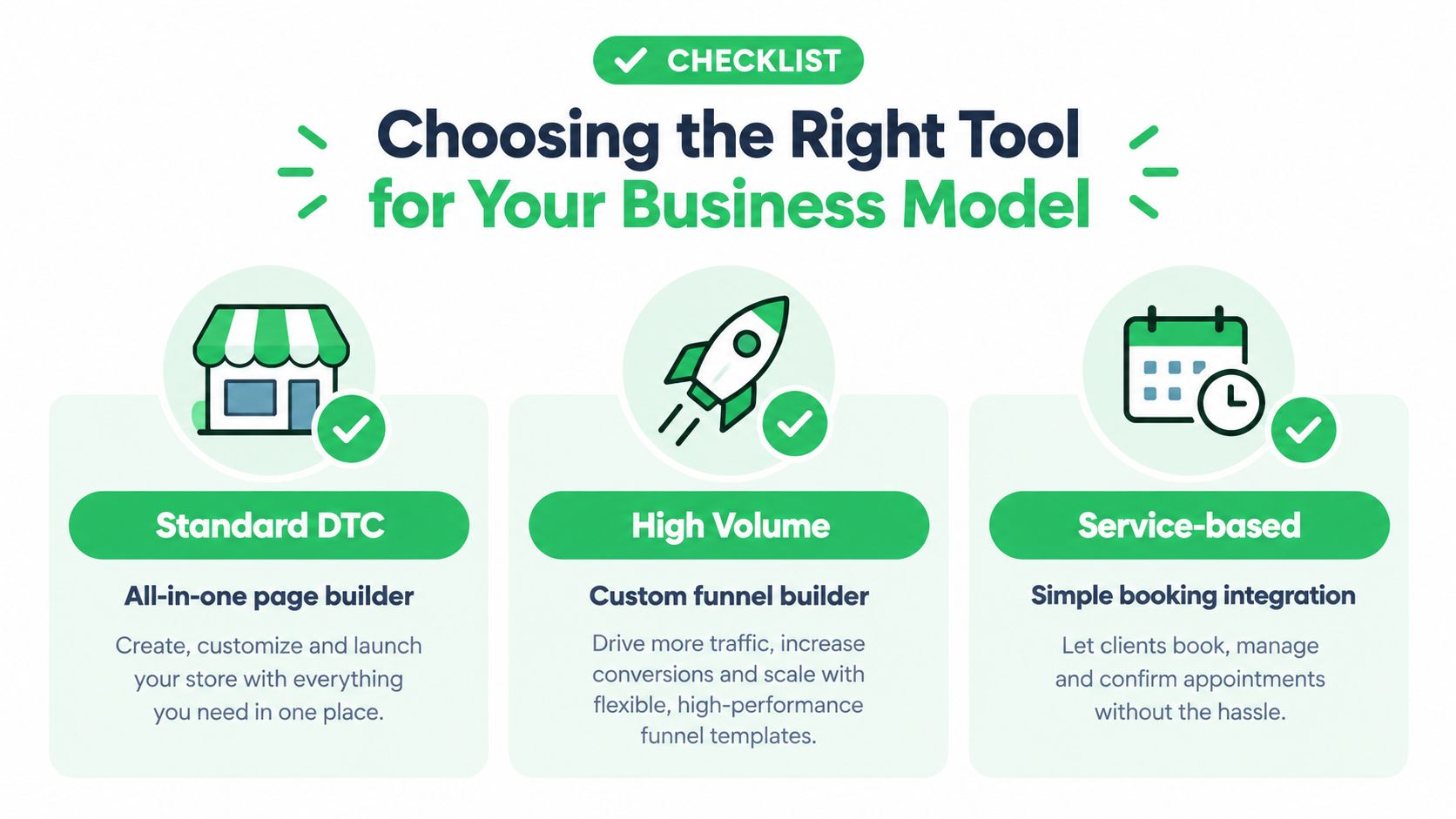
Start by mapping the commercial model. A merchant selling one physical product with a straightforward card checkout may not need a full orchestration layer. A high-volume international merchant, a high-risk seller, or a subscription business with rebills has different requirements because payment routing, decline recovery, and customer continuity directly affect revenue.
A practical decision matrix
| Business model | Start with | Prioritize | Avoid |
|---|---|---|---|
| Standard DTC | A page builder connected to dependable checkout | Clear offers, mobile usability, product education, and simple analytics | Paying for complex routing that the business won't use |
| High-volume ecommerce | A dedicated funnel and payment orchestration layer | Multi-processor routing, uptime, local methods, authorization reporting, and event-level tracking | Treating processor failures as landing-page problems |
| High-risk commerce | A funnel builder that supports specialized payment operations | Risk-aware routing, decline handling, chargeback-aware controls, and processor redundancy | Relying on a single generic payment path |
| Subscription or rebill | A funnel and billing system designed around lifecycle revenue | Consent records, dunning, smart retries, card updates, grace periods, and cancellation | Measuring success only at the first charge |
| Service business | A lightweight page builder with booking integration | Lead capture, qualification, scheduling, and follow-up | Adding checkout complexity without a payment need |
Calculate the app tax honestly
The cheapest monthly subscription isn't always the lowest-cost system. Count the page builder, checkout tool, payment connectors, subscription manager, email platform, SMS tool, pixel integrations, reporting layer, implementation work, and maintenance time. Then inspect what happens when an integration breaks or an event arrives out of order.
A dedicated funnel builder may cost more than a basic page editor, but it can reduce duplicated customer records and custom middleware. A lightweight page builder may be the better decision when checkout is already stable and the merchant needs content flexibility more than funnel logic.
Teams evaluating sales funnel software should ask vendors to demonstrate a failed payment, a processor timeout, a local method selection, a post-purchase upsell, and a subscription renewal. If the demo covers only the canvas and templates, the evaluation is incomplete.
Unifying Design and Orchestration Without the App Tax
A practical implementation starts with one customer journey, not a collection of disconnected tools.
Consider a DTC brand launching a paid campaign for a focused product offer. The team creates the landing page, pricing block, checkout form, order summary, and post-purchase offer in the same funnel environment. The shopper's selected variation travels into checkout, the payment layer chooses an available route, and the messaging system receives a confirmed payment or a specific failure event.

The implementation team can then build messages around actual outcomes. A shopper who abandoned before payment can receive a reminder about the offer. A shopper whose payment was declined can receive a secure method-update prompt. A customer who completed the payment can receive fulfillment information instead of another acquisition message.
Design freedom needs operational boundaries
A Framer-style canvas is useful for fast experimentation, but unrestricted flexibility can create inconsistent forms, duplicated scripts, and hard-to-maintain checkout patterns. Reusable offer sections and checkout components keep the visual system flexible without allowing every campaign to invent a new payment experience.
For teams shaping the entry page, Wojo Media landing page tips offer a useful design reference. Apply those principles to the full journey, then validate the result against payment completion, not just the first CTA click.
Developers and agencies can extend the system through headless browser SDKs or a Node SDK when the visual layer doesn't cover a specialized storefront requirement. AI-assisted store generation can accelerate the first version, but generated code still needs review for event integrity, accessibility, payment security, and performance.
Tagada provides one example of this unified approach through TagadaStudio, a visual funnel and page builder with native checkout, upsells, payment routing, A/B testing, and server-side tracking. Its related payment and messaging capabilities connect funnel activity with processor outcomes, subscription management, dunning, local methods, and revenue-aware email or SMS. The relevant evaluation standard remains the same for any vendor: confirm that the system preserves cart state, records payment events, and gives operators control over the recovery path.
Performance Budgets and Tracking for Funnel Optimization
Interactive builders can add scripts, pixels, media, widgets, and layout dependencies faster than most teams notice. A page may look excellent in the editor while field performance deteriorates on mobile, especially when third-party tools load synchronously.
Google's Core Web Vitals classify a page as good at the 75th percentile when Largest Contentful Paint is at most 2.5 seconds, Interaction to Next Paint is at most 200 milliseconds, and Cumulative Layout Shift is at most 0.1, according to the Core Web Vitals ecommerce benchmark.
Set budgets at the template level
Reserve image dimensions, compress hero media, defer nonessential widgets, and load analytics or remarketing asynchronously. Limit synchronous third-party scripts and expose a per-page asset budget so campaign teams can see the cost of adding a chat widget, review tool, or extra tracking tag.
Measure real users separately by mobile and desktop, template, traffic source, country, and release. Then connect performance alerts to funnel-step abandonment and payment completion. A slower page matters commercially only when the team can see how it affects the journey.
Track revenue events server side
Browser pixels remain useful for campaign optimization, but they shouldn't be the only record of a transaction. The reporting layer should reconcile page views, checkout starts, authorization outcomes, completed payments, refunds, renewals, and recovered failures.
A merchant planning to scale your WooCommerce store should treat performance and event integrity as infrastructure work, not as a final marketing task. The most useful dashboard reports completed revenue, authorization rate, payment-method mix, renewal success, and recovery by country and device. Click-through rate is helpful for diagnosing the top of the funnel, but it cannot explain a payment failure at the bottom.
Tagada helps ecommerce and subscription teams connect visual funnel building with native checkout, multi-processor payment routing, smart retries, local methods, dunning, and server-side revenue tracking. If your current page builder stops at the landing page, visit Tagada to explore an orchestration layer built around completed payments and customer continuity.