
The tool with the most templates isn't automatically the best sales funnel software. Templates help you publish pages, but they don't tell you whether a payment was authorized, whether an upsell increased profitable revenue, whether a subscription rebill succeeded, or whether a failed card received the right recovery message.
That distinction matters because Baymard Institute's checkout research places average ecommerce cart abandonment at 70.19%. Independent benchmark reporting also puts typical online conversion around 2% to 3%, which means most visitors leave without buying, as summarized in this data-driven funnel guide from Data Hunters Agency. The funnel is an operating system for revenue, not merely a sequence of attractive pages.
This list compares ten sales funnel software options across acquisition, checkout control, payment authorization, upsells, recurring billing, failed-payment recovery, risk handling, tracking, messaging, and implementation burden. It also explains where each platform fits physical products, digital offers, agencies, subscriptions, and high-risk operations.
Tagada deserves special attention when the bottleneck isn't page creation but fragmented infrastructure. Its Ecommerce OS connects funnel design, checkout, payment routing, subscriptions, testing, tracking, and lifecycle messaging. Compare every platform by total operating cost, including transaction economics, usage charges, integrations, maintenance, support, and the internal time required to keep the stack reliable.
1. Tagada, the Ecommerce OS to Make Money Online
Tagada takes a different position from a conventional funnel builder. TagadaStudio provides visual control over landing pages, offer pages, checkout screens, upsells, and thank-you pages, while the wider platform connects those steps to payment and customer lifecycle events. That matters for merchants who need more than a page editor.
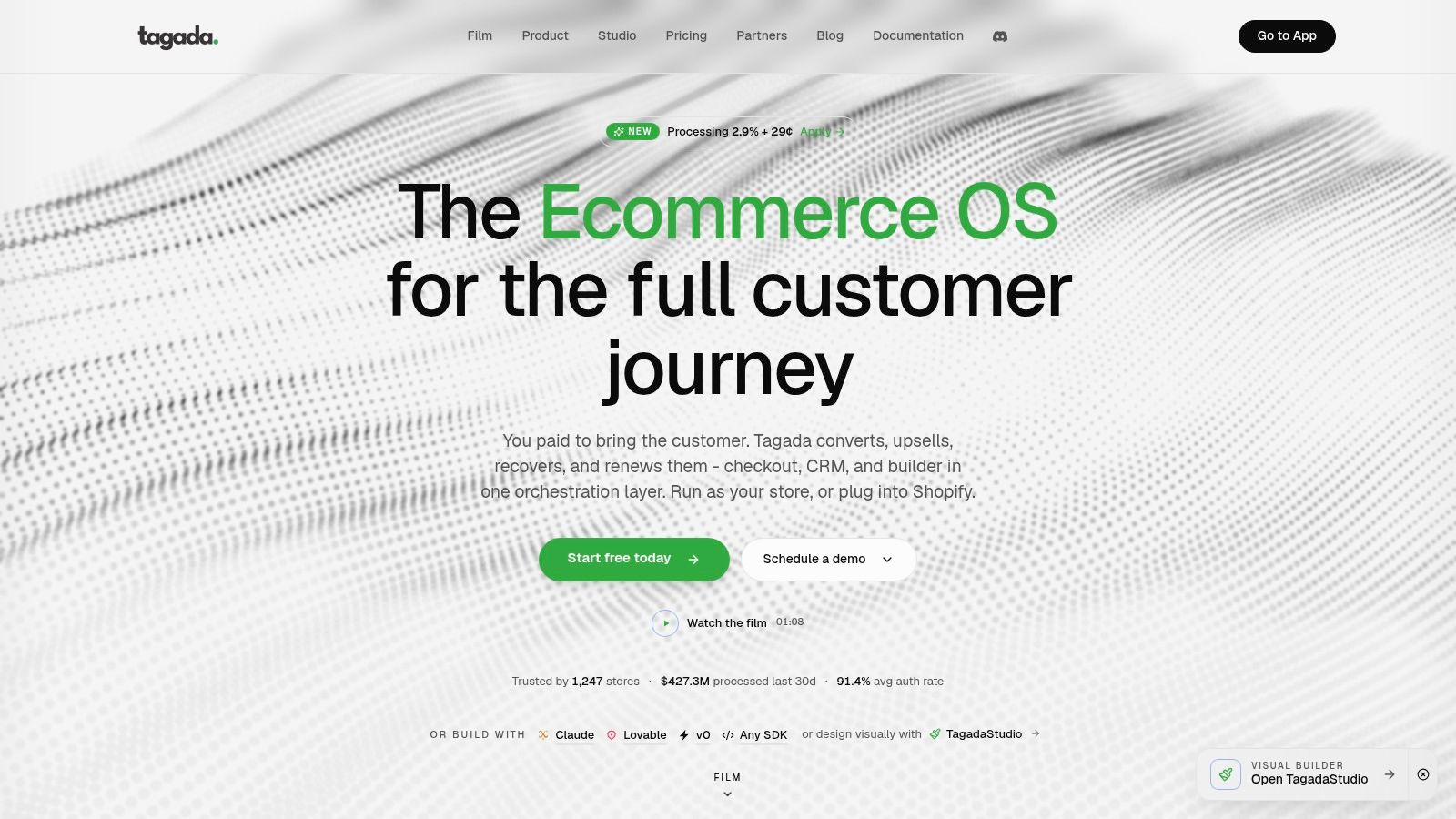
TagadaCheckout can adapt storefronts and purchase flows in real time. TagadaPay can route transactions across processors such as Stripe, Adyen, and NMI, or use native rails, with smart retries and local payment methods. That gives subscription, international, high-volume, and high-risk merchants a way to investigate the revenue after a checkout click, rather than stopping their analysis at an abandoned-cart event.
Payment recovery deserves that level of attention. Recent benchmark reporting estimates that failed payments represent 20% to 40% of B2C subscription churn, while payment-recovery systems can recapture up to 70% of failed payments, according to this analysis of retry engines and involuntary churn. Treat those figures as directional benchmarks, not guaranteed outcomes.
Where Tagada works best
- Unified orchestration: Funnel pages, native checkout, one-click upsells, subscriptions, A/B testing, server-side tracking, and messaging live in one revenue workflow.
- Payment intelligence: Multi-PSP routing, retries, local methods, dunning, and chargeback-aware risk controls address problems that page builders usually leave to separate tools.
- Developer flexibility: Headless browser SDKs, a Node SDK, and AI store-generation tools support custom storefronts and rapid integration.
- Lifecycle automation: TagadaSend triggers email and SMS from real payment events, including successful purchases, failed charges, and recovery states.
Tagada charges a platform fee plus a fee per successful transaction, with waivers above volume thresholds. That model may be less attractive for very low-volume merchants, and the feature depth creates a learning curve. For merchants managing multiple processors, subscriptions, retries, risk, and post-purchase messaging, however, the extra orchestration can replace several disconnected systems. Tagada says it supports 1k+ merchants and provides 24/7 support, details available on the Tagada platform website.
2. ClickFunnels
ClickFunnels remains a practical choice for teams that want a familiar, template-led funnel system. Its visual builder supports landing pages, multi-step funnels, checkout flows, upsells, downsells, courses, and a customer center. A non-technical marketer can usually assemble a working campaign without asking a developer to build every page.
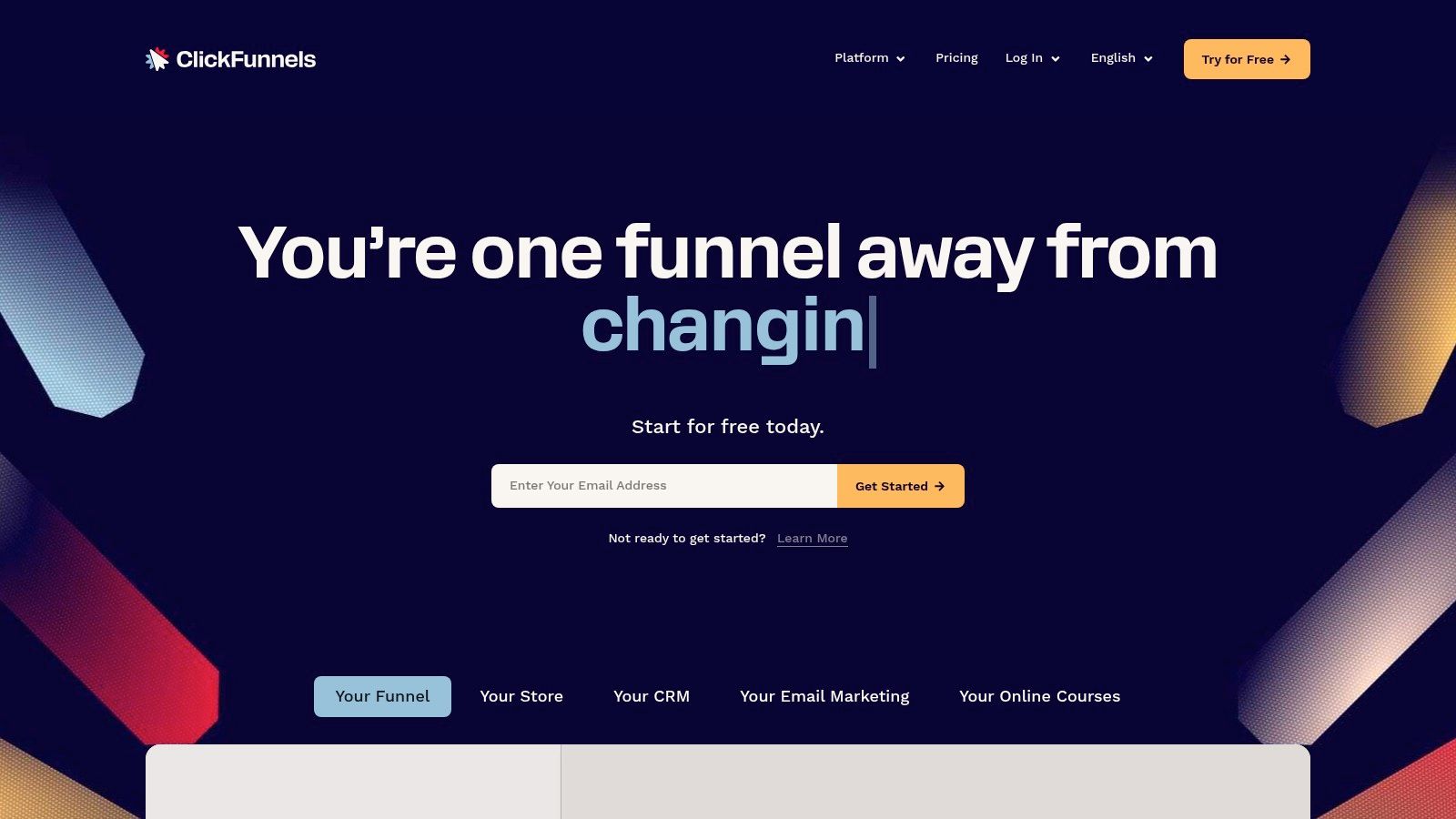
The platform's biggest strength is speed to launch. The template ecosystem gives creators a starting structure for lead generation, direct response offers, memberships, and simple ecommerce campaigns. Basic CRM and email automation help keep the initial stack compact, while the customer center supports order and course access.
The trade-off
ClickFunnels is easier to justify when your primary problem is building and iterating conventional funnels. It becomes harder to justify when you need detailed payment intelligence, complex attribution, custom storefront behavior, or a highly specialized ecommerce operating model. Advanced tracking and testing may require additional tools, and growing teams can find the subscription cost difficult to separate from the cost of supporting integrations.
Practical rule: Choose ClickFunnels when launch speed and templates matter more than deep infrastructure control.
The platform doesn't replace a payment operations layer for merchants handling multiple processors, regional payment methods, subscription recovery, or chargeback-aware workflows. It can still be a sensible fit for creators and small teams that want one vendor for pages, basic CRM, email, courses, and straightforward checkout. Teams comparing it with newer builders should also review this guide to AI funnel builders, particularly if rapid page generation and integrated revenue events are priorities. Visit the ClickFunnels website for current product details.
3. Kartra
Kartra combines funnel pages, checkout, email and SMS automation, memberships, courses, helpdesk tools, calendars, affiliate management, and analytics. That breadth makes it attractive to creators and digital sellers who'd rather learn one substantial system than maintain separate tools for delivery, support, and marketing.
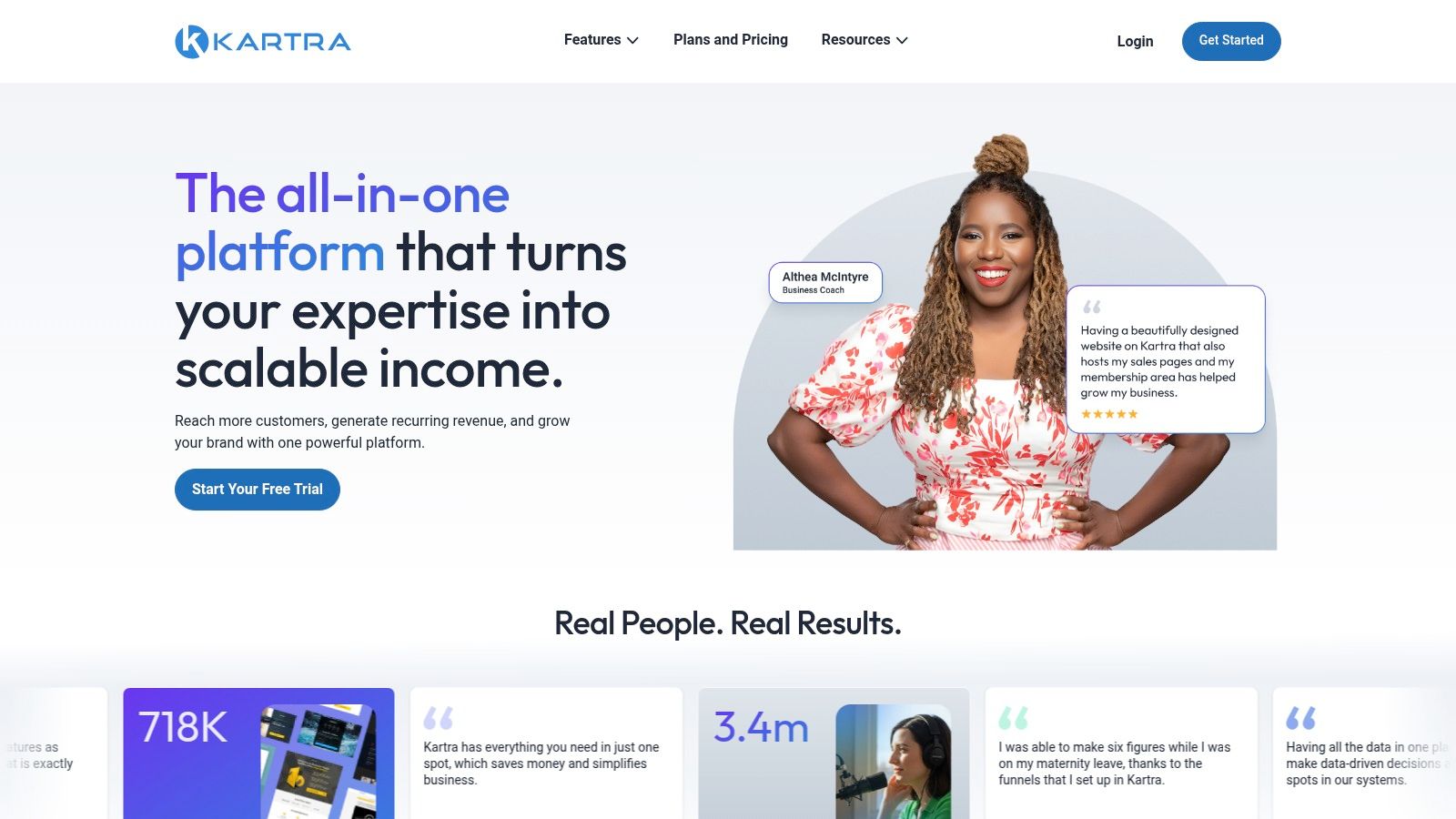
Its funnel mapper and simulator can help teams reason about how pages, offers, follow-up, and customer actions connect. Higher tiers add real-time funnel analytics, which is useful when a business has several campaigns and needs more than a single conversion number. Built-in webinars, memberships, and course delivery also reduce the handoffs between marketing and fulfillment.
Best fit and friction
Kartra suits a digital product business with an established offer model. A course creator can sell access, run email and SMS sequences, manage affiliates, and provide support without assembling a WordPress ecosystem. A creator selling subscriptions can also keep enrollment and customer communication closer together.
The cost of that breadth is operational complexity. New users need time to understand tags, campaigns, products, memberships, permissions, and automation paths. The entry-level Essentials tier carries a 5% transaction fee, while the Starter tier and above offer 0% transaction fees, according to the product plan information supplied for this comparison. That difference makes plan selection part of the transaction model, not just a software preference.
Kartra's checkout can support digital offers, but it isn't the obvious first choice for a physical-product merchant that needs advanced catalog, fulfillment, processor routing, or inventory operations. Subscription teams should also verify consent records and cancellation workflows. The FTC's Click-to-Cancel rule requires clear terms, informed consent, and a simple cancellation mechanism for covered negative-option programs. Kartra is worth considering when its native delivery and automation justify the learning curve. Review the Kartra platform before committing.
4. Kajabi
Kajabi is built around knowledge businesses. Its core workflow connects landing pages, email, products, payments, automations, courses, memberships, and communities in a cohesive interface. That makes it one of the more comfortable choices for coaches, educators, consultants, and creators whose funnel ends in digital access rather than a large physical-product catalog.
Kajabi's ready-made funnel blueprints reduce the number of decisions required at launch. A creator can begin with a lead magnet, nurture sequence, sales page, checkout, and course delivery path, then refine the offer without moving between unrelated applications. The shared design language across pages, email, and products also lowers the risk of a fragmented customer experience.
Where Kajabi stops short
Kajabi isn't a specialist checkout optimization system. It handles payments through Kajabi Payments or external gateways, but merchants with complex payment routing, high-risk acceptance needs, local methods, or processor failover should validate the available coverage before selecting it. Its ecommerce depth is also less compelling for large physical-product catalogs than a dedicated commerce stack.
The platform's opinionated structure is an advantage for creators who want proven patterns and a manageable interface. It's a limitation for teams that need unrestricted storefront design, intricate merchandising, or highly granular transaction-level experimentation. Advanced automations are available on higher tiers, so the workflow you design during a trial may not be available on the plan you initially prefer.
A creator platform should make delivery easier, but it shouldn't hide the payment and retention events that determine whether the offer remains profitable.
Kajabi works when the product, community, email list, and checkout belong to one creator-led business. It works less well as the central revenue layer for international DTC, high-volume subscriptions, or operations that need several processors and detailed recovery logic. Teams selling courses can also consult this guide to selling online courses. Explore the Kajabi website for current capabilities.
5. Systeme.io
Systeme.io lowers the barrier to launching a basic funnel. Its feature set includes visual funnels, landing pages, email automation, evergreen webinars, course hosting, memberships, affiliate tools, order bumps, one-click upsells, and support for payment options including Stripe, PayPal, and regional providers.
The free plan is the obvious attraction for new creators and lean teams. It lets a business test an offer without building a full paid stack on day one. A creator can publish an opt-in page, send an automated sequence, sell a digital product, and add a simple upsell without paying for a separate email platform and course host.
What you give up
Systeme.io's lower cost comes with less design freedom and less granular reporting than premium funnel or enterprise platforms. Teams that care about detailed experimentation, advanced attribution, custom checkout behavior, or complex lifecycle segmentation may reach its limits as the operation grows.
That doesn't make the tool weak. It makes it a sensible validation platform. Use it when the offer is simple, the team is small, and the main goal is to get a complete funnel operating. Don't choose it solely because the free plan exists if your business already requires processor routing, high-risk underwriting support, advanced subscription recovery, or deep server-side measurement.
A useful starting architecture is a short funnel with one primary offer, one order bump, and a clear post-purchase sequence. Instrument the events that matter, including checkout start, payment success, subscription start, and refund. Once those events are reliable, you can decide whether the limitation is the software or the offer itself. See the current Systeme.io platform before comparing plans.
6. ThriveCart
ThriveCart is checkout-first sales funnel software. It focuses on hosted carts, order bumps, one-click upsells, subscription billing, dunning, affiliate management, and embeddable purchase experiences. That focus makes it particularly useful for course creators, digital sellers, and lean DTC teams that already have pages but need a stronger path from offer to payment.
The platform is well suited to offers where average order value and post-purchase monetization matter. Order bumps can appear at checkout, one-click upsells can follow a purchase, and subscription tools can manage recurring payment logic. Affiliate management is also included, which prevents another operational handoff for businesses that rely on partners.
Strong cart, lighter orchestration
ThriveCart's strength is also its boundary. Email and CRM workflows generally depend on integrations, so teams need to map purchase, refund, failed-payment, and membership events into the rest of the stack. That connection can work well, but every integration introduces another place for field mappings, retries, and customer states to drift.
If your bottleneck is checkout conversion, don't buy an enterprise CRM first. Fix the cart, payment event, and offer sequence that sits closest to revenue.
ThriveCart has historically been associated with lifetime licensing and now also offers monthly plans. Merchants should compare the current license, application or platform charges, processor fees, and integration costs rather than assuming a one-time license makes the entire stack inexpensive. Subscription merchants should also test dunning behavior with real decline scenarios, not just successful renewals. Read this checkout flow guide for a broader view of the stages a cart should support. Visit the ThriveCart website for current plan details.
7. CartFlows for WordPress and WooCommerce
CartFlows turns WooCommerce into a more deliberate funnel environment. It adds custom checkout flows, optimized checkout templates, order bumps, one-click post-purchase upsells, downsells, A/B testing, analytics, and compatibility with leading WordPress page builders.
This is the ownership option in the list. A WordPress team keeps control of its site, content, hosting environment, data, theme, and plugin choices. That flexibility is valuable for merchants with unusual catalog logic, strong SEO requirements, custom checkout layouts, or developers already comfortable with WooCommerce.
The trade-off is maintenance. CartFlows doesn't remove the responsibility for WordPress hosting, updates, security, theme compatibility, plugin conflicts, backups, or performance monitoring. Email, CRM, advanced messaging, and payment recovery may also require additional tools.
Who should choose it
CartFlows is a strong fit for an existing WooCommerce store that wants funnel capabilities without migrating to a hosted platform. It's less attractive for a creator who wants to launch today without touching hosting, or for a high-volume merchant that lacks technical ownership of uptime and checkout troubleshooting.
Baymard reports that the average checkout contains 11.3 form fields, and 22% of users have abandoned because checkout was too complex, as documented in its checkout research collection. CartFlows gives WooCommerce teams more control over reducing those fields, clarifying the flow, and testing alternatives. The result still depends on the theme, payment extensions, hosting, and implementation quality. Review CartFlows if owning the stack matters more than minimizing technical work.
8. HighLevel
HighLevel, also known as GoHighLevel, is designed for agencies that need client sub-accounts, funnels, CRM pipelines, email, SMS, phone capabilities, calendars, appointments, reputation management, and white-label delivery. Its value comes from managing several client operations in one environment, not from being the simplest page builder for a solo merchant.
An agency can build a lead funnel, route inquiries into a pipeline, schedule appointments, automate follow-up, and offer the software under its own brand. Rebilling options can also support an agency's service model. That makes HighLevel more relevant to client acquisition and service workflows than to processor-level ecommerce operations.
Agency value, merchant limitations
The interface is dense because the platform covers many jobs. A solo operator may spend more time configuring modules than improving the offer. Agencies need to train staff, define account templates, document permissions, and control usage costs across email, telephony, AI, and other pay-as-you-go services.
HighLevel also shouldn't be treated as a complete payment orchestration layer for a subscription or high-risk merchant. Validate the checkout, processor coverage, recurring billing controls, decline recovery, refund handling, chargeback workflows, and transaction-level reporting before placing it at the center of a commerce stack.
For agencies, the right comparison is between the platform's breadth and the cost of maintaining separate CRM, messaging, calendar, and client-account systems. For ecommerce brands, the more important question is whether the platform can prove collected revenue after payment fees, refunds, and failed renewals. Visit the HighLevel website if multi-client automation and white-label delivery are central to your model.
9. GetResponse Conversion Funnel
GetResponse is an email-first platform with a built-in Conversion Funnel for landing pages, lead magnets, paid-ad connections, ecommerce selling, and automated follow-up. It suits teams that already think in email sequences and want their pages and nurturing workflows to live beside the email platform.
The practical advantage is continuity. A visitor can arrive from a paid campaign, submit a form, enter a segment, receive an automated sequence, and move toward an ecommerce action without the team stitching together a separate email service and basic landing page tool. Webinars and list-based automation also make it useful for education-led offers.
Where email-first becomes a constraint
GetResponse isn't the strongest choice when checkout optimization is the primary commercial problem. Its page and funnel design is less flexible than specialist builders, and advanced CRO or payment experimentation may require external tools. Merchants selling subscriptions, physical products, or high-risk offers should pay particular attention to payment ownership and event synchronization.
Browser tracking alone won't always show whether cash was collected. Consent restrictions, ad blockers, cross-device journeys, asynchronous payments, refunds, and renewals can all make a front-end conversion report look better than the underlying revenue. A serious implementation should reconcile email events with payment-confirmed server-side events.
GetResponse works well for an SMB team whose funnel begins with content or a lead magnet and is monetized through email. It works less well as the only operating layer for a complex international store with multiple processors and recovery paths. See the current GetResponse Conversion Funnel before comparing it with checkout-first tools.
10. HubSpot Marketing Hub
HubSpot Marketing Hub brings funnel activity into a broader CRM and RevOps environment. Its capabilities include landing pages, forms, email, marketing automation, ad management, attribution, analytics, and native CRM integration, with an expansion path into other Hubs.
HubSpot is valuable when sales, marketing, service, and leadership need a shared customer record. A team can connect a lead's acquisition source, form activity, emails, pipeline status, and customer history. That unified data model is much more useful for considered purchases and multi-team operations than for a simple one-product checkout.
Use it for customer intelligence, not blind checkout confidence
HubSpot can become overkill for a small ecommerce team that only needs a landing page, cart, payment, upsell, and post-purchase message. Pricing tiers and contact-based costs can be complex, and changes to the pricing model in 2026 may affect renewals. Review the commercial terms against contact growth, required Hubs, seats, integrations, onboarding, and reporting needs.
Attribution also needs careful governance. Ad-platform dashboards, CRM lifecycle stages, browser events, and payment records can disagree. HubSpot can organize customer and marketing data, but merchants still need a source of truth for approved payments, refunds, chargebacks, processor fees, and recurring revenue.
HubSpot fits larger organizations that need CRM depth and multi-channel reporting more than specialized funnel mechanics. It may be the right operating layer for a complex sales motion, while a commerce-focused platform handles payment routing and checkout. Explore HubSpot Marketing Hub before choosing it for a straightforward ecommerce funnel.
Top 10 Sales Funnel Software, Features & Pricing
| Product | Core features | UX / Quality (★) | Price / Value (💰) | Target (👥) | Unique selling points (✨) |
|---|---|---|---|---|---|
| Tagada – The Ecommerce OS to make money online 🏆 | Visual funnel & page builder, native checkout & upsells, TagadaPay routing, revenue-aware email/SMS, A/B testing, server-side tracking | 4.8★, fast onboarding, 24/7 support | 💰 per-successful-transaction + platform fee; start free; waivers at scale | 👥 Growth-first DTC & brands, teams needing unified payments+funnels | ✨ Multi-PSP routing & smart retries, server-side pixels, AI store generation |
| ClickFunnels | Visual funnel builder, templates, basic CRM & email, upsells | 4.0★, quick to launch, large template library | 💰 subscription tiers; can get pricey as needs grow | 👥 Non-technical marketers, small teams launching funnels | ✨ Huge template ecosystem, purpose-built funnel flows |
| Kartra | Funnels, built-in checkouts, memberships/courses, email/SMS, analytics | 4.1★, broad native features, some learning curve | 💰 flat plans; 0% tx fees above Starter, Essentials has tx fees | 👥 Creators & digital sellers wanting all-in-one platform | ✨ Funnel mapper, built-in webinars, real-time funnel analytics (higher tiers) |
| Kajabi | Course/membership-first funnels, page & email builders, automations, payments | 4.2★, cohesive UI, opinionated templates | 💰 premium pricing vs lightweight tools | 👥 Info-product creators, coaches, subscription businesses | ✨ Pre-built funnel blueprints, strong membership/course tooling |
| Systeme.io | Funnels, email automation, evergreen webinars, courses, basic ecommerce | 3.8★, budget-friendly, simpler design/customization | 💰 free plan + low-cost upgrades | 👥 New creators, lean teams, bootstrapped sellers | ✨ Free tier, broad feature set at low price |
| ThriveCart | Hosted high-converting checkouts, order bumps, 1-click upsells, subscriptions, affiliates | 4.3★, checkout-first, conversion optimized | 💰 lifetime/now monthly options; some platform fees possible | 👥 Digital sellers, course creators, teams prioritizing checkout CRO | ✨ Conversion-optimized carts, strong affiliate center |
| CartFlows (WP + WooCommerce) | Funnel builder for WooCommerce, one-click upsells, order bumps, A/B testing | 4.0★, highly customizable, requires WP expertise | 💰 plugin licensing; cost-effective at high volume | 👥 WordPress/WooCommerce stores, dev-savvy teams | ✨ Full ownership of stack & data, lower SaaS overhead |
| HighLevel (GoHighLevel) | Funnels/pages, CRM, email/SMS, calendar, white-label & rebilling | 4.1★, powerful for agencies, dense UI | 💰 agency pricing; add-ons (telephony/AI) can add costs | 👥 Agencies & multi-client operators | ✨ White-label SaaS mode, deep automation + rebilling |
| GetResponse (Conversion Funnel) | Landing pages, email automation, conversion funnels, paid-ads integration, ecommerce | 3.9★, email-first, reliable automations | 💰 ESP-style pricing; competitive for SMBs | 👥 Email-centric teams, SMB marketers | ✨ Funnels inside the ESP, native ad integrations |
| HubSpot Marketing Hub | Landing pages/forms, automation, ads, analytics, native CRM | 4.4★, enterprise-grade reporting & scale | 💰 tiered/contact-based pricing; can be complex & costly | 👥 Mid-market to enterprise, RevOps teams | ✨ Unified CRM data model, advanced analytics & multi-hub growth |
Choose the Stack That Protects the Next Sale
Start with the offer, not the software category. A physical product funnel, a course launch, a subscription rebill flow, an agency lead funnel, and a high-risk international checkout may all use landing pages, but they don't share the same operational requirements.
Define the funnel model first. Is traffic moving from an ad to a product page and checkout? Is a lead entering a sales pipeline before an appointment? Is the customer buying a one-time digital product, accepting an upsell, enrolling in a subscription, or starting a free trial? The answer determines whether you need page flexibility, order bumps, one-click upsells, course delivery, appointment scheduling, or recurring-payment controls.
Then identify the actual constraint:
- Pages: Choose a lightweight builder when the main requirement is publishing landing pages and simple flows quickly.
- Checkout conversion: Choose a checkout-first platform when order bumps, upsells, payment plans, and cart recovery drive the business model.
- Recurring billing: Verify subscription enrollment, rebills, dunning, failed-payment recovery, consent records, and cancellation workflows before choosing a platform.
- Payment acceptance: Ask whether the system supports your processors, local methods, routing rules, retries, risk controls, refunds, and chargeback processes.
- CRM depth: Choose HubSpot or HighLevel when customer records, pipelines, client accounts, and team workflows matter more than specialized cart mechanics.
- Lifecycle automation: Choose an email-led platform when segmentation and nurture drive the sale, but reconcile those events with confirmed payment data.
The economics need the same discipline. Calculate subscription charges, transaction fees, usage charges, processor costs, integration licenses, developer time, maintenance, support, and the revenue impact of failed payments. A cheap page builder can become expensive when you add a checkout app, email service, CRM, tracking layer, retry engine, and custom synchronization.
For WordPress teams, CartFlows offers ownership and customization, but the team must own hosting and upkeep. For creators with straightforward digital offers, Systeme.io, Kajabi, Kartra, ClickFunnels, or ThriveCart can reduce implementation time, with different trade-offs between breadth, checkout depth, and integrations. For agencies, HighLevel's client-account and white-label model can be more valuable than a simpler funnel editor.
Merchants with multiple processors, subscriptions, international payment methods, retries, risk requirements, and revenue-aware messaging need broader orchestration. Tagada is designed for that environment, combining visual funnel creation with native checkout, TagadaPay routing, TagadaSend messaging, A/B testing, server-side tracking, subscription management, dunning, and chargeback-aware risk handling.
Before signing a contract, run a real workflow. Test a successful payment, an issuer decline, an expired card, a retry, a refund, a chargeback signal, a subscription renewal, a cancellation, and a post-purchase message. Confirm that the platform records each event, passes it to the systems that need it, and reports collected revenue rather than only clicks or browser conversions.
The best sales funnel software isn't the one with the longest feature list. It's the one that protects the next sale after the visitor clicks Buy.
Tagada unifies visual funnel building, native checkout, multi-processor payment routing, subscriptions, smart retries, server-side tracking, A/B testing, and revenue-aware email and SMS in one Ecommerce OS. If fragmented infrastructure is limiting your ecommerce, subscription, digital, or high-risk operation, visit Tagada to see how one orchestration layer can connect the full revenue workflow.