
Sales Funnels for Telehealth Companies
The steps of a telehealth funnel, 4 funnel types, and what a funnel builder must handle: intake, charge after approval, processor, ad rules, tracking.



Article summary
TL;DR
A telehealth funnel has a step no other funnel has: a licensed clinician decides whether the patient can buy. So a telehealth funnel builder needs a branching intake with consent, a checkout that holds the card until that decision, a processor that accepts telemedicine, and tracking that sends purchases to ad platforms without health data.
- Stripe lists "Telemedicine and telehealth services" as restricted: the builder's built-in payments may not be available to you (read November 2, 2026).
- Google "restricts the use of prescription drug terms in ads, landing pages, and keywords". Funnel pages are landing pages.
- Meta requires telehealth providers to be "actively certified with LegitScript" and targets only people 18 or older.
- The FTC alleged in July 2026 that a telehealth company enrolled consumers in recurring plans "shortly after receiving consumers' intake forms".
- Quiz funnels on landing pages capture a lead from 11.28% of visitors on average, per ConvertFlow's September 2026 benchmark across all industries.
 ChatGPT
 Claude
 Perplexity
 Grok
On this page
This guide is part of our playbook on the best ecommerce platform for telehealth companies. The general guide, for any business: sales funnel software. The offer and page content inside the funnel are covered in the telehealth sales funnel: offer and page structure.
The telehealth funnel, step by step
Each step needs something specific from the builder. The fourth step is the one generic funnel tools do not have.
| Step | What happens | What the builder must do |
|---|---|---|
| 1. Ad to offer page | Patient learns what the program is and costs | Fast pages, no treatment claims, no drug terms where ad rules restrict them2Google Ads policy, Healthcare and medicines, prescription drug services, read November 2, 2026 |
| 2. Intake | Medical questions, consent, state, ID if needed | Branching logic, required consent, state check, answers kept out of marketing tools |
| 3. Checkout | Plan choice and payment details | Hold the card, show terms and when the card is charged, express payment |
| 4. Clinician decision | Approve, decline or ask for a visit | Capture on approval, release the hold on decline, message the patient |
| 5. First shipment | Pharmacy ships | Confirmation and tracking, content-free |
| 6. Refill | Next cycle | Rebill on shipment, reminders, pause and cancel online |
Fig. 1Six steps, and the one generic tools do not have
approved declined or closed routing step
- 1. Ad to offer pageNo treatment claims
- then2. IntakeConsent, state, ID if needed
- then3. CheckoutCard held
- then4. Clinician decisionApproved: capture · Declined: hold releasedApproved
- then5. First shipmentTracking, content-free
- then6. RefillRebill on shipment
Step 4 decides whether the card is captured or released.
4 funnel types for telehealth
| Funnel | Flow | Best for | Key metric |
|---|---|---|---|
| Quiz first | Ad, short eligibility quiz, plan and price, full intake, checkout | Programs where eligibility is the first question | Quiz completion rate |
| Offer first | Ad, offer page with price, intake, checkout | Simple programs with one price | Offer page to intake rate |
| Membership | Ad or content, membership page, sign-up, intake when needed | Ongoing access to clinicians | Month-2 retention |
| Reactivation | Email or SMS to lapsed or declined patients, new intake | Patients whose plan ended or whose state is now covered | Return rate |
Quiz first
Ad, short eligibility quiz, plan and price, full intake, checkout. Key metric: quiz completion rate.
Offer first
Ad, offer page with price, intake, checkout. Key metric: offer page to intake rate.
Membership
Ad or content, membership page, sign-up, intake when needed. Key metric: month-2 retention.
Reactivation
Email or SMS to lapsed or declined patients, new intake. Key metric: return rate.
Quiz first or price first is a real trade-off. A quiz gives the patient an answer before the price; a price first filters out people who will not pay. Test it with A/B testing for telehealth companies.
What a telehealth funnel builder must handle
Choose the tool on these six points, then on its page editor.
Fig. 2Six points to check before the page editor
- Branching intake and consent. Questions that change with answers, required consent, photo ID upload when the offer needs it.
- State check. The patient's state captured early. Clinicians generally must be licensed where the patient is; the Interstate Medical Licensure Compact speeds licensing across 44 states, the District of Columbia and Guam but is not a national license8Interstate Medical Licensure Compact Commission, A faster pathway to physician licensure, read November 3, 2026.
- Charge after the decision. An authorization at checkout, captured only if the clinician prescribes. The hold must not read as a medical approval9Tagada Docs, Rx: Introduction, read November 2, 2026.
- Your choice of processor. Stripe approval for telemedicine is case by case and "specific to each service offer"1Stripe, Prohibited and restricted businesses, read November 2, 2026. A builder locked to one processor leaves you with no fallback.
- Tracking without health data. Purchase events sent from the server, with no quiz answers, condition or product names. The FTC's actions against Cerebral (2024) and Hims & Hers (2026, allegations) involve health data shared with ad platforms4FTC, "FTC and States Act Against Hims & Hers", press release, July 29, 2026 (allegations; case pending)5FTC, proposed order against Cerebral, press release, April 15, 2024.
- Refills after the funnel. The funnel's job ends at the first refill, not the first order. See subscription billing for telehealth companies.
Choose the tool on these six points, then on its page editor.
Point 3: charge only after the clinician decides.
Watch out
A funnel builder that charges the full amount at checkout bills people before any clinician sees their case. Expect refund requests, disputes and regulatory attention4FTC, "FTC and States Act Against Hims & Hers", press release, July 29, 2026 (allegations; case pending).
Rules that shape funnel pages
| Rule | What it means for the funnel |
|---|---|
| Google, prescription drug services | Telemedicine providers must apply; in the US, LegitScript certification and Google certification. Drug terms restricted in ads, landing pages and keywords (Google Ads policy)2Google Ads policy, Healthcare and medicines, prescription drug services, read November 2, 2026 |
| Meta, drugs and pharmaceuticals | LegitScript certification, then Meta authorization; target 18+ only; ads that "Promote telehealth services generally" need no written authorization (Meta)3Meta Transparency Center, Drugs and pharmaceuticals, read November 2, 2026 |
| FTC, native advertising | An advertorial or pre-sell page must be identifiable as advertising (FTC, 2015 policy statement)6FTC, Enforcement Policy Statement on Deceptively Formatted Advertisements, December 22, 2015 |
| FTC Act and ROSCA | Clear terms, consent and easy cancellation for recurring plans; the Hims & Hers complaint cites both (FTC)4FTC, "FTC and States Act Against Hims & Hers", press release, July 29, 2026 (allegations; case pending) |
Ad setup in detail: Meta and TikTok ads for telehealth companies. Whether you can advertise at all: advertising telehealth services on Facebook, Google and TikTok.
Generic builder, health builder or integrated stack
| Option | Strong point | What to check |
|---|---|---|
| Generic funnel builder | Page editor, templates, price | Built-in payments that exclude telemedicine; no hold and capture; pixels on every page by default |
| Health form or quiz builder | Intake logic, consent | Still needs a checkout, a processor and a refill system; data passed between tools |
| Integrated telehealth stack | Intake, clinician decision, payment and refill in one flow | Less freedom on page design; check it fits your offer |
Fig. 3Three ways to build it
- Generic funnel builderPage editor, templates, priceBuilt-in payments that exclude telemedicine; no hold and capture; pixels on every page by default
- Health form or quiz builderIntake logic, consentStill needs a checkout, a processor and a refill system; data passed between tools
- Integrated telehealth stackIntake, clinician decision, payment and refill in one flowLess freedom on page design; check it fits your offer
Check each one on hold, capture and refills.
If you keep Shopify for the store, see Shopify or a sales funnel for your telehealth company.
What to measure
| Metric | Formula | Watch for |
|---|---|---|
| Intake completion | Completed intakes ÷ started | Drop at one question |
| Checkout conversion | Checkouts with a hold ÷ completed intakes | Price or terms surprise |
| Approval rate | Approved ÷ decided cases | Traffic from states or profiles you cannot serve |
| Capture success | Captured ÷ approved | Cards that fail after approval |
| Month-2 retention | Patients on their first refill ÷ first orders | Funnel promising more than the program gives |
Then follow cost per paying patient, not per lead: see LTV and CAC for a telehealth company.
How Tagada helps
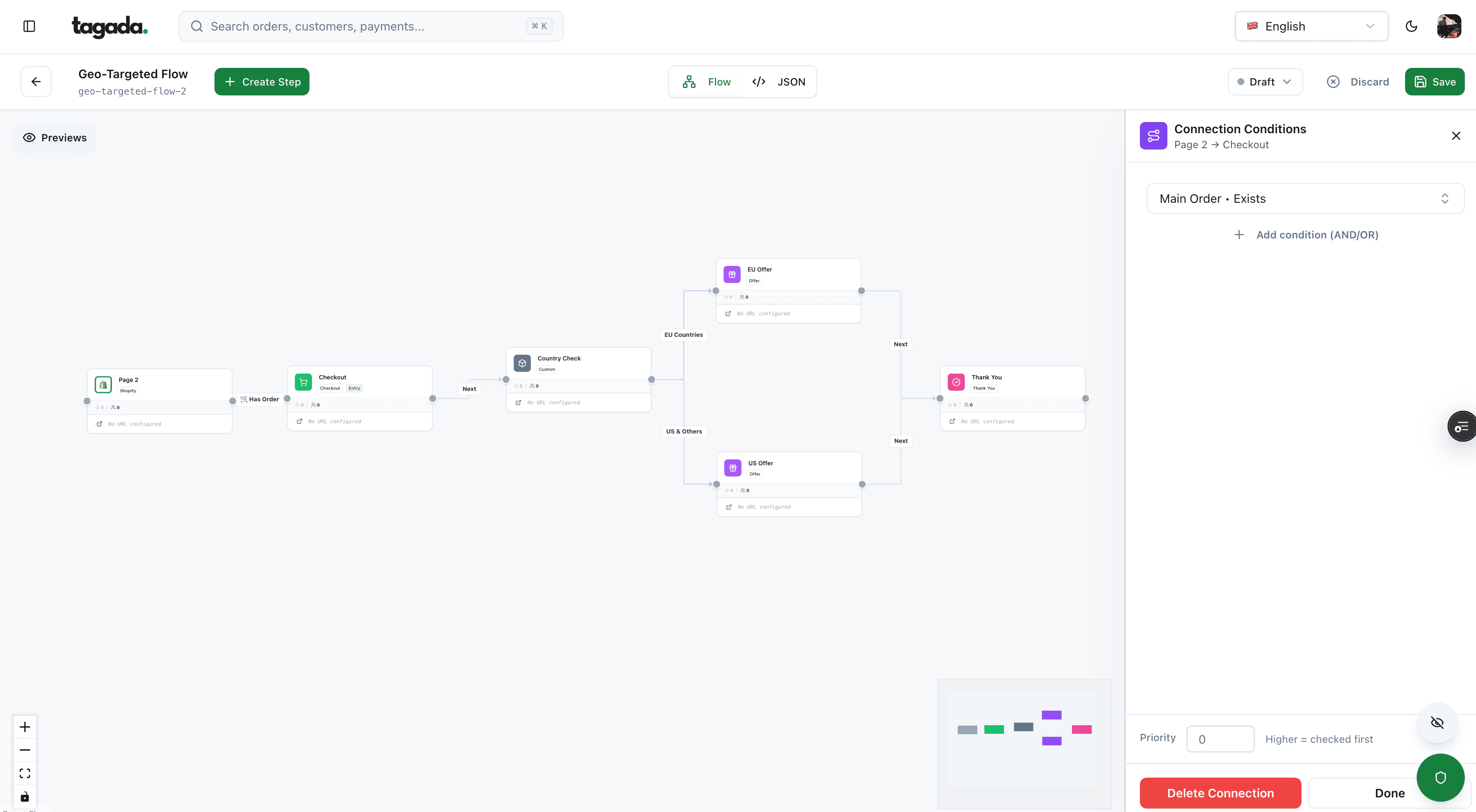
Funnel, checkout and payments in one Tagada stack
Tagada runs the checkout and payment side of the funnel in one place, and TagadaPay brings "Native 3DS2, device intelligence, and rules engine: approve real customers, block the rest."10TagadaPay, homepage, read November 2, 2026
- Checkout tools: order bumps, one-click upsells, A/B tests, Apple Pay and Google Pay
- Server-side events to Meta (Conversions API)
- Routing across TagadaPay and processors such as Stripe, NMI and Airwallex, with a cascade to another processor when one is down or times out
- Integrations: "Already on Shopify, WooCommerce, ClickFunnels or BigCommerce? Drop TagadaPay in."
Building a telehealth brand from scratch? Tagada Rx runs storefront, intake quiz, doctors, pharmacy and payments in one stack, and the card is only captured once a doctor approves9Tagada Docs, Rx: Introduction, read November 2, 2026. US patients only, by selection.
Frequently asked questions
Can I use ClickFunnels or another generic funnel builder for telehealth?
Should the intake quiz come before or after the price?
Does my funnel builder need a BAA?
Can I put the Meta pixel on my intake quiz?
When should a telehealth funnel charge the patient?
Sources
Checked November 2, 2026- Stripe, Prohibited and restricted businesses, read November 2, 2026
- Google Ads policy, Healthcare and medicines, prescription drug services, read November 2, 2026
- Meta Transparency Center, Drugs and pharmaceuticals, read November 2, 2026
- FTC, "FTC and States Act Against Hims & Hers", press release, July 29, 2026 (allegations; case pending)
- FTC, proposed order against Cerebral, press release, April 15, 2024
- FTC, Enforcement Policy Statement on Deceptively Formatted Advertisements, December 22, 2015
- ConvertFlow, Lead Generation Quiz Funnel Benchmark, September 2026, 1,063 campaigns, as published in its therapy booking quiz playbook (vendor data)
- Interstate Medical Licensure Compact Commission, A faster pathway to physician licensure, read November 3, 2026
- Tagada Docs, Rx: Introduction, read November 2, 2026
- TagadaPay, homepage, read November 2, 2026
Tagada
A funnel that charges after the clinician decides
Funnels, one-click upsells, subscription billing and payment routing, on one customer record.
- 01Create your free account
- 02Connect your store or build a checkout
- 03Launch funnels, upsells and subscriptions