
Telehealth Payment Processing
Which processors accept telehealth, who requires LegitScript, what underwriters check, and the payment setups that keep a telehealth brand live.



Article summary
TL;DR
Mainstream processors don't ban telehealth, they gate it. Stripe restricts "telemedicine and telehealth services" and reviews each business; PayPal requires pre-approval; Square excludes pharmacy models built on remote consultations. Card networks have no telehealth program, but once you sell the medication yourself, pharmacy rules apply. Plan your setup around that line.
- Stripe restricts "Telemedicine and telehealth services" and approves case by case; the approval "may be modified or revoked by Stripe at any time".
- PayPal's US policy lists "Telemedicine Services" among activities that need pre-approval (policy updated October 29, 2022).
- Visa's high-risk program names pharmacies (MCC 5122, 5912), not telemedicine.
- Google and Meta require LegitScript for telehealth ads; Stripe says telemedicine doesn't need it.
- As of November 2, 2026, the DEA's temporary telemedicine flexibilities run through December 31, 2026.
 ChatGPT
 Claude
 Perplexity
 Grok
On this page
This page is the hub for telehealth payments. The general guide, for any business: how to get and keep a high-risk merchant account. The store side lives in our guide to the best ecommerce platform for telehealth companies.
Tagada Rx: if you want to launch or run a telehealth brand without assembling every piece, Tagada Rx is a telehealth stack with storefront, doctors, pharmacy and payments in one place. It is open by application20Tagada Rx, read November 2, 2026.
Why processors treat telehealth as high risk
Telehealth is legal, and nothing in Visa's or Mastercard's rules names it. Processors still review it because of what sits around the consultation: licensed prescribing, medication shipping, recurring billing and health data.
| Trigger | What the rule says | Who sets it |
|---|---|---|
| Remote diagnosis or treatment | "Telemedicine and telehealth services" need approval | Stripe1Stripe, Prohibited and restricted businesses, read November 2, 2026 |
| Remote consultations | "Telemedicine Services" need pre-approval | PayPal3PayPal, Acceptable Use Policy (US), last updated October 29, 2022, read November 2, 2026 |
| Medication fulfilled after a remote consult | Unsupported: pharmacies where fulfillment follows "an internet or telephone consultation, absent a physical visit" | Square4Square, Payment Terms (US), section 3, updated July 30, 2026 |
| Selling the medication card-not-present | Pharmacies, MCC 5122 and 5912, are Tier 1 of Visa's integrity risk program | Visa6Visa, Visa Integrity Risk Program, guide for acquirers, April 6, 2023 |
| Subscriptions | Clear terms, express consent, simple cancellation | ROSCA13Restore Online Shoppers' Confidence Act, 15 U.S.C. § 8403, Visa14Visa Core Rules and Visa Product and Service Rules, edition of April 18, 2026, tables 5-20 and 5-21 |
Stripe's definition sets the scope: telemedicine "includes synchronous and asynchronous patient communication that involves diagnosis or treatment conducted over phone, text, email, or video consultations". Education or wellness resources "aren't categorized as telemedicine"2Stripe Support, Prohibited and restricted businesses list FAQs, read November 2, 2026.
Consultation or medication: what you sell sets the rules
The biggest payment question for a telehealth brand is who charges for the medication. The consultation and the membership are a medical service. The medication is a pharmacy sale, with its own codes and network rules.
| The consultation, membership or treatment plan | The medication | |
|---|---|---|
| Closest Visa MCC | 8011 (doctors) or 8099 (medical services)8Visa Merchant Data Standards Manual, October 2026 | 5912 (drug stores and pharmacies)8Visa Merchant Data Standards Manual, October 2026 |
| Visa integrity risk program | Not listed6Visa, Visa Integrity Risk Program, guide for acquirers, April 6, 2023 | Tier 1, registration required6Visa, Visa Integrity Risk Program, guide for acquirers, April 6, 2023 |
| Mastercard | NoTelemedicine category7Mastercard Security Rules and Procedures, Merchant Edition, August 4, 2026, section 9.4 | "Non–face-to-face pharmaceutical Merchants" must be registered7Mastercard Security Rules and Procedures, Merchant Edition, August 4, 2026, section 9.4 |
| Stripe line | "Telemedicine and telehealth services"1Stripe, Prohibited and restricted businesses, read November 2, 2026 | "Card-not-present prescription-only products and pharmaceuticals"1Stripe, Prohibited and restricted businesses, read November 2, 2026 |
The acquirer chooses the code, not you. A brand that bills the medication itself can end up under pharmacy rules: see online pharmacy payment processing. The split in detail: charging the consultation and the medication separately. Code by code: 8011, 8099, 5912 and 5122.
Three details often catch telehealth brands out:
- 5122 isn't a patient-facing code. Visa describes it as wholesale or business-to-business distribution of drugs8Visa Merchant Data Standards Manual, October 2026. A brand selling medication to patients shouldn't sit on it; if your provider gave you 5122, ask why.
- Pharmacies aren't "Health Care Merchants". In the US, Visa's rules define a Health Care Merchant as a merchant, other than a pharmacy, whose main business is providing health care services under codes such as 8011 or 809914Visa Core Rules and Visa Product and Service Rules, edition of April 18, 2026, tables 5-20 and 5-21. Some options, like charging the balance after insurance pays, are reserved to that group.
- One code per Stripe account. "Each Stripe account has exactly one MCC"21Stripe Docs, Set merchant category codes, read November 3, 2026, so a brand that bills both the consultation and the medication usually ends up with two accounts or two merchants of record, one per code.
Fig. 1The consultation and the medication, under two sets of rules
Consultation or plan
- Patient paysVisit, membership, plan
- coded asMCC 8011 or 8099Stripe: telemedicine and telehealth servicesApproved
Medical service: not listed in Visa's integrity program
Medication
- Patient paysPrescription filled and shipped
- coded asMCC 5912Stripe: card-not-present prescription-only productsDeclined
Pharmacy sale: Tier 1, registration required
Who charges for the medication decides which column you're in.
Do Stripe, PayPal, Square and Shopify accept telehealth?
None refuses telehealth outright in the US, and none approves it by default.
| Provider | Position | Exact wording |
|---|---|---|
| Stripe | RestrictedCase by case; prohibited for Mexico accounts | "Stripe reviews each business on a case-by-case basis"2Stripe Support, Prohibited and restricted businesses list FAQs, read November 2, 2026 |
| PayPal | Pre-approval required | "Telemedicine Services: Providing medical services and consultations in a remote fashion"3PayPal, Acceptable Use Policy (US), last updated October 29, 2022, read November 2, 2026 |
| Square (US) | Consultation not named; pharmacy models excluded, plus "direct marketing or subscription offers or services" | Pharmacies "where fulfillment of medication is performed with an internet or telephone consultation, absent a physical visit"4Square, Payment Terms (US), section 3, updated July 30, 2026 |
| Shopify Payments | Telemedicine not named; prescription drugs listed as regulated | "Products or services that require regulatory approval or compliance, such as [...] prescription drugs, medical devices"5Shopify Help Center, Shopify Payments eligibility, read November 2, 2026 |
Details: Stripe, Shopify, PayPal and Square. Marketplaces such as Amazon or TikTok Shop are built to sell products, not consultations, so they are not a payment channel for the service itself.
Who actually requires LegitScript
LegitScript is the certification most guides call "mandatory". The rules say something narrower.
| Who | What the rule says |
|---|---|
| Visa | Doesn't require it. It exempts pharmacies (MCC 5122, 5912) certified by LegitScript or accredited by NABP from registration6Visa, Visa Integrity Risk Program, guide for acquirers, April 6, 2023 |
| Mastercard | Doesn't name it. For pharmacies, legality checks "may include [...] accreditation by a recognized third party"7Mastercard Security Rules and Procedures, Merchant Edition, August 4, 2026, section 9.4 |
| Stripe | "Telemedicine businesses don't need certification from LegitScript"2Stripe Support, Prohibited and restricted businesses list FAQs, read November 2, 2026 |
| Google Ads (US) | Required for telemedicine providers, plus Google certification10Google Ads policy, Prescription drug services, read November 2, 2026 |
| Meta | "Meta requires online pharmacies and telehealth providers to be actively certified with LegitScript"11Meta Transparency Center, Drugs and pharmaceuticals, read November 2, 2026 |
Fig. 2Who asks for LegitScript, and who doesn't
Visa
Doesn't require it. It exempts pharmacies (MCC 5122, 5912) certified by LegitScript or accredited by NABP from registration6Visa, Visa Integrity Risk Program, guide for acquirers, April 6, 2023.
Stripe
"Telemedicine businesses don't need certification from LegitScript"2Stripe Support, Prohibited and restricted businesses list FAQs, read November 2, 2026.
Google Ads (US)
Required for telemedicine providers, plus Google certification10Google Ads policy, Prescription drug services, read November 2, 2026.
Meta
"Meta requires online pharmacies and telehealth providers to be actively certified with LegitScript"11Meta Transparency Center, Drugs and pharmaceuticals, read November 2, 2026.
Ads, more than payments, are why most telehealth brands get certified.
Watch out
LegitScript says its certification is "a necessary part of the approval process for conducting card-not-present transactions with Visa and Mastercard"9LegitScript, Healthcare Certification FAQ, read November 2, 2026. That is the certifier's position. Some processors also make it a condition of their own. Ask each processor in writing.
In practice, ads are the most common reason a telehealth brand gets certified. More in telehealth advertising rules and whether a platform's LegitScript covers your brand.
Your payment setups
| Setup | How it works | Strength | Weakness |
|---|---|---|---|
| Aggregator (Stripe, PayPal) | Shared account, restricted review at sign-up | Fast if approved | Approval specific to each service, revocable1Stripe, Prohibited and restricted businesses, read November 2, 2026 |
| Dedicated merchant account | A bank underwrites the brand before you process | Terms known up front | One account is still a single point of failure |
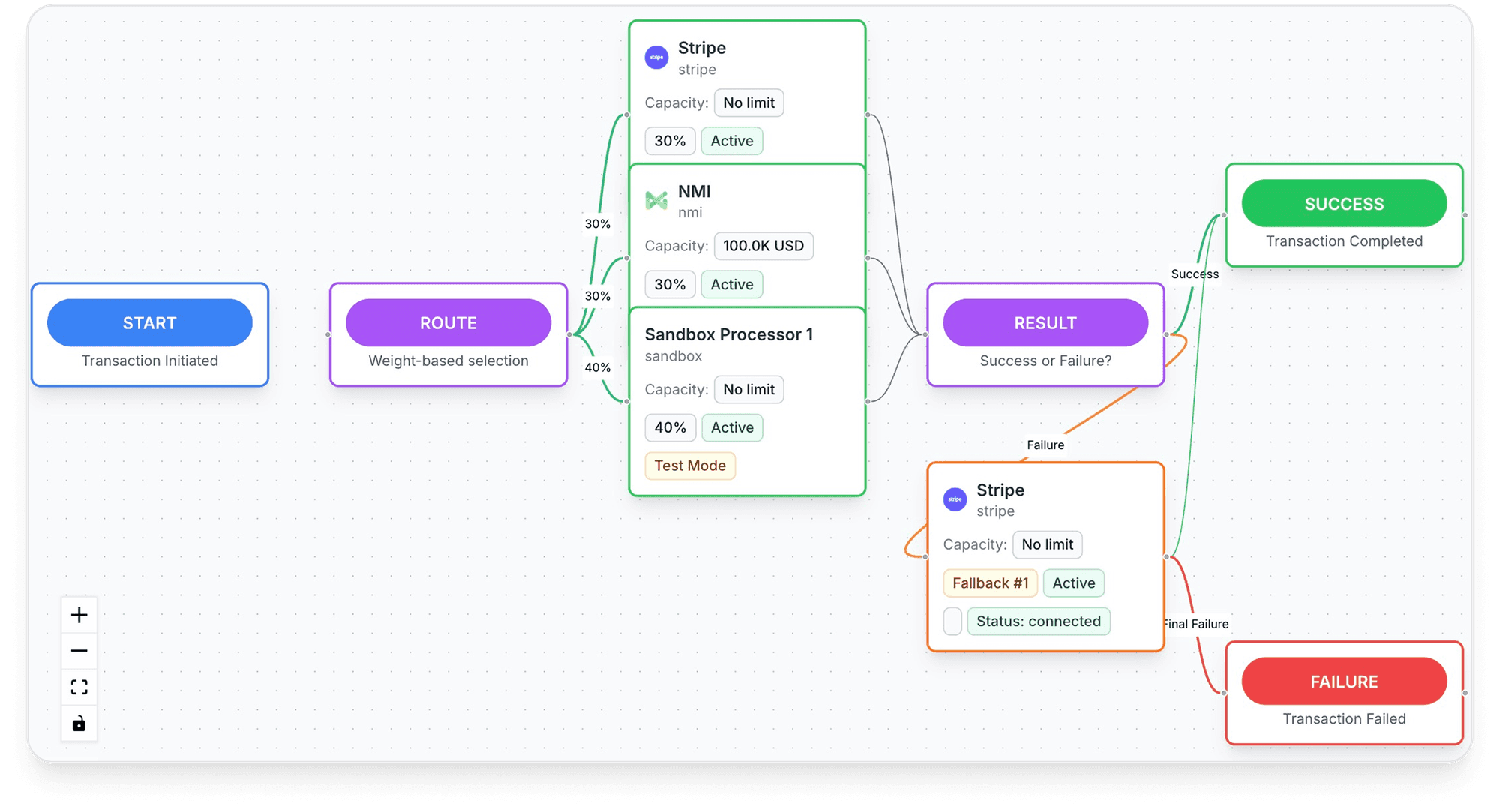
| Several processors, one checkout | Two accounts with routing rules | An outage or closure moves volume instead of stopping it | Each account needs its own approval |
| Full telehealth stack | A platform runs storefront, clinicians, pharmacy and payments | NoSeparate approvals to assemble | You work inside the platform's model |
Watch out
A second account is a continuity plan. Splitting volume to stay under a network threshold is evasion, which Stripe lists among prohibited uses1Stripe, Prohibited and restricted businesses, read November 2, 2026.
Fig. 3Several processors behind one checkout
An outage or a closure moves the volume; a bank decline stays a decline.
Routing in practice: payment routing for telehealth companies.
What underwriters check
Stripe says telemedicine applicants "typically need to provide items such as license numbers and information on your processes"2Stripe Support, Prohibited and restricted businesses list FAQs, read November 2, 2026. Specialized processors list the usual business file on top18PaymentCloud, Telemedicine merchant account, read November 2, 2026:
- Government-issued ID of each owner, signed application, voided check or bank letter
- Three months of bank statements and three months of processing statements, if you have them
- Prescriber license numbers and the states they cover
- Your clinical flow: intake, review, consult type, when a prescription is issued or refused
- Who charges for what: medical group, pharmacy, brand
- Billing terms: price, renewal frequency, cancellation, refund if a prescription is refused
- If you prescribe controlled medications: how you'll comply when the DEA's temporary telemedicine flexibilities end. The current extension runs through December 31, 202612DEA and HHS, Fourth Temporary Extension of COVID-19 Telemedicine Flexibilities, 90 FR 61301, December 31, 2025
Published timelines range from 1 to 4 business days (Easy Pay Direct) to 2 to 3 weeks (Adaptiv Payments)19Easy Pay Direct (1 to 4 business days on clean files) and Adaptiv Payments (2 to 3 weeks), published telemedicine pages, read November 2, 2026. Step by step: how to get a telehealth merchant account approved. New brands: merchant accounts for new telehealth companies.
Subscriptions and the FTC
Most telehealth brands bill memberships or treatment plans. Card rules and federal law both apply.
| Requirement | Rule |
|---|---|
| Before billing details | Clear disclosure of all material terms (ROSCA)13Restore Online Shoppers' Confidence Act, 15 U.S.C. § 8403 |
| Consent | Express informed consent before charging (ROSCA)13Restore Online Shoppers' Confidence Act, 15 U.S.C. § 8403 |
| Stopping | "Simple mechanisms for the consumer to stop recurring charges" (ROSCA)13Restore Online Shoppers' Confidence Act, 15 U.S.C. § 8403 |
| Trial reminder | At least 7 days before a trial or intro price ends (Visa)14Visa Core Rules and Visa Product and Service Rules, edition of April 18, 2026, tables 5-20 and 5-21 |
| Online cancellation | Required when the sign-up was online (Visa)14Visa Core Rules and Visa Product and Service Rules, edition of April 18, 2026, tables 5-20 and 5-21 |
Fig. 4A subscription, from checkout to cancellation
- Before billing detailsAll material terms disclosed
- ConsentExpress and informed, before charging
- Trial reminderAt least 7 days before the intro price ends
- CancellationOnline when the sign-up was online
Each step is a rule, and each one is a dispute reason when it's missed.
Example
On July 29, 2026, the FTC, Utah and California sued Hims & Hers. The FTC alleges consumers were enrolled in recurring plans "shortly after receiving consumers' intake forms", charged for a prescription "without having a chance to review or approve it", and faced a hidden cancellation button. These are allegations; the case is pending15FTC, press release on Hims & Hers, July 29, 2026 (allegations; case pending).
Charging only after a clinician approves avoids the first problem. More: how to sell telehealth services on subscription and cancellation compliance.
Chargeback thresholds
| Visa (VAMP) | Mastercard (ECM) | |
|---|---|---|
| Counted | Fraud reports plus disputes | Chargebacks |
| Threshold | 1.5% in the US since April 1, 202616Visa, Acquirer Monitoring Program fact sheet, 2025 | 1.5%17Chargeback Gurus, Understanding the Mastercard Excessive Chargeback Program, October 21, 2025 (secondary source) |
| Minimum | 1,500 fraud reports and disputes a month16Visa, Acquirer Monitoring Program fact sheet, 2025 | 100 chargebacks a month17Chargeback Gurus, Understanding the Mastercard Excessive Chargeback Program, October 21, 2025 (secondary source) |
1.5%
Visa VAMP threshold in the US since April 1, 2026
1,500
Visa fraud reports and disputes a month, minimum
100
Mastercard ECM chargebacks a month, with the 1.5% ratio
Telehealth disputes are mostly patients who didn't expect a charge: a renewal, a refused prescription already billed, an unfamiliar descriptor. Tagada follows Visa and Mastercard rules and the laws that apply to payments. Prevention: chargebacks for telehealth companies.
Guides for telehealth brands
| Theme | Guides |
|---|---|
| Providers | Stripe · Shopify · PayPal and Square · Stripe closed your account |
| Legal and structure | Is it legal? · Legal by state · Ownership and licensing · Start a telehealth company |
| Getting approved | Get approved · New companies · LegitScript for ads and payments · HIPAA and payments |
| Checkout and billing | Consultation vs medication · Prescription-gated checkout · Subscriptions · Cancellation compliance · Trial offers |
| Money | Fees and reserves · Payouts · International payments · Payment methods |
| Staying approved | Compliance · Advertising |
| Disputes and fraud | Chargebacks · Chargeback alerts · Fraud and 3D Secure · Declined payments · Switch payment processor |
How Tagada helps
Payments for telehealth brands
TagadaPay brings telehealth brands "enhanced review for regulated verticals"23TagadaPay, homepage, read November 2, 2026 and "24/7 human support on Slack Connect".
- Routing across TagadaPay and processors such as Stripe, NMI and Airwallex, with one logic and a cascade to another processor when one is down or times out
- Your vault, portable: "Switch processors without re-onboarding customers. No vendor lock-in. Ever."
- Fraud and security: "Native 3DS2, device intelligence, and rules engine: approve real customers, block the rest"
- Subscriptions with retries and automatic recovery
Building a telehealth brand from scratch? Tagada Rx runs storefront, doctors, pharmacy and payments in one stack: "The card is only captured once a doctor approves"20Tagada Rx, read November 2, 2026, "Recurring treatments rebill the day the pharmacy ships" and "Tagada never persists PHI"22Tagada Docs, Tagada Rx introduction and how it works, read November 2, 2026, and stores run on tgdcare.com, which is LegitScript certified (ad approval still depends on Google and Meta)20Tagada Rx, read November 2, 2026. US patients only, by selection.
Frequently asked questions
Is telehealth considered high risk for payment processing?
Can I use Stripe for a telemedicine business?
Do I need LegitScript to accept telehealth payments?
What MCC does a telehealth company use?
Can I bill patients before the doctor reviews their case?
Sources
Checked November 2, 2026- Stripe, Prohibited and restricted businesses, read November 2, 2026
- Stripe Support, Prohibited and restricted businesses list FAQs, read November 2, 2026
- PayPal, Acceptable Use Policy (US), last updated October 29, 2022, read November 2, 2026
- Square, Payment Terms (US), section 3, updated July 30, 2026
- Shopify Help Center, Shopify Payments eligibility, read November 2, 2026
- Visa, Visa Integrity Risk Program, guide for acquirers, April 6, 2023
- Mastercard Security Rules and Procedures, Merchant Edition, August 4, 2026, section 9.4
- Visa Merchant Data Standards Manual, October 2026
- LegitScript, Healthcare Certification FAQ, read November 2, 2026
- Google Ads policy, Prescription drug services, read November 2, 2026
- Meta Transparency Center, Drugs and pharmaceuticals, read November 2, 2026
- DEA and HHS, Fourth Temporary Extension of COVID-19 Telemedicine Flexibilities, 90 FR 61301, December 31, 2025
- Restore Online Shoppers' Confidence Act, 15 U.S.C. § 8403
- Visa Core Rules and Visa Product and Service Rules, edition of April 18, 2026, tables 5-20 and 5-21
- FTC, press release on Hims & Hers, July 29, 2026 (allegations; case pending)
- Visa, Acquirer Monitoring Program fact sheet, 2025
- Chargeback Gurus, Understanding the Mastercard Excessive Chargeback Program, October 21, 2025 (secondary source)
- PaymentCloud, Telemedicine merchant account, read November 2, 2026
- Easy Pay Direct (1 to 4 business days on clean files) and Adaptiv Payments (2 to 3 weeks), published telemedicine pages, read November 2, 2026
- Tagada Rx, read November 2, 2026
- Stripe Docs, Set merchant category codes, read November 3, 2026
- Tagada Docs, Tagada Rx introduction and how it works, read November 2, 2026
- TagadaPay, homepage, read November 2, 2026
TagadaPay
A telehealth brand that keeps taking payments
Tell us what you sell and how you sell it. Each application is underwritten, and approval is not guaranteed.
- 01Tell us what you sell and how
- 02Underwriting reviews your business
- 03Process through TagadaPay alongside your other processors