
Payment Routing and Backup Processors for Telehealth Companies
Why telehealth payments get paused, how routing and a backup processor keep checkouts and renewals running, and a setup checklist.

Article summary
TL;DR
Telehealth is a restricted category for mainstream processors, and approval can be withdrawn at any time. Routing sends each payment to the right processor, and a backup takes over when the first one is down, paused or holding your account. Set it up early, keep cards in a vault you control, and capture each card hold where it was taken.
- Stripe lists "Telemedicine and telehealth services" as restricted; approval "is specific to each service offer and it may be modified or revoked by Stripe at any time" (read November 2, 2026).
- Square doesn't support pharmacy or referral models "where fulfillment of medication is performed with an internet or telephone consultation, absent a physical visit" (terms updated July 30, 2026).
- Shopify allows one card processor at a time in its checkout; a backup needs a checkout or payment layer that supports several.
- A card hold doesn't wait for the clinician: on Stripe, an online Visa authorization stays valid 7 days when the patient initiates it and about 5 days when you do (read November 3, 2026).
- Visa allows up to 20 attempts in 30 days on retryable declines and forbids retrying category 1 codes (Visa Core Rules, October 24, 2026).
 ChatGPT
 Claude
 Perplexity
 Grok
On this page
This guide is part of our playbook on the best ecommerce platform for telehealth companies. The general guide, for any business: multiple merchant accounts. The processor side: telehealth payment processing.
Why telehealth payments stop
| Trigger | What happens |
|---|---|
| Restricted category | Stripe reviews each telehealth business and can modify or revoke approval (Stripe)1Stripe, Prohibited and restricted businesses, read November 2, 2026 |
| Your offer changes | Approval is "specific to each service offer": adding medication sales or a new service can reopen the review (Stripe)1Stripe, Prohibited and restricted businesses, read November 2, 2026 |
| Medication in the model | Square excludes fulfillment of medication after a remote consultation; Shopify Payments lists "prescription drugs" among products that require regulatory approval (Square, Shopify)3Square, General Terms of Service (US), §3 item 8, updated July 30, 20264Shopify Help Center, Shopify Payments eligibility, read November 2, 2026 |
| Category follows you | A prescription-related model may be classified as a pharmacy; "it travels with you" from one processor to the next (Recurly)2Recurly, Telehealth companies leaving Stripe, September 2, 2026 (vendor article) |
| Outage or review | Payments decline or are held while the account is reviewed (Common to any processor) |
Keeping the business model clear to every processor lowers the risk; it doesn't remove it. That is why the backup matters. Which side of the line your model sits on: can I charge the consultation and the medication separately.
What routing does
| Routing | How | For a telehealth brand |
|---|---|---|
| Cascade | Send the payment to processor B when processor A is down or times out | Recover new orders lost to outages |
| Failover | Send payments to B when A is down, paused or holding funds | Keep taking new patients during a review |
| Rules | Pick the processor by service, card type or amount | Keep each processor on the offer it approved |
| Renewal routing | Charge renewals where the saved card can be charged | Keep treatment plans and memberships billing |
A cascade never covers a decline from the patient's bank: Visa forbids changing the acquirer, MCC or country to resubmit a transaction the issuer declined (Visa Core Rules 1.7.2.1, October 24, 2026)13Visa Core Rules and Visa Product and Service Rules, edition of October 24, 2026, sections 1.7.2.1, 1.9.1.4 and 7.3.6.3, table 7-2.
Two ways to run it. Active-passive: the backup waits until it's needed, which is simpler to run. Active-active: both processors take live traffic all the time, so a switch is faster and the backup is always proven.
Either way, Stripe's guide says the backup route should be integrated and ready before you need it, with the same payment methods, currencies and compliance requirements (Stripe, updated February 2026)15Stripe, Payment failover: How a backup plan can increase payment reliability, updated February 2, 2026.
Fig. 1Where the cascade starts, and where it never does
approved declined or closed routing step
- CheckoutNew patient or renewal
- checked byRouting ruleBy service, card type or amount
- routes toProcessor ADown / timed outDeclined
- falls throughProcessor BApproved; authorization and capture stay hereApproved
An outage or a timeout, never a no from the bank or a fraud block.
Vendor results give an idea of scale, not a benchmark: one anonymous telehealth company reports 7% approval on cascaded transactions and 28.6% of declined revenue recovered over six months (Sticky.io, vendor-reported)8Sticky.io, From declines to dollars: a telehealth subscription billing success story, vendor case study, undated, read November 2, 2026. The case study doesn't say which declines were cascaded; under Visa rules, only outages and timeouts justify a cascade.
Holds and captures stay on one processor
Many telehealth checkouts authorize the card at sign-up and capture it after the clinician approves. That creates a constraint ordinary stores don't have.
- The authorization is taken on one processor. Routing and cascade decide which one, at checkout.
- The clinician reviews the case. This can take hours or days.
- The capture goes to the same processor. A hold taken on processor A can't be captured on processor B.
- If A is down at capture time, you need a new authorization on B, with the patient's card on file and the terms they accepted.
Authorization and capture stay on the same processor.
Fig. 2The capture follows the authorization
Processor A up at capture
- AuthorizationProcessor A, at checkout
- thenClinician reviewHours or days
- same processorCaptureProcessor AApproved
Captured on the processor that authorized
Processor A down at capture
- AuthorizationProcessor A, at checkout
- thenClinician reviewHours or days
- thenCapture on AProcessor A downDeclined
New authorization on B, with the card on file and the accepted terms
A hold taken on A can't be captured on B.
The hold also has a deadline. If it expires before capture, Stripe releases the funds and cancels the payment6Stripe Docs, Place a hold on a payment method, authorization validity windows, read November 3, 2026:
| Online card payment (Stripe) | Patient-initiated | Merchant-initiated |
|---|---|---|
| Visa | 7 days | 5 days (exactly 4 days and 18 hours) |
| Mastercard | 7 days | 7 days |
| American Express | 7 days | 7 days |
| Discover | 7 days | 7 days |
Read November 3, 2026. Stripe also offers extended authorizations for eligible payments6Stripe Docs, Place a hold on a payment method, authorization validity windows, read November 3, 2026. Other processors set their own windows: check each one.
Plan this case before it happens: what happens when a review runs past the window, and what the patient is told if a new authorization is needed.
Renewals and saved cards
Cards stored by one processor stay with that processor
Unless they sit in a vault you control. "Gateway-specific tokens are not inherently portable, and migrations may require cooperation from both processors" (Recurly)2Recurly, Telehealth companies leaving Stripe, September 2, 2026 (vendor article).
An export moves cards, not subscriptions
Stripe transfers card data only "to another PCI DSS Level 1-compliant payment processor", and "doesn't export your account's payment history, subscriptions, or other objects" (read November 3, 2026)14Stripe Docs, Request a payment data export, read November 3, 2026. Cards saved with Link are excluded14Stripe Docs, Request a payment data export, read November 3, 2026.
Subscriptions that live only inside a processor
Stop when that account stops.
Keep subscription logic in your billing layer
So a renewal can be charged on the backup: subscription billing for telehealth companies.
Failed renewals
Follow the retry rules: failed payment recovery for telehealth companies.
Changing processor for good
Cascade rules
| Do | Don't |
|---|---|
| Cascade to another processor only when one is down or times out | Send an issuer decline or a payment blocked by the processor's fraud rules to another processor13Visa Core Rules and Visa Product and Service Rules, edition of October 24, 2026, sections 1.7.2.1, 1.9.1.4 and 7.3.6.3, table 7-2, or retry Visa category 1 codes, such as closed accounts or lost cards7Payway, Visa excessive reattempts rule and fees (rule effective April 2022), read November 2, 2026 (secondary source) |
| Stay within 20 attempts in 30 days13Visa Core Rules and Visa Product and Service Rules, edition of October 24, 2026, sections 1.7.2.1, 1.9.1.4 and 7.3.6.3, table 7-2 | Pay excess-retry fees on every failed renewal |
| Show one clear charge to the patient | Charge the same order twice: when a failover retry's first outcome is unclear, use idempotency keys so it can't bill twice15Stripe, Payment failover: How a backup plan can increase payment reliability, updated February 2, 2026 |
| Use the same brand name on every descriptor | Use descriptors patients won't recognize |
| Send order and patient IDs only | Send intake answers or treatment names: Stripe's contract says you "must not provide Protected Health Information to Stripe"9Stripe Services Agreement, §4 Third Party Data, modified September 28, 2026 |
Tagada follows Visa and Mastercard rules and the laws that apply to payments.
What routing is not
- Not a way to spread disputes across accounts to stay under card network monitoring thresholds.
- Not a way to hide what you sell. Every processor must review your real model: consultation, membership, and whether you sell the medication.
- Not a way to come back under another name. Visa may permanently prohibit a merchant for "Entering into a Merchant Agreement or Payment Facilitator Agreement under a new name with the intent to circumvent the Visa Rules" (rule 1.9.1.4)13Visa Core Rules and Visa Product and Service Rules, edition of October 24, 2026, sections 1.7.2.1, 1.9.1.4 and 7.3.6.3, table 7-2.
- Not a substitute for clear subscription terms, easy cancellation and low disputes.
Setup checklist
- A second processor that has reviewed your telehealth model, with the same services you actually sell.
- A checkout that can route between them (Shopify's own checkout takes one card processor5Shopify Help Center, Configuring third-party payment providers, read October 26, 2026).
- Rules: cascade to another processor when one is down or times out, failover on outages or holds, capture on the processor that authorized.
- A card vault you control, so renewals can run on either processor.
- Live traffic on the backup every day, so it stays tested.
- Same brand descriptor on both.
- Monthly review of declines, holds and disputes by processor.
The backup is ready before you need it, and proven by live traffic.
How Tagada helps
Routing and a backup processor behind every renewal
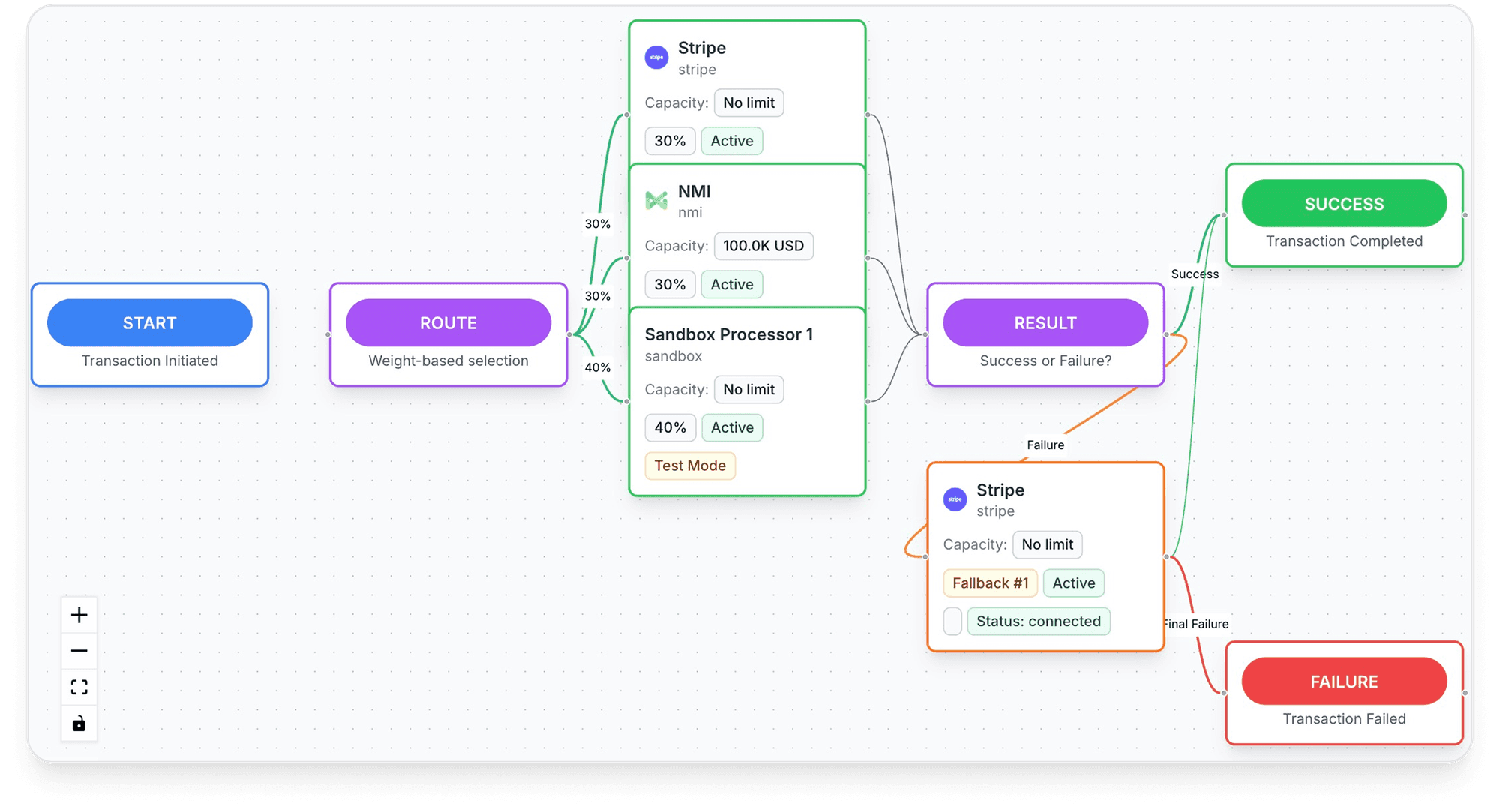
Tagada routes first charges and renewals through TagadaPay: "Every transaction is scored against your live MID network in real time."12TagadaPay, tagadapay.io, read November 2, 2026
- Rules: "Automatic cascade, weighted routing, sticky MID"; the cascade goes to another processor only when one is down or times out, never after a bank decline.
- Portability: "Switch processors without re-onboarding customers. No vendor lock-in. Ever."
- Orchestration: "Already on Stripe, NMI or Airwallex? We orchestrate those too."
- Fraud: "Native 3DS2, device intelligence, and rules engine"
TagadaPay reports a "+18% approval uplift" from routing12TagadaPay, tagadapay.io, read November 2, 2026. Tagada subscriptions are PSP-agnostic: a subscription can be assigned to a processor or left to the payment flow10Tagada docs, Node SDK: subscriptions, read November 2, 2026. Each file is underwritten, with enhanced review on regulated verticals.
Building a telehealth brand from scratch? Tagada Rx runs storefront, doctors, pharmacy and payments in one stack, and "The card is only captured once a doctor approves"11Tagada, Tagada Rx, read November 2, 2026. US patients only, by selection.
Frequently asked questions
Do telehealth companies need a backup payment processor?
Can I use two payment processors for a telehealth brand?
What happens to subscriptions if my processor closes my account?
Can a card hold be moved to another processor?
Can I move my patients' saved cards to a new processor?
Sources
Checked November 3, 2026- Stripe, Prohibited and restricted businesses, read November 2, 2026
- Recurly, Telehealth companies leaving Stripe, September 2, 2026 (vendor article)
- Square, General Terms of Service (US), §3 item 8, updated July 30, 2026
- Shopify Help Center, Shopify Payments eligibility, read November 2, 2026
- Shopify Help Center, Configuring third-party payment providers, read October 26, 2026
- Stripe Docs, Place a hold on a payment method, authorization validity windows, read November 3, 2026
- Payway, Visa excessive reattempts rule and fees (rule effective April 2022), read November 2, 2026 (secondary source)
- Sticky.io, From declines to dollars: a telehealth subscription billing success story, vendor case study, undated, read November 2, 2026
- Stripe Services Agreement, §4 Third Party Data, modified September 28, 2026
- Tagada docs, Node SDK: subscriptions, read November 2, 2026
- Tagada, Tagada Rx, read November 2, 2026
- TagadaPay, tagadapay.io, read November 2, 2026
- Visa Core Rules and Visa Product and Service Rules, edition of October 24, 2026, sections 1.7.2.1, 1.9.1.4 and 7.3.6.3, table 7-2
- Stripe Docs, Request a payment data export, read November 3, 2026
- Stripe, Payment failover: How a backup plan can increase payment reliability, updated February 2, 2026
Tagada
Keep intakes and renewals billing when one processor stops
Funnels, one-click upsells, subscription billing and payment routing, on one customer record.
- 01Create your free account
- 02Connect your store or build a checkout
- 03Launch funnels, upsells and subscriptions