
Multiple Merchant Accounts: Backup, Routing and What Is Allowed
Can you have more than one merchant account? Legitimate uses like a backup processor, what card networks prohibit, and how to run two processors cleanly.

Article summary
TL;DR
Yes, a business can have more than one merchant account. A backup processor, routing by cost or approval rate, and separate accounts for separate business lines are normal. What card networks prohibit is using several accounts to hide your real numbers: splitting volume to stay under monitoring thresholds, or changing merchant data when you retry a decline.
- Stripe lists evading card network chargeback monitoring programs among prohibited uses.
- Visa can fine an acquirer up to 25,000 USD per merchant per month for changing a merchant's name, data or performance to evade its programs, and disqualify the merchant and its principals.
- When retrying a declined authorization, the acquirer, country, MCC, POS codes and ECI must not be manipulated (section 1.7.2.1).
- Visa requires a high-risk activity to have its own MCC, separate from other activities.
- Visa's VAMP ratio is counted per merchant: 1.5% fraud plus disputes in the US since April 2026.
 ChatGPT
 Claude
 Perplexity
 Grok
On this page
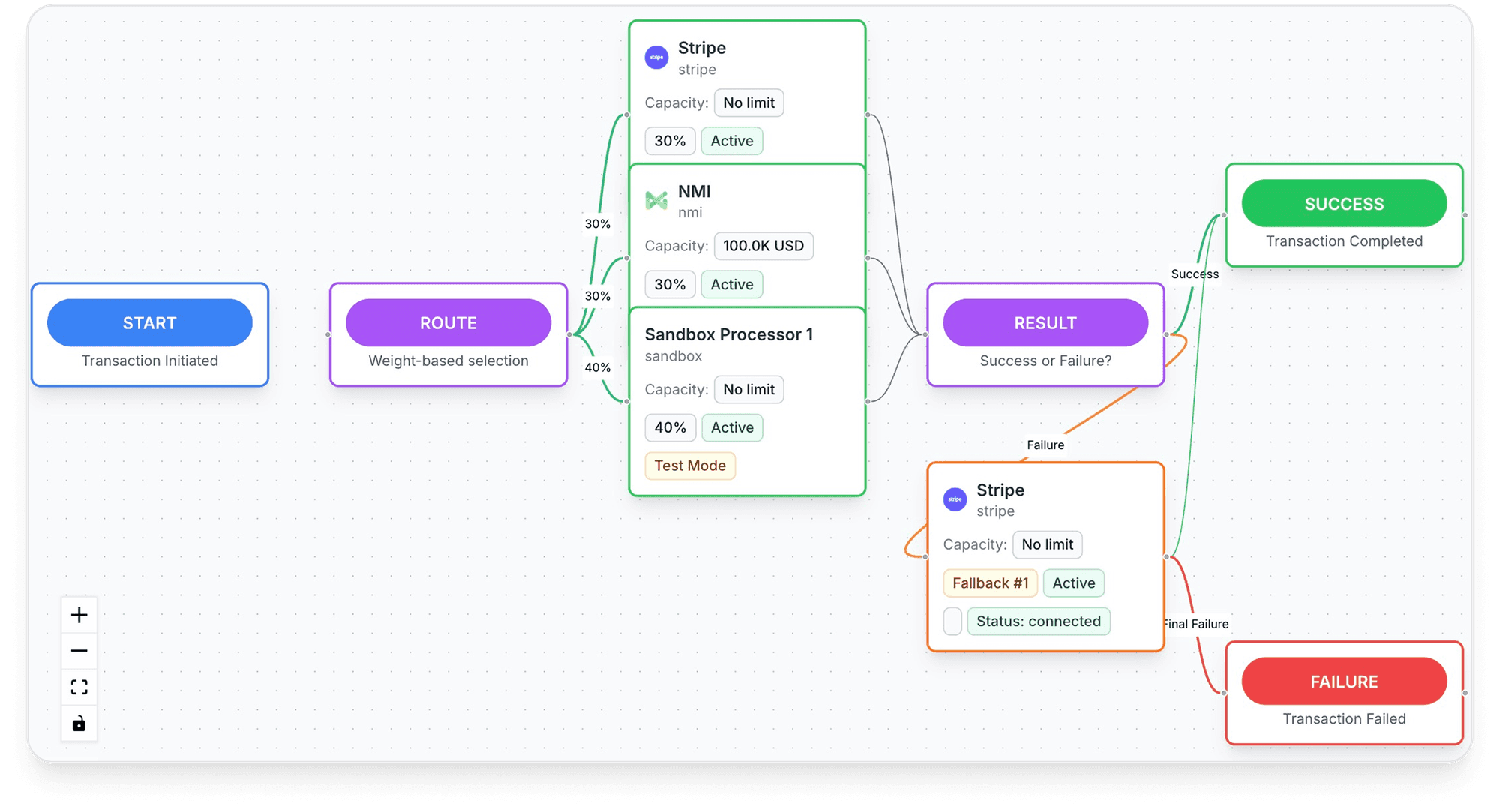
A second merchant account is insurance. It keeps you selling when one processor pauses payouts, raises a reserve or closes the account. It's also the thing card networks watch most closely, because it can be abused. This guide draws the line. How routing works technically: dynamic payment routing and cascading payments.
Why merchants keep more than one account
| Use | What it does |
|---|---|
| Backup | Keeps sales running if one processor pauses or closes the account. Stripe pauses payouts for 120 days on a risk action, typically7Stripe, Unacceptable Risk Policy, read October 27, 2026 |
| Routing by cost | Sends each payment where it's cheapest for that card |
| Routing by approval | Sends a payment to the processor most likely to approve it |
| Separate business lines | A distinct account, and MCC, for a distinct activity3Visa Merchant Data Standards Manual, April 2026 |
| Local acquiring | A local account where you have a real local outlet: see international payment processing |
Allowed vs prohibited
Fig. 1Same tool, two uses
Redundancy
Every processor knows the business, its products and its full volume. Allowed.
Optimization
Routing by cost or approval rate, retries within the rules. Allowed.
Disguise
Splitting volume, renaming, changing data so a program doesn't see you. Prohibited.
The test: would each processor see your real business and your real numbers?
Tagada follows Visa and Mastercard rules and the laws that apply to payments.
Declare every account
Underwriters ask about your other processors and your total volume. Tell each one:
- [ ] Every processor you use and what share of volume goes there.
- [ ] The same products and offers on every account.
- [ ] Your total dispute and refund rates, not only the share each one sees.
- [ ] Why you have more than one: backup, cost, coverage.
A processor that discovers an undeclared account, or a product it didn't approve, reads it as concealment.
One activity, one MCC
Visa's merchant data manual is explicit: a high-risk activity must have its own MCC, separate from other activities3Visa Merchant Data Standards Manual, April 2026. If you run two genuinely different businesses, separate accounts with the right codes are the rule, not a trick. More in high-risk MCC codes.
What isn't allowed is the reverse: putting a high-risk product under a low-risk code, or under a sister company's account.
Retries across processors
Retrying a soft decline on another processor can be legitimate. Two limits:
| Limit | What it says |
|---|---|
| Data | NoManipulation of acquirer, country, MCC, POS codes or ECI on a retry (Visa 1.7.2.1)1Visa Core Rules and Visa Product and Service Rules, edition of April 18, 2026, sections 1.7.2.1 and 12.5.3.2 |
| Count | Up to 15 reattempts in 30 days on Visa, with fees beyond, as reported5Payway, Visa excessive reattempts rule and fees, read October 26, 2026 (secondary source) |
| Hard declines | Never retried: closed account, lost or stolen card |
More on declines: authorization rate.
Setting up a second processor cleanly
- Apply with your full picture: products, volume, current processor, dispute history.
- Get the same products approved on both accounts.
- Decide the routing rule and write it down: backup only, by cost, or by approval.
- Check your platform's limits. Shopify allows only one card provider at a time6Shopify Help Center, Configuring third-party payment providers, read October 27, 2026, so routing needs a checkout that supports several.
- Test both routes with real payments and refunds.
- Monitor disputes per account and in total. Each processor sees its own ratio; you should see both. Visa's VAMP line is 1.5% in the US8Visa, Visa Acquirer Monitoring Program fact sheet, 2025.
A backup you haven't tested isn't a backup.
How Tagada helps
Several processors, one set of rules
- Routing across Stripe, Adyen and TagadaPay with one logic, and cascade on decline.
- Every TagadaPay file is underwritten, with enhanced review on regulated verticals.
- TagadaPay refuses chargeback circumvention and deceptive marketing around trials, subscriptions and cancellation.
- Native 3DS2, device intelligence and a rules engine to keep fraud down on every route.
Plans are on the pricing page.
Frequently asked questions
Can a business have two merchant accounts?
Is load balancing between merchant accounts legal?
Do I need to tell my processor about my other merchant accounts?
Can I retry a declined payment on another processor?
Do I need a separate MCC for each business?
Sources
Checked October 27, 2026- Visa Core Rules and Visa Product and Service Rules, edition of April 18, 2026, sections 1.7.2.1 and 12.5.3.2
- Stripe, Restricted and prohibited businesses, updated September 22, 2026
- Visa Merchant Data Standards Manual, April 2026
- Stripe Docs, Terminated merchant files (MATCH and VMSS), read October 27, 2026
- Payway, Visa excessive reattempts rule and fees, read October 26, 2026 (secondary source)
- Shopify Help Center, Configuring third-party payment providers, read October 27, 2026
- Stripe, Unacceptable Risk Policy, read October 27, 2026
- Visa, Visa Acquirer Monitoring Program fact sheet, 2025
TagadaPay
Two processors, one checkout, the rules respected
Tell us what you sell and how you sell it. Each application is underwritten, and approval is not guaranteed.
- 01Tell us what you sell and how
- 02Underwriting reviews your business
- 03Process through TagadaPay alongside your other processors