
High-Risk MCC Codes: The Visa and Mastercard List
Which MCC codes Visa classes as high-risk in 2026, tier by tier, what Stripe allows for each, and what registration changes for your account.

Article summary
TL;DR
Visa lists 13 high-risk MCC codes in three tiers: adult content, dating, gambling and pharmacies in Tier 1; crypto, cyberlockers and skill games with wagering in Tier 2; trading platforms, outbound telemarketing, negative-option subscriptions and tobacco in Tier 3. For card-absent sales, your acquirer must be approved for the tier and register you with Visa before you process.
- The list comes from Visa's Integrity Risk Program, in force since May 1, 2023, and is repeated in Visa's April 2026 MCC manual.
- 13 codes, three tiers, all for card-absent sales. Outside the US, pharmacies and tobacco count only on cross-border sales.
- Your acquirer must be approved by Visa for your tier, then register you before your first transaction.
- A high-risk line of business must run on its own MCC, separate from the rest of your sales.
- Processors add their own rules: Stripe prohibits gambling, adult content and negative-option marketing outright.
 ChatGPT
 Claude
 Perplexity
 Grok
On this page
"High-risk" sounds like a judgement call. For Visa it's a list: 13 merchant category codes, sorted into three tiers, that an acquirer must register before it processes a single online payment. Here is the 2026 list, what each processor does with it, and what it changes for your account.
Visa tier check
Is your MCC on Visa's high-risk list?
Visa High Integrity Risk
5968Tier 3 Subscription "negative option" merchantsYour acquirer must be registered for Tier 3 and must register you with Visa before you process.
Applies to card-absent sales.
Sources: Visa Integrity Risk Program guide (2023), Visa Merchant Data Standards Manual (April 2026).
Which MCC codes are high-risk?
Visa calls them High Integrity Risk merchants: businesses that are legal, but that could process illegal transactions without the right controls.1Visa, Visa Integrity Risk Program guide for acquirers, April 6, 2023 Every business type below is card-absent, meaning sold online or by phone.
Tier 1: risk of harm to health, safety or wellbeing
| MCC | Business type | Condition |
|---|---|---|
| 5967 | Adult content and services | All card-absent sales |
| 7273 | Dating and escort services | All card-absent sales |
| 7995 | Gambling | All card-absent sales |
| 5122, 5912 | Pharmacies | 5912: outside the US, only sales that aren't domestic |
Pharmacies accredited by the National Association of Boards of Pharmacy (NABP), or another body Visa recognizes, don't need to be registered under 5122 or 5912.7Visa Core Rules and Visa Product and Service Rules, April 18, 2026 For a telehealth brand, see telehealth payment processing.
Tier 2: risk of financial harm
| MCC | Business type | Condition |
|---|---|---|
| 6051, 6012 | Crypto exchanges, wallets and on-ramps | Transactions must carry Special Condition Code 7 |
| 4816 | Cyberlockers and remote file sharing | Only for selling access to those services |
| 5816 | Games of skill with wagering | For example daily fantasy sports |
Tier 3: risk of regulatory breach or deceptive marketing
| MCC | Business type | Condition |
|---|---|---|
| 6211 | High-risk financial trading platforms | Card-absent |
| 5966 | Outbound telemarketing | All card-absent sales |
| 5968 | Subscription "negative option" merchants | Card-absent |
| 5993 | Tobacco | Outside the US, only sales that aren't domestic |
Verdict
If your code is in these tables and the conditions apply, your acquirer has to register you with Visa first. If it isn't, Visa doesn't require registration, but your processor may still apply its own rules.
The program has been in force since May 1, 2023, when it replaced Visa's Global Brand Protection Program.6LegitScript, What you need to know about the Visa Integrity Risk Program Visa's April 2026 MCC manual repeats the same codes, with the conditions above.2Visa, Merchant Data Standards Manual, April 2026
Three rules most lists leave out
The codes are the easy part. Visa's manual adds three rules that decide whether they apply to you.2Visa, Merchant Data Standards Manual, April 2026
A high-risk line gets its own code
If one line of your business is high-risk and the others aren't, the high-risk line must run on its own MCC. It can't hide under your main code.
Domestic sales can be exempt
Outside the US, pharmacies (5912) and tobacco (5993) count as high-risk only on sales that aren't domestic. A pharmacy selling only in its own country isn't in scope.
Online gambling is always 7995
A merchant taking online gambling payments must use 7995 for all of them, even if gambling isn't its main business.
Who decides: Visa, Mastercard or your processor
Three layers decide whether your code counts as high-risk, and only the first one is public.
Fig. 1Three layers, three lists
 Visa13 codes in three tiers, registration required
 MastercardIts own registration program for overlapping categories
 Your processorIts own prohibited and restricted lists
the strictest one wins
- Visa publishes the tiers above and sets what acquirers must check for each one.
- Mastercard runs its own registration program for high-risk categories. The categories overlap with Visa's, but the list and the fees are set separately and change over time: ask your acquirer for the current version.
- Your processor decides what it accepts at all, and that list is often stricter than Visa's.
Your MCC isn't your choice
Your provider assigns your code from what you sell. A subscription brand can end up on 5968 even if it never asked for it. See how to find your MCC code on Stripe, Adyen, Shopify and PayPal, and when 5968 is the wrong code.
Visa's list against Stripe's rules
A Visa registration doesn't mean every processor will take you. Here is what Stripe's own list says about each Visa category.4Stripe, Prohibited and restricted businesses
| Visa category | Visa tier | At Stripe |
|---|---|---|
| Gambling | Tier 1 | Prohibited |
| Adult content and services | Tier 1 | Prohibited |
| Dating | Tier 1 | RestrictedNeeds review (prohibited in some countries) |
| Online pharmacies | Tier 1 | RestrictedNeeds review |
| Crypto exchanges and wallets | Tier 2 | RestrictedNeeds review; mining and deposits prohibited |
| Cyberlockers, file sharing | Tier 2 | RestrictedNeeds review |
| Subscriptions that bill until cancelled | Tier 3 | ProhibitedAs are discounted trials with hidden or unclear pricing |
| Tobacco, e-cigarettes | Tier 3 | RestrictedNeeds review; in the US, only FDA-authorized vape products |
Verdict
On Stripe, a Tier 1 business is usually a no. Tier 2 and 3 businesses go through a review, except negative-option subscriptions, which are prohibited.
Inside Tagada
See every payment's route, processor by processor
Set the order your processors are tried in, per store, per country or per product.
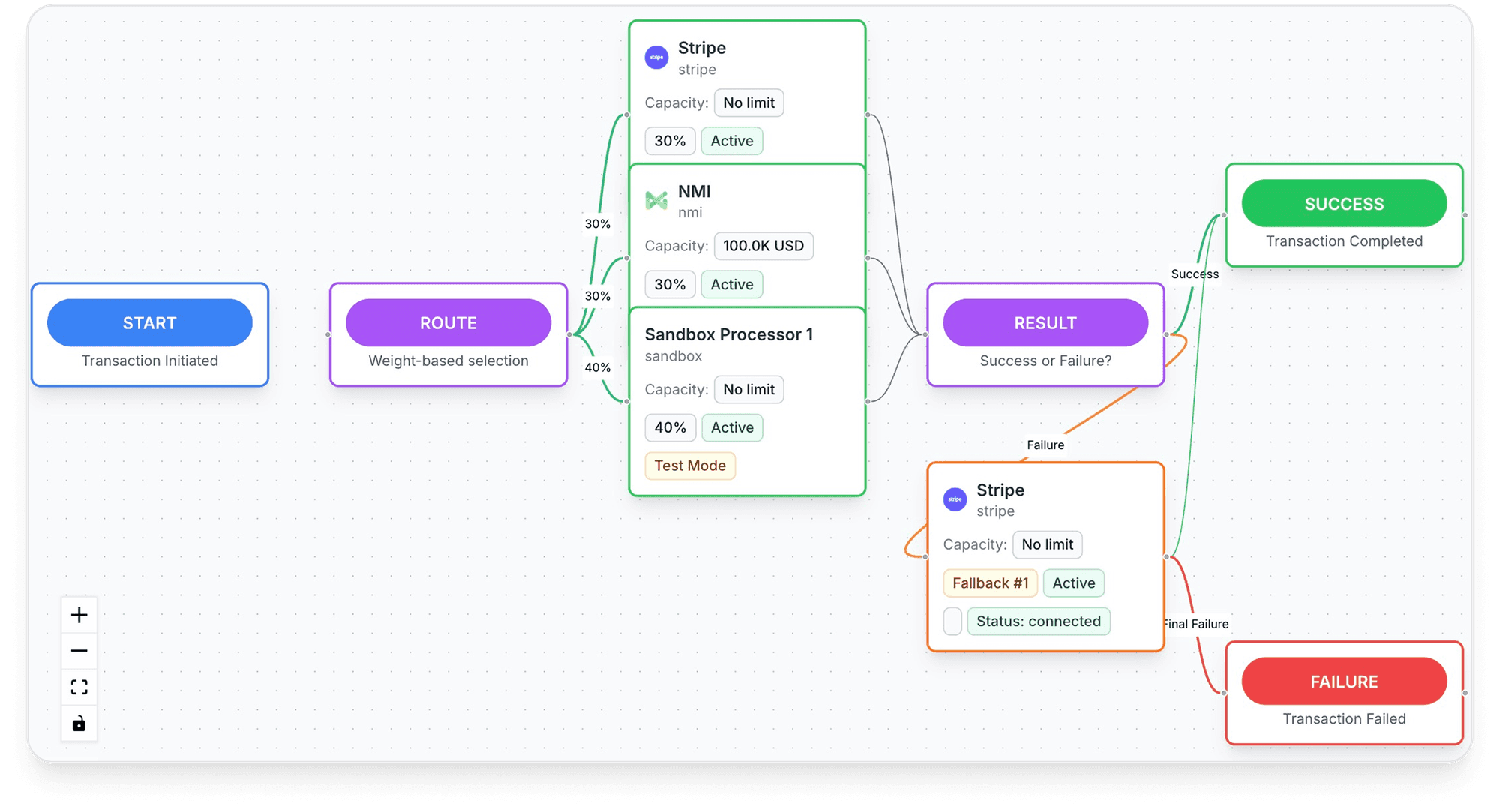
What each tier changes for your account
The tier sets how much checking your acquirer has to do, on itself and on you.1Visa, Visa Integrity Risk Program guide for acquirers, April 6, 2023
- Tier 1. The acquirer needs a separate Visa approval for each Tier 1 category, an initial control assessment and a yearly self-assessment. It runs enhanced due diligence on you, attests to Visa that you passed, and registers you before you process.
- Tier 2. One approval covers all Tier 2 categories, with an initial control assessment and a yearly self-assessment. Same enhanced due diligence and registration for you.
- Tier 3. The acquirer registers for Tier 3 and completes a self-assessment when Visa asks. You still have to be registered before your first transaction.
Source: Visa Integrity Risk Program guide. An acquirer approved for Tier 1 can also take Tier 2 and 3 merchants; one approved for Tier 3 can't take a Tier 1 or 2 merchant.
That cascade is why fewer acquirers serve Tier 1 businesses: each Tier 1 category needs its own approval from Visa.
Codes processors treat as high-risk anyway
Outside Visa's 13 codes, processors build their own lists. They look at dispute rates, refund patterns and how a product is sold, not only at the code.
- Subscriptions and free trialsCustomers forget to cancel, and disputes followClear terms at checkout, a reminder before renewal, easy cancellation
- Health and wellness productsProduct claims draw regulators and refund requestsProduct pages without medical claims, a visible refund policy
- Travel and event ticketsPayment long before delivery, so disputes arrive lateProof of delivery, a cancellation policy
- Digital goodsEasy to resell stolen cards onFraud screening, 3-D Secure, delivery logs
None of these is on Visa's list by default. Supplements, for example, usually sit on 5499, which Visa defines as specialty food stores including vitamin stores, and which isn't high-risk for Visa.2Visa, Merchant Data Standards Manual, April 2026 Each one can still get you a no, a reserve or a closure from a processor that doesn't want the risk.
Reserves and account reviews
When a processor sees more risk, it doesn't always say no. It can hold part of your money instead.
Sometimes, Stripe might create a reserve balance on your behalf to ensure that your Stripe account can cover any expected incoming refunds or disputes. The reserve balance holds funds that you can't pay out or transfer until the reserve hold period is complete.
The size and length of a reserve depend on the processor and on your account. Ask before you sign: what triggers a reserve, how much, for how long, and how it's released. A chargeback also takes the disputed amount from your balance the day it's filed, so high-risk accounts need cash set aside for both.
Dispute thresholds you must stay under
A registered code doesn't change Visa's dispute limits, but high-risk businesses hit them faster. Visa's Acquirer Monitoring Program (VAMP) counts fraud reports and disputes against settled card-absent transactions.3Visa, Visa Acquirer Monitoring Program fact sheet, 2025
1.5%
VAMP 'Excessive' merchant ratio in the US, Canada, EU and Asia-Pacific since April 1, 2026, down from 2.2%
1,500
Fraud reports plus disputes per month before a merchant can be flagged in those regions
0
Disputes resolved through a pre-dispute service that count in the ratio
Fraud reports covered by Visa's Compelling Evidence 3.0 rules are left out of the ratio too. More on keeping it down in our guide to chargeback prevention.
How to get processed with a high-risk MCC
- Confirm your code. Ask your provider which MCC you have and why. If it's wrong, ask for the right one before you apply anywhere.
- Check the processor's own list. A Visa registration is useless if the processor prohibits your business. Read its prohibited and restricted list first.
- Find an acquirer approved for your tier. Ask directly: "Are you approved by Visa for Tier 1, 2 or 3?" A no means they can't take you on.
- Prepare your file. Website with clear terms, refund and cancellation policy, product list, who you sell to and where, past processing statements and dispute history.
- Plan for a second processor. A registered account can still be reviewed, put on reserve or closed. Keep a backup account ready so orders don't stop.
Visa requires acquirers to check your controls before they register you. The better your file, the faster that check goes.
Practical rule
Apply where your tier is already served. A processor that has never registered a Tier 1 merchant is unlikely to start with you.
How Tagada helps
Payments that follow the card network rules
Tagada follows Visa and Mastercard rules and the laws that apply to payments. TagadaPay runs native 3DS2, device intelligence and a rules engine, and payments route across Stripe, Adyen and TagadaPay with one logic. See pricing for plans.
Frequently asked questions
Which MCC codes are high-risk?
Is MCC 5968 high-risk?
Is MCC 5967 high-risk?
Is MCC 5499 high-risk?
What is the difference between VIRP and GBPP?
Can Stripe process a high-risk MCC?
Sources
Checked October 14, 2026- Visa, Visa Integrity Risk Program guide for acquirers, April 6, 2023
- Visa, Merchant Data Standards Manual, April 2026
- Visa, Visa Acquirer Monitoring Program fact sheet, 2025
- Stripe, Prohibited and restricted businesses
- Stripe Docs, Balances and settlement time (reserve balance)
- LegitScript, What you need to know about the Visa Integrity Risk Program
- Visa Core Rules and Visa Product and Service Rules, April 18, 2026
TagadaPay
Registered MCC? Don't run it through a single processor
Tell us what you sell and how you sell it. Each application is underwritten, and approval is not guaranteed.
- 01Tell us what you sell and how
- 02Underwriting reviews your business
- 03Process through TagadaPay alongside your other processors