
Payment Acceptance Rate: How to Measure It and Raise It
What payment acceptance rate measures, how to calculate it without fooling yourself, why issuers decline cards, and the fixes card network rules allow.



Article summary
TL;DR
Payment acceptance rate is the share of payment attempts that end up authorized. The basic formula divides authorized payments by attempts, but the result depends on what you count: blocked payments, failed 3D Secure and retries. Track a payment success rate and an issuer authorization rate, both deduplicated, and you'll see where payments fail.
- Acceptance rate covers every step of the payment. Authorization rate covers only the payments that reached the card issuer.
- Retries change the number: one payment that fails twice and then passes is 33% raw and 100% deduplicated.
- Visa never allows a retry on the same card after a Category 1 decline (lost, stolen, closed account). Other declines allow up to 20 attempts in 30 days.
- Expired and replaced cards are a fixable cause of declines: card account updater and network tokens keep saved cards current.
- In Europe, low-value, low-risk and merchant-initiated payments can skip the 3D Secure challenge, but the issuer has the final say.
 ChatGPT
 Claude
 Perplexity
 Grok
On this page
Payment acceptance rate tells you how much of the demand you already paid for turns into money. It sounds like one number. In practice it's at least four, depending on whether you count blocked payments, failed 3D Secure and retries, and two providers can report very different rates on the same traffic. Here's how to calculate it properly, why issuers decline, and what you can actually do about it.
What is payment acceptance rate?
Payment acceptance rate is the share of payment attempts that end up authorized. The name covers several metrics that look alike but don't count the same things.1Stripe Docs, Acceptance analytics
| Term | What it counts | Where you'll see it |
|---|---|---|
| Payment acceptance rate | Authorized payments ÷ all payment attempts, from checkout submission to the issuer's answer | Processor dashboards, vendor guides |
| Payment success rate | Same idea at Stripe: payments authorized ÷ unique payment attempts, including blocked payments and failed 3D Secure | Stripe Acceptance page |
| Authorization rate (or approval rate) | Payments the issuer authorized ÷ payments sent to the card network | Stripe, Adyen, card network reports |
| Checkout conversion rate | Paid orders ÷ visitors who reached checkout | Your analytics, not your processor |
Two practical points. First, an authorization is not a capture: Stripe counts a payment as authorized whether or not you later capture it.1Stripe Docs, Acceptance analytics Second, checkout conversion is a different metric. A shopper who leaves before clicking "Pay" never becomes a payment attempt, so it belongs in checkout abandonment, not here.
How to calculate payment acceptance rate
The basic formula fits on one line:
Acceptance rate = authorized payments ÷ payment attempts × 100
The trouble is the denominator. Each choice below changes the result.
| Variant | Numerator | Denominator | What it shows |
|---|---|---|---|
| Payment success rate | Authorized | All valid attempts: blocked, failed 3D Secure, declined, authorized | The whole funnel after "Pay" |
| Authorization rate | Authorized | Attempts sent to the card network only | The issuer's decision alone |
| Raw rate | Authorized attempts | Every attempt, retries included | Retry volume and its cost |
| Deduplicated (net) rate | Purchases finally authorized | Unique purchases, retries grouped | How many orders you actually collected |
Stripe's documentation gives a worked example of the first two, and of the effect of retries:1Stripe Docs, Acceptance analytics
93%
Payment success rate in Stripe's example: 93,000 authorized out of 100,000 valid attempts
94.9%
Authorization rate on the same data: 93,000 out of 98,000 attempts that reached the network
33% vs 100%
One purchase that fails twice, then passes: raw rate against deduplicated rate
The 2,000 attempts between the two first numbers were 1,000 failed authentications and 1,000 blocked payments. They never reached the bank. Adyen calls the two retry views "gross" and "net", and makes the point that a provider reporting net figures can show a much higher rate than one reporting gross figures on identical traffic.12Adyen, Why your payment acceptance rate isn't the full story, July 2026
- Export every attempt for the period. Include declined and blocked attempts, not only successful charges.
- Remove what isn't a payment. Test payments and invalid API calls (a request your integration got wrong) never reached anyone.2Stripe Docs, Declines
- Group retries. Same card fingerprint or customer, same amount, attempts close together: that's one purchase. Stripe suggests card fingerprints rather than charge IDs to exclude repeat attempts.3Stripe Docs, Card declines
- Tag where each one failed. Blocked by your fraud rules, failed or abandoned 3D Secure, declined by the issuer, or authorized.
- Compute two rates. Payment success rate (all valid attempts) and authorization rate (attempts sent to the network), both deduplicated.
- Split by segment. Card country, card type, first payment against renewal, processor. That's where the fixes show up.
Stripe groups retries on the same invoice, the same customer, or the same card for the same amount close in time. Use the same logic on any export.
Recent months look worse on a deduplicated rate
If renewals are still being retried, the last few weeks show a temporary dip until all retries have run. Stripe flags this in its own reports.1Stripe Docs, Acceptance analytics Compare complete periods only.
What is a good payment acceptance rate?
No card network publishes a public benchmark, and the figures quoted by vendors rely on different definitions, which makes them hard to compare with your own. What processors do document is which segments usually perform better. Stripe states these patterns in its acceptance analytics:1Stripe Docs, Acceptance analytics
Domestic beats cross-border
On average, success rates are higher when the card is issued in the same region as your business than on cross-border payments.
Credit beats debit beats prepaid
Debit and prepaid cards are more likely to be declined for insufficient funds.
Wallets beat typed cards
Apple Pay and Google Pay usually succeed more often, because they're tokenized and authenticated on the device.
Customer-initiated and merchant-initiated differ
Issuers give one-time payments and recurring charges different risk profiles, so renewals need their own line in your report.
The useful benchmark is yourself, segment by segment. If cross-border debit renewals drop while domestic credit stays flat, you know where to look. A single blended rate hides that.
Where payments fail between "Pay" and the bank
A payment can fail at four points. Only the last one is the issuer's decision.1Stripe Docs, Acceptance analytics
Fig. 1The path of a card payment
approved declined or closed routing step
- CheckoutCard details checked for format: invalid calls stop here
- thenFraud rulesYour rules or your processor's model can block the payment
- when requested3D SecureThe customer can fail or abandon the challenge
- sent for authorizationCard networkRoutes the request to the issuer
- decidesIssuerApproves, or declines with a codeDeclined
Three gates before the bank
When a processor blocks a payment, it doesn't ask the issuer for an authorization at all.2Stripe Docs, Declines Those blocks protect you from fraud and disputes, but each legitimate customer blocked by a rule that's too strict is a lost sale. Stripe lets you add a payment you recognize as legitimate to an allow list, which stops your rules from blocking future payments matching it.2Stripe Docs, Declines How to set the balance between fraud and false declines is covered in our guide to ecommerce fraud prevention.
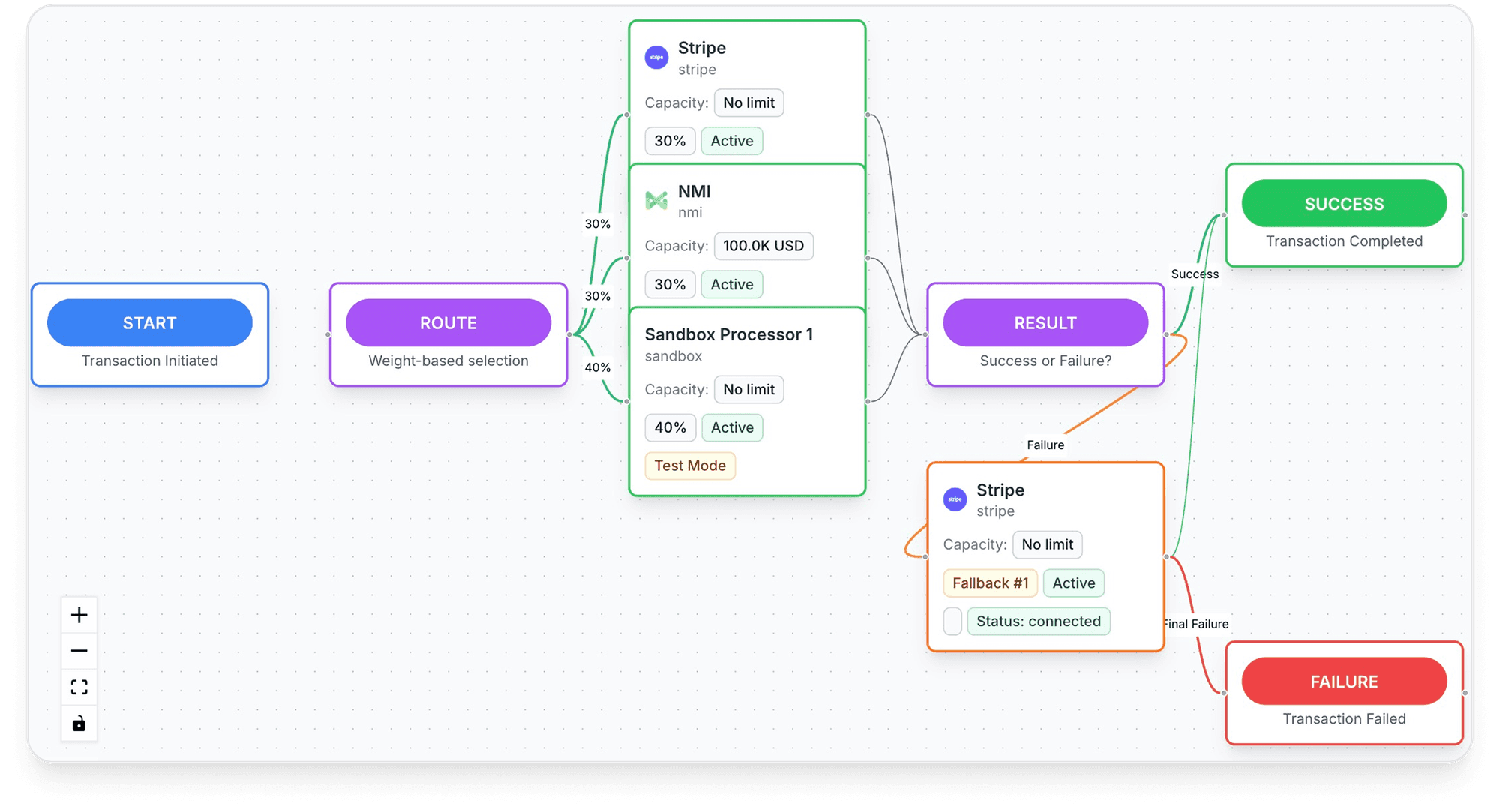
Inside Tagada
See every payment's route, processor by processor
Set the order your processors are tried in, per store, per country or per product.
Why payments get declined: soft vs hard declines
An issuer that declines a payment sends a decline code. Card issuers categorize most declines as generic, so the exact reason is often unclear, and for privacy they discuss specifics only with their cardholder.3Stripe Docs, Card declines The most common generic code is do_not_honor.1Stripe Docs, Acceptance analytics
What matters is whether the decline can succeed later. Visa's rules sort every decline code into four categories, each with its own retry limit:6Visa Core Rules and Visa Product and Service Rules, April 18, 2026
| Visa category | Example codes | Retry allowed |
|---|---|---|
| 1. Issuer will never approve | 04 pick up card, 07 fraud account, 14 invalid account number, 41 lost card, 43 stolen card, 46 closed account, 57 not permitted to cardholder, R0/R1/R3 stop payment orders | NoNever again on the same card |
| 2. Issuer cannot approve at this time | 51 insufficient funds, 59 suspected fraud, 61 amount limit exceeded, 65 frequency limit, 91 issuer unavailable, 96 system malfunction | YesUp to 20 attempts in 30 days |
| 3. Data quality, revalidate the payment information | 54 expired card, N7 CVV2 failure, 82 negative CVV result; in Europe, 1A additional authentication required | YesUp to 20 attempts in 30 days, after fixing the data |
| 4. Generic | All other codes | YesUp to 20 attempts in 30 days |
Category 1 is what most people call a hard decline. The others are soft declines: the same card may go through later, or after the customer fixes the details. Mastercard sends a Merchant Advice Code (MAC) with some declines, which says whether updated card data is available, whether to retry later, or not to retry at all.3Stripe Docs, Card declines5Stripe Docs, Network decline codes
- Insufficient fundsThe money isn't there today, more often on debit and prepaid cardsRetry later; offer another method. Stripe suggests a buy now, pay later option
- Do not honor, generic declineThe issuer won't say: fraud suspicion, spending pattern, card restrictionCheck CVC and postal code results, then ask the customer to call their bank or use another card
- Expired card, incorrect number or CVCData entered wrong, or a saved card replaced by the bankAsk the customer to re-enter; use card account updater for saved cards
- Authentication requiredThe issuer wants 3D Secure, common in EuropeRun 3D Secure on session; off session, bring the customer back to authenticate
- Lost, stolen, pick up cardThe card is blocked, possibly not in the hands of its ownerNever retry. Show a generic decline message, not the reason
- Transaction not allowed, card not supportedThe card can't be used for this type of purchase or countryOffer another payment method; retries won't help until the customer contacts the issuer
Stripe's advice on lost, stolen and fraud-related codes is explicit: don't tell the customer the specific reason, show them the same message as a generic decline.4Stripe Docs, Decline codes The person at the checkout may not be the cardholder.
Address and CVC checks
Issuers look at the expiration date, address information and CVC when deciding.2Stripe Docs, Declines Stripe recommends collecting the CVC and postal code at checkout to avoid declines for suspected fraud. Address verification is mainly supported by issuers in the US, Canada and the UK.3Stripe Docs, Card declines1Stripe Docs, Acceptance analytics
How to retry declined payments without making it worse
Retries recover soft declines. Done badly, they cost fees, trigger network penalties and look like fraud to the issuer. Stripe recommends at most eight retries for a charge that permits them, and warns that issuers can read extra retries as potential fraud, which increases declines on legitimate charges.3Stripe Docs, Card declines
An Acquirer, a Merchant, a Payment Facilitator, or a VisaNet Processor that reattempts an Authorization Request following a Decline Response […] must not intentionally manipulate any data elements from the original Authorization Request.
The list that follows in Visa's rules includes the acquiring identifier, the acquirer and merchant country, the MCC and the e-commerce indicator.6Visa Core Rules and Visa Product and Service Rules, April 18, 2026 In plain terms, changing your merchant category code or merchant country to push a declined payment through is against the rules.
What works instead:
- Read the code before retrying. Stripe's Smart Retries won't retry hard declines such as
lost_card,stolen_card,pickup_card,incorrect_number,transaction_not_allowedorauthentication_required: they wait for a new payment method.9Stripe Docs, Automate payment retries - Space retries out. Stripe's default Smart Retries policy is 8 tries within 2 weeks, timed by a model. For example, some debit card payments do slightly better just after midnight local time in certain countries.9Stripe Docs, Automate payment retries
- Fix the data first on Category 3. An expired card or a failed CVC won't pass on the next attempt unless something changes.
- Ask the customer when the code says so. Off session, a payment that needs authentication or a new card requires an email or in-app message to bring the customer back.3Stripe Docs, Card declines
For subscriptions, the full recovery flow (retries, emails, grace period) is covered in subscription payment failures and what dunning is.
How to improve your payment acceptance rate
Each fix below addresses a specific cause from the previous sections. None of them forces an issuer to approve. They remove reasons to decline.
Keep saved cards current: card account updater and network tokens
Cards expire and get replaced after loss or theft. Saved card details then fail. Stripe uses the card account updater services of the major networks to refresh saved cards automatically. Coverage is wide in the US for American Express, Visa, Mastercard and Discover, varies by country elsewhere, and you can't tell in advance which cards are covered.8Stripe Docs, How cards work (automatic card updates)
Network tokens go further: the card network keeps the link between the token and the current card number, so the same token keeps working after the card is replaced.7Stripe Docs, Payments optimization (Authorization Boost) Visa describes the same benefit: tokens spare customers from updating their card details "when the card expires or needs to be replaced".15Visa, Visa tokens bring USD2 billion uplift to digital commerce in Asia Pacific, March 26, 2024 Visa's rules also forbid issuers from declining a token transaction solely because the CVV2 is missing.6Visa Core Rules and Visa Product and Service Rules, April 18, 2026 On cost, Stripe notes that Mastercard charges a Credential Continuity Program fee for payments attempted with outdated card details, which network tokens help avoid, and that some network token payments qualify for lower interchange in some markets.7Stripe Docs, Payments optimization (Authorization Boost)
Send the data issuers check
Collect the CVC and postal code. Send the full billing address where your processor recommends it: its impact varies by card brand and country.3Stripe Docs, Card declines Visa requires acquirers to send complete, accurate and valid data in every authorization request.6Visa Core Rules and Visa Product and Service Rules, April 18, 2026
Use a statement descriptor your customers recognize. Stripe limits it to 5 to 22 characters, and Visa requires the name on the statement to make sense next to your category.14Stripe Docs, Best practices for preventing fraud13Visa, Merchant Data Standards Manual, April 2026 A descriptor doesn't change the authorization decision by itself, but a charge customers recognize is a charge they don't report as fraud.
Use 3D Secure where it helps, and exemptions where it doesn't
Stripe says 3D Secure can lower decline rates in countries that support it,3Stripe Docs, Card declines and in Europe banks can decline payments that need authentication but don't have it.16Stripe Docs, Strong Customer Authentication readiness The cost is friction: customers who abandon the challenge count as failed payments in your success rate.1Stripe Docs, Acceptance analytics European rules let payment providers skip strong customer authentication in defined cases:10Commission Delegated Regulation (EU) 2018/389, RTS on strong customer authentication11Stripe Docs, Strong Customer Authentication exemptions
| Exemption | Condition | Liability shift |
|---|---|---|
| Low value (Art. 16) | Up to €30, until €100 cumulative or 5 payments since the last authentication | None |
| Transaction risk analysis (Art. 18) | Provider's card fraud rate at or below 0.13% for up to €100, 0.06% up to €250, 0.01% up to €500, and no risk signal in real time | None |
| Recurring, same amount (Art. 14) | Authentication on the first payment of the series, then exempt | None on later payments |
| Merchant-initiated transactions | Saved card authenticated when saved, with a customer agreement; outside SCA scope | None |
Two caveats from Stripe: an exemption is a request, and the issuer can still ask for authentication; and when the issuer accepts an exemption, liability for fraud stays with you.11Stripe Docs, Strong Customer Authentication exemptions How to decide when to authenticate is covered in our guide to payment authentication.
Process locally where your customers are
Cards issued in another country than your account's are declined more often. Stripe's own suggestion for businesses with customers concentrated in several regions is to set up accounts in the larger markets so charges are processed locally.3Stripe Docs, Card declines That's what local acquiring means: the issuer sees a domestic payment instead of a cross-border one.
Route payments, and keep a second path
Rates vary by processor, card type and country. Sending each payment to the processor that performs best for it, and failing over when one has an outage, is the job of payment routing. We cover it in depth in dynamic payment routing and payment orchestration. Keep the Visa rule above in mind: a technical failure (timeout, processor down) and an issuer decline are two different events, and a decline is reattempted only within the network's limits.
Offer the payment methods customers expect
A customer whose debit card is short of funds may still pay with buy now, pay later.3Stripe Docs, Card declines Wallets like Apple Pay and Google Pay usually succeed more often than typed card numbers.1Stripe Docs, Acceptance analytics In some countries, a local payment method is what customers use first.
Where Tagada fits
How Tagada helps
Acceptance across several processors, from one place
Tagada routes payments across Stripe, Adyen and its own processor, TagadaPay, with one set of rules and a cascade on decline. Its card vault moves customers between merchant accounts without collecting their cards again, so running subscriptions keep charging. Subscriptions come with automatic retries, and TagadaPay includes native 3DS2, device intelligence and a rules engine. Pricing is on the pricing page. Tagada follows Visa and Mastercard rules and the laws that apply to payments.
Whatever you use, the method is the same: one written definition of your rate, a report split by where payments fail, and fixes chosen from the decline codes rather than from a blended number.
Frequently asked questions
What is a good payment acceptance rate?
What's the difference between acceptance rate and authorization rate?
What is the difference between a soft decline and a hard decline?
Why do payments get declined with do not honor?
How many times can you retry a declined card payment?
Does 3D Secure increase or lower acceptance rate?
Sources
Checked October 14, 2026- Stripe Docs, Acceptance analytics
- Stripe Docs, Declines
- Stripe Docs, Card declines
- Stripe Docs, Decline codes
- Stripe Docs, Network decline codes
- Visa Core Rules and Visa Product and Service Rules, April 18, 2026
- Stripe Docs, Payments optimization (Authorization Boost)
- Stripe Docs, How cards work (automatic card updates)
- Stripe Docs, Automate payment retries
- Commission Delegated Regulation (EU) 2018/389, RTS on strong customer authentication
- Stripe Docs, Strong Customer Authentication exemptions
- Adyen, Why your payment acceptance rate isn't the full story, July 2026
- Visa, Merchant Data Standards Manual, April 2026
- Stripe Docs, Best practices for preventing fraud
- Visa, Visa tokens bring USD2 billion uplift to digital commerce in Asia Pacific, March 26, 2024
- Stripe Docs, Strong Customer Authentication readiness
TagadaPay
Selling across several processors? Run them from one checkout
Tell us what you sell and how you sell it. Each application is underwritten, and approval is not guaranteed.
- 01Tell us what you sell and how
- 02Underwriting reviews your business
- 03Process through TagadaPay alongside your other processors