
What Is Payment Authentication? A Merchant's Guide to 3DS and SCA
Payment authentication for merchants: 3-D Secure flows, SCA rules and exemptions with EU thresholds, liability shift limits, subscriptions and wallets.

Article summary
TL;DR
Payment authentication is the check that the person paying is the real cardholder, done by the card issuer before it decides to approve the payment. Online, it runs through 3-D Secure: often invisibly, sometimes with a code, an app or biometrics. In the EEA and UK, Strong Customer Authentication makes it mandatory unless an exemption applies.
- Authentication proves who is paying. Authorization checks the card and the funds. The issuer does both, in that order.
- With 3-D Secure 2, the issuer decides between a frictionless approval and a challenge. You can state a preference, not force it.
- In the EEA and UK, SCA needs two independent factors on customer-initiated online payments. Exemptions exist, but the issuer has the final say.
- Exempted and merchant-initiated payments skip the challenge and the liability shift. Fraud disputes on them stay with you.
- Subscriptions: authenticate the first payment or the card setup with a mandate, then charge renewals as merchant-initiated transactions.
 ChatGPT
 Claude
 Perplexity
 Grok
GrokOn this page
Payment authentication is the moment the card issuer asks "is this really the cardholder?" before it decides whether to approve. For a merchant, it decides three things at once: whether the order goes through, who pays if it turns out to be fraud, and how many customers drop out at checkout. Here is how it works, what the rules require in Europe, and how to keep it from costing you sales. For supplement and skincare brands: fraud and 3D Secure for supplement brands and fraud and 3D Secure for skincare brands.
What is payment authentication?
Payment authentication verifies that the person making a payment is the legitimate cardholder. Online, the card issuer runs it through 3-D Secure, which customers know as Visa Secure, Mastercard Identity Check or American Express SafeKey.9Stripe Docs, 3D Secure authentication The checks rely on three kinds of factors.
| Factor | What it is | Examples at checkout |
|---|---|---|
| Knowledge | Something the customer knows | Password, PIN, answer to a question |
| Possession | Something the customer has | The phone that receives a one-time code, the banking app on a registered device |
| Inherence | Something the customer is | Fingerprint, face recognition |
Strong Customer Authentication in Europe requires at least two of these, from different categories, and they must be independent: breaching one must not compromise the other.1Commission Delegated Regulation (EU) 2018/389, RTS on strong customer authentication When both factors run on the same phone, the issuer must isolate them in separate secure environments.1Commission Delegated Regulation (EU) 2018/389, RTS on strong customer authentication A password alone doesn't meet the standard.
Who does what matters. You, the merchant, collect the payment and pass data to the issuer through your processor. The issuer authenticates. You can ask for authentication or ask for an exemption, but you never decide the outcome.
Payment authentication vs authorization
People mix them up because they happen within seconds of each other. They answer different questions.
- Authentication: is this the cardholder? The issuer checks identity, through 3-D Secure data or a challenge.
- Authorization: can this payment go through? The issuer checks the card's status, the available funds and its own risk rules, then approves or declines.
Fig. 1Where authentication sits in an online card payment
approved declined or closed routing step
- CheckoutCard, device and order data
- authentication3-D SecureIssuer checks the cardholder
- result attachedAuthorizationCard status, funds, riskApproved
- approvedCaptureFunds settle to youApproved
identity first, money second
Two consequences for merchants. A payment can be authenticated and still declined at authorization, for instance for insufficient funds. And in Europe, the authentication is tied to the amount and the payee: the customer must see both, the authentication code must match them, and any change to the amount or the payee invalidates it.1Commission Delegated Regulation (EU) 2018/389, RTS on strong customer authentication If you authenticate a hold for one amount, the code covers that amount. A larger charge needs a new authentication.
How 3-D Secure 2 works
EMV 3-D Secure, the current version of the protocol, is maintained by EMVCo. Its stated purpose is to help issuers and merchants prevent card-not-present fraud. It works in browsers and inside mobile apps, and it sends the issuer data about the transaction, the payment method and the device.4EMVCo, EMV 3-D Secure The issuer uses that data to decide between two paths.
Fig. 2Frictionless or challenge: the issuer picks
Frictionless flow
- Data sentTransaction, card, device
- Issuer risk checkLooks like the cardholderApproved
- AuthenticatedGoes on to authorizationApproved
The customer clicks Buy and sees nothing more
Challenge flow
- Data sentTransaction, card, device
- Issuer risk checkNeeds more proofDeclined
- Customer actsCode, app approval, biometrics
One more step, and a chance to lose the customer
For many transactions, EMVCo says, the consumer simply clicks Buy and the payment is approved. On riskier ones, the issuer may require a challenge: a one-time passcode, a knowledge question or biometrics.4EMVCo, EMV 3-D Secure In app integrations, the challenge screens come in four types: one-time passcode, out-of-band approval in the banking app, and single- or multi-select questions.5Stripe Docs, Authenticate with 3D Secure
What you control and what you don't:
- You can request 3-D Secure on any payment, with a preference for a frictionless or a challenge flow. The issuer still decides the final flow.5Stripe Docs, Authenticate with 3D Secure
- You can't style the challenge. On the web, the issuer controls the fonts and colors of the authentication window. You choose where it appears: a modal, inline or a redirect.5Stripe Docs, Authenticate with 3D Secure
- You can't rush it. In Stripe's mobile SDKs, the authentication timeout must be at least 5 minutes to stay compliant with SCA.5Stripe Docs, Authenticate with 3D Secure
- Better data means fewer challenges. Stripe fills 3-D Secure requests with data from the payment flow and the customer's past transactions to reduce friction and failed authentications.5Stripe Docs, Authenticate with 3D Secure Billing address, email and a consistent device all help the issuer recognize the cardholder.
The first version of the protocol is gone: major card brands no longer support 3D Secure 1.5Stripe Docs, Authenticate with 3D Secure EMVCo recommends version 2.2 or higher for full functionality.4EMVCo, EMV 3-D Secure
What happens behind the screen:
- The issuer decides a challenge is needed and sends a push to its app.
- The customer approves with a fingerprint or face, which is the second factor.
- The checkout receives the result and sends the payment for authorization.
- Your banknowConfirm your payment€84.00 to Northline Store. Open the app to approve.
- Your banknowPayment approvedBiometrics confirmed. You can return to the store.
Liability shift: what authentication buys you, and its limits
When a payment is authenticated with 3-D Secure, liability for most fraud disputes usually moves from you to the issuer. That's covered, with Stripe's exact wording, in our ecommerce fraud prevention guide: the shift is expected but never guaranteed, early fraud warnings still arrive, and non-fraud disputes follow the normal process. What matters here is which kind of authentication outcome gives you the shift.
| What happened | Fraud liability | Source |
|---|---|---|
| 3-D Secure completed, frictionless or challenge | Usually the issuer's, never guaranteed | Stripe5Stripe Docs, Authenticate with 3D Secure |
| Network requires 3DS, but the card isn't enrolled | Can still shift to the issuer | Stripe5Stripe Docs, Authenticate with 3D Secure |
| Card doesn't support 3DS, or an error occurred | Generally stays with you | Stripe5Stripe Docs, Authenticate with 3D Secure |
| Exemption requested and accepted by the issuer | Stays with you | Stripe6Stripe Docs, Strong Customer Authentication (SCA) exemptions |
| Merchant-initiated transaction (renewal, saved card) | Stays with you | Stripe6Stripe Docs, Strong Customer Authentication (SCA) exemptions |
| Data Only request (data shared, no authentication) | Stays with you | Stripe6Stripe Docs, Strong Customer Authentication (SCA) exemptions |
| Apple Pay or Google Pay with a cryptogram | Can shift in some cases | Stripe5Stripe Docs, Authenticate with 3D Secure |
Two more limits from Stripe's documentation. A merchant in a card network fraud monitoring program can lose the shift, and Visa excludes some industries from it altogether: wire transfers and money orders, non-fiat currency sold by non-financial institutions, and stored-value card purchases or loads. And if the issuer sends an inquiry on an authenticated payment, you must answer it: an unanswered inquiry can become a "no-reply" chargeback that voids the shift.5Stripe Docs, Authenticate with 3D Secure More in our glossary entry on liability shift.
Practical rule
Every frictionless shortcut has a price. An exemption or a merchant-initiated charge removes the challenge, and with it the liability shift. Use them where your fraud is low, and keep 3-D Secure where it isn't.
Strong Customer Authentication: where it applies
SCA comes from the second Payment Services Directive (PSD2) and its technical standards, Delegated Regulation 2018/389. It has applied since September 14, 2019, with enforcement for ecommerce phased in later.7Stripe Docs, Strong Customer Authentication readiness In the UK, the rules sit in the Payment Services Regulations 2017 and the related technical standards, supervised by the FCA.11FCA, Strong Customer Authentication
EEA or UK card, EEA or UK acquirer
SCA applies to customer-initiated online card payments. Issuers may decline a payment that needed authentication and didn't get it, unless an exemption applies.
One leg out of the EEA
When one side, such as the acquirer, is outside the EEA, the EBA says SCA applies on a best-effort basis and the issuer makes its own assessment of whether to block the payment.
Everywhere else
No SCA mandate. Stripe lists similar rules in India, Japan and Australia; in other regions, including the US, 3-D Secure is optional and used to reduce fraud.
Sources: Stripe Docs for the scope and other regions,9Stripe Docs, 3D Secure authentication EBA Q&A for one-leg-out payments.3EBA Single Rulebook Q&A 2018_4233, one-leg-out transactions Mail and telephone orders are outside SCA: card details taken by phone don't need it, but the payment must be flagged as such.8Stripe, Strong Customer Authentication guide
The regulation also sets some limits that shape the customer experience. The authentication code can be used only once. After at most five consecutive failed attempts, the payer's access is blocked, temporarily or permanently.1Commission Delegated Regulation (EU) 2018/389, RTS on strong customer authentication
Inside Tagada
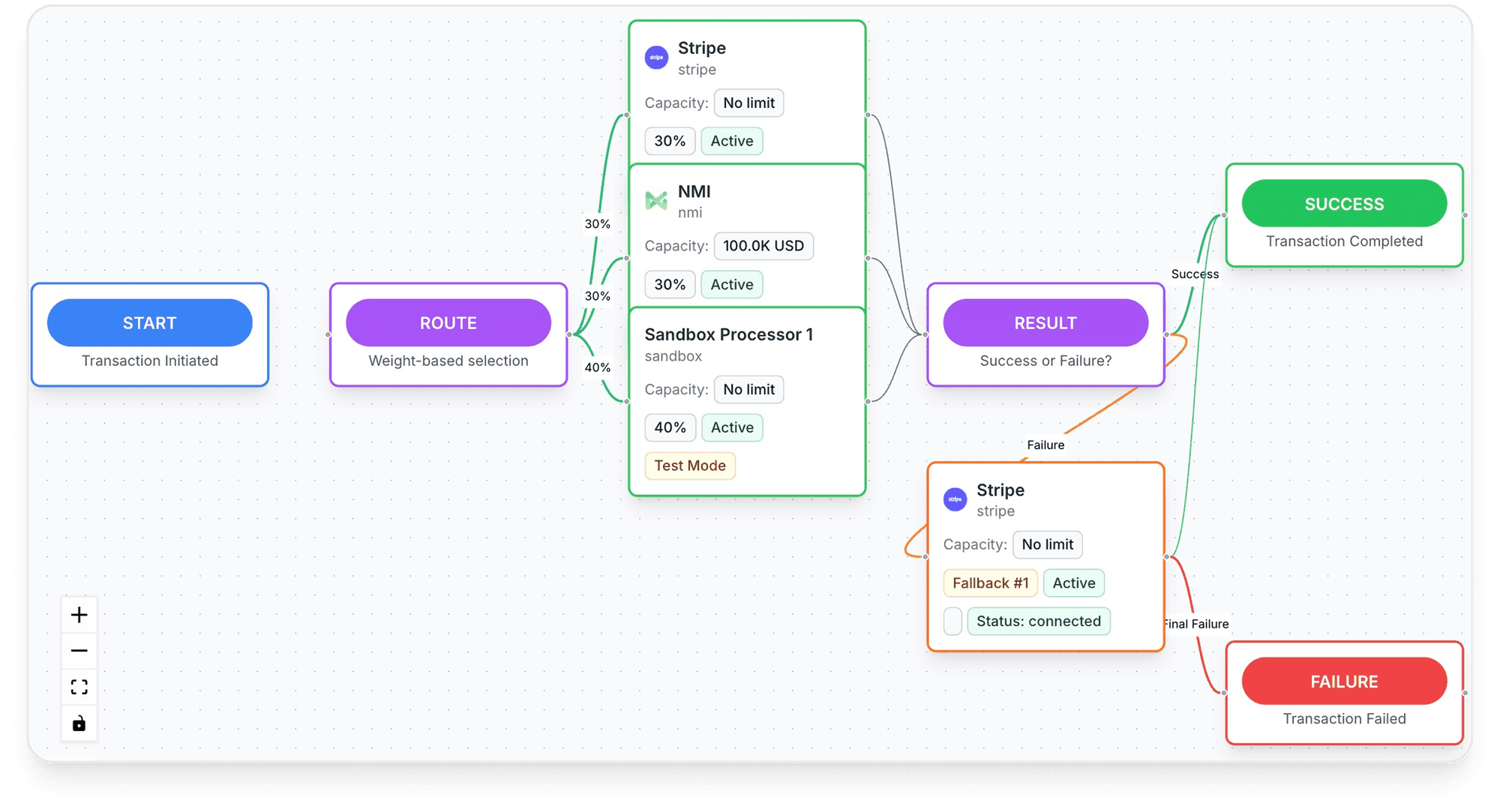
See every payment's route, processor by processor
Set the order your processors are tried in, per store, per country or per product.
SCA exemptions and their thresholds
Exemptions let a payment skip the challenge. They come from Articles 13 to 18 of the regulation, and they are permissions, not rights: the issuer receives the request, assesses the risk, and makes the final decision.8Stripe, Strong Customer Authentication guide
| Exemption | Condition | Who uses it | Liability shift? |
|---|---|---|---|
| Low value (Art. 16) | Up to €30, as long as the payer hasn't passed €100 in total, or five consecutive payments, since the last SCA | Issuer or acquirer; the issuer keeps count | NoYou keep fraud liability |
| Transaction risk analysis (Art. 18) | Payment provider's fraud rate under the reference rate for the amount band (table below), and no abnormal signal in real-time analysis | Issuer or acquirer | NoYou keep fraud liability |
| Recurring, same amount (Art. 14) | Same amount, same payee; SCA on creation, change or first payment | Issuer | No |
| Trusted beneficiaries (Art. 13) | The cardholder adds you to a list at their bank, with SCA | Cardholder, through the issuer | No |
| Secure corporate payments (Art. 17) | Dedicated processes for business payers, approved by the authorities | Issuer only | No |
| Merchant-initiated transactions | Out of scope, not an exemption: payments you start from a mandate, without the customer | You, flagged through your processor | No |
Sources: the regulation for the conditions,1Commission Delegated Regulation (EU) 2018/389, RTS on strong customer authentication Stripe for liability and who can request each one.6Stripe Docs, Strong Customer Authentication (SCA) exemptions8Stripe, Strong Customer Authentication guide In the UK, the low-value limits are £25 per payment and £85 cumulative.6Stripe Docs, Strong Customer Authentication (SCA) exemptions Stripe also notes that banks have been slow to offer trusted-beneficiary lists.8Stripe, Strong Customer Authentication guide
The transaction risk analysis exemption depends on the fraud rate of the payment provider asking for it, calculated over a rolling 90 days on all its remote card payments, authenticated or exempted.1Commission Delegated Regulation (EU) 2018/389, RTS on strong customer authentication
≤ 0.13%
Fraud rate to exempt card payments up to €100 (£85 in the UK)
≤ 0.06%
Fraud rate to exempt card payments up to €250 (£220)
≤ 0.01%
Fraud rate to exempt card payments up to €500 (£440)
Reference rates from the annex of Regulation 2018/389;1Commission Delegated Regulation (EU) 2018/389, RTS on strong customer authentication UK equivalents from Stripe.6Stripe Docs, Strong Customer Authentication (SCA) exemptions In practice, the band you get depends on your provider. Stripe, for example, currently offers the exemption up to €250 for EEA merchants and up to £220 for UK and Swiss merchants.6Stripe Docs, Strong Customer Authentication (SCA) exemptions
When the issuer says no
An exemption request can come back as a soft decline: the issuer refuses the shortcut and asks for authentication. That isn't a lost sale if your checkout can respond.
- Exemption acceptedNo challenge, no liability shiftKeep fraud rules on these payments
- Soft decline asking for authenticationThe issuer wants SCA on this oneRetry with 3-D Secure while the customer is still there
- Off-session payment declined for authenticationThe customer must authenticate a renewalEmail a link to complete payment, then retry
- Challenge failed or timed outNot authenticated, not sent for authorizationLet the customer retry or switch method without losing the cart
Stripe retries automatically with authentication when the issuer sends a soft decline on an exempted payment.5Stripe Docs, Authenticate with 3D Secure If you run your own integration, build that retry in: a decline for missing authentication is often the easiest one to recover.
Subscriptions, saved cards and one-click upsells
The rule turns on who starts the payment. When the customer triggers each payment, SCA applies, even with a card on file. When you charge on the basis of a mandate, without any action from the customer, the payment is payee-initiated and outside SCA. Setting up that mandate online is itself subject to SCA.2EBA Single Rulebook Q&A 2018_4031, payee-initiated card payments
Fig. 3The authentication life of a subscription
- Sign-upFirst payment or card setup authenticated, mandate accepted
- RenewalsMerchant-initiated: no challenge, no liability shift
- Issuer pushes backA renewal declined for authentication
- Customer returnsAuthenticates once, renewals resume
What that means in practice:
- Authenticate when you save the card. Stripe's guidance is to authenticate the card at the first payment, or with a setup flow when there's no payment, and to flag later payments as off-session.7Stripe Docs, Strong Customer Authentication readiness
- Get the mandate in writing. The agreement must cover the customer's permission for you to charge them, the expected frequency and how the amount is set.7Stripe Docs, Strong Customer Authentication readiness
- Variable amounts work too. A fixed-amount series can use the recurring exemption, but Stripe treats variable subscriptions as merchant-initiated transactions as well.6Stripe Docs, Strong Customer Authentication (SCA) exemptions
- Older cards. Cards saved before December 31, 2020 (EU) or September 14, 2021 (UK) can rely on the earlier agreement, if the issuer accepts it.7Stripe Docs, Strong Customer Authentication readiness
- Exemptions aren't guaranteed on renewals either. The issuer can still require authentication on an off-session payment.7Stripe Docs, Strong Customer Authentication readiness Plan a dunning email with a payment link for that case.
A one-click upsell after checkout is a different case. The customer clicks to buy, so it's a new customer-initiated payment on a card on file. In the EEA and UK, it needs SCA, unless the issuer accepts an exemption such as low value or transaction risk analysis.2EBA Single Rulebook Q&A 2018_4031, payee-initiated card payments Expect some upsells to trigger a second challenge, and design the page so that's not a dead end. More on renewals in our guide to subscription payment processing.
Apple Pay, Google Pay and wallets
Wallets authenticate before the payment reaches you. With Apple Pay or Google Pay on a device, the customer unlocks the payment with Face ID, a fingerprint or a device code, and the payment carries a cryptogram. Stripe describes them as payment methods with a built-in layer of authentication, well suited to SCA.8Stripe, Strong Customer Authentication guide
What wallets give you
- Authentication built in, without a 3-D Secure window
- Liability shift possible with the cryptogram, in some cases5Stripe Docs, Authenticate with 3D Secure
- With a device token, the real card number stays out of your checkout
What to watch
- Google Pay can also return a card saved in the customer's Google account, without a device token: that one may still need 3-D Secure10Google Pay API for Web, Strong Customer Authentication
- 3-D Secure can't be added on top of a wallet payment at Stripe5Stripe Docs, Authenticate with 3D Secure
Google's guidance is explicit: when the response says the cardholder wasn't authenticated, apply your risk checks and step up with 3-D Secure where it applies.10Google Pay API for Web, Strong Customer Authentication How wallet tokens work is a separate subject, covered in tokenization vs encryption.
Passkeys, biometrics and the end of the SMS code
The SMS one-time code was the default challenge for years. It has known weaknesses: it can arrive late, it can't be received without signal, and a SIM swap hands it to a fraudster. Issuers have been moving to approvals in their banking apps, where the customer confirms with a fingerprint or a face scan.
Passkeys go one step further. The cardholder's device holds a cryptographic key and unlocks it with biometrics or a device PIN, so one gesture can combine possession and inherence. EMVCo and the FIDO Alliance have published how FIDO authentication data can be carried in EMV 3-D Secure messages, to reduce fraud and friction.4EMVCo, EMV 3-D Secure For a merchant, nothing changes in the integration: you still send a 3-D Secure request, and the issuer picks the method. What changes is how many challenges the customer completes. More on biometric authentication in our glossary.
Good to know
You don't choose the challenge method. The issuer does. What you control is the data you send, the moments you request authentication, and how your checkout behaves while the customer completes it.
The conversion trade-off: when to ask for authentication
Every challenge is a step where a legitimate customer can drop out. Every skipped one leaves fraud liability with you. The aim is to authenticate where the risk is and let the rest through.
- Request 3-D Secure where the risk is. New cards, high amounts, an elevated fraud score, a mismatch between card, IP and shipping country. Our fraud prevention guide has Stripe's example rule.
- Send complete data. Email, billing address, device data and the customer's history with you help the issuer approve without a challenge.
- Use exemptions where your fraud is low. Low-value and transaction risk analysis exemptions remove the challenge, and the liability shift with it.
- Handle the return trip. Keep the cart, the order and the session through the challenge, on mobile too. Never let a failed challenge send the customer back to an empty checkout.
- Recover soft declines. Retry with authentication when the issuer asks for it, on-session right away, off-session with a payment link.
- Measure by issuer and country. Track frictionless rate, challenge completion and approvals after authentication. One issuer that challenges everything can hide in an average. Our guide to acceptance rate shows how to read approvals.
Outside Europe, 3-D Secure is your choice. Inside, it's the default, and exemptions are the shortcut.
Authentication when you use more than one processor
Each processor runs its own 3-D Secure integration, its own exemption requests and its own fraud model. Some tools split the two jobs: Stripe, for example, can run 3-D Secure on a payment that another provider processes, and can import 3-D Secure results run elsewhere.9Stripe Docs, 3D Secure authentication If you route payments across processors, check with each one how it handles a card first authenticated elsewhere before you charge renewals through it. Routing itself is covered in dynamic payment routing.
How Tagada helps
3DS2 at checkout, cards that move with the customer
TagadaPay runs native 3DS2 with device intelligence and a rules engine. Payments route across Stripe, Adyen and TagadaPay with one logic, with a cascade when one declines. The card vault lets you move customers between merchant accounts without collecting their cards again, so running subscriptions keep charging. The checkout supports Apple Pay, Google Pay and one-click upsells, and subscriptions come with automatic retries. See pricing for plans. Tagada follows Visa and Mastercard rules and the laws that apply to payments.
Frequently asked questions
What is payment authentication?
What is the difference between payment authentication and authorization?
What does failed payment authentication mean?
Is 3D Secure mandatory?
Do recurring payments need strong customer authentication?
Does Apple Pay count as strong customer authentication?
Sources
Checked October 14, 2026- Commission Delegated Regulation (EU) 2018/389, RTS on strong customer authentication
- EBA Single Rulebook Q&A 2018_4031, payee-initiated card payments
- EBA Single Rulebook Q&A 2018_4233, one-leg-out transactions
- EMVCo, EMV 3-D Secure
- Stripe Docs, Authenticate with 3D Secure
- Stripe Docs, Strong Customer Authentication (SCA) exemptions
- Stripe Docs, Strong Customer Authentication readiness
- Stripe, Strong Customer Authentication guide
- Stripe Docs, 3D Secure authentication
- Google Pay API for Web, Strong Customer Authentication
- FCA, Strong Customer Authentication
TagadaPay
Selling across several processors? Run them from one checkout
Tell us what you sell and how you sell it. Each application is underwritten, and approval is not guaranteed.
- 01Tell us what you sell and how
- 02Underwriting reviews your business
- 03Process through TagadaPay alongside your other processors