
Payment Gateway vs Payment Processor: Who Does What, and Who Holds Your Money
A gateway carries card data, a processor takes it to the card networks, an acquirer holds your merchant account. The flow, setups, costs and PCI scope.

Article summary
TL;DR
A payment gateway takes the card details at checkout and sends them, encrypted, to a processor. The processor carries the payment to the card network and the customer's bank, then handles clearing and settlement. The acquirer is the bank that holds your merchant account. Stripe and Adyen do all of it in one account; Authorize.net can be just the gateway.
- The gateway moves card data. The processor moves the transaction. The acquirer moves the money and carries the risk of your account.
- Online, you always need all three roles. The question is whether one company fills them or several.
- Stripe, Adyen and Braintree bundle gateway, processing and the merchant account. Authorize.net and NMI also sell the gateway alone, for a merchant account you already have.
- A separate gateway costs a monthly fee plus cents per transaction, on top of what your processor charges.
- Your PCI scope depends on where card numbers go, not on the label on the contract.
 ChatGPT
 Claude
 Perplexity
 Grok
GrokOn this page
A payment gateway and a payment processor are two jobs in the same card payment. The gateway takes the card details at checkout and passes them on safely. The processor carries the payment to the card networks and the customer's bank, then settles it. A third player, the acquirer, holds your merchant account and receives the money. Most online stores never see the seams because one company does all three.
Payment gateway vs payment processor at a glance
| Payment gateway | Payment processor | Acquirer (merchant account) | |
|---|---|---|---|
| Its job | Collects card data at checkout, encrypts or tokenizes it, sends it on | Sends the payment through the card network to the issuer, returns the answer, runs clearing and settlement | Signs the merchant, receives the card funds, pays them out to the business |
| What it touches | Card data | Transaction messages and settlement files | Money, and the risk of your account |
| Who sees it | The customer, on the payment form | Nobody at checkout | You, in payouts, reserves and statements |
| Typical pricing | Monthly fee plus a few cents per transaction | Percentage plus a fixed fee, or interchange-plus | Usually bundled with the processor's price |
| Examples | Authorize.net, NMI, or the checkout part of Stripe | Stripe, Adyen, Braintree, a bank's processor | Adyen (a licensed bank), your bank's acquiring arm |
Verdict
The gateway moves data. The processor moves the transaction. The acquirer moves the money and answers for your account. Online, all three jobs have to be done. What you choose is whether one company does them or several.
People also say "gateway processing" for the whole chain, and many providers sell all three under one name. A payment service provider is exactly that bundle.
What is a payment gateway?
A payment gateway is the secure entry point of a payment. It collects the card number, expiry date and security code on a payment form, a hosted page or a mobile SDK, and sends them encrypted to a processor. It then returns the processor's answer to your site: approved or declined, with a code.
Stripe calls the gateway the technology that transmits payment data securely, the online equivalent of the card terminal in a shop.1Stripe, Payment processor vs payment gateway Most gateways also turn the card into a token you can store and reuse, run basic checks (address and security code), and launch 3D Secure when the issuer asks for it.
What a gateway doesn't do: decide whether the payment is approved, or move any money. A gateway with nothing behind it can collect a card and go nowhere.
What is a payment processor?
A payment processor is the company that carries the transaction from the gateway to the card network (Visa, Mastercard), which passes it to the customer's bank, the issuer. The issuer checks funds and risk, approves or declines, and the answer travels back the same way.1Stripe, Payment processor vs payment gateway
After approval, the processor does the less visible part: it sends the captured transactions for clearing, handles settlement so the money reaches the merchant, and processes refunds and chargebacks. That's why a processor's performance shows up in your approval rate and your payouts, not on your checkout page.
What is an acquirer, and where does the merchant account fit?
The acquirer is the bank or licensed institution that is a member of the card networks and signs the merchant. It holds your merchant account, receives the funds for your card sales and pays them out to your business bank account. It also answers to Visa and Mastercard for your business: your disputes, your fraud and your category count against it. That's why the acquirer, not the gateway, decides whether to accept your business and whether to hold a reserve.
Processor and acquirer are often the same company, or a processor works on behalf of a partner bank. Adyen holds banking licenses in the EU (since 2017), the UK and the US, and describes its platform as covering the gateway, risk management, processing, acquiring and settlement.4Adyen Knowledge Hub, Adyen's banking license
Two more terms you'll meet:
- An independent sales organization (ISO) resells merchant accounts from an acquirer. You sign with the ISO, but the acquirer still underwrites you.
- A payment facilitator signs merchants under its own acquiring contract, so you can start without a merchant account in your own name.
Your account at the acquirer is identified by a merchant ID (MID). One business can have several MIDs, at one acquirer or several.
How a card payment moves: authorization, clearing, settlement
Fig. 1One online card payment, from the Pay button to your bank
approved declined or closed routing step
- CheckoutCustomer enters a card or picks a wallet
- PayGatewayEncrypts or tokenizes the card, sends the request
- sends toProcessorFormats the authorization request for the network
- routes toCard network and issuerIssuer approves or declines and holds the funds
- settles toAcquirerReceives the funds after clearing, pays them outApproved
Approval comes back at checkout. The money comes days later.
The same payment goes through three stages.
- Authorization. The issuer approves the amount and holds it on the customer's card. Nothing has moved yet. At Stripe, an authorization on an online card payment is usually valid for 7 days. For a Visa payment you start without the customer (a renewal, for example), it's 4 days and 18 hours.2Stripe Docs, Place a hold on a payment method
- Capture and clearing. You capture the payment, right away or later (when you ship, for example), for the full amount or less. The captured transactions go to the card network in the clearing files, which tell each issuer what to pay. If you don't capture before the authorization expires, the funds are released and the payment is canceled.2Stripe Docs, Place a hold on a payment method
- Settlement and payout. The issuer pays the acquirer, and the acquirer pays you, minus fees. At Stripe, the default settlement time in the US is 2 business days. Your first payout usually comes 7 to 14 days after your first live payment, depending on your industry, country and risk level.3Stripe Docs, Payouts
Sources: Stripe Docs, Place a hold on a payment method; Stripe Docs, Payouts.
Approved is not paid
Some issuers show an authorization and a captured payment the same way on the customer's statement, which confuses customers.2Stripe Docs, Place a hold on a payment method On your side, an approved order is not money in the bank until it settles, and it can still come back as a refund or a chargeback.
Who does what at Stripe, Adyen, PayPal Braintree and Authorize.net
The four names people compare most fill the roles differently.
| Provider | Gateway | Processing | Merchant account |
|---|---|---|---|
 Stripe Stripe | Included (Checkout, Elements, API) | Included | Included in your Stripe account; payouts to your bank |
 Adyen Adyen | Included | Included | Included: Adyen is the acquirer, with banking licenses in the EU, UK and US |
 PayPal Braintree PayPal Braintree | Included | Included, 2.89% + 29¢ standard US rate | One or more merchant accounts inside your gateway account, by business or currency |
| Authorize.net, all-in-one plan | Included | Included, $25 a month + 2.9% + 30¢ | Authorize.net's own merchant account |
| Authorize.net, gateway-only plan | Included, $25 a month + 10¢ per transaction + 10¢ daily batch fee | From your existing provider | Your own, kept as it is |
 NMI NMI | Included | From one of 200+ processors it integrates with | Your own, usually through a reseller |
Sources: Stripe describes itself as gateway and processor in one platform;1Stripe, Payment processor vs payment gateway Adyen;4Adyen Knowledge Hub, Adyen's banking license a Braintree gateway account can hold several merchant accounts "for different businesses or currencies";5PayPal Developer, Braintree: Important gateway credentials PayPal Braintree's US rate;6PayPal, PayPal Braintree fees (US), October 2026 Authorize.net's two plans, where the gateway-only one "connects Authorize.net to it without replacing your existing account";7Authorize.net, Pricing, October 2026 NMI's integration count.8NMI, Payment gateway
All-in-one or separate gateway: which setup fits?
Fig. 2Same order, two setups
All-in-one
- CheckoutProvider's fields or hosted page
- everything in oneProviderGateway, processor and merchant account
One contract, one dashboard, one risk team
Separate gateway
- CheckoutGateway's fields or hosted page
- sends toGatewayAuthorize.net, NMI
- connects toProcessor and acquirerYour merchant account
Two contracts, but the checkout survives a change of acquirer
The all-in-one setup is the default for a new store: one integration, one sign-up, payouts within days. The trade-off is concentration. The same company runs your checkout, your approvals and your account review. If it restricts or closes the account, you lose all three at once.
The separate setup takes more work: two contracts, two support desks, and a merchant account that is underwritten on its own. In return, the gateway stays in place if you change acquirers, and some gateways can send payments to more than one.
When do you need a separate gateway?
- You already have a merchant account from your bank or an ISOYou have an acquirer but no online checkoutA gateway-only plan, such as Authorize.net's
- Your category is on Stripe's restricted listStripe has to review more information and may not approveAsk Stripe first; prepare a merchant account elsewhere in parallel
- An acquirer that knows your category offers an account but no gatewayIt expects you to bring the gatewayA gateway that integrates with that acquirer
- You want two acquirers live at the same timeOne gateway per acquirer means two checkoutsA gateway or orchestration layer that connects to both
- You sell one product line in one country at normal volumesYou gain little from the extra contractStay all-in-one
Stripe publishes a list of prohibited businesses, which it won't accept, and restricted businesses, which need extra review. An approval in a restricted category covers only the service approved and can be changed or revoked.10Stripe, Prohibited and restricted businesses Businesses in those categories often end up with a merchant account from an acquirer that specializes in their sector, and a gateway in front of it. Approval for a merchant account depends on your industry and history: Authorize.net says it can be immediate or take one to five business days, and longer depending on the industry.7Authorize.net, Pricing, October 2026 The category your acquirer assigns you is your MCC: see high-risk MCC codes for the ones card networks watch.
What each layer costs
On an all-in-one plan, the gateway is inside the rate. With a separate gateway, you pay it on top of your processor. The standard US prices, as published in October 2026:
| Setup | Monthly | Per transaction |
|---|---|---|
| Stripe | None listed | 2.9% + 30¢ |
| PayPal Braintree | None listed | 2.89% + 29¢ |
| Authorize.net all-in-one | $25 | 2.9% + 30¢ |
| Authorize.net gateway only | $25 | 10¢ + 10¢ daily batch fee, plus your processor's fees |
Sources: Stripe,11Stripe, Pricing (United States), October 2026 PayPal,6PayPal, PayPal Braintree fees (US), October 2026 Authorize.net.7Authorize.net, Pricing, October 2026
Fig. 3When a separate gateway pays off
- All-in-one at Stripe. 2.9% of $50,000 is $1,450, plus 1,000 × 30¢ = $300. Total: $1,750.
- Gateway only at Authorize.net. $25 + 1,000 × 10¢ + 30 daily batches × 10¢ = $128, before any processing fee.
- Break-even. The separate setup is cheaper only if your merchant account costs less than $1,750 − $128 = $1,622 a month, about 3.24% of volume, all fees included.
Illustrative: 1,000 orders of $50 a month, domestic cards
A merchant account on interchange-plus pricing can come in below that line on domestic consumer cards, and above it if your mix has many premium, business or foreign cards. To check your own numbers, see what a transaction fee is made of, how interchange fees work, and how to read a merchant statement.
Which layer puts you in PCI scope?
PCI DSS applies to every business that stores, processes or transmits card data. What matters for your workload is whether the card number ever reaches your servers. Stripe says a business that takes untokenized card numbers on its own payment page may have to meet more than 300 security controls, while its low-risk integrations send the card data straight to Stripe and reduce your obligations.9Stripe Docs, Integration security guide
Hosted page or payment fields
The gateway's page or fields collect the card. Your site never sees the number, only a token. Lightest scope.
Your own form, card sent to an API
The card number passes through your page or servers before it reaches the gateway. You carry far more of PCI DSS.
Stored cards for renewals
Keep tokens, not card numbers. The last four digits, card type and expiry date returned by Stripe are out of PCI scope.9Stripe Docs, Integration security guide
Even with the lightest integration, you still attest to PCI compliance every year: the gateway's certification covers its part, not yours.9Stripe Docs, Integration security guide The difference between the token your gateway gives you and an encrypted card number is explained in tokenization vs encryption.
Using more than one gateway or processor
Once you have two processors, each with its own gateway, every payment needs a decision: which one gets it, and where it goes if the first one declines.
Fig. 4One checkout, several processors
- StripeYour Stripe account
- AdyenYour Adyen merchant account
 Gateway + merchant accountAn acquirer that knows your category
That layer is called payment orchestration. It routes each payment by card, country or amount, moves traffic when one processor fails, and keeps the cards in a vault you can use with every processor, so a change of processor doesn't mean asking customers for their cards again. The rules for retrying a declined payment on another processor are in dynamic payment routing.
Where Tagada and TagadaPay fit
Searching for "Tagada payment processor"? TagadaPay is Tagada's own payment processor. Tagada itself is the checkout and routing layer above it: it routes payments across Stripe, Adyen and TagadaPay with one set of rules, and cascades to another route on decline. Each TagadaPay file is underwritten, with enhanced review for regulated verticals.
Inside Tagada
Stripe, Adyen and TagadaPay behind one checkout
Route across Stripe, Adyen and TagadaPay with one set of rules, and cascade on decline. The card vault moves customers between merchant accounts without collecting their cards again, so running subscriptions keep charging. 3DS2 and a rules engine are built in.
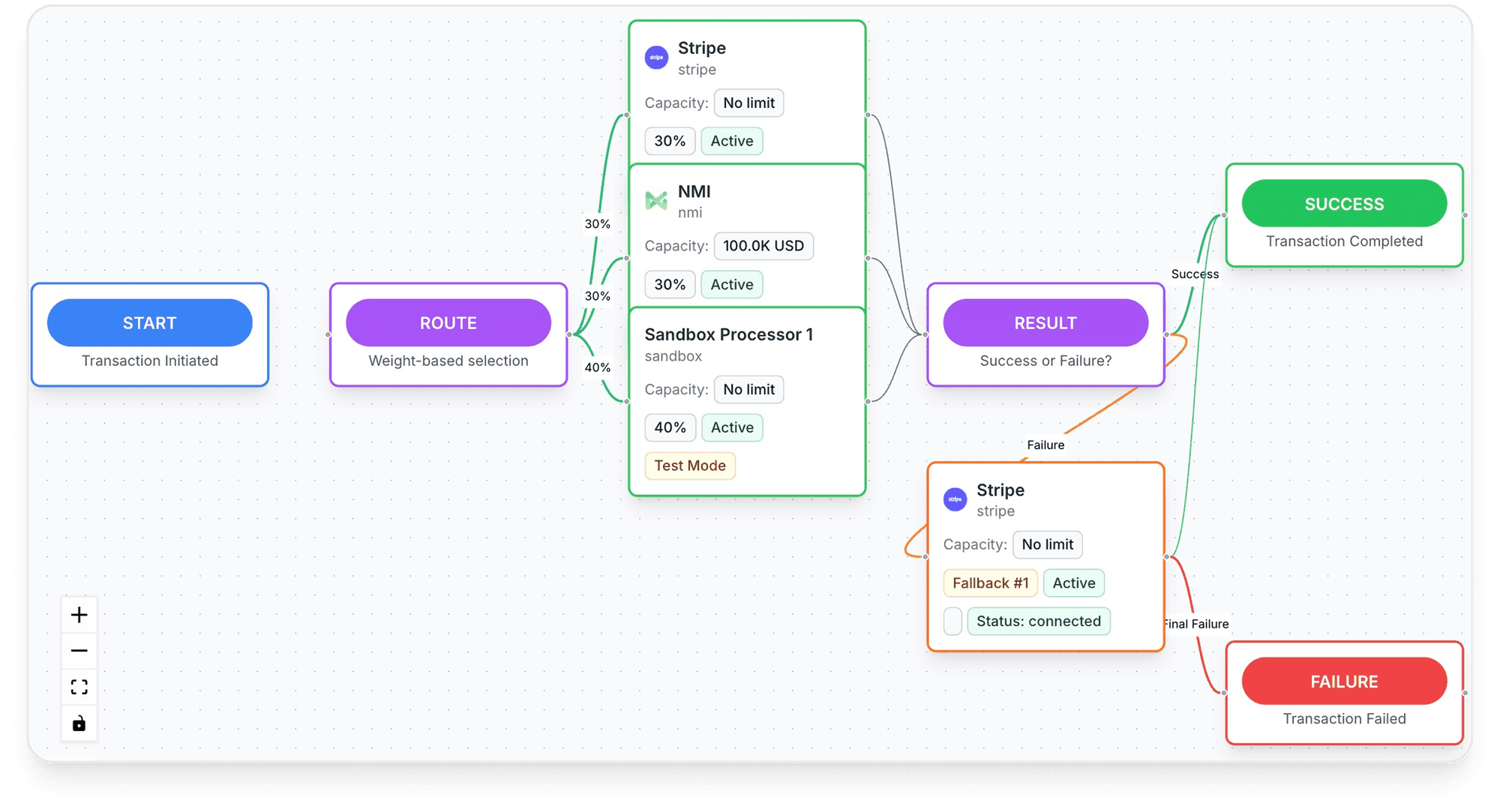
Whatever you use, the split above stays the same: a gateway to take the card, a processor to carry it, and an acquirer that has accepted your business.
Tagada follows Visa and Mastercard rules and the laws that apply to payments.
Frequently asked questions
Is Stripe a payment gateway or a payment processor?
Do I need both a payment gateway and a payment processor?
Is a payment processor the same as a merchant account?
Is PayPal a payment gateway or a processor?
Can one payment gateway work with several processors?
What is TagadaPay?
Sources
Checked October 14, 2026- Stripe, Payment processor vs payment gateway
- Stripe Docs, Place a hold on a payment method
- Stripe Docs, Payouts
- Adyen Knowledge Hub, Adyen's banking license
- PayPal Developer, Braintree: Important gateway credentials
- PayPal, PayPal Braintree fees (US), October 2026
- Authorize.net, Pricing, October 2026
- NMI, Payment gateway
- Stripe Docs, Integration security guide
- Stripe, Prohibited and restricted businesses
- Stripe, Pricing (United States), October 2026
TagadaPay
One checkout, several processors behind it
Tell us what you sell and how you sell it. Each application is underwritten, and approval is not guaranteed.
- 01Tell us what you sell and how
- 02Underwriting reviews your business
- 03Process through TagadaPay alongside your other processors