
What Is a Merchant ID (MID), and Where Do You Find Yours?
What a merchant ID is, who issues it, how it differs from a TID or MCC, where to find yours on Stripe, PayPal, Square or Shopify, and when to run several.

Article summary
TL;DR
A merchant ID (MID) is the code your acquiring bank assigns to your merchant account so card networks know which business a payment belongs to. Mastercard defines it as a 15-character code, the card acceptor ID. It sits on every authorization, and it's where disputes, fraud reports and payouts are counted.
- Your acquirer issues the MID, not you and not the card network. Mastercard calls it the card acceptor ID: 15 characters, field DE42 of the payment message.
- One MID per merchant account, one TID per terminal. Change processor and you get a new MID.
- On Stripe, Square or Shopify Payments you get an account ID, not the acquirer's MID. PayPal shows a PayPal Merchant ID in Business information.
- Several MIDs are normal for several brands, websites or countries. Visa wants each website selling distinct goods on its own accurate MCC.
- Using extra MIDs to dodge monitoring is a Visa violation: USD 25,000 per merchant per month and possible permanent disqualification.
 ChatGPT
 Claude
 Perplexity
 Grok
GrokOn this page
A merchant ID, or MID, is the number that tells the card networks which business a payment belongs to. Your acquiring bank assigns it when it opens your merchant account. Every authorization carries it, and every dispute, fraud report and payout is counted against it.
Here is what the MID is, how it differs from the TID and the MCC, where to find yours on each provider, and when running several MIDs is normal and when it breaks the rules.
What is a merchant ID?
A merchant ID is the identifier of a merchant account. The acquirer, the bank that signs you up to accept cards, creates it during onboarding. You don't pick it, and the card networks don't issue it.
Mastercard's developer documentation gives the cleanest definition. It calls the field the card acceptor ID:1Mastercard Developers, Merchant Identifier API glossary
A unique 15-character code assigned by an acquiring bank to identify a merchant within the Mastercard payment network. Also known as the Acquirer Merchant ID or MID.
Three things follow from that definition:
- The acquirer owns it. Change acquirer and you get a new MID. Your old one stays with the old account.
- It's 15 characters wide, not always 15 digits. That's the size of the field in the payment message (DE42). Each acquirer fills it its own way.
- It identifies an account, not a company. One company can hold several merchant accounts, so several MIDs.
The acquirer also reports the MID to Visa with the rest of your merchant data: trading name, legal name, address, tax ID and, in the US, your MCCs.2Visa Core Rules and Visa Product and Service Rules, April 18, 2026 That's the record the networks match your transactions against.
MID vs TID, card acceptor ID, MCC and descriptor
Merchants mix these five up because they all sit near the top of a receipt or a statement. They answer different questions.
| Identifier | What it identifies | Who assigns it | Where it shows up |
|---|---|---|---|
| Merchant ID (MID) | Your merchant account | Your acquirer | Merchant statement, terminal, processor dashboard |
| Terminal ID (TID) | One device or checkout under that account | Your processor or acquirer | Receipt, terminal settings |
| Card acceptor ID | The merchant in the authorization message (DE42) | Your acquirer | Payment message; often the same value as the MID |
| MCC | What you sell | Your acquirer or processor | Account settings, merchant agreement |
| Statement descriptor | Your name on the customer's statement | You, within your processor's limits | Cardholder's bank statement |
Verdict
The MID says who gets paid. The TID says which device took the payment. The MCC says what was sold. The descriptor says what the customer sees.
MID and TID. One merchant account can run many terminals: one MID, one TID per device. The TID is the subject of our guide to terminal ID numbers, so we won't repeat it here.
MID and card acceptor ID. Mastercard treats them as the same thing. Visa's rules list "Acquirer-assigned Merchant ID" and "Card acceptor identification" as two separate items the acquirer must report.2Visa Core Rules and Visa Product and Service Rules, April 18, 2026 At most acquirers they carry the same value. If a partner asks for one and your statement shows the other, ask your acquirer which value goes in the authorization message.
MID and MCC. The MCC is a four-digit category, shared by thousands of merchants. The MID is unique to your account. Each MID carries an MCC. How to find yours, and fix it if it's wrong, is in how to find your MCC code.
How a MID travels with each payment
You never type your MID at checkout. Your processor adds it to every authorization request, and it stays attached to the payment for the rest of its life.
Fig. 1Where your MID is read
approved declined or closed routing step
- CheckoutCustomer pays by card
- sendsProcessorAdds MID, TID, MCC to the request
- forwards

 Card networkRoutes to the issuer, records the merchant
 - asksIssuerApproves or declinesApproved
- clearsSettlementFunds and disputes land on the same MIDApproved
same MID at every stop
Visa requires the data in the clearing record to match the authorization, and the merchant's country to stay the same through the whole life of the transaction, refunds and disputes included.2Visa Core Rules and Visa Product and Service Rules, April 18, 2026 That's why a refund or a chargeback is tied back to the MID that took the original sale.
It's also why the networks count your disputes and fraud per account. When Visa or Mastercard puts a merchant in a monitoring program, the ratio is calculated on the transactions of that account, not on the whole company.
Where to find your merchant ID
Start with your monthly merchant statement. Stripe's guide says the MID is usually the 15-digit number in the top right corner, and warns that a statement may show only part of it.5Stripe, Merchant ID: what merchant identification numbers are, and how to find yours There is no public database to look it up.
On platforms that hold the acquirer relationship for you, what you see is usually an account ID, not the acquirer's MID.
| Provider | What you see | Where | The acquirer's MID |
|---|---|---|---|
 Stripe Stripe | A Stripe account ID (acct_…) | Dashboard, account settings | Not shown. Stripe says users "don't directly see or deal with" a MID. Ask Stripe support |
 PayPal PayPal | PayPal Merchant ID | Account Settings → Business information, under Business profile | That's PayPal's own account ID, used for buttons. For anything else, ask PayPal support |
| Square | A merchant ID in the API | Merchants API: GET /v2/merchants/me | Square's own identifier. Ask Square support for a card network identifier |
 Shopify Payments Shopify Payments | NoMID documented | Not in Shopify's help center | Ask Shopify Support, as the store's account owner |
| Your own merchant account (bank or ISO) | The MID | Monthly statement, merchant agreement, terminal | YesThat's the number |
Sources: Stripe,5Stripe, Merchant ID: what merchant identification numbers are, and how to find yours PayPal Help Center,6PayPal Help Center, How do I find my Secure Merchant ID on my PayPal account? Square Developer.7Square Developer, Merchants API: RetrieveMerchant
Stripe. Stripe's own page is direct: users get an account ID that identifies their Stripe account, "but not an actual merchant ID."5Stripe, Merchant ID: what merchant identification numbers are, and how to find yours The MIDs exist on Stripe's side, though. Stripe's monitoring documentation mentions that having multiple MIDs, or Stripe updating your MID during a month, can make the networks' figures differ from your Dashboard.4Stripe Docs, Dispute and fraud card monitoring programs
PayPal. PayPal documents the path: Account Settings, then Business information under Business profile, and the ID is next to "PayPal Merchant ID". PayPal presents it as a way to show an ID instead of your email address on payment buttons.6PayPal Help Center, How do I find my Secure Merchant ID on my PayPal account?
Square. Square's Merchants API returns the merchant linked to your access token when you pass me as the ID.7Square Developer, Merchants API: RetrieveMerchant That ID identifies your Square account to Square's API. It isn't documented as an acquirer MID.
Shopify Payments. Shopify doesn't document a MID for Shopify Payments merchants. If a dispute tool or a tax form asks for one, contact Shopify Support from the account owner's login and say what the number is for.
Practical rule
Ask your provider in writing: "Which merchant ID and card acceptor ID are used in authorization requests for my account?" Then say why you need it. A 3D Secure provider, a dispute alert service and a tax form don't always want the same number.
Do you have your own MID?
How you signed up decides whether a MID is yours. Visa lets a payment facilitator sign merchants up as sponsored merchants. The facilitator gets its own Visa identifier, assigns a sub-merchant identifier to each seller, and both appear in each authorization.2Visa Core Rules and Visa Product and Service Rules, April 18, 2026 For the data Visa collects on sponsored merchants, the facilitator's card acceptor ID is acceptable.2Visa Core Rules and Visa Product and Service Rules, April 18, 2026
Sponsored merchant (payment facilitator)
- Your accountAccount ID and sub-merchant ID
- Payment facilitatorIts own Visa identifier
- AcquirerContracts with the facilitator
Fast to open. The facilitator holds the acquirer relationship and the MIDs.
Direct merchant account
- Your accountYour own MID
- AcquirerContracts with you
Slower underwriting. The MID is yours and appears on your statement.
Neither is better in general. A sponsored setup gets you selling with little paperwork. A direct account gives you a MID you can quote, a statement you can read line by line, and a contract you negotiate. Many brands start with the first and add the second as volume grows.
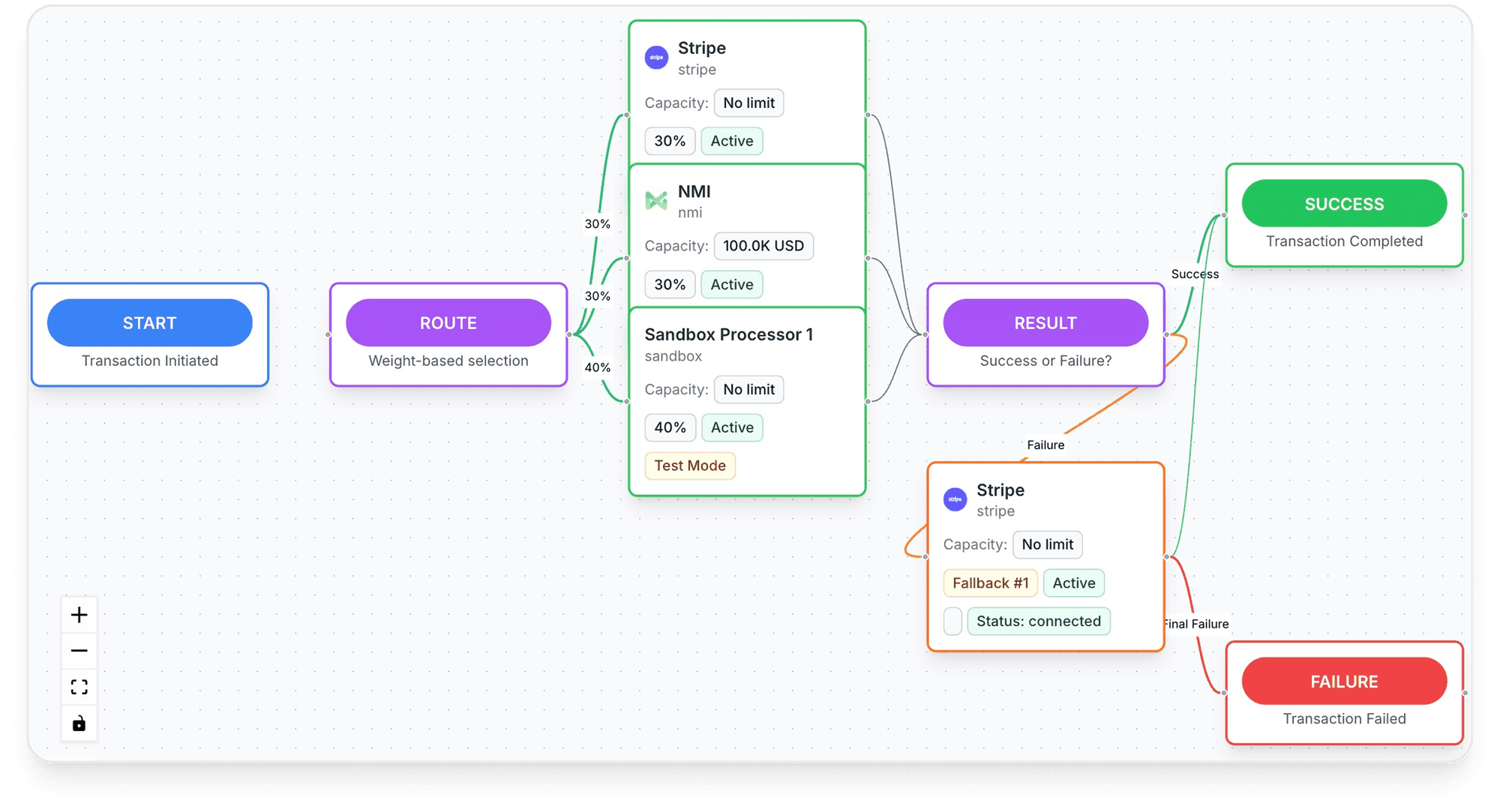
Inside Tagada
See every payment's route, processor by processor
Set the order your processors are tried in, per store, per country or per product.
When a business needs several MIDs
Most small merchants need one MID. Several are normal as soon as the business has more than one thing a network or an acquirer needs to tell apart.
- Brand A, USUS acquirer, MCC that fits brand A
- Brand A, EUEU acquirer, same products
- Brand B websiteDistinct goods, its own MCC
- Second processorSame brand, backup route
Separate websites selling distinct goods. Visa's MCC manual is explicit. Where a merchant runs several e-commerce websites, each offering distinct goods or services, each website must get the MCC that most accurately reflects what it sells, "regardless of whether the websites are linked from a common parent site or operated under the same merchant entity."3Visa, Merchant Data Standards Manual, April 2026 Different MCC usually means a different merchant account, so a different MID.
A high-risk line of business. Visa requires a merchant with several lines of business to put the high integrity risk line on its own high-risk MCC, separate from the rest.3Visa, Merchant Data Standards Manual, April 2026 The list of those codes is in our high-risk MCC codes guide.
Several countries. An acquirer accepts transactions from merchant outlets in its own country, unless Visa approves otherwise.2Visa Core Rules and Visa Product and Service Rules, April 18, 2026 Selling through local acquirers in the US and in Europe means one MID with each.
Several processors. Each processor or acquirer gives you its own MID. A brand running Stripe and a second processor already has at least two.
How Visa counts your accounts
Visa doesn't monitor a company. It monitors accounts. Stripe's documentation explains how Visa draws the line for Stripe users:4Stripe Docs, Dispute and fraud card monitoring programs
Visa places individual accounts in its programs, but identifies an account by the static component of its statement descriptor and its acquiring bank. Because banks often vary by country or region, one Stripe business might represent multiple monitored accounts to Visa.
Stripe gives examples: one descriptor in Canada plus a second one in Canada and the US counts as three accounts; the same descriptor across Ireland, France and Germany counts as one, because Visa aggregates EU volume. Stripe also explains how to merge them: give each descriptor the same static prefix and ask Stripe to request aggregation from Visa.4Stripe Docs, Dispute and fraud card monitoring programs
That last point matters. Stripe tells merchants how to combine their accounts so the rate reflects the whole business. Splitting goes the other way, and that is where the rules start.
Multiple MIDs for high-risk merchants: the line not to cross
High-risk merchants run several MIDs for sound reasons: one processor can close an account overnight, reserves tie up cash, and some acquirers only take part of the volume. Spreading volume across processors keeps the business selling if one stops. Routing the right payment to the right processor is covered in dynamic payment routing and high-risk payment resilience.
What the networks forbid is using MIDs to hide your numbers. Visa's rules are specific.
| Practice | Visa's position |
|---|---|
| A separate MID for a brand, a website, a country or a second processor, with accurate data | Allowed |
| Retrying a declined payment, with the same accurate data | ConditionalWithin Visa's reattempt limits (section 7.3.6.3), never after a "will never approve" decline |
| Changing the MCC, the acquiring identifier or the merchant country when you retry a declined payment | Prohibited(rule 1.7.2.1) |
| Changing merchant name, data or performance to stay out of VAMP or the Integrity Risk Program | Prohibited(rule 12.5.3.2) |
| Running another business's sales through your MID | ProhibitedLaundering (rule 1.9.1.4) |
| Opening a new merchant agreement under a new name to get around the rules | Prohibited(rule 1.9.1.4) |
Source: Visa Core Rules and Visa Product and Service Rules, April 2026, p. 123, 133, 538 and 808.2Visa Core Rules and Visa Product and Service Rules, April 18, 2026
The retry rule names the MID's own field. After a decline, an acquirer, merchant, payment facilitator or processor must not intentionally manipulate data elements of the original request:2Visa Core Rules and Visa Product and Service Rules, April 18, 2026
An Acquirer, a Merchant, a Payment Facilitator, or a VisaNet Processor that reattempts an Authorization Request following a Decline Response […] must not intentionally manipulate any data elements from the original Authorization Request, including, but not limited to, the following: Acquiring Identifier, Acquirer and Merchant country, MCC, POS condition code, POS environment field, POS Entry Mode, Electronic Commerce Indicator.
The monitoring rule carries the penalty:2Visa Core Rules and Visa Product and Service Rules, April 18, 2026
If Visa determines that an Acquirer, a Merchant, a Sponsored Merchant, or a Third Party Agent changed, modified, or altered the Merchant name, Merchant data, or Merchant performance in any way to circumvent the Visa Acquirer Monitoring Program (VAMP) or the Visa Integrity Risk Program (VIRP), Visa may […] impose a non-compliance assessment of USD 25,000 per Merchant or Sponsored Merchant, per month to the Acquirer [and] permanently disqualify the Merchant, or Sponsored Merchant, and its principals from participating in the Visa system.
Transaction laundering
Visa can ban a merchant for presenting transactions that don't come from a sale between a cardholder and that merchant, which Visa calls laundering.2Visa Core Rules and Visa Product and Service Rules, April 18, 2026 Processing sales for an undisclosed website or another company on your MID is exactly that. Visa's terminated merchant file has a reason code for it, 23 Transaction Laundering, and Mastercard's MATCH has code 3, Laundering.8Stripe Docs, Terminated merchant files (MATCH and VMSS)
The test is simple. If each MID matches a real business line, website, country or processor, and every transaction carries accurate data, you're using MIDs as intended. If a MID exists so that disputes land somewhere a monitoring program won't see them, it's a violation, and the penalty falls on your acquirer first and then on you.
Can you lose your MID? MATCH and VMSS
Yes. A MID lives as long as the merchant account. If your acquirer terminates the account for fraud, serious rule violations or excessive chargebacks, it must check whether you qualify for Mastercard's MATCH and Visa's VMSS, the terminated merchant files.8Stripe Docs, Terminated merchant files (MATCH and VMSS)
- Your processor closes the accountThe MID stops working. The acquirer reviews the closure against MATCH and VMSS criteriaAsk for the reason in writing and whether a listing was filed
- You open a new account to start againMATCH records the principal owners' names and tax IDs, not just the MIDDisclose the history. A new MID doesn't hide a listing
- You were listed in errorOnly the acquirer that filed the listing can remove itContact that acquirer. Unknown? Mastercard handles queries for MATCH
Listings last 5 years, and most processors reject listed businesses and their owners.8Stripe Docs, Terminated merchant files (MATCH and VMSS) The thresholds, how to stay below them, and what happens after a listing are in our guide to payment risk management and the MATCH list glossary entry.
Keep your MID safe
A MID isn't a password, but it's not public information either. Visa's rules now limit how much of it a customer sees: on terminals and payment gateways deployed since October 15, 2022, and on all of them from October 16, 2027, the cardholder's receipt must not show the full card acceptor ID, merchant ID or terminal ID. The acquirer can show the last 4 digits on the customer's copy and the full number on yours. Devices connected with point-to-point encryption are exempt.2Visa Core Rules and Visa Product and Service Rules, April 18, 2026
- Your acquirer and processor. They issued it.
- Vendors you hire to configure payments. Terminal installers, 3D Secure providers, dispute alert services. Give them the exact value your acquirer confirmed.
- Tax and compliance forms that ask for it. Check with your provider which number the form means.
- Nobody else. Not in public forums, not in support tickets to unrelated vendors.
Who usually needs your MID, and who doesn't.
Where Tagada fits
How Tagada helps
Several MIDs, one card vault
Tagada's card vault moves customers between MIDs without re-collecting cards, and running subscriptions keep charging. Payments route across Stripe, Adyen and Tagada's own TagadaPay processor with one logic, with a cascade on decline. A second merchant account can then serve as a backup route, or carry a new brand or country, without asking customers for their card again. It doesn't change what each MID must carry: accurate merchant data, and every account underwritten on its own. Pricing is on the pricing page. Tagada follows Visa and Mastercard rules and the laws that apply to payments.
Whichever provider you use, keep a simple map: each MID, its acquirer, its MCC, its descriptor and what it sells. It's the first thing an acquirer asks for in a review, and the fastest way to answer it.
Frequently asked questions
What is a merchant ID number?
How many digits is a merchant ID?
Can I look up a merchant ID online?
Is my Stripe account ID my merchant ID?
Can a business have more than one merchant ID?
Is it safe to share my merchant ID?
Sources
Checked October 14, 2026- Mastercard Developers, Merchant Identifier API glossary
- Visa Core Rules and Visa Product and Service Rules, April 18, 2026
- Visa, Merchant Data Standards Manual, April 2026
- Stripe Docs, Dispute and fraud card monitoring programs
- Stripe, Merchant ID: what merchant identification numbers are, and how to find yours
- PayPal Help Center, How do I find my Secure Merchant ID on my PayPal account?
- Square Developer, Merchants API: RetrieveMerchant
- Stripe Docs, Terminated merchant files (MATCH and VMSS)
TagadaPay
Several MIDs, one checkout and one card vault
Tell us what you sell and how you sell it. Each application is underwritten, and approval is not guaranteed.
- 01Tell us what you sell and how
- 02Underwriting reviews your business
- 03Process through TagadaPay alongside your other processors