
A customer completes a subscription checkout on their phone, sees the confirmation screen, and closes the tab. The payment processor records the transaction, but the browser pixel never fires. The first purchase disappears from campaign reporting. Months later, the renewal succeeds through the billing system, yet the marketing stack still shows no conversion because it was waiting for a page event that could never happen.
That isn't a rare edge case. It appears whenever teams treat rendering, tracking, and payment processing as separate architecture decisions. The browser controls the experience and captures useful behavior. The server controls durable transactions and can receive events after the browser session has ended. Production systems need both, connected by stable identifiers and reconciliation.
The practical question in server side vs client side architecture isn't which side wins. It's which layer should own each event, how the layers stay synchronized, and what evidence remains when a customer renews, retries payment, or disputes a charge.
The Checkout That Vanished Between Browser and Server
A subscription merchant had a familiar funnel. A visitor arrived from a paid social campaign, opened a product page, entered card details, and submitted the form. The payment provider authorized the transaction. The merchant's frontend displayed a success state, and the customer left.
The analytics report showed an abandoned checkout.
The failure wasn't necessarily in payment processing. It was in the handoff between payment confirmation and browser tracking. The success page depended on a client-side pixel, but the customer closed the browser before the script completed. The processor had the authoritative transaction record. The ad platform had no durable event to match against it.

This is why a checkout flow deserves architectural attention beyond its visible screens. A well-designed checkout flow has to survive redirects, mobile browser behavior, authentication steps, processor responses, retries, and a customer who leaves immediately after payment.
The boundary conditions cause the losses
Client-side tracking is excellent at recording what happens inside the interface. It can observe product views, field interaction, button clicks, scroll depth, and the sequence that leads to a purchase. It can't guarantee delivery after the browser disappears.
Server-side processing has the opposite strength. A billing platform or payment processor can record authorization, settlement, renewal, recovery, and failure events against a transaction record. It doesn't know every hesitation that preceded the payment, and it can't explain why a customer abandoned a form unless the browser sends that context.
The gap becomes expensive in subscription commerce:
- Renewals: The browser usually isn't open when a rebill occurs.
- Retries: A recovered payment may happen through a dunning workflow rather than a checkout page.
- Chargebacks: Evidence must connect the payment to authorization, fulfillment, customer communication, and cancellation records.
- Consent: The event's collection basis must remain traceable even when a backend forwards it to another platform.
Practical rule: If an event changes revenue, the server should be able to confirm it without waiting for a browser.
By the end of an architecture review, every critical event should have an owner. The browser can provide context. The server should provide transaction truth. Silent revenue loss usually begins when neither layer clearly owns the handoff.
Server Side and Client Side Across Rendering, Tracking, and Payments
The terms mean different things depending on the layer, but the underlying distinction stays consistent. Client-side work runs in the browser, where JavaScript controls presentation and interaction. Server-side work runs on backend infrastructure, where applications, billing systems, and processors can enforce logic outside the customer's session.
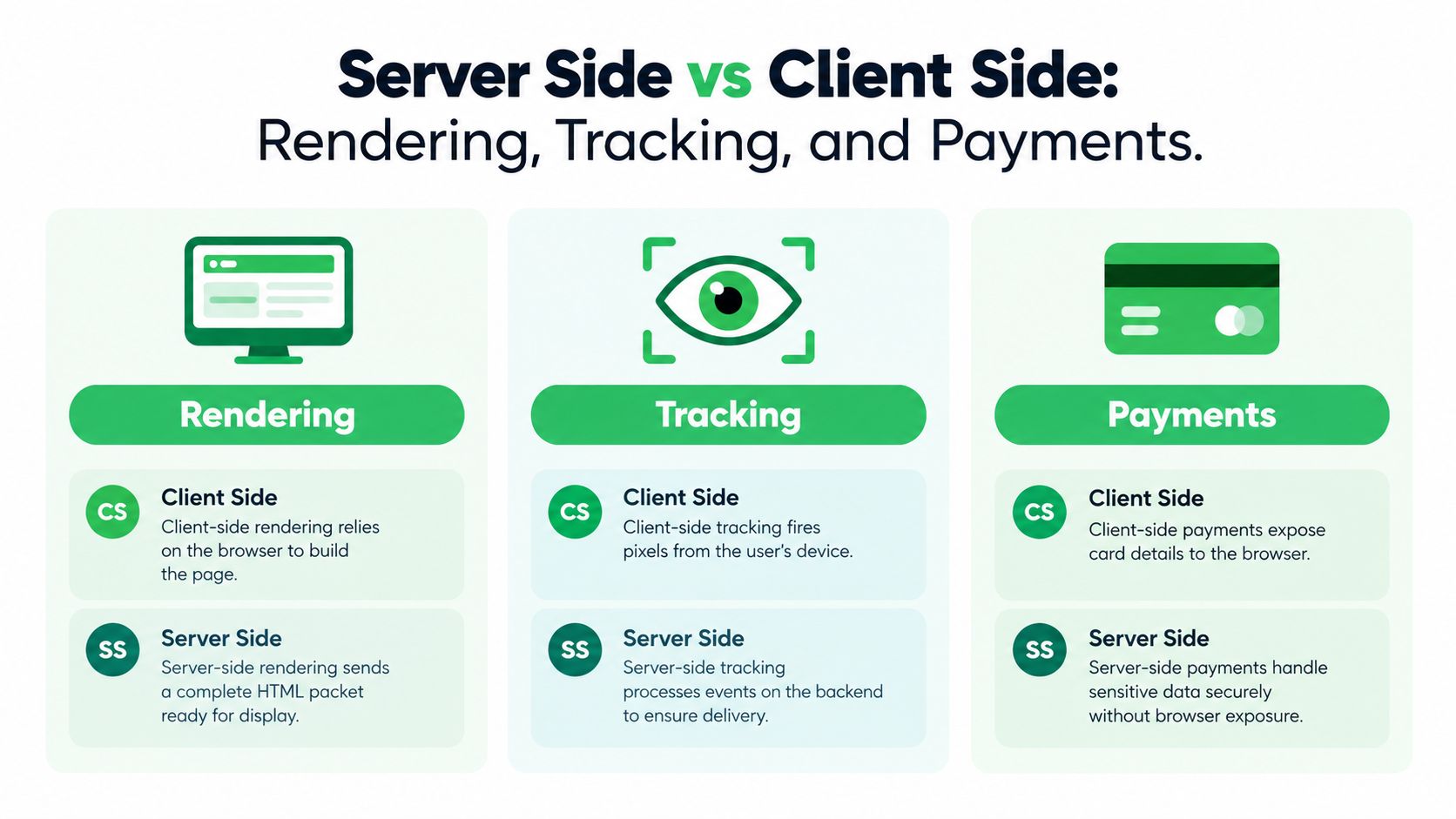
| Layer | Client-Side Focus | Server-Side Focus |
|---|---|---|
| Rendering | The browser builds or updates the interface with JavaScript | The server prepares HTML and sends content ready for display |
| Tracking | Pixels capture interaction and UI context from the device | Backend events capture durable actions from applications, billing systems, and processors |
| Payments | The browser collects payment details or initiates tokenization | The backend creates payment instruments, authorizes transactions, routes attempts, and receives webhooks |
Rendering is about perceived readiness
Client-side rendering can produce a highly interactive application after the browser downloads and executes its JavaScript. That model works well for application-like interfaces where frequent interaction matters, but it makes the browser responsible for assembling content before the page becomes useful.
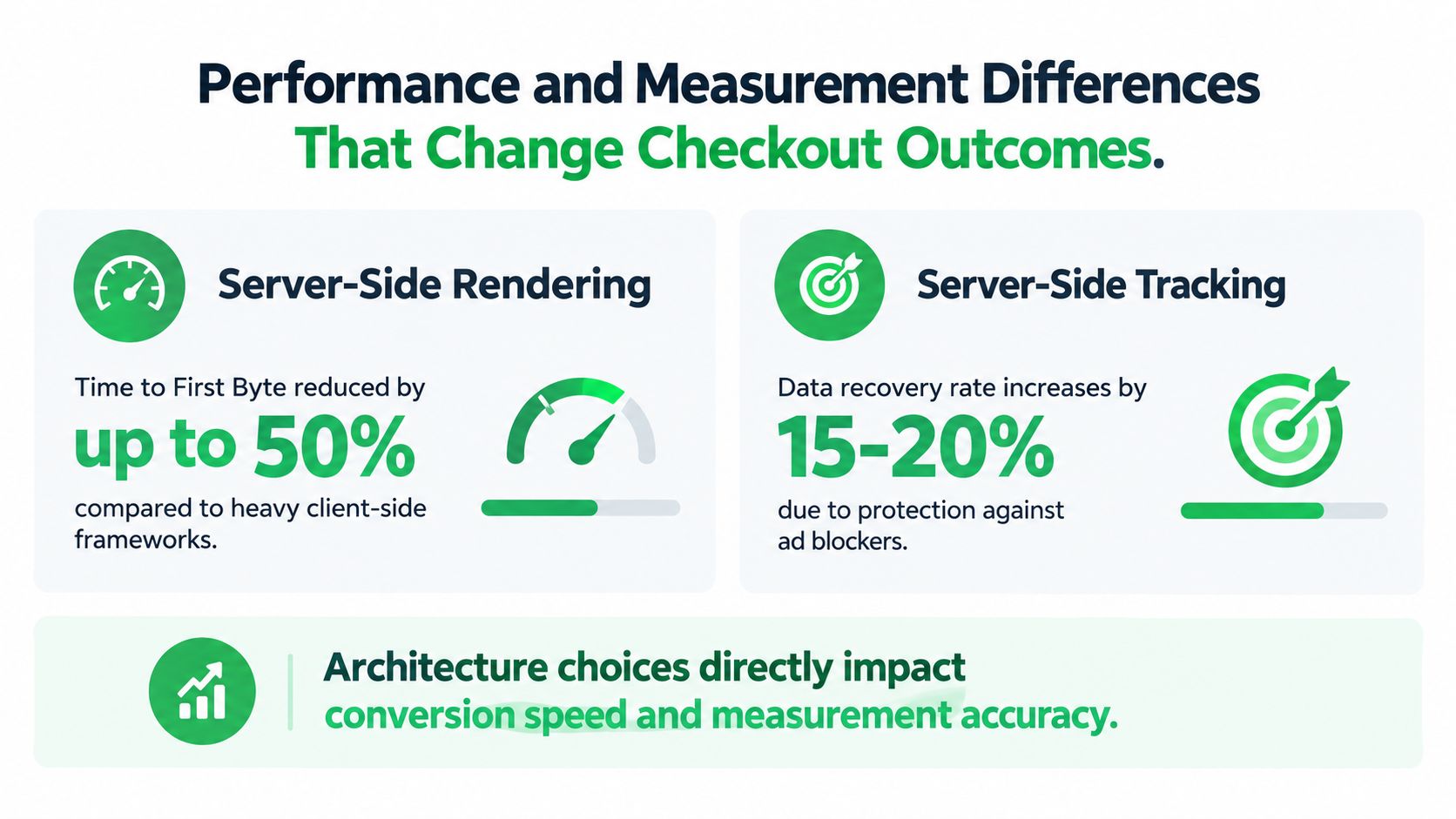
Server-side rendering sends more of the initial page from the backend. Under heavier data loads, a 2026 comparative study reported that SSR reduced Time to Interactive by a mean of 62.3% and Largest Contentful Paint by 58.7% compared with client-side rendering (comparative rendering study). That connection matters to ecommerce because a product or checkout page can become usable sooner when the browser has less assembly work.
Tracking divides context from authority
Client-side tracking sees the customer's environment and behavior. It can capture screen resolution, browser version, mouse clicks, scrolls, and other interaction signals. Server-side tracking is stronger for event reliability, privacy control, and transaction accuracy, but it typically loses much of that detailed UI context, as Snowplow's comparison of server-side and client-side tracking explains.
Payments need a deliberate handoff
Payment forms often use the browser to tokenize card details, reducing the exposure of sensitive data in the merchant's frontend. The server then uses the resulting payment instrument to process the transaction, apply routing logic, and receive processor notifications. A payment success screen is useful for the customer, but it shouldn't be the sole authority for the order state.
The decision is therefore event-specific. Keep behavioral signals in the browser, confirm money movement on the server, and use a shared order or customer reference to connect the two.
Performance and Measurement Differences That Change Checkout Outcomes
A page can respond quickly at the network layer and still feel slow to a buyer. That distinction is easy to miss when engineering teams focus on Time to First Byte rather than the moment when a customer can see and use the relevant content.
One published comparison found CSR had a lower TTFB of 120 ms versus 220 ms for SSR. Yet the SSR version delivered stronger user-facing metrics, with FCP moving from 1.9 seconds to 1.1 seconds, LCP from 3.0 seconds to 1.8 seconds, and TTI from 3.4 seconds to 2.3 seconds (rendering comparison from Netguru). The explanation is practical: a lightweight client-side shell can arrive quickly, while the browser still needs to download and execute JavaScript before the page becomes useful.
JavaScript cost shows up on weaker connections
The rendering model affects the amount of work a device must perform. A replication study of React Server Components reported an 82% reduction in JavaScript payload, from 1,315 characters to 237 characters, when rendering work moved server-side. The same study reported a 36.8% mean improvement in First Contentful Paint, a 30.4% improvement in Largest Contentful Paint, and a 49.7% reduction in Total Blocking Time, with the strongest benefit on slower networks such as 3G (React Server Components replication study).
For checkout, this can affect more than the first paint. Heavy scripts compete with payment widgets, validation, consent managers, experimentation code, and analytics tags. A customer who sees a form quickly but can't focus an input or submit it reliably experiences a slow checkout.
Measurement has its own performance failure
A browser event can fail because the customer changes tabs, loses connectivity, closes the page, blocks a tag, or never reaches the expected confirmation route. The payment can still complete. If the merchant trusts only the pixel, the system undercounts revenue and misclassifies acquisition performance.
Server-side confirmation doesn't replace the browser event. It gives the business a durable source for approved payments, renewals, recoveries, and refunds. The browser event can carry campaign and interaction context, while backend reconciliation prevents a missing pixel from becoming a missing order.
Faster rendering improves the chance that a customer completes checkout. Server confirmation improves the chance that the business can prove what happened.
Performance and measurement should be reviewed together. A fast page with fragile conversion reporting still creates bad decisions. A durable event pipeline attached to a sluggish checkout still loses customers before the payment request begins.
<iframe width="100%" style="aspect-ratio: 16 / 9;" src="https://www.youtube.com/embed/SM9RFYVKCDY" frameborder="0" allow="autoplay; encrypted-media" allowfullscreen></iframe>
Privacy, Compliance, and the Dual-Tracking Reality for Ecommerce
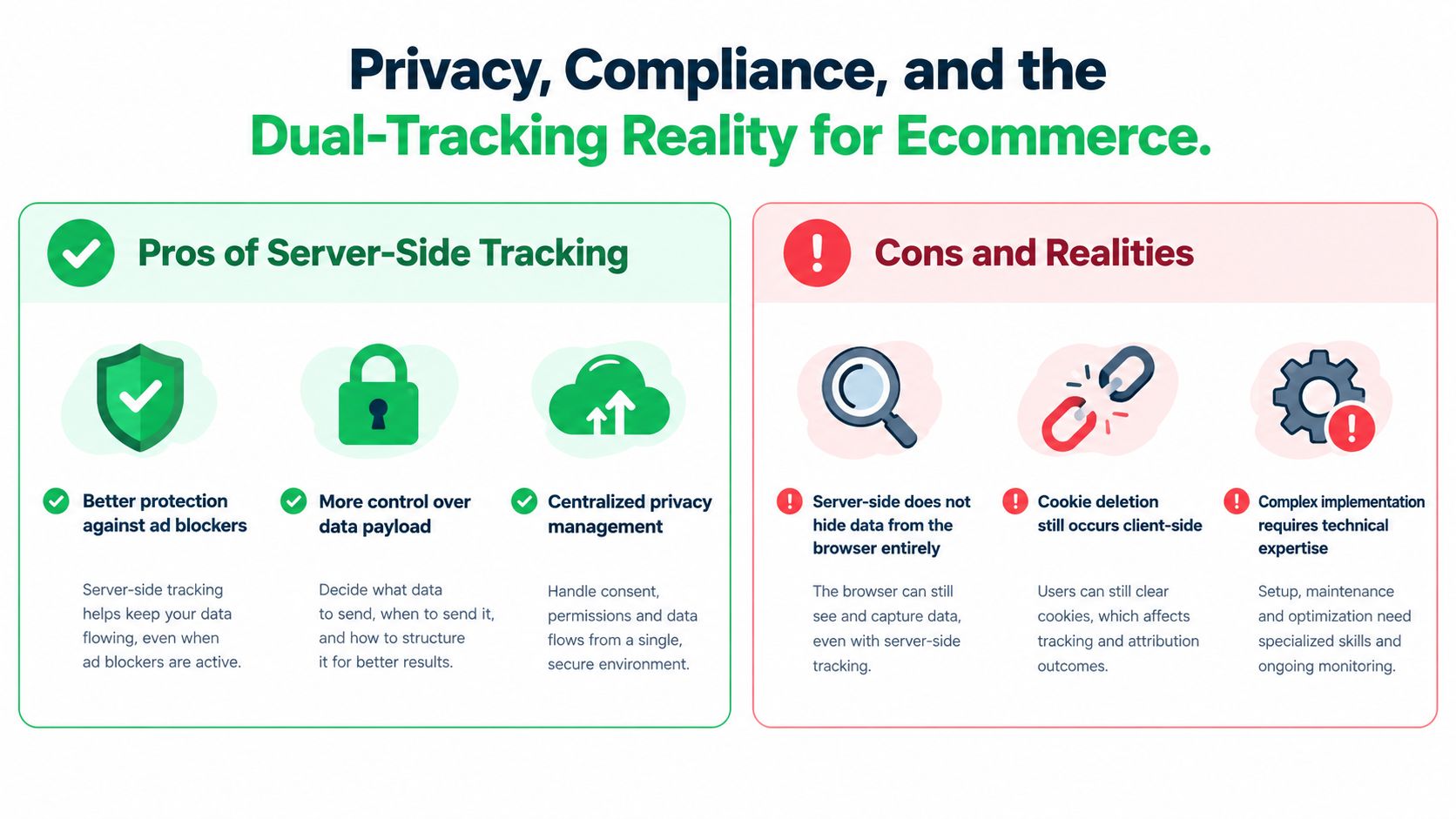
Server-side tracking isn't a privacy loophole. Moving an event from a browser tag manager to a backend doesn't remove the need for clear notice and explicit consent before collecting data. The organization still decides what information it collects, why it collects it, where it processes it, how long it retains it, and which vendors receive it.
That makes privacy architecture broader than pixel replacement. Current guidance emphasizes PII minimization, geographic processing controls, deduplication, and recovery of missed conversions, alongside consent management. A backend can reduce the payload sent from the browser and centralize controls, but it can't turn an unconsented event into a compliant one. Teams comparing regional requirements can use this resource on conformità cookie tra Europa e America to frame the differences between consent environments.
Behavioral context still belongs close to the user
A server receives the result of a transaction, but it doesn't naturally see every interaction that led there. Client-side signals remain valuable for:
- Funnel analysis: Identify where visitors hesitate, encounter validation errors, or abandon.
- Checkout UX: Observe field engagement, payment method selection, and interface friction.
- Experimentation: Preserve exposure and variant information for browser-based A/B tests.
- Product behavior: Understand clicks, scrolling, navigation, and device-specific interaction patterns.
Those signals need consent controls and careful data minimization. They also need a stable event identifier so a browser purchase and a server-confirmed purchase don't become two conversions.
Durable revenue events belong in the backend
The backend should receive events that define financial reality, including approved payment, renewal, failed attempt, recovery, refund, and cancellation. A server-side tag manager implementation can help centralize routing and governance, but it still needs an explicit consent state and a clear event contract. Google server-side tagging guidance provides useful implementation context for teams deciding which collection and forwarding responsibilities should move away from the browser.
The practical answer is dual tracking, not total replacement. Let the browser explain behavior. Let the server confirm revenue. Reconcile both streams using an order ID, subscription ID, event ID, timestamp, and consent state. If one stream is missing, the other still provides enough information to diagnose the gap without pretending that either layer contains the full customer story.
Implementation Patterns for Subscriptions, Chargebacks, and Payment Routing
Recurring commerce exposes weak tracking architecture quickly. A browser pixel can observe the initial checkout, but it won't be present for an automatic renewal. Renewal and rebill events should come from the billing system and webhooks, where they can map directly to the underlying subscription and transaction record. Authorization and recovery events should come from the processor or payment orchestration layer, not from a success page.
A reliable implementation separates event creation from event forwarding:
- Create the subscription server-side. Store the customer, subscription, order, processor, and payment method references together.
- Receive webhook notifications. Treat authorization, renewal, failure, recovery, refund, and cancellation messages as asynchronous events.
- Make handlers idempotent. The same webhook may be delivered again, so the event ID must prevent duplicate orders or duplicate conversions.
- Reconcile status. Compare the billing record, processor response, fulfillment state, and marketing event state.
- Forward approved events. Send only the event and customer data permitted by the consent and privacy policy.
A server-side tracking setup for ecommerce should be tested against retries, delayed webhooks, processor timeouts, and a customer who never returns to the site.
Chargebacks require an evidence chain
A chargeback is a formal bank or issuer process. The customer contests a payment, the merchant submits evidence, and the final resolution can take up to 60 days. Chargeback fees are non-refundable regardless of the outcome, according to Rebill's chargeback guidance.
The evidence chain should connect the transaction to:
- Authorization details: The payment attempt, processor response, and billing agreement.
- Customer intent: The checkout record, consent state, terms presented, and subscription disclosure.
- Fulfillment: Delivery records, login activity, download access, or service usage.
- Communication: Renewal reminders, receipts, cancellation requests, and support responses.
- Lifecycle status: Retries, dunning actions, refunds, and cancellation timing.
Client-side behavior can strengthen the context, but server-side records should preserve the core proof even after cookies expire.
Routing needs one transaction identity
Multi-processor routing adds another failure mode if each PSP uses different identifiers. Keep a merchant-side transaction ID constant while storing the processor attempt ID, route decision, response code, and retry sequence as related records. That lets the system distinguish a declined attempt from a successful recovery and prevents marketing platforms from counting both as separate purchases.
For subscription merchants, route decisions should also account for renewal behavior, local payment methods, processor availability, and risk rules. A renewal isn't a new browser checkout. It's a server-controlled financial event that needs its own routing and reconciliation path.
Use Cases That Determine Which Layer Wins
The right architecture changes with the question the business is asking. A single-layer answer usually fails because ecommerce teams need both behavioral explanation and transactional proof.
| Use case | Primary layer | Why |
|---|---|---|
| Button clicks, scrolls, and form interaction | Client side | The browser sees the interaction context |
| Approved purchase and refund | Server side | The payment system owns the financial state |
| Subscription renewal and rebill | Server side | Billing systems and webhooks operate without a browser session |
| Checkout UX optimization | Both | Browser behavior explains friction, server data confirms revenue |
| A/B test exposure and conversion | Both | The browser records exposure, backend events validate the outcome |
| International routing and failover | Server side | Routing must happen consistently across attempts |
| Funnel drop-off analysis | Client side, with server reconciliation | Interaction data explains where users leave, payment data prevents false conclusions |
| Chargeback preparation | Server side, enriched by client context | Evidence must remain available after the session ends |
A/B testing is a good example. Client-side exposure data tells the team which variation the visitor saw and how they interacted with it. The final conversion should be validated against the backend, especially when the purchase triggers a redirect, a delayed processor response, or an asynchronous subscription creation.
Subscription businesses should give server-side systems authority over billing lifecycle events. They should still retain client-side signals for product engagement, checkout usability, and experiment analysis. High-risk merchants need the same split, with extra attention to disclosure records, cancellation mechanics, consent documentation, and processor reporting.
Choose the layer that can still answer the question after the browser is gone.
International payment routing and multi-processor failover make this especially clear. The browser can request a payment method, but the server should select and record the route, handle the response, and decide whether a retry is safe. Otherwise, the merchant risks losing the relationship between the customer's action and the processor's final result.
Practical Recommendations and Decision Framework
Start with the revenue events, not the technology label. List every event that affects money, customer access, attribution, or compliance. Then assign an authoritative source and a recovery path.
Build the event map first
For each event, record five fields:
- Business meaning: What happened, such as an approved initial payment, renewal, recovery, refund, or cancellation.
- Authoritative system: Billing platform, processor, checkout backend, browser, or support system.
- Required context: Campaign, experiment, device, consent, customer, subscription, and order references.
- Forwarding destinations: Analytics, advertising, CRM, fulfillment, risk, and finance systems.
- Reconciliation rule: How the organization detects missing, duplicated, delayed, or conflicting events.
This map exposes weak assumptions quickly. If “purchase” exists only as a browser pixel, the merchant has no durable confirmation. If “checkout abandonment” exists only on the server, the team lacks the interaction detail needed to improve the form.
Use a layered operating model
A practical model looks like this:
- Render for the experience. Use server-side rendering where initial content and performance matter, while keeping client-side code for interactions that genuinely require it.
- Capture behavior in the browser. Collect consented interaction signals with identifiers that can connect to the order.
- Confirm revenue on the server. Use billing records, processor responses, and webhooks for purchases, rebills, retries, refunds, and cancellations.
- Deduplicate centrally. Treat event IDs and merchant-side transaction IDs as first-class data, not optional metadata.
- Reconcile continuously. Compare checkout attempts with processor outcomes, subscription records, fulfillment, and reported conversions.
- Test failure paths. Close the browser, block scripts, delay webhooks, reject a card, recover a renewal, and simulate a dispute workflow.
Tagada offers one example of this orchestration approach. Its platform combines checkout, payment routing, subscription management, dunning, and server-side event delivery, while supporting browser-side tokenization and backend processing across processors such as Stripe, Adyen, and NMI.
The strongest architecture isn't purely server-side or purely client-side. It's a coordinated system in which the browser records why a customer acted, the server confirms what happened, and the payment layer preserves the transaction through renewals, retries, and disputes. Merchants that align those responsibilities get cleaner attribution, more dependable billing data, stronger evidence, and fewer silent gaps between a successful payment and the report that should contain it.
If your subscription or ecommerce stack still depends on a browser pixel to confirm revenue, Tagada can help you connect checkout, payment routing, webhooks, subscription events, dunning, and server-side tracking in one operating layer. Visit Tagada to map your critical events, protect renewal attribution, and build a payment flow that remains reliable after the customer leaves the browser.