
Most ecommerce advice treats an upsell cart drawer as an automatic upgrade: replace the cart page, keep shoppers in the browsing flow, and add a few recommendations. That advice is incomplete. A drawer can raise cart value while reducing completed purchases, especially on mobile, and a successful upsell can still fail to become captured revenue if payment routing, fraud screening, or subscription billing can't handle the changed transaction.
The right question isn't whether a drawer looks modern. It's whether the entire path, from recommendation to authorization to rebill, removes more friction than it introduces. Shopify ecosystem benchmarks place cart drawer offers around 2% to 8% in typical conversion or take rate, with several benchmark ranges clustering around 2% to 5% or 3% to 7%, depending on the offer and merchant setup (UpsellPlus analytics guidance). That makes the drawer a meaningful monetization surface, but not a license to compromise checkout.
The Mobile vs Desktop Drawer Dilemma
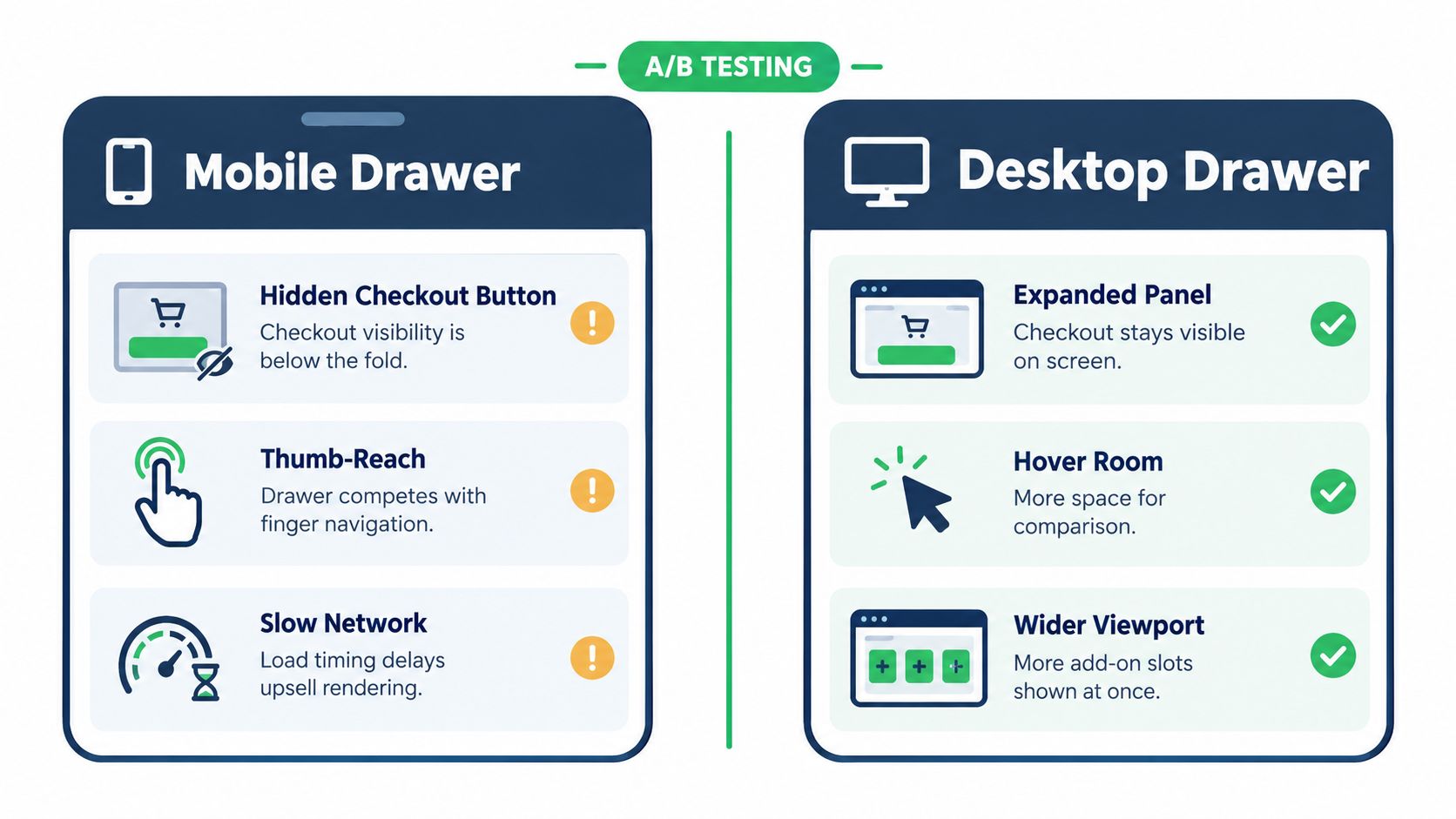
The popular assumption is that a slide-out cart is universally better than a full cart page. It isn't. One A/B analysis reported a -8.4% change in mobile conversion alongside a +17% change on desktop after introducing a cart drawer (Ecomhint's cart drawer comparison). The result is a useful warning: the same interface can remove friction for a mouse user and create friction for a thumb user.
Why the same drawer behaves differently
Desktop shoppers usually see more of the panel at once. The checkout button can remain visible while the shopper compares an add-on, reviews quantities, and reads delivery information. A mobile drawer has less vertical space, so recommendations can push the primary CTA below the fold. The shopper then needs an extra gesture to reach checkout, while the overlay may compete with browser navigation, sticky store elements, and the thumb's natural reach.
Network conditions add another layer. If the drawer renders the cart immediately but loads recommendations, pricing, inventory, and payment messaging afterward, the shopper sees a shifting interface. Layout movement makes the experience feel unreliable, even when every component eventually works.
Published Shopify commentary places cart drawer upsell acceptance around 5% to 12% in one benchmark set and estimates the drawer reaches about 40% of visitors, while another estimate associates replacing the default cart page with a cart-to-checkout lift of 5% to 12% on mobile and 3% to 7% on desktop (Cartly Labs' Shopify cart drawer analysis). Those figures shouldn't override your own testing. They show why the placement matters, not that every implementation will win.
Practical rule: A drawer is a hypothesis about friction, not a best practice you can install without segmentation.
Choosing the architecture
Start with device-level reporting, then examine catalog and order complexity. A small catalog with simple quantities and familiar products can suit a drawer. A store selling configurable products, subscriptions, bundles, gift options, or regulated goods may need the space and deliberation of a full cart page.
A hybrid setup often makes more sense:
- Use the drawer for speed: Open it after add-to-cart, expose one relevant add-on, and let the shopper continue browsing.
- Keep the full cart available: Give shoppers a clear route to a dedicated page when they need to edit variants, review terms, or inspect a complex order.
- Test mobile independently: Do not combine desktop and mobile into one experiment result. Measure cart-to-checkout progression, completed purchase, and drawer-close behavior by device.
- Protect the primary action: If the checkout CTA disappears below the fold on common phone sizes, treat that as a defect rather than a merchandising choice.
The safest rollout is not “drawer everywhere.” It's a device-segmented experiment with a rollback path, a persistent full-cart option, and success criteria tied to captured orders rather than accepted offers alone.
Designing for Relevance and Checkout Visibility
The drawer earns its space when it answers a specific customer need. A generic recommendation carousel asks the shopper to browse again at the moment they're trying to finish. A relevant add-on, shown with a clear reason and a one-click action, can increase order value without turning checkout into another product-discovery page.
The quality gap is substantial. One benchmark-style source says roughly 52% of desktop sites display cross-sells that are irrelevant or based only on what other customers bought (Ecomhint's cross-selling and bundling analysis). Another source reports AI-selected cart suggestions at 3.8% add-to-cart versus 1.56% for manually curated recommendations, more than double in that comparison (Ecomhint's cart drawer guidance). Treat those figures as directional benchmark evidence, not a promise for your catalog.
Build the offer around the cart
Recommendation logic should use more than product popularity. Map the offer to the cart's contents, price context, and customer stage.
- Complement the selected product: Pair a camera with a compatible accessory, or a replenishable product with a related item the customer is likely to use alongside it.
- Respect order value: A low-value cart needs a low-friction add-on. A premium cart may support a protection plan, upgrade, or bundle, but the offer must still explain its value.
- Separate first purchase from replenishment: A new customer may need education and reassurance. A returning subscriber may respond better to a remembered replenishment or a subscription option.
- Suppress conflicts: Hide an offer when the item is already in the cart, unavailable in the customer's market, incompatible with the selected variant, or already included in a bundle.
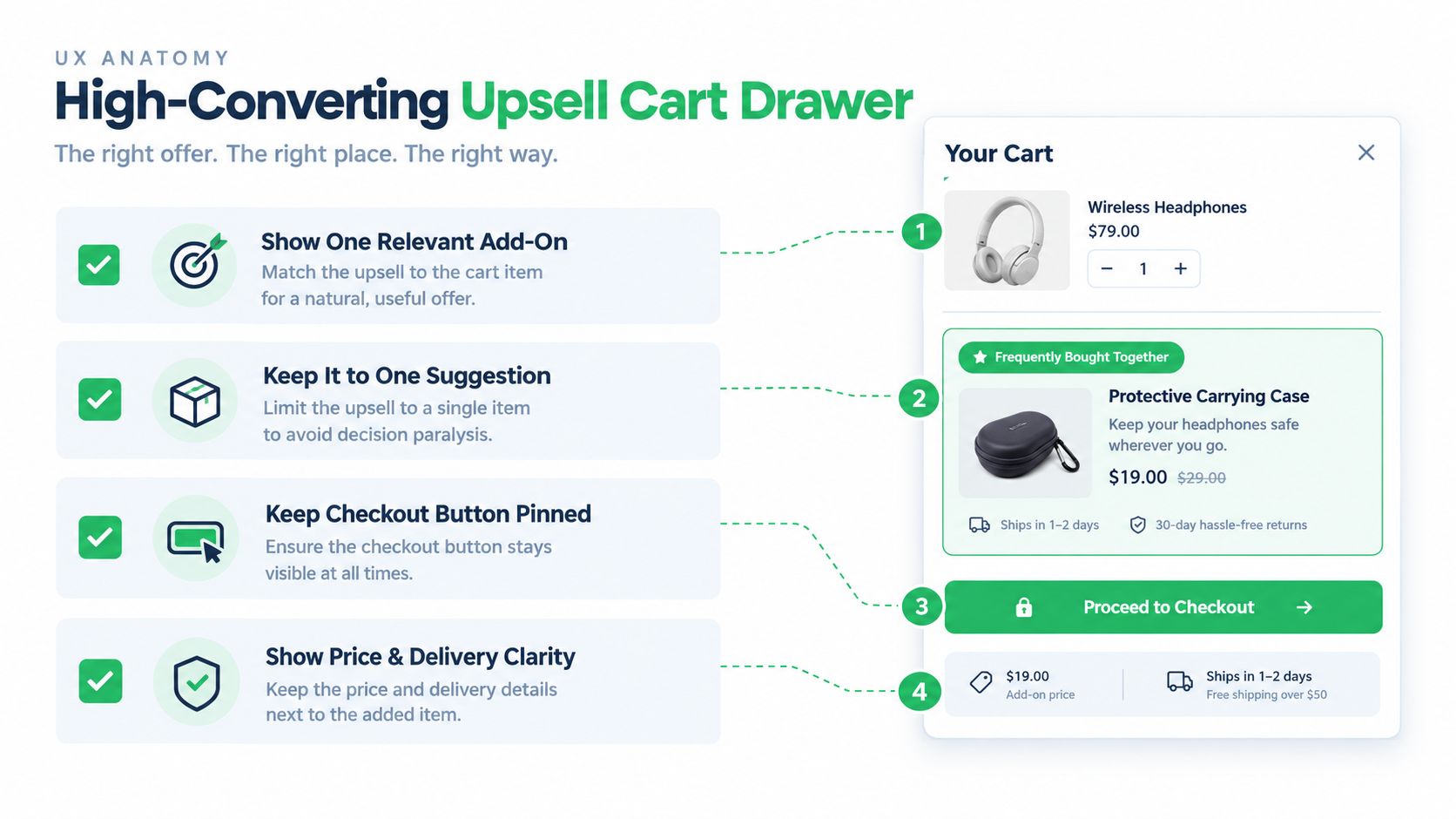
The drawer shouldn't expose every possible rule. It should present the result of those rules in a compact decision. Public guidance commonly recommends 1 to 3 highly relevant suggestions, while stronger mobile implementations often narrow that down to one primary offer (Metricuno's cart drawer UX guidance). The choice depends on screen size and catalog complexity, but the principle is consistent: reduce comparison work.
Keep checkout visible while the cart changes
A good drawer has a stable hierarchy. Cart contents come first, the recommendation sits below or beside them without displacing the purchase path, and the checkout CTA remains visible. Price, variant, delivery implications, and any recurring terms should appear next to the offer, not behind another product page.
One-click add should update the cart asynchronously, preserve scroll position, refresh totals, and avoid reopening or jumping the drawer. If an add-on requires variant selection, show only the necessary selector inline. Don't send the customer away unless the product requires configuration.
For a deeper treatment of the final purchase path, use this checkout flow resource. The same discipline applies here: every extra interaction needs a reason, and every dynamic update needs to preserve orientation.
Technical Integration and Payment Routing
A front-end upsell is only half an implementation. The drawer must synchronize with the store backend, recalculate the order, pass the updated payload to the payment layer, and preserve fraud and tax logic. If the add-on changes the subtotal but the payment request still reflects the original cart, the interface has created a promise the order system can't fulfill.
The event sequence should be explicit:
- Add the offer: Record the offer ID, source placement, product variant, price, and customer session.
- Sync the cart: Revalidate inventory, discounts, shipping eligibility, tax, and subscription selling plans on the server.
- Refresh the payment intent: Pass the authoritative total to the processor rather than trusting a browser-side amount.
- Run risk checks again: A higher subtotal or a different product mix can alter fraud signals and payment routing.
- Confirm the order: Store the upsell as a distinct line item so fulfillment, refunds, analytics, and customer support can identify it.
The payment layer needs the same care as the recommendation layer. Merchants may route transactions across Stripe, Adyen, and NMI, or use native processing with smart retries and local payment methods. Routing should consider geography, currency, card type, recurring status, processor health, and risk profile. A larger cart total can change authorization behavior, so don't assume the original route remains optimal after the upsell.
For implementation teams reviewing tokenization, webhooks, retries, and reconciliation, these payment processing integration tips provide useful technical context. Keep the checkout state idempotent, especially when a customer taps twice or a network response arrives late.
Payment rule: Never measure an upsell as successful at “added to cart.” Measure it at authorized, captured, fulfilled, and, where relevant, successfully rebilled.
Installment messaging and express checkout also belong in the architecture discussion. One documented cart drawer setup supports installment configuration, provider selection, provider branding, and express checkout buttons (Cartly Pro's custom cart drawer guide). Those controls should be driven by eligibility and the final cart total, not displayed as static decoration.
A dynamic routing strategy deserves its own technical review, particularly where multiple processors share customer and subscription data. This dynamic payment routing guide is a relevant reference for teams designing that layer.
<iframe width="100%" style="aspect-ratio: 16 / 9;" src="https://www.youtube.com/embed/22qamcR2eOc" frameborder="0" allow="autoplay; encrypted-media" allowfullscreen></iframe>
Tailoring Drawers for Subscriptions and Digital Goods
Subscription commerce turns a cart drawer into a billing decision point. The shopper is choosing whether an item is charged once, attached to an existing subscription, or created as a new recurring line. Those states must be visible before payment, because a persuasive offer that creates billing ambiguity can increase support contacts, refunds, and disputes.
Recharge's cart early adopter documentation describes a flow in which adding a one-time product with subscription selling plans opens the drawer, shows the subscription option, updates the cart when the shopper converts, and hides the upsell for products already added as subscriptions. The implementation principle is clear: subscription eligibility belongs in cart logic, not only in merchandising copy.
Subscription implementation
Display the billing interval, price, renewal behavior, and cancellation terms beside the subscription control. If the cart already contains a subscription item, explain whether the offer creates a separate subscription or changes the existing one. A short label can prevent a costly misunderstanding.
Dunning and retry systems also need accurate line-item data. An upsell that changes a recurring order can affect future invoices, fulfillment timing, taxes, and customer communication. Reconcile the initial order with the subscription record before sending confirmation. If a renewal fails, the recovery workflow should identify the intended recurring charge rather than repeatedly attempting an offer the shopper never agreed to rebill.
Smart retries combined with dunning can recover 45% to 70% of failed subscription payments, according to Rebill's subscription payments guidance. The practical requirement is broader than that range. The drawer must pass reliable billing metadata into the recovery system, so later messages distinguish a failed recurring payment from an abandoned one-time cart. Retry timing, processor response codes, and the customer's payment method should remain available to the billing workflow.
Digital goods and high-risk products
Digital goods support immediate fulfillment, so an add-on can be framed around use instead of shipping. A course buyer might receive an offer for a relevant template, downloadable companion, or implementation pack. Automate delivery, verify entitlement, and prevent duplicate access when the shopper taps the offer twice or a delayed response creates duplicate cart events.
High-risk merchants need restrained presentation. Avoid aggressive claims, unclear continuity terms, and surprise recurring add-ons. Show the descriptor, refund policy, product identity, and billing cadence before payment. For chargeback-sensitive businesses, record consent and preserve the exact offer version displayed at purchase.
Chargeback costs can change the economics of a low-margin upsell. Rebill's chargeback guidance lists non-refundable fees that vary by market, including USD 15 for cross-border and USD 15 for domestic US payments. If an impulse offer raises dispute volume without creating durable customer value, its added cart value may not translate into captured revenue.
International merchants must also match payment presentation to routing. Whop's online payments guide cites ecommerce average approval at about 85% and connects stronger approval with local acquiring, local currency, familiar methods, and richer transaction data. A drawer can recommend the right product and still lose the order if the final transaction reaches the wrong processor or lacks the data needed for smart retries. Payment routing belongs in the upsell design, not after it.
A/B Testing and Analytics for Captured Revenue
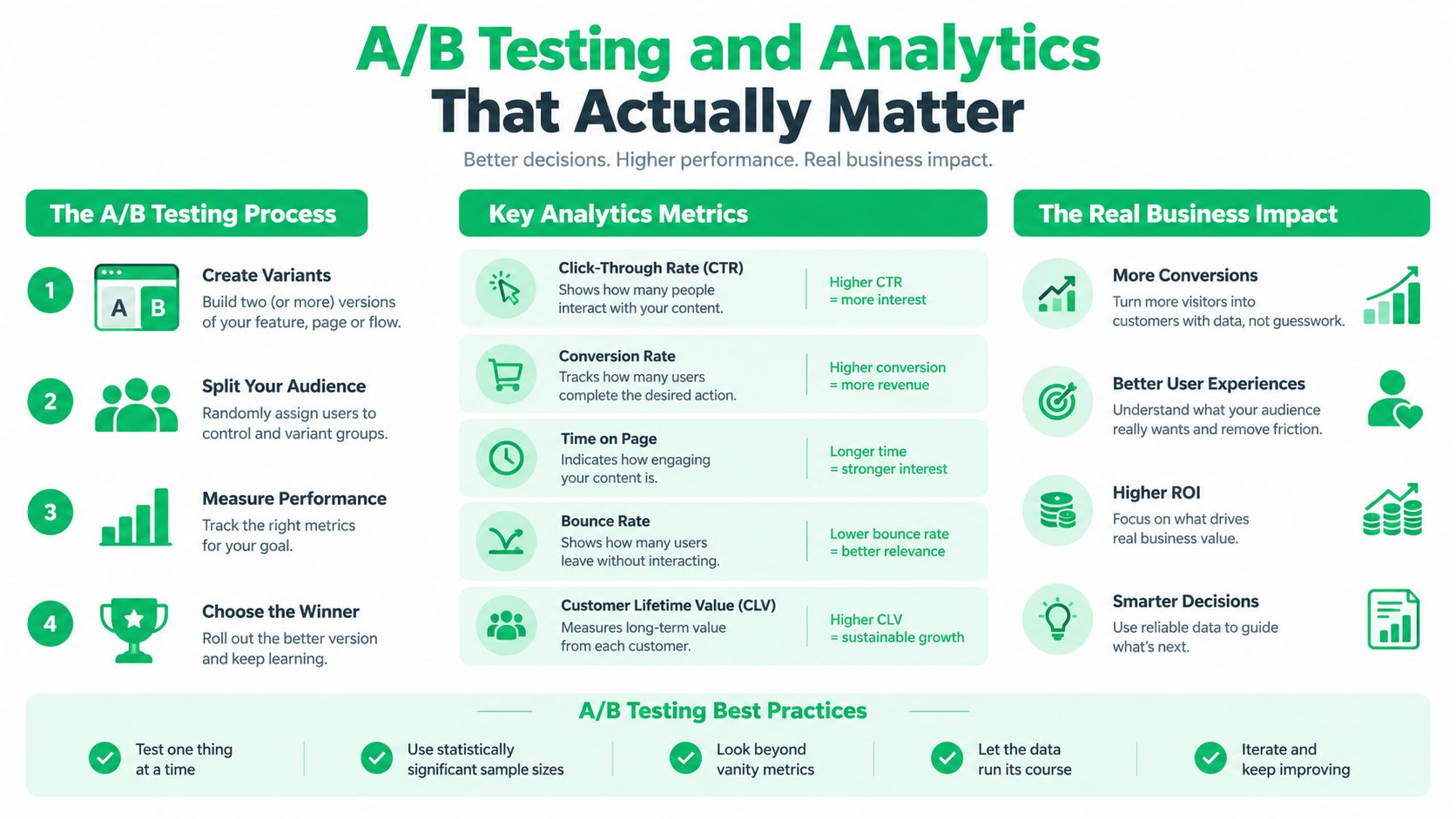
An accepted upsell becomes revenue only after the order captures. A drawer may raise attach rate while reducing checkout starts, increasing dismissals, or triggering payment failures. Test against the current customer journey, not merely another recommendation layout. The control must preserve the existing drawer, cart synchronization, checkout route, and payment behavior.
Define the complete measurement chain
Track each event against a stable session and order identity:
- Impression: The drawer and offer rendered successfully.
- Interaction: The shopper viewed, expanded, dismissed, or selected the recommendation.
- Attach: The added line item was accepted and remained after cart synchronization.
- Checkout initiation: The shopper reached the payment step with the updated cart.
- Authorization and capture: The processor approved and captured the final amount.
- Post-purchase outcome: The order was fulfilled, refunded, disputed, or sent to recovery.
Report attach rate, AOV lift, drawer-close rate, checkout click-through, completed-purchase progression, and captured revenue. Compare mobile results with the appropriate category and traffic mix rather than applying one universal target. Cart value is an early signal. Captured revenue is the decision metric.
Segment before interpreting
Start with separate mobile and desktop cuts. Then segment by traffic source, customer status, cart value, product family, payment method, and subscription intent. A recommendation may suit returning customers while distracting first-time visitors, or lift acceptance on high-value carts while causing smaller carts to stall. Mobile drawer height, sticky controls, and express-wallet behavior can change the result independently of the offer itself.
Use guardrails. If attach rate rises while checkout initiation falls, the offer is diverting shoppers from the primary path. If checkout initiation holds but capture declines, inspect payment-intent updates, processor routing, fraud rules, smart-retry eligibility, and express-checkout compatibility. If a sticky CTA raises mobile close rate, verify whether it obscures cart content or creates accidental taps.
Dynamic carts also require server-side event capture. Browser pixels can miss drawer state changes without a page load, while client-side retries can create duplicate events. Send authoritative cart, order, authorization, and capture events from the backend, then connect Meta, TikTok, and GA4 through a controlled event model. Automatic pixel firing can support campaign reporting, but backend reconciliation should determine whether revenue was captured.
Teams assessing test infrastructure can compare these A/B testing tools. The platform matters less than the operating discipline: change one meaningful variable, preserve the control, segment results, and judge the outcome at captured revenue rather than added cart value.
Orchestrating Revenue Beyond the Cart
The upsell cart drawer shouldn't operate as an isolated widget. A customer who accepts an offer creates fulfillment work, payment metadata, support context, and messaging opportunities. A customer who closes the drawer creates a different signal, one that may inform recovery without treating hesitation as consent.
Consider a subscription brand selling a replenishable product. The drawer offers a compatible one-time item, the customer adds it, and the backend updates the order without changing the recurring plan. The confirmation message names both line items, fulfillment receives the correct shipment instruction, and a later renewal message reflects only what the customer agreed to rebill. If the payment fails, dunning uses the billing event rather than a generic abandoned-cart email.
A digital seller has another path. The drawer can offer an instant-access companion product, grant entitlement after capture, and send a delivery message only when the payment event confirms success. If the shopper declines, the brand can use the session signal to personalize a later message, but it shouldn't imply that the customer purchased or reserved the offer.
This orchestration requires shared state across storefront, checkout, payment, and messaging systems. Fragile webhooks and disconnected app logic often create duplicate orders, stale totals, missing pixels, and contradictory customer emails. A unified layer can instead expose the same cart and payment status to a visual funnel builder, headless browser SDK, Node SDK, analytics pipeline, and messaging system.
Tagada is one option in this category. Its platform combines checkout, payment routing, messaging, funnel building, upsells, subscription management, dunning, server-side tracking, and chargeback-aware risk handling, while its products can also be used independently. The relevant architectural idea isn't the drawer itself. It's the ability to connect the drawer's decision to authorization, fulfillment, recovery, and retention.
The strongest implementation treats every interaction as part of a revenue state machine:
- Accepted and captured: Fulfill the line item and send accurate confirmation.
- Accepted but declined: Retry or reroute according to payment policy, without duplicating the order.
- Viewed and rejected: Keep the customer journey clean and avoid repetitive offers.
- Closed before checkout: Record the signal for measured recovery, not aggressive targeting.
- Subscribed: Pass the correct plan and cadence to future billing and dunning.
That approach turns an upsell from a decorative cart component into an accountable commercial workflow. The drawer earns its place only when it improves the path to captured, supportable, and repeatable revenue.
Tagada gives ecommerce and subscription teams a unified layer for checkout flows, cart upsells, payment routing, smart retries, local payment methods, subscriptions, dunning, messaging, and server-side tracking. If your drawer is adding cart value but losing revenue at authorization or rebill, visit Tagada to explore a checkout and payment architecture built around the full revenue path.