
You're probably in one of two situations right now.
Traffic isn't the problem. Your brand is getting visitors, paid media is holding steady, and the top-line story looks fine until you open the funnel and see orders leaking out late in the journey.
Or traffic is expensive enough that you've stopped pretending more sessions will solve everything. You need the visitors you already paid for to turn into buyers, subscribers, and approved payments.
What Conversion Rate Optimization Really Means
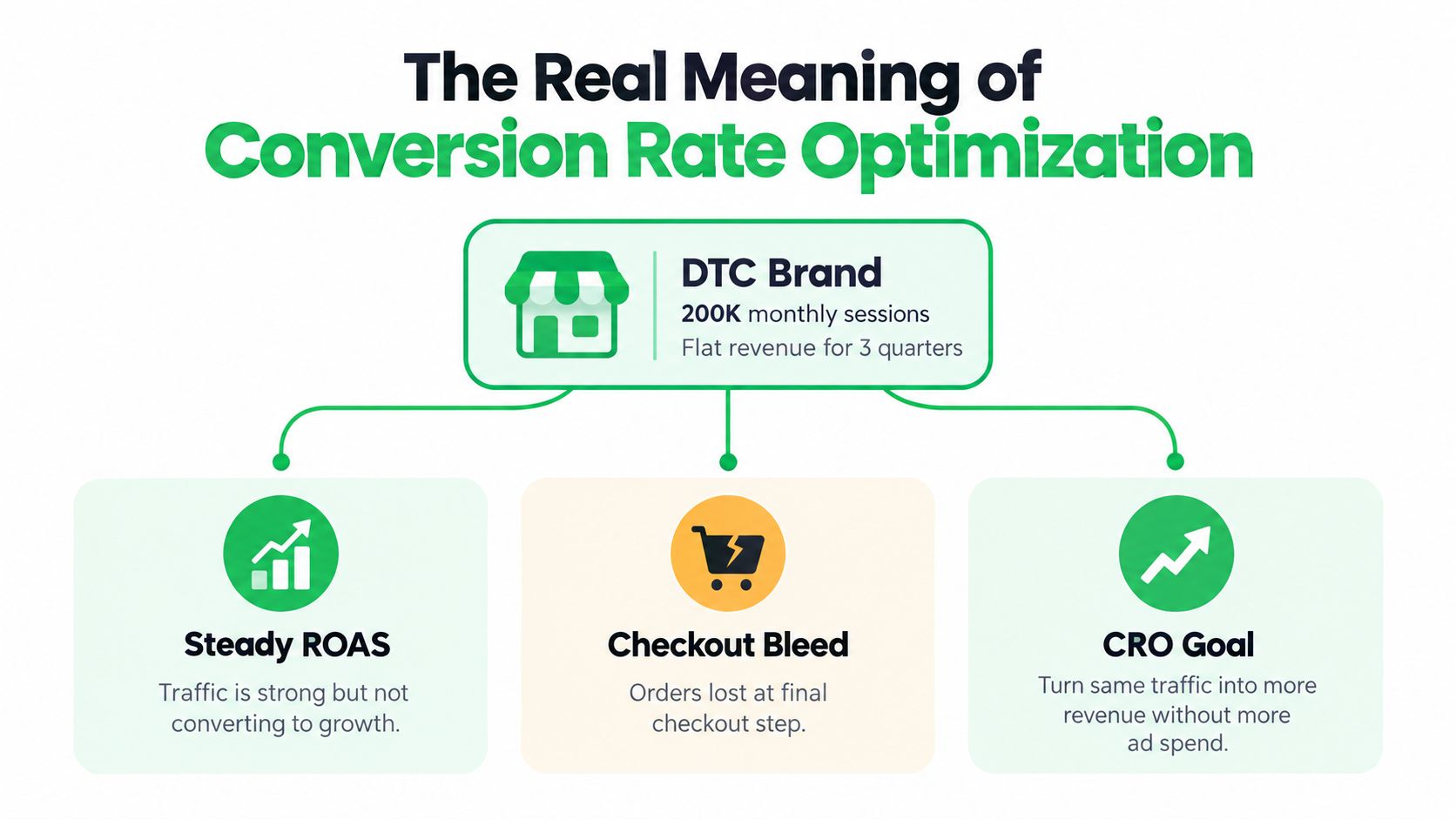
A founder checks the dashboard and sees 50,000 sessions, healthy add-to-cart volume, and a checkout completion rate that looks passable at first glance. Then the month closes, approved revenue comes in light, and renewals miss plan because too many rebills fail. That is still a conversion problem.
Conversion rate optimization is the practice of increasing the share of visitors or customers who complete a valuable action, then proving which changes caused the lift. The basic math is simple. Conversion rate = (conversions ÷ visitors) × 100. If 100 people visit and 3 buy, your conversion rate is 3%, which matches the standard definition summarized in Shopify's CRO statistics overview.
The mistake early teams make is treating CRO like a page polish project. They run tests on headlines, button labels, or hero images while money is leaking later in the funnel. For a DTC or subscription brand, CRO is closer to operating a pipe system. Product pages, checkout, card authorization, fraud controls, retry logic, and renewal recovery all sit on the same line. If pressure drops at any point, revenue drops at the end.
For operators, the practical definition is tighter. Get more approved revenue from the traffic and customer demand you already have.
That changes what you watch. A cleaner product page can help. So can faster mobile checkout. But if checkout starts are healthy and authorization rates are weak, the highest-return CRO work may sit with payment routing, card updater coverage, issuer messaging, or dunning logic. Many guides skip that because it feels less visible than a landing page test. It usually matters more.
Benchmarks help, if you read them like an operator
Benchmarks give you context, not a target you copy blindly. Published ecommerce ranges often cluster around the low single digits, and audited test datasets show a wide spread based on traffic quality, catalog, device mix, and checkout design, as reported in ConversionTeam's ecommerce conversion rate benchmarks.
The useful lesson is not the exact number. It is that mature stores rarely find one giant fix. They stack gains. A small lift on product-page progression, a small lift on checkout completion, and a small lift on payment approval can compound into meaningful revenue growth.
What CRO includes, and what it does not
CRO includes measurement, hypothesis building, testing, checkout analysis, payment performance, and post-purchase recovery. It covers the full path from visit to approved order, and for subscription brands, from first payment to successful rebill.
SEO, paid media, and brand creative still matter. They create demand and bring qualified people in. CRO handles what happens after that demand shows up, and whether it turns into collected revenue instead of abandoned carts, declined cards, or failed renewals.
The Core Metrics Every CRO Program Watches
If you only watch sitewide conversion rate, you'll miss the reason it moved. Good operators read CRO from the top down, then from the inside out.
Start with the headline metric. Then pressure-test it with the supporting numbers that reveal whether your lift is real, fragile, or coming from the wrong place.
The dashboard that matters
| Core CRO Metrics at a Glance | Formula | Healthy Range |
|---|---|---|
| Conversion rate | (conversions ÷ visitors) × 100 | Ecommerce benchmarks often land around 2.5% to 3.0%, though some broader measurement approaches report around 1.6% to 2.0% |
| Average order value | revenue ÷ orders | Varies by catalog and price point |
| Lifetime value | cumulative revenue per customer over time | Varies by retention model |
| Bounce rate | single-page sessions ÷ total sessions | Depends heavily on traffic intent and page type |
| Funnel conversion rate | next-step completions ÷ prior-step entrants | Depends on each funnel stage |
| Approval rate | approved transactions ÷ submitted transactions | Varies by processor, issuer, market, and risk profile |
Read the numbers in context
Conversion rate is the headline because it tells you how efficiently traffic becomes action. But it can hide a lot. A store can post a decent sitewide rate while mobile checkout underperforms, or while approved payments lag behind completed checkouts.
Average order value matters because revenue growth doesn't come only from more buyers. Sometimes a cleaner cart, better bundle design, or smarter post-purchase offer increases revenue even when the purchase rate barely moves.
Lifetime value becomes the north star when you run subscriptions or repeat-purchase products. A first purchase that looks marginal on day one may be excellent if the customer stays, renews, and buys again.
Here's where newer teams get tripped up:
- A solid conversion rate can mask weak order quality. If a store lifts purchases but average order value falls, total revenue may not improve much.
- A strong first order can hide weak retention. Subscription brands need to separate acquisition from renewal health.
- A checkout completion number can look clean while payment approvals are weak. That's common in high-risk and cross-border setups.
Don't ask only, “Did more people click buy?” Ask, “Did more approved revenue land, and did those customers stick?”
Match the metric to the business model
Different models need different north stars.
- Catalog DTC brands usually care most about conversion rate plus average order value.
- Subscription businesses care most about lifetime value, renewal recovery, and failed-payment recovery.
- High-risk merchants often need to watch approval rate and chargeback exposure as closely as the front-end funnel.
That's why serious CRO dashboards stack behavioral metrics, checkout metrics, and payment metrics together instead of treating them as separate teams' problems.
Where Conversion Leaks Actually Start
A shopper adds to cart, starts checkout, enters a real card, and still does not become revenue. That failure can happen in more than one place, and standard funnel reports usually show only part of it.
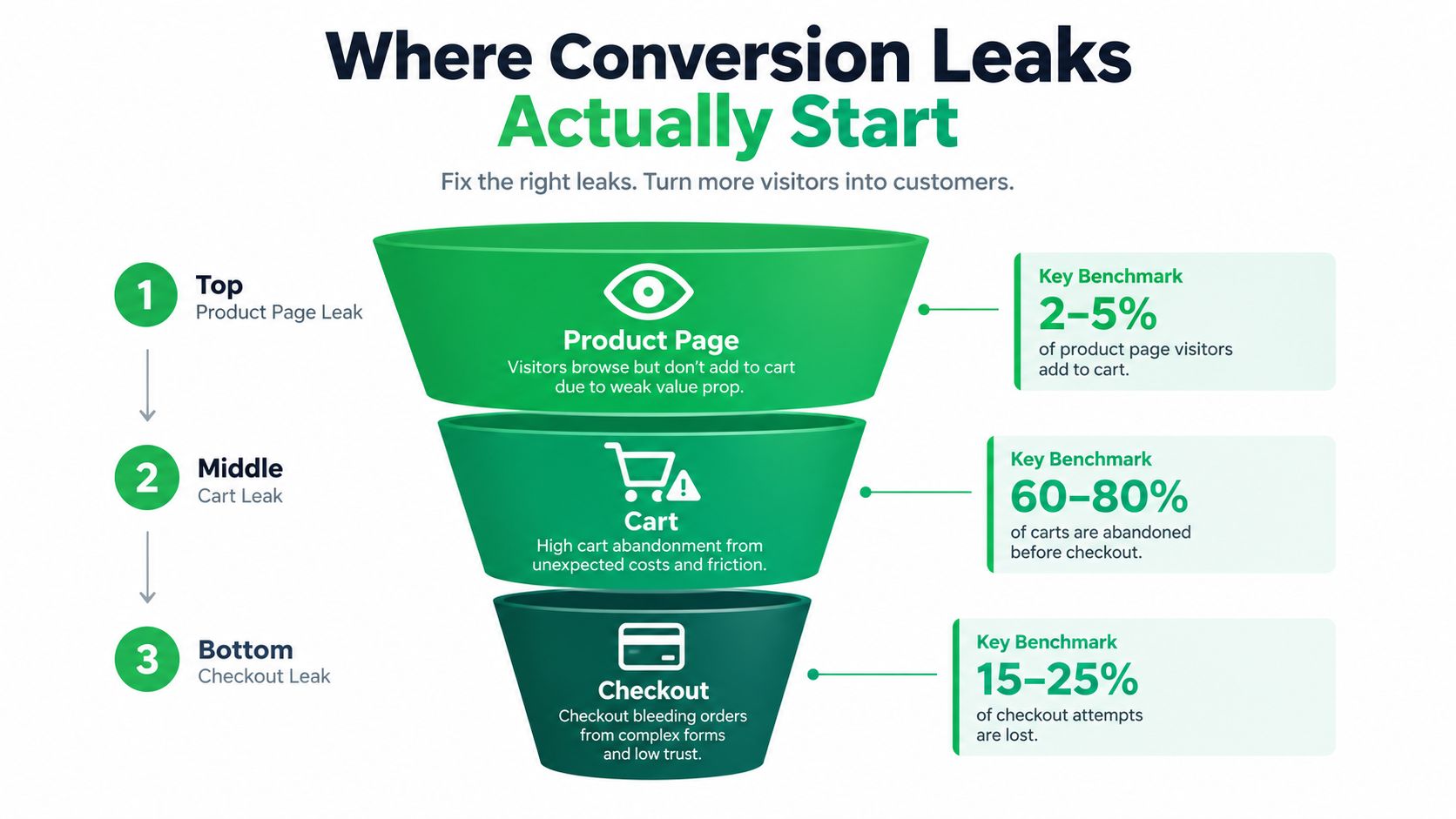
The biggest leaks tend to cluster in three layers. The checkout flow. Site speed at high-intent moments. Payment approval and recovery after the customer clicks pay.
Checkout friction is where intent gets wasted
Checkout abandonment often sits in the 48% to 67% range depending on vertical, with mobile usually performing worse than desktop, based on benchmark reporting summarized in ConversionTeam's CRO statistics analysis.
That range matters for one reason. Many shoppers who already decided to buy still fail to finish. They are not debating your brand story at that point. They are trying to complete a job, and the checkout is making the job harder than it should be.
The common blockers are familiar:
- Forced account creation before payment
- Late surprise charges such as shipping or taxes
- Missing payment methods for the market or device
- Weak reassurance on returns, delivery timing, or card security
Checkout works like a cash register with a sticky drawer. Demand exists, but the final step slows everything down. Founders often read this as a traffic problem because top-line sessions stayed flat while sales dropped. In practice, the traffic may be fine and the finish line is broken.
To see the user side of these leaks, this walkthrough is worth a watch:
<iframe width="100%" style="aspect-ratio: 16 / 9;" src="https://www.youtube.com/embed/pPtPkUvb8_Y" frameborder="0" allow="autoplay; encrypted-media" allowfullscreen></iframe>
Page speed changes behavior before shoppers can explain it
Slow pages reduce buying momentum. A product page that loads late on mobile gives the customer extra time to hesitate, reopen a comparison tab, or drop altogether.
Google has published guidance showing that as page load time rises, bounce probability increases sharply, especially on mobile, in its mobile speed research. You do not need a dramatic redesign to feel this effect. A lag on the cart, shipping step, or payment page is often enough.
Teams miss this because speed problems rarely show up in session totals alone. You need to compare page load by device, browser, and funnel step against checkout starts and completed orders. Otherwise, a performance issue looks like weaker buyer intent.
Payment failures often sit outside the usual CRO workflow
This leak gets ignored because it starts after the customer has done everything right.
A buyer can complete the funnel, pass every visible step, and still fail at the issuer, gateway, fraud filter, 3DS flow, or processor routing layer. In reporting, that often gets flattened into a generic decline. To the customer, it feels like your store could not take their money.
For DTC, subscription, and high-volume merchants, conversion rate optimization becomes a revenue discipline instead of a page-tweak hobby. If 100 shoppers attempt payment and 8 to 12 of them fail for preventable payment reasons, no headline test on button copy will beat fixing approval rate, fallback routing, retry logic, or dunning. The customer intent was already there. The system failed to convert it into approved revenue.
Core CRO Methods You Can Stack Today
Trying to stack CRO methods in the wrong order is a common pitfall. Starting with testing software feels scientific, but then running experiments on a funnel that isn't instrumented well enough to trust leads to unreliable results.
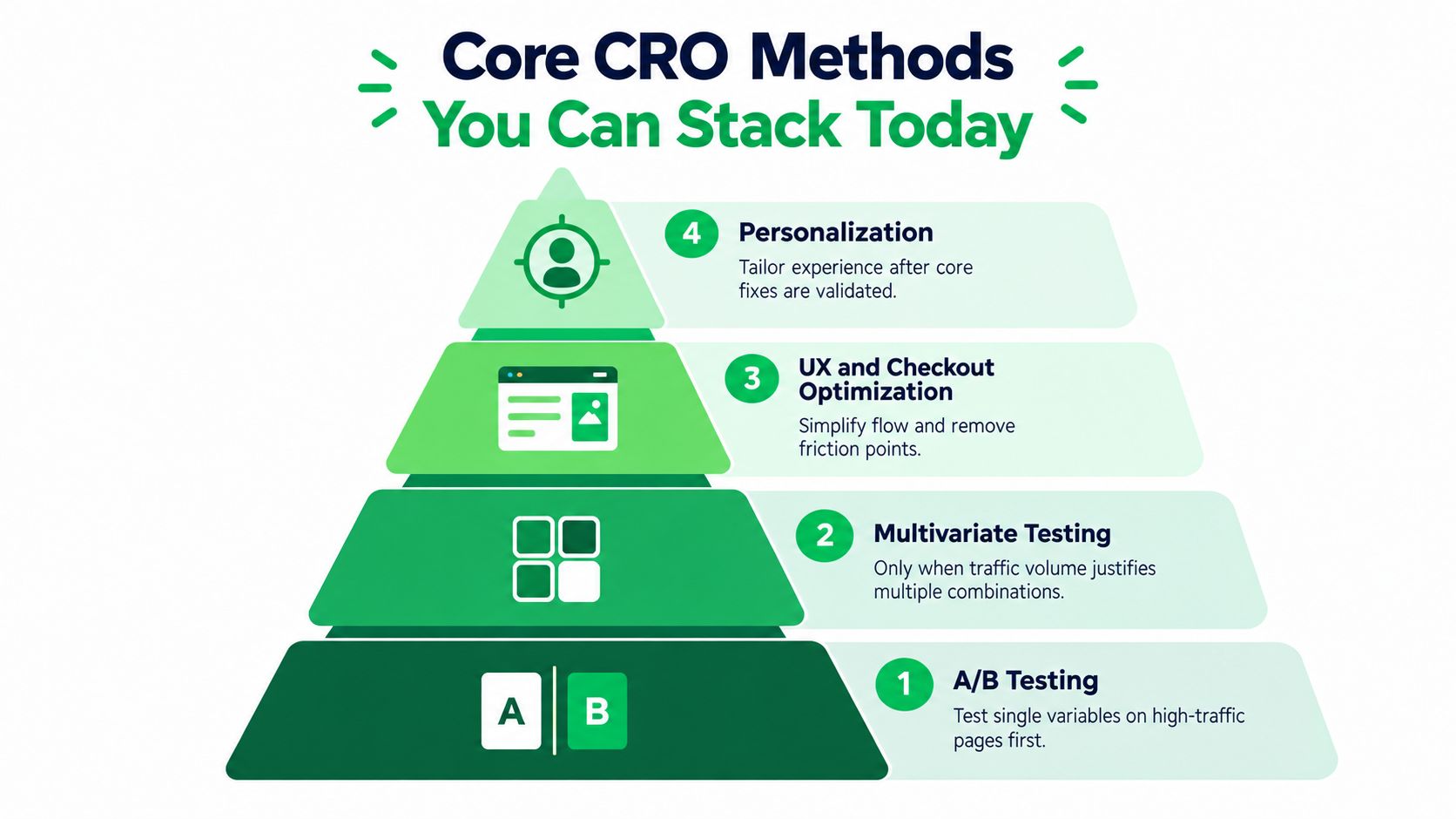
The better order is structural first, experimental second, personalized third, and measurement underneath all of it.
Start with UX and checkout work
If a funnel is confusing, testing tiny creative changes won't save it. Fix the obvious friction first.
That usually means tightening the purchase path, reducing form burden, improving mobile behavior, making payment options clearer, and removing any step that doesn't help the user finish. If your checkout is structurally bad, you don't have a testing problem. You have a design problem.
Use A/B testing where a single change can win
A/B testing earns its place on pages that get enough traffic and have one clear bottleneck. You change one meaningful variable, split traffic, and compare outcomes.
Industry practice commonly uses 95% confidence (p < 0.05), which means the result has at most a 5% chance of being a false positive. But significance alone isn't enough. You still need a pre-calculated sample size and enough runtime to cover weekly behavior patterns, often at least 7+ days or one to two full business cycles, as explained in this A/B test calculator guidance.
If you want a clean refresher on test design basics, this A/B testing guide is a useful place to align your team on terminology and setup.
Use multivariate testing sparingly
Multivariate testing sounds fascinating. In practice, it's expensive in traffic and easy to misuse.
Run it when you have enough volume to test combinations without starving each variant of data. If not, keep it simple. One major change per test beats five overlapping micro-changes you can't interpret later.
Add personalization only after the basics are sound
Personalization can work well for return visitors, known cohorts, or different traffic sources. But it compounds only when the base journey already works.
That's why a good framework like bionic marketing for CRO can be helpful. It pushes you to align messaging, decision stages, and intent instead of throwing “personalized” content onto a shaky funnel.
Practical rule: Personalization magnifies a good system. It also magnifies a bad one.
Instrument with server-side tracking from the start
This is the part many teams treat as a later upgrade. It shouldn't be.
Without reliable event capture, your tests are judged on partial data. Front-end pixels miss things. Payment tools and storefront tools disagree. Subscription renewals get misread. A “winner” can look strong in the ad platform and weak in actual approved revenue.
The six-stage operating sequence
Here's the order that keeps CRO disciplined:
Research
Pull funnel analytics, heatmaps, session recordings, support tickets, and payment logs. Look for leaks, not opinions.Hypothesis
Write the test clearly: because we observed X, changing Y should move Z for audience A.Prioritize
Score by likely business impact, confidence, ease, and revenue exposure.Design
Build one primary change and define one main success metric plus guardrails.Test
Set the sample size, stop rule, and runtime before launch. Then don't improvise midstream.Rollout
Ship the winner, document what you learned, and queue the next experiment.
Teams that do this well aren't “more creative.” They're less sloppy.
Why Measurement and Attribution Decide Everything
A lot of CRO reporting is fake precision.
A team celebrates a lift, but the purchase pixel fires inconsistently, ad blockers drop client-side events, and the payment processor records a different commercial reality than the storefront. The spreadsheet still looks neat. The revenue does not.
Measurement quality is part of the funnel
Recent CRO trend coverage highlights measurement and data quality as a top priority for 2026, alongside AI-powered personalization and zero-party data, according to WebFX's CRO trends summary. That priority makes sense. Privacy changes and fragmented tracking have turned measurement into part of the optimization problem itself.
Without server-side tracking, several things break at once:
| Where Measurement Breaks Without Server-Side Tracking | Typical Data Loss | Impact on CRO |
|---|---|---|
| Browser pixels | Qualitative data loss from blockers and browser restrictions | Tests may undercount purchases or misread channel performance |
| Storefront and payment processor mismatch | Qualitative mismatch between checkout events and approved payments | Teams may optimize for checkout starts instead of approved revenue |
| Subscription billing systems | Qualitative confusion between new conversions and renewals or retries | Acquisition and retention performance get blended together |
| Duplicate event firing across tools | Qualitative overcounting or conflicting totals | False test winners and bad budget allocation |
Attribution errors create fake winners
Here's the common failure pattern. Marketing trusts the ad platform. Ecommerce trusts the storefront. Finance trusts settled payments.
When those three systems disagree, founders often choose the number that feels most convenient instead of the one closest to approved revenue. That creates bad calls on channel quality, checkout design, and experiment outcomes.
A useful background read on this problem is attribution modeling for ecommerce teams. It helps frame why one order can look different depending on which system reports it.
If your measurement layer is weak, you're not running CRO. You're running opinion tests with charts attached.
Subscription and High Risk Brands Need Payment-Aware CRO
Most CRO playbooks were built around a one-time checkout. That's fine for simple catalogs. It breaks down fast for subscriptions, cross-border sales, and high-risk verticals.
Those brands don't stop caring after the click on “complete order.” They need to know whether the transaction approved, whether the next rebill approved, whether a retry saved the account, and whether chargeback pressure is poisoning the payment stack.
The funnel keeps going after the thank-you page
Payment processors and card networks typically classify merchants as high-risk when chargeback ratios exceed 1% of total transactions, and passing that threshold can trigger monitoring programs or account suspensions, according to Swell's high-risk ecommerce overview.
That matters for CRO because conversion isn't just about getting the order. It's about getting the order approved and kept.
For recurring billing, payment recovery becomes part of optimization. One industry benchmark set says involuntary churn should stay under 8% with proper dunning, first-payment success rate should be 90%+, and recurring chargeback ratio should stay under 0.5%, with retries spaced out instead of hammered daily, based on WebPayMe's recurring billing benchmark guide.
What payment-aware CRO actually watches
A payment-aware program extends beyond session analytics and page metrics.
It watches things like:
- Authorization quality by issuer, processor, market, and card type
- Soft versus hard declines so teams know what can be retried
- Retry and dunning logic for failed renewals
- Payment method update flows that save subscribers before churn lands
- Chargeback pressure because it affects long-term merchant stability
A frontend-only CRO program can celebrate a lift while the payment stack rejects the revenue. Subscription and high-risk operators can't afford that blind spot.
Example Experiments Worth Running First
A founder launches a checkout redesign, sees a higher click-to-checkout rate, and calls it a win. Two weeks later, approved revenue is flat because cards are still failing and renewals are still slipping. That is a common first mistake in CRO. Teams test the part they can see and miss the part that collects the money.
Start with three experiments that cover the full revenue path: checkout completion, payment approval, and renewal recovery. If you only test page elements, you learn about intent. If you also test payments and retention, you learn what turns intent into collected revenue.
Keep the setup simple. Each test needs one clear hypothesis, one primary metric, and a stop rule the team agrees to before launch.
Three starter experiments
| Three starter CRO experiments | Hypothesis | Primary Metric | Success Threshold | Min Sample |
|---|---|---|---|---|
| Checkout redesign | Reducing mobile friction and making payment options easier to scan will increase completed purchases | Purchase conversion rate | Reach the team's pre-set significance threshold and improve approved revenue without lowering order quality | Pre-calculated before launch |
| Payment routing test | Sending a defined card cohort or market through a better-fit acquiring path will improve approvals | Authorization rate | Reach the team's pre-set significance threshold without worse fraud or dispute outcomes | Pre-calculated before launch |
| Failed-renewal recovery flow | Better dunning and clearer payment-method update prompts will recover more renewals | Renewal recovery rate | Reach the team's pre-set significance threshold and improve recovered recurring revenue | Pre-calculated before launch |
Experiment one: checkout redesign
This is still worth doing. Just keep it grounded.
Start with high-friction moments near the finish line: too many fields, poor mobile spacing, confusing error handling, or payment methods buried below the fold. A checkout works like a retail counter with a line forming behind the customer. Every extra step gives people another chance to leave.
Hypothesis: a simpler checkout increases completed purchases because fewer buyers get stuck or second-guess the process.
Method: test the current experience against a version with fewer visible steps, cleaner form handling, and clearer presentation of the payment methods shoppers already trust.
Success criterion: decide before launch what lift matters commercially, then run the test to the sample size and confidence standard your team uses. Judge the result on approved revenue, not just clicks into checkout.
Experiment two: payment routing
For many DTC, subscription, and high-volume merchants, the larger gains sit.
Two checkouts can produce the same purchase intent and very different collected revenue. The difference often comes after the buyer clicks pay. Routing, acquirer fit, issuer behavior, and decline handling shape whether the order gets approved.
Hypothesis: sending a specific market, issuer group, or card type through a better-fit payment path increases authorization rate.
Method: baseline approvals and declines by gateway, issuer, market, card type, and transaction type. Group decline codes into buckets your team can act on, such as soft declines, hard declines, fraud decisions, and technical failures. Then test one routing variable at a time, as outlined in this payment authorization optimization guide.
Success criterion: approval rate rises, while fraud rates, disputes, and customer support issues stay within guardrails.
Experiment three: failed-renewal recovery
Subscription brands often find their highest-return test here.
A failed renewal is not always a lost customer. It is often a billing problem that was left untreated. Dunning works like a save sequence in a sales pipeline. The timing, message, and payment update path determine whether the account recovers or churns.
Hypothesis: a better recovery sequence plus a clearer card-update flow saves renewals that would otherwise be lost.
Method: trigger recovery messages and payment-method update prompts from failed payment events, not generic campaign schedules. Keep the path short and easy to complete on a phone.
Success criterion: more recovered subscriptions, cleaner reporting on what saved them, and no increase in customer confusion or complaint volume.
In a subscription business, the highest-profit experiment is often the one that saves an existing subscriber, not the one that gets a small lift on a landing page.
Failure modes that create fake wins
CRO gets expensive when teams learn the wrong lesson.
Calling results too early
A test looks promising halfway through, so the team stops it and declares a winner. That raises the chance of a false positive. Set the stop rule before launch and hold it.Hunting for a winning segment after the fact
The overall test loses, but one small slice looks good, so the team ships it anyway. Report the full result first. Treat segment cuts as ideas for the next test, not proof.Optimizing the wrong layer
Teams spend weeks debating copy while mobile form friction, payment approval, or renewal recovery remains weak. Rank tests by revenue exposure. A one-point approval lift can beat a prettier page.Reviewing mobile in theory instead of in hand
A variant can look clean in a desktop review and still feel awkward on a real phone. Check every major experiment on actual devices before launch.Writing soft hypotheses
“This may help” is not enough. A useful hypothesis names the problem, the change, and the expected business effect. For example: “Reducing visible fields on mobile checkout will increase approved orders because fewer buyers abandon during form completion.”
How Tagada Turns CRO into a Revenue System
A founder sees checkout conversion rise after a redesign, celebrates the win, then finds weekly revenue barely moved. The missing piece usually sits after the click. Orders fail at authorization, retries are weak, renewal recovery is inconsistent, or tracking cannot connect the test to approved revenue.
That is the gap Tagada is built to close.
Many ecommerce teams still split conversion work across four systems. One tool changes the storefront. Another routes payments. A third tracks events. A fourth handles retention messages. Each team improves its own step, but nobody can answer the question that matters: did this change produce more approved revenue and more retained customers?
A payment-aware CRO program needs one operating view across checkout, approval, retry, and rebill. Tagada's ecommerce orchestration layer brings those pieces together, including checkout control, payment routing, server-side event tracking, and revenue-triggered messaging. That lets operators judge experiments by approved orders, recovered renewals, and retained revenue, not just checkout starts or page clicks.
The difference is practical, not theoretical.
If a new checkout layout increases form completion but sends more transactions to a weaker routing path, revenue can fall. If dunning recovers failed subscriptions but those saves never reach the analytics layer, the team loses the lesson and repeats weak tests. A single system makes those tradeoffs visible faster.
Why this changes the way teams run CRO
Payment performance is often the highest-value conversion layer left under-managed. Strong operators break it down by gateway, issuer response, card type, market, and transaction type. Then they test one variable at a time so they can see what changed and why.
That work gets messy when every signal lives in a different tool.
With an integrated setup, the team can answer questions that usually stay fuzzy:
- Which processor or route approves more orders in a given market?
- Which decline patterns should trigger a retry, a payment method swap, or a customer message?
- Which subscription save flow recovers revenue without increasing support issues or risk flags?
- Which checkout test improves approved revenue instead of just increasing starts?
A useful first week
The first week should build the measurement spine. It should not chase a miracle uplift.
Day 1
Map the funnel from session to checkout start, attempted payment, approved order, and renewal. Write down the current baselines your team uses to make decisions.
Day 2
Check server-side event capture for payment attempts, declines, approvals, retries, and rebills. If those events are missing or delayed, later test results will be unreliable.
Day 3
Pick one high-traffic page and one payment or checkout friction point. A focused test plan beats six half-finished ideas.
Day 4
Write a hypothesis with a business outcome attached. Example: changing payment method order for mobile buyers will raise approved orders because more buyers will choose the option that succeeds on their device and in their market.
Day 5
Launch with a fixed stop rule, a named primary metric, and a clear owner for implementation and review.
Day 6
Queue one payment experiment. Routing logic, retry timing, decline recovery messaging, card updater use, or renewal save rules are all valid CRO work.
Day 7
Review only after a full behavior cycle. For many brands, that means at least one complete week so weekday and weekend patterns do not distort the result.
One rule keeps this honest. Ship one meaningful change, measure one primary business outcome, record what happened, then run the next test.
That is how CRO becomes a revenue system. Checkout changes matter. Payment approval matters. Renewal recovery matters. The operators who connect all three usually learn faster and find larger gains than the teams still arguing over button color.