
What Is an Acquirer Reference Number (ARN)?
ARN meaning: the 23-digit number banks use to trace a card refund. ARN vs RRN vs authorization code, where to find it on Stripe, Adyen, PayPal.

Article summary
TL;DR
An acquirer reference number (ARN) is a 23-digit code that the merchant's bank puts on a card transaction when it sends it into clearing. Every bank along the way stores the same number, so the cardholder's bank can use it to find a payment or a refund. A refund gets its own ARN, separate from the purchase.
- Visa defines the ARN as an identification number included in a clearing record. It exists once a payment or refund is cleared, not at authorization.
- A refund gets its own ARN. Give that one to a customer who can't see the money.
- Stripe can take up to 7 business days to receive a refund's ARN. A refund that went through as a reversal has none.
- The RRN is set at authorization, the ARN at clearing. The authorization code only proves the issuer approved the payment.
- Visa's dispute rules name the ARN when a merchant already refunded and when a customer claims they were charged twice.
 ChatGPT
 Claude
 Perplexity
 Grok
GrokOn this page
The acquirer reference number is the tracking number of the card world. A merchant can't use it to move money, but it's the one reference that the merchant's bank, the card network and the customer's bank all hold for the same transaction. Most people meet it when a refund doesn't show up.
What an ARN is
Visa's rules define the acquirer reference number as "an identification number included in a Clearing Record".1Visa Core Rules and Visa Product and Service Rules, April 18, 2026 The acquirer, the merchant's bank, adds it when it sends the transaction into clearing. The record then travels to the cardholder's bank, which stores the same number.
Three facts follow:
- No clearing, no ARN. An authorization that was never captured, or a void, never gets one.
- A refund gets its own ARN. It isn't traced with the purchase's number.3Stripe, What is an acquirer reference number (ARN)? (read October 14, 2026)
- A reversal has none. At Stripe, a refund issued soon after the charge can go through as a reversal: the charge drops off the statement and no separate credit is sent, so there is no ARN.2Stripe Docs, Refund and cancel payments (read October 14, 2026)
ARN vs RRN vs authorization code vs transaction ID
A card payment carries several references. They answer different questions.
| Reference | Who sets it | When | Format | What it's for |
|---|---|---|---|---|
| ARN | Acquirer | Clearing | 23 digits | Tracing a payment or refund between banks |
| RRN (retrieval reference number) | Acquirer or processor | Authorization | 12 letters and digits, ISO 8583 field 37 | Matching a payment to its approval, retrieval requests |
| Authorization code | Card issuer (or Visa, when it approves on the issuer's behalf) | Authorization | Short code on the receipt | Proof the issuer approved the payment |
| Visa Transaction Identifier | Visa | Authorization response | Network value | Linking reversals, adjustments and disputes to the original |
| Processor payment ID | Your processor | When you create the payment | Processor format (Stripe: pi_, re_) | Your own dashboard, support and refunds |
Sources: Visa glossary for the ARN, authorization code and Transaction Identifier;1Visa Core Rules and Visa Product and Service Rules, April 18, 2026 Solidgate for the RRN;6Solidgate, Retrieval reference number (read October 14, 2026) Stripe for the 23 digits.3Stripe, What is an acquirer reference number (ARN)? (read October 14, 2026) If you searched "ARN/RRN": Stripe treats them as alternatives. It shows an ARN for card refunds and falls back to a STAN (system trace audit number) or an RRN for networks that don't use ARNs.2Stripe Docs, Refund and cancel payments (read October 14, 2026) For terminal IDs and other numbers on a receipt, see what a TID number is.
What's inside the 23 digits
Stripe says an ARN is 23 digits long and that its structure changes with the card network. For Visa, it lists a 6-digit segment for the acquiring bank, a 4-digit Julian date (year and day of the year) and a 6-digit sequence number. Mastercard uses the same length with the segments in a different order.3Stripe, What is an acquirer reference number (ARN)? (read October 14, 2026) Visa's public rules confirm that each acquirer has a 6-digit Acquiring Identifier, but they don't publish the ARN layout.1Visa Core Rules and Visa Product and Service Rules, April 18, 2026
Don't decode it, copy it
Online guides disagree on the rest, such as what the first digit means. Treat the ARN as a label: copy all 23 digits as text, without spaces, and keep leading zeros.
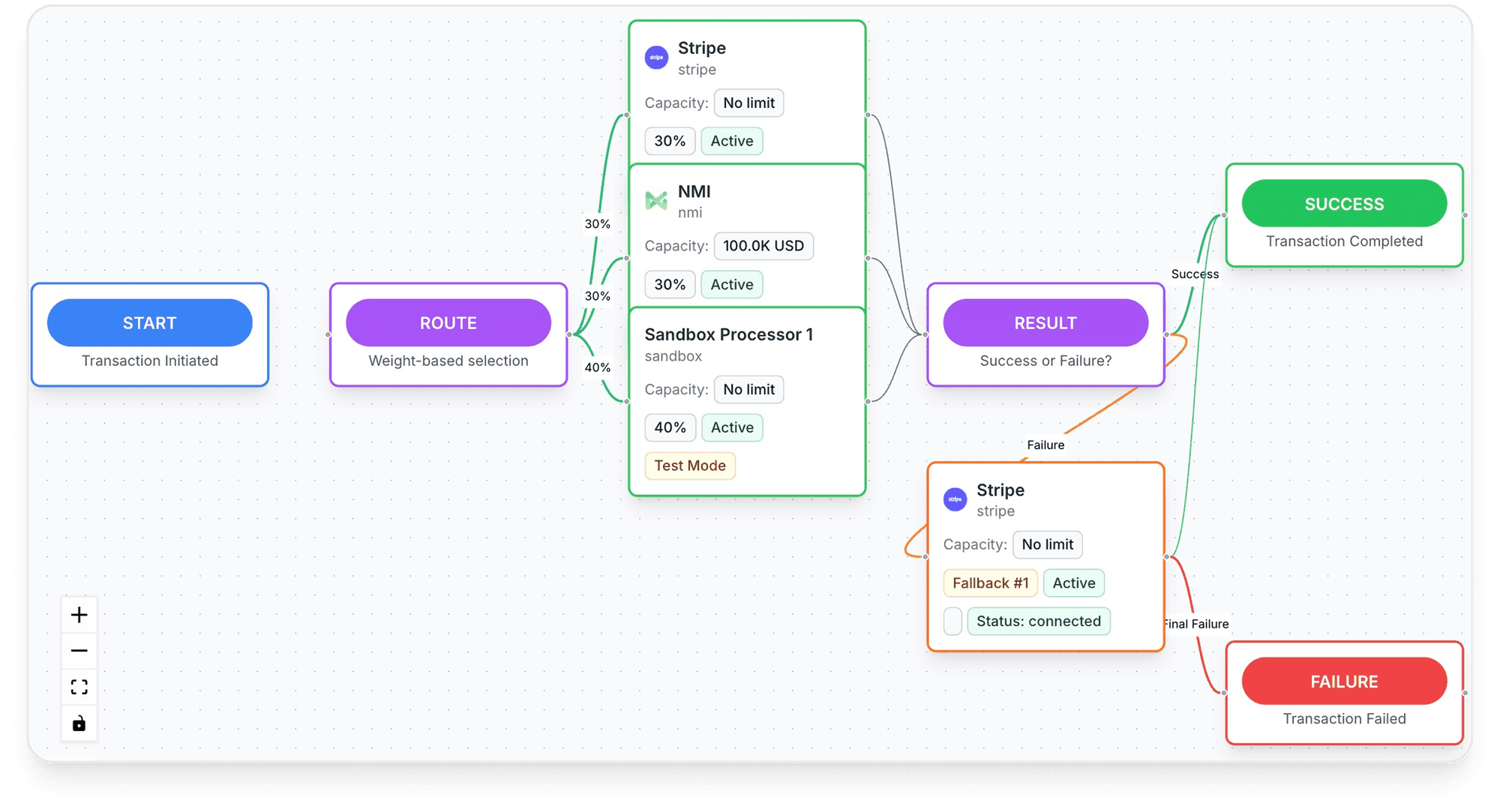
Inside Tagada
See every payment's route, processor by processor
Set the order your processors are tried in, per store, per country or per product.
Where merchants find the ARN
Stripe
Open the payment, then View Details on the refund in the Timeline. In the API, read
destination_details.card.reference, withreference_type: acquirer_reference_number. Allow up to 7 business days.2Stripe Docs, Refund and cancel payments (read October 14, 2026)Adyen
Customer Area, Transactions > Payments, select the PSP Reference, then Payment events. You need the View payments role.4Adyen Help Center, Where can I find the Acquirer Reference Number (ARN)? (read October 14, 2026)
PayPal
In the response of the orders, captures and refunds endpoints, a few days after the capture or refund. Available with Expanded Checkout in the US, UK, Canada, Australia and the EU.5PayPal Developer, Track transactions using an acquirer reference number (read October 14, 2026)
If you run several processors, each one issues its own ARN for the payments it clears. Look up the refund at the processor that took the original payment.
The customer's case: "I don't see my refund"
Stripe says a refund shows as a credit about 5 to 10 business days after it's issued, depending on the bank.2Stripe Docs, Refund and cancel payments (read October 14, 2026) When it doesn't:
- Check whether the charge disappeared. A refund issued soon after the payment may be a reversal: the charge drops off the statement and no credit line appears.2Stripe Docs, Refund and cancel payments (read October 14, 2026)
- Get the refund's ARN. The merchant reads it in the processor's dashboard once it's available.
- Call the bank with the ARN. Stripe says the customer's bank can use it to tell them when the refund will be available.2Stripe Docs, Refund and cancel payments (read October 14, 2026) PayPal adds that without an ARN, a bank can struggle to route a refund to a card that was lost, stolen or closed.5PayPal Developer, Track transactions using an acquirer reference number (read October 14, 2026)
- Know the bank's own deadline. Outside the US, Visa requires the issuer to post a credit within 5 calendar days of settlement. In the US: 3 business days for credit cards, 1 business day for Visa debit and prepaid cards.1Visa Core Rules and Visa Product and Service Rules, April 18, 2026
If the money still doesn't arrive, the bank can open a "Credit Not Processed" dispute. Waiting times are on our partial refund page.
When Visa rules call for the ARN
The ARN is the reference Visa's dispute rules ask for when a credit or a duplicate is in question:1Visa Core Rules and Visa Product and Service Rules, April 18, 2026
- The merchant refunded before the dispute (sections 11.2.2 and 11.2.3, Tables 11-1 and 11-2). The issuer must apply the credit, or give the Transaction Identifier or ARN of the credit, its date and why it doesn't resolve the dispute.
- Duplicate processing (section 11.9.5.5, Table 11-81, condition 12.6). The issuer must certify the date and ARN of the valid transaction.
- Paid by other means (same table). Evidence of the other payment includes its ARN when it was made with a Visa card.
For a merchant, the practical rule is simple: store the ARN of every refund with the order. If a customer disputes a payment you already refunded, that number links your credit to the dispute. See chargeback vs refund for the next steps.
How Tagada helps
Refunds that follow the card network rules
Tagada follows Visa and Mastercard rules and the laws that apply to payments. Payments route across Stripe, Adyen and TagadaPay with one logic, and TagadaPay runs native 3DS2, device intelligence and a rules engine.
Frequently asked questions
What is an ARN nummer?
What is the difference between ARN and RRN?
Does a refund have the same ARN as the purchase?
How long does it take to get an ARN?
Does every card payment have an ARN?
Sources
Checked October 15, 2026- Visa Core Rules and Visa Product and Service Rules, April 18, 2026
- Stripe Docs, Refund and cancel payments (read October 14, 2026)
- Stripe, What is an acquirer reference number (ARN)? (read October 14, 2026)
- Adyen Help Center, Where can I find the Acquirer Reference Number (ARN)? (read October 14, 2026)
- PayPal Developer, Track transactions using an acquirer reference number (read October 14, 2026)
- Solidgate, Retrieval reference number (read October 14, 2026)
TagadaPay
Refunds and payments across processors, one checkout
Tell us what you sell and how you sell it. Each application is underwritten, and approval is not guaranteed.
- 01Tell us what you sell and how
- 02Underwriting reviews your business
- 03Process through TagadaPay alongside your other processors