
What Is Acquirer Processing?
What acquirer processing is, acquirer vs acquirer processor, Visa's rules for processors, and a role table with gateway, payfac and issuer processor.

Article summary
TL;DR
Acquirer processing is the technical work behind the merchant side of a card payment: sending authorization requests, submitting transactions for clearing and handling settlement. The acquiring bank is responsible for it, but it often hires a third-party processor, which Visa calls an Acquirer Processor. The bank stays liable to Visa for that processor's work.
- The acquirer is the Visa member that signs the merchant. The acquirer processor is a non-member company it hires to run the processing.
- Visa splits processing into authorization services and clearing and settlement services. One company can do both, or two can share them.
- Outsourcing moves the work, not the liability. Visa makes the acquirer responsible for any losses its processor causes.
- If a merchant can't pay its chargebacks, the acquiring bank must pay the card issuer. That is why acquirers underwrite merchants.
- Acquirers report to Visa (Operating Certificate, third parties using their BIN) and track chargebacks, fraud and volumes internally.
 ChatGPT
 Claude
 Perplexity
 Grok
GrokOn this page
The bank that signs a merchant and the company that runs its card processing are often not the same. This page explains who does what on the acquiring side and what the card rules say about it.
What is acquirer processing?
Acquirer processing is the work the merchant's bank must get done for every card payment. The US bank regulator, the OCC, lists it as "gathering sales information from the merchant, obtaining authorization for the transaction, collecting funds from the card-issuing bank, and reimbursing the merchant."2OCC, Comptroller's Handbook, Merchant Processing, Version 1.0, August 2014 (read October 14, 2026)
The bank that owns this work is the acquirer. In Visa's rulebook, an acquirer is "a Member that signs a Merchant or Payment Facilitator [...] and directly or indirectly enters a Transaction into Interchange." The company it hires to do the work has its own name:1Visa Core Rules and Visa Product and Service Rules, April 18, 2026
Acquirer Processor: A non-Member agent or processor that a Member has engaged to support its Visa acquiring business.
Visa's glossary uses four more terms for the companies around the acquirer:1Visa Core Rules and Visa Product and Service Rules, April 18, 2026
VisaNet Processor
A member, or Visa-approved non-member, directly connected to VisaNet that provides authorization, clearing or settlement services.
Authorizing Processor
A member or its processor that provides authorization services for merchants or other members. The industry calls this front-end processing.
Clearing Processor
A member or its processor that provides clearing and/or settlement services. The industry calls this back-end processing.
Third Party Agent
Any other company that provides payment services to a member or its merchants, such as a payment facilitator.
Acquirer vs acquirer processor
The OCC says acquiring banks "frequently outsource functions to third-party organizations" to control costs, because their volume "may not justify the cost of in-house data processing." Outsourcing can cover some or all of the work.2OCC, Comptroller's Handbook, Merchant Processing, Version 1.0, August 2014 (read October 14, 2026) In practice, the processor captures the authorization, sends clearing records with an acquirer reference number, and handles settlement. The OCC notes that most third-party processors net settle with the bank each day and usually prepare the ACH file that pays merchants.2OCC, Comptroller's Handbook, Merchant Processing, Version 1.0, August 2014 (read October 14, 2026)
The bank keeps the responsibility. Visa sets out what an acquirer must do when it hires a processor:1Visa Core Rules and Visa Product and Service Rules, April 18, 2026
- Register it before use. The acquirer files a client information questionnaire. A non-member processor also signs a VisaNet Letter of Agreement.
- Control the risk. Give the processor written instructions and procedures, run a risk program covering service failure and data security, and inspect its premises from time to time.
- Audit it. Outside Europe, get an independent audit of the processor's VisaNet interface controls every year, unless the processor is itself a member.
- Plan for failure. Keep contingency plans in case the processor goes bankrupt or stops operating.
- Answer for it. "A Member is responsible for any and all losses caused by its VisaNet Processor." A clearing processor must also withhold or redirect settlement funds when Visa requires.
Source: Visa Core Rules, April 2026, sections 1.1.8.22, 1.9.8.1, 1.9.8.3, 10.2.1.5, 10.2.1.9 and 10.2.1.10.
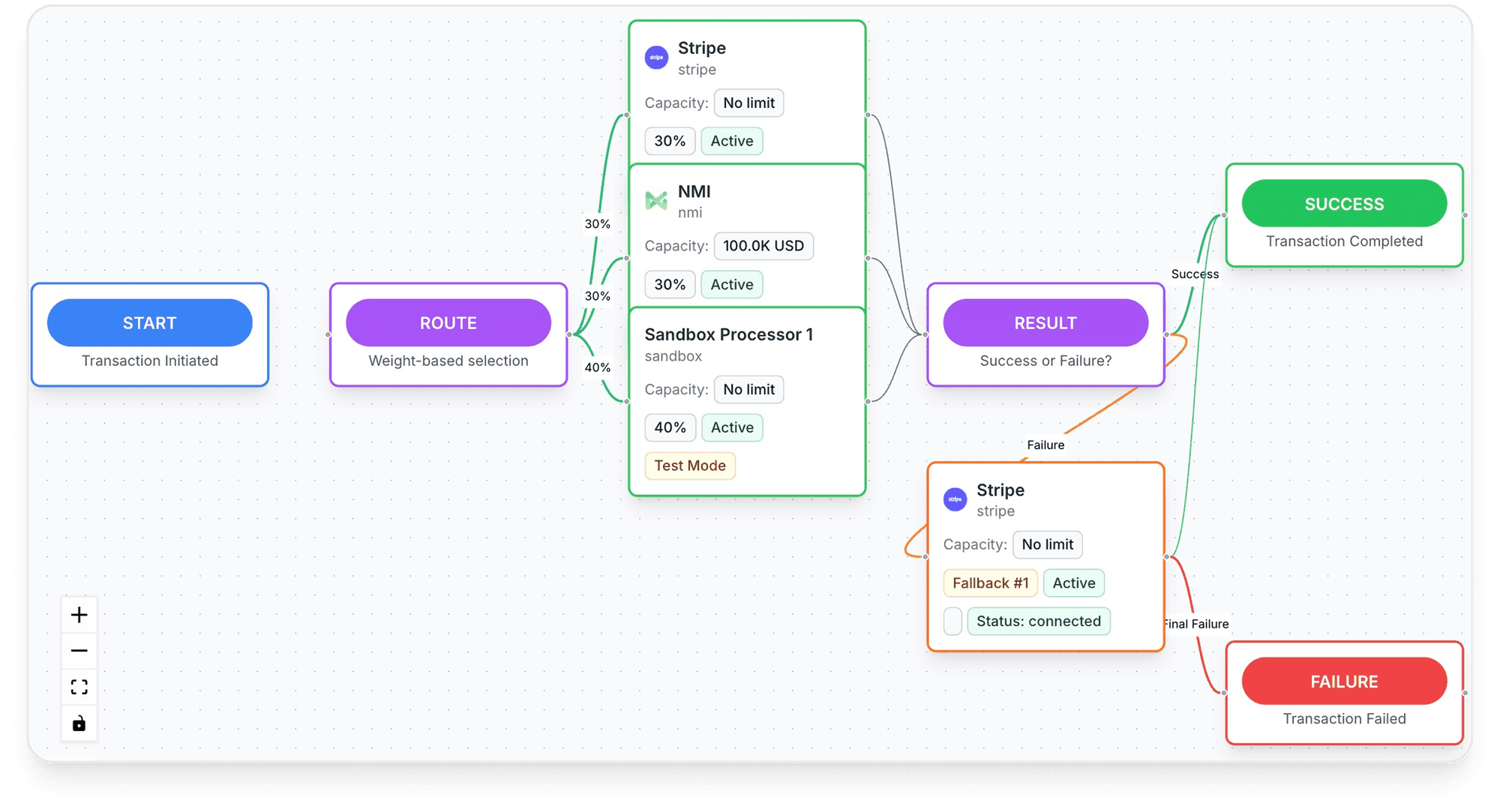
Inside Tagada
See every payment's route, processor by processor
Set the order your processors are tried in, per store, per country or per product.
Acquirer, processor, gateway, payfac and issuer processor
| Role | Network member? | Authorization | Clearing and settlement | Merchant risk |
|---|---|---|---|---|
| Acquirer | Member; signs the merchant | Responsible, often outsourced | Responsible; owns the BIN used to settle | Pays the issuer if the merchant can't cover chargebacks |
| Acquirer processor | Non-member, registered by the acquirer | Sends requests to the network | Submits clearing, often prepares merchant payouts | Per its contract; the acquirer stays liable to Visa |
| Payment gateway | Not a member | Passes card data to the processor | Not involved | Holds no merchant risk |
| Payment facilitator | Non-member; contracts with an acquirer | Through its acquirer's processing | Receives settlement for its sponsored merchants | Liable for each transaction it processes |
| Issuer processor | Not required; works for the issuer | Approves or declines for the issuer | Receives clearing records for the issuer | Cardholder side, not merchant |
Sources: Visa Core Rules, April 2026, Glossary and sections 1.1.8.22 and 5.3.1.1; OCC Merchant Processing, pages 2 to 4, 7 to 10 and 14.1Visa Core Rules and Visa Product and Service Rules, April 18, 20262OCC, Comptroller's Handbook, Merchant Processing, Version 1.0, August 2014 (read October 14, 2026) The gateway row reflects the usual split: the gateway carries card data and holds no funds. The payfac model from the seller's side is on our aggregator merchant page. For the gateway and processor split at real providers, see payment gateway vs payment processor.
Acquirer and issuer in payments
| Issuer | Acquirer | |
|---|---|---|
| Contracts with | The cardholder | The merchant |
| In authorization | Approves or declines | Sends the request |
| Money | Pays through the network | Receives and pays the merchant |
Visa defines the issuer as a member that "enters into a contractual relationship with a Cardholder for the issuance of one or more Card products."1Visa Core Rules and Visa Product and Service Rules, April 18, 2026 Funds flow "from the card-issuing bank to the bank card association, then to the acquirer, and finally to the merchant."2OCC, Comptroller's Handbook, Merchant Processing, Version 1.0, August 2014 (read October 14, 2026) The full acquiring business is covered on our card acquiring page.
Reporting in acquirer operations
Acquirers report in two directions.1Visa Core Rules and Visa Product and Service Rules, April 18, 20262OCC, Comptroller's Handbook, Merchant Processing, Version 1.0, August 2014 (read October 14, 2026)
- To Visa. An Operating Certificate, a certified report of the member's issuing and acquiring statistics (section 1.1.4.1). The processor must report at least quarterly, to the acquirer and Visa, any third party using the acquirer's BIN (section 10.2.1.4). On request, an annual report on each non-member processor, its services and the BINs it handles (section 10.2.1.8). Visa also monitors acquirers for fraud and disputes under its Acquirer Monitoring Program (section 10.4.3.1).
- To management. The OCC expects reports on "new account acquisitions, account attrition, portfolio composition, sales volumes, charge-back volumes, charge-back aging, fraud, suspicious activity reporting, sanctions screening, and department profitability" (page 19).
What it means for an online merchant
Your contract may be with a bank, a payment service provider or a payfac, and the processing may run elsewhere. The risk sits with the acquirer. If a merchant cannot honor its chargebacks, "the acquiring bank must pay the card-issuing bank."2OCC, Comptroller's Handbook, Merchant Processing, Version 1.0, August 2014 (read October 14, 2026) That is why every acquirer underwrites you before you go live, and keeps watching your disputes after.
How Tagada helps
Several processors behind one checkout
Tagada routes payments across Stripe, Adyen and our own TagadaPay processor with one logic, and cascades on decline. Each file is still underwritten, with enhanced review on regulated verticals. Tagada follows Visa and Mastercard rules and the laws that apply to payments.
Frequently asked questions
What is an acquirer processor?
What is the difference between an acquirer and a processor?
What is an acquirer in payments?
What is the difference between an acquirer and an issuer?
What reports does an acquirer produce?
Sources
Checked October 15, 2026TagadaPay
Route your payments across more than one processor
Tell us what you sell and how you sell it. Each application is underwritten, and approval is not guaranteed.
- 01Tell us what you sell and how
- 02Underwriting reviews your business
- 03Process through TagadaPay alongside your other processors