
The most feature-rich platform isn't automatically the best choice for ecommerce experimentation. A visual editor may be ideal for a landing page, but it won't solve a server-side authorization test, a subscription rebill problem, or payment routing analysis. The right ab testing software depends on where the experiment runs, who owns implementation, and whether the result connects to revenue, payment approval, refunds, chargebacks, and customer lifetime value.
Ecommerce teams should also distinguish between testing a storefront experience and testing a commercial decision. Headlines, layouts, product-page content, and calls to action are one class of experiment. Prices, shipping thresholds, payment methods, checkout steps, rebills, and fulfillment logic require stronger control over identity, event tracking, and backend systems.
This comparison focuses on those practical trade-offs. It considers marketer-led web testing, server-side experimentation, price and offer testing, privacy and performance, engineering effort, and suitability for subscriptions or higher-risk payment environments. Pricing is described only through published-plan or quote-based context where the supplied information supports it, not through invented figures.
For statistical interpretation, teams should also understand what a p-value does and doesn't tell them. Uxia's explanation of p < 0.05 in UX and A/B testing is a useful reference before turning an experiment result into a production decision.
1. Optimizely Web + Feature Experimentation
Optimizely Web + Feature Experimentation is built for organizations that want marketing and product experimentation under one governance model. Web Experimentation gives growth teams a mature visual editor for storefront changes, while Feature Experimentation supports server-side flags, SDK-based releases, and full-stack experiments owned by engineering.

The split matters for ecommerce. A merchandising manager can test product-page messaging without waiting for a deployment, while developers can test checkout services, account flows, or feature behavior before exposing a change to every customer. Audience targeting, personalization, collaboration, and program-level reporting help larger teams coordinate tests across regions and business units.
The trade-off is operational. Optimizely is quote-based and typically positioned as a premium enterprise purchase, so the business case needs to include governance, experimentation volume, implementation, and analyst time. Teams without a clear hypothesis process may buy powerful infrastructure and still run shallow button tests.
Practical rule: Choose Optimizely when the organization needs both marketer-led web experiments and engineering-led feature experiments, not simply a visual editor.
Its integrations across content, commerce, and data products can reduce fragmentation for companies already standardizing on the Optimizely ecosystem. For a broader comparison of experimentation approaches, see this guide to A/B testing tools for ecommerce teams.
2. VWO Testing + Feature Experimentation
VWO Testing + Feature Experimentation takes a web-first approach but extends into feature flags and server-side experimentation. Its no-code visual editor is approachable for marketers, while A/B/n and multivariate testing give experienced CRO teams more room than a basic two-variant workflow.

The platform uses a Bayesian statistics engine and provides resources that help teams plan, document, and interpret experiments. That can be valuable for ecommerce groups where marketing, product, and UX teams need a shared language for deciding whether a variation is useful, inconclusive, or ready for rollout.
VWO is strongest when the primary surface is the website. Teams can build visual tests quickly, target audiences, and explore combinations of page changes without turning every experiment into a development ticket. Server-side capabilities make it more versatile, but the implementation experience still depends on the quality of the underlying event model and engineering ownership.
Public pricing isn't always consistently published, and buyers should expect the commercial discussion to change with scale, traffic, modules, and support requirements. That makes direct evaluation important for merchants with seasonal demand or multiple storefronts.
- Good fit: Marketer-led ecommerce experimentation with a need for a broad suite.
- Watch closely: Pricing at scale, data definitions, and the work required to connect experiments to payment and subscription outcomes.
- Weak fit: Teams that need deep backend control but don't have engineering capacity to operate it.
VWO is a practical alternative to heavier enterprise platforms for web-led organizations, provided the team doesn't mistake an easy test builder for a complete revenue measurement system.
3. AB Tasty
AB Tasty combines web experimentation, personalization, and server-side testing with a strong ecommerce orientation. Its visual editor supports A/B and multivariate tests, while server-side and feature experimentation cover changes that shouldn't be handled solely through browser code.

The native Shopify integration is useful for merchants that want experiments closer to their commerce workflow. Hosting the testing tag under a merchant-controlled subdomain can also help teams address performance and compliance concerns, including the visual flicker that undermines the validity of a storefront test.
That performance detail matters more than a feature checklist suggests. If a variation appears late, customers may see the original before the challenger loads. The platform might report a conversion difference, but the customer experienced a timing artifact rather than a clean design comparison. AB Tasty's implementation options are intended to reduce that risk, though teams still need to test real devices, consent states, caching, and checkout transitions.
The commercial limitation is that pricing is quote-based and generally enterprise-oriented. Smaller stores may find the platform capable but difficult to justify unless they have meaningful experimentation volume or need its implementation support.
For practical ecommerce hypotheses, review these A/B testing examples for online stores. AB Tasty works best when the team has a testing backlog, a technical owner, and enough traffic to learn from more than isolated visual changes.
4. Convert Experiences
Convert Experiences is a strong option for teams that care about privacy, performance, and a more self-serve buying experience. It supports A/B, split URL, and multivariate testing, along with client-side and full-stack experiments.
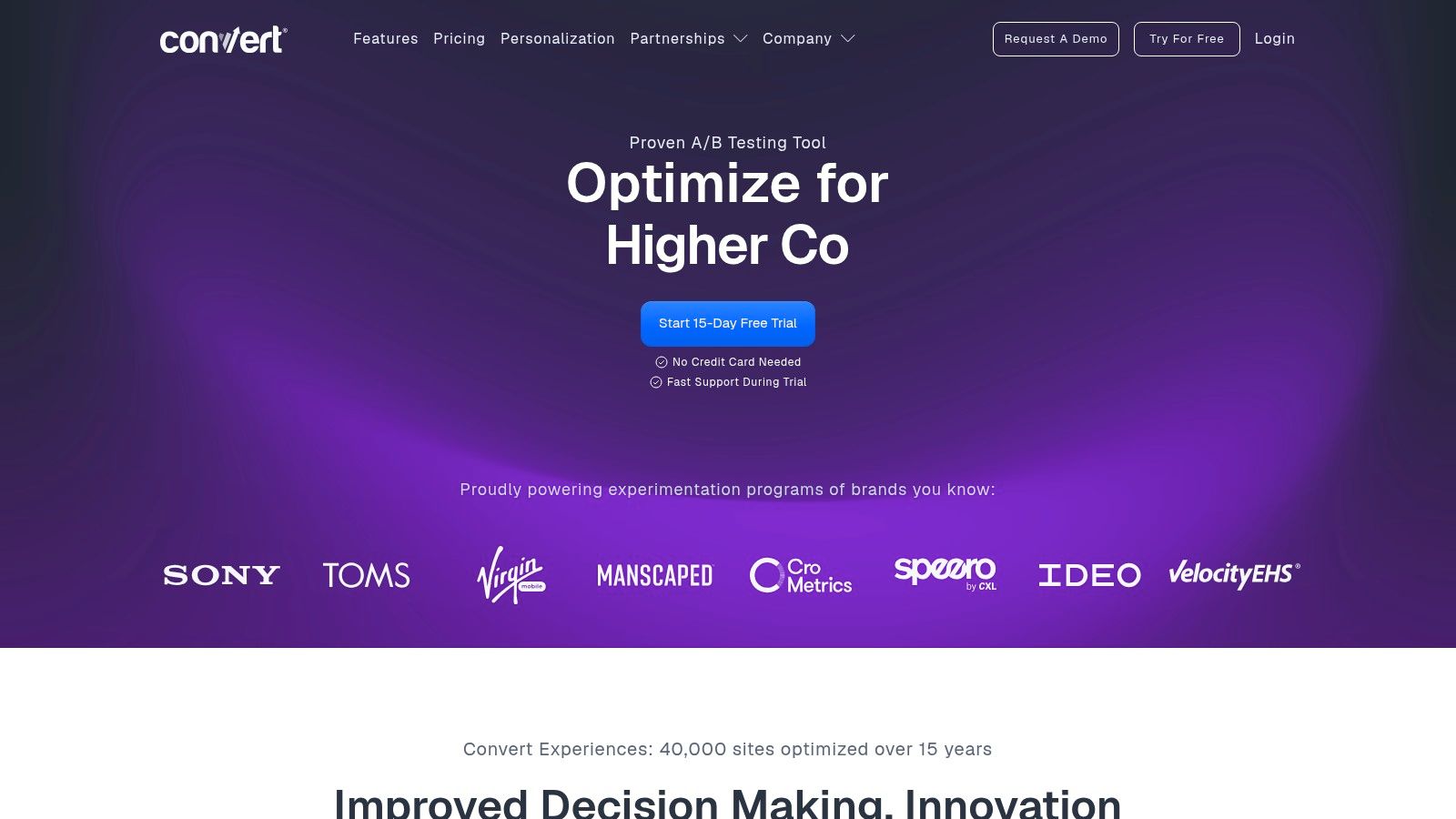
Convert is particularly relevant to cost-conscious CRO teams and agencies. Its plan structure and self-serve onboarding make it easier to start without entering a long enterprise procurement cycle, while its emphasis on low flicker and Core Web Vitals addresses a common weakness in browser-based testing.
Price testing and Shopify workflows broaden its usefulness beyond copy and layout. A team can test a commercial proposition, then connect the result to a revenue metric rather than relying only on clicks. That said, price experiments need careful handling of catalogs, feeds, promotions, currencies, tax logic, and customer support. A platform can assign variants correctly while downstream systems still misclassify the transaction.
A fast experiment that measures the wrong revenue event is still a bad experiment.
Convert's ecosystem is smaller than the largest enterprise suites, and advanced personalization may require custom work. That isn't necessarily a problem for a focused CRO program. It becomes a limitation when a retailer wants a large personalization library, extensive governance, and many business units working in one environment.
- Best use: Performance-sensitive storefront tests and privacy-conscious experimentation.
- Useful capability: Self-serve access for agencies and smaller optimization teams.
- Main compromise: More advanced personalization and broader orchestration may need engineering support.
Convert is a sensible choice when the team wants control over implementation without paying for enterprise complexity it won't use.
5. Kameleoon
Kameleoon uses a hybrid client-side and server-side architecture, which makes it a good match for ecommerce teams trying to balance marketer speed with engineering control. Marketers can build web A/B and multivariate tests, while developers can use SDKs for feature flags and full-stack experiments.
The platform's anti-flicker measures, consent management, and SPA-ready SDKs address problems that appear frequently in modern storefronts. Single-page applications can change routes without full page loads, and consent decisions can change which identifiers or events are available. A testing system that assumes a simple document reload may assign users inconsistently or lose funnel context.
Kameleoon's Shopify solutions and connectors make it more relevant to merchants than a purely developer-oriented feature platform. It can support a web team testing product discovery while engineering tests a service behind the checkout. That architecture also helps teams decide which changes belong in the browser and which should happen before the response reaches the customer.
The quote-based model is structured around usage and modules. Buyers should evaluate the expected number of experiments, environments, SDKs, consent requirements, and reporting destinations rather than comparing license labels alone.
- Engineering fit: Strong for teams that want one system across storefront and product layers.
- Privacy fit: Consent tooling is useful where experimentation must respect regional choices.
- Operational risk: Server-side power requires release discipline, ownership, and reliable event contracts.
Kameleoon is less suitable for teams seeking instant experimentation with no technical process. Its value appears when the organization is ready to treat experimentation as part of the product delivery system.
6. Dynamic Yield by Mastercard
Dynamic Yield by Mastercard is personalization-led, with experimentation embedded into the experience delivery workflow. It supports web and app testing through a client-side script, Experience APIs, SDKs, segmentation, and personalization components such as recommendations.
For retailers and marketplaces, that combination is useful on product listing pages, product detail pages, merchandising modules, and promotional messaging. The team isn't limited to asking whether version A or B won overall. It can inspect performance by relevant segments and use affinity-based targeting to identify where a different experience may be appropriate.
That strength also creates a risk. Personalization can make an experiment harder to interpret because multiple decisions influence what each visitor sees. A clean hypothesis, stable assignment rules, and a clear primary metric matter more when the platform is doing more than simple traffic splitting.
Dynamic Yield is quote-based and generally enterprise-level. Implementation can involve data feeds, catalog structures, recommendation logic, analytics integrations, and cross-channel governance. A merchant should budget for operational ownership, not only the software evaluation.
Revenue test: Don't stop at click-through rate. Check whether the experience improves completed orders, margin, payment outcomes, refunds, and repeat behavior.
The platform is a strong fit for large retailers that want personalization and experimentation to operate together. It is less compelling for a small store that only needs to compare two landing pages or validate a single checkout change.
7. Adobe Target
Adobe Target is designed for companies already invested in Adobe Experience Cloud. It combines A/B and multivariate testing with automated personalization, recommendations, enterprise governance, and integrations with Adobe Analytics and customer journey tools.
The main advantage is not a standalone visual editor. It's the ability to connect experimentation to an established Adobe data and governance environment. Large organizations can standardize permissions, reporting, privacy controls, and audience definitions instead of creating a separate measurement island for CRO.
That integration is also the central buying criterion. Adobe Target's quote-based enterprise pricing and implementation demands make less sense when the rest of the Adobe stack isn't already part of the operating model. A team may spend more effort reproducing data connections than learning from experiments.
Adobe Target can support storefront optimization, but payment and subscription businesses still need to define their own backend truth. A checkout test should distinguish between a button click, an authorization attempt, a captured payment, a successful rebill, and a later refund. Adobe can help analyze the experience, but the merchant must ensure those events arrive consistently and with appropriate privacy controls.
Read this practical explanation of what A/B testing is and how teams use it before mapping Adobe Target into a broader experimentation process. Adobe is the natural shortlist choice for Adobe-standardized enterprises, not necessarily for a merchant seeking the shortest route from hypothesis to deployment.
8. Intelligems
Intelligems is built around Shopify merchants and the commercial variables that often matter most to direct-to-consumer businesses. It supports price testing, multi-currency assignment, shipping-rate and threshold experiments, checkout and post-purchase testing, and content or theme tests through a Shopify app.
That focus is its biggest advantage. Many experimentation suites are excellent at changing a headline but leave merchants to build the difficult parts of a price experiment themselves. Intelligems aims closer to the profit model by helping teams evaluate price, offer, shipping, and checkout decisions alongside conversion behavior.
Price testing needs more than variant assignment. Product feeds, ad platforms, promotional calendars, customer service scripts, inventory, tax calculations, and currency presentation can all affect the result. A test that changes a product price without updating acquisition channels or internal reporting can create confusion outside the storefront.
AI-assisted test ideation and profit analytics can help a DTC team generate ideas and judge outcomes in commercial terms. The platform remains Shopify-focused, so it isn't the natural choice for a custom commerce stack, a native mobile product, or backend experiments involving authorization and fulfillment.
- Best fit: Shopify merchants testing prices, offers, shipping, and post-purchase flows.
- Strength: Direct attention to profit drivers rather than only page engagement.
- Caution: Coordinate price and offer tests with feeds, ads, promotions, and support operations.
Intelligems is a practical specialist tool when the core question is how a Shopify offer performs, not how a distributed payment system behaves.
9. Statsig
Statsig is developer-centric ab testing software for feature flags, server-side experiments, application metrics, and complex backend flows. It fits teams that need to test logic inside checkout, authorization, fulfillment, account management, or subscription services rather than only changing browser-rendered content.
The platform's holdouts, experiment analysis, metrics pipelines, and governance options support a more rigorous product workflow. Engineering teams can expose a new payment retry rule to a controlled population, compare authorization outcomes, or test a fulfillment decision without pretending that a browser click represents business success.
Statsig differs sharply from visual suites. It doesn't aim to let a marketer redesign a page without technical help. Developers need to define assignment, event schemas, exposure logging, guardrail metrics, and rollout behavior. That work creates durable infrastructure, but it also means the organization must have engineering time available.
For subscriptions, the measurement model should follow the customer lifecycle. A landing-page conversion can be an early signal, but the team may ultimately care about successful initial payment, rebill completion, involuntary churn, refunds, and support contacts. Statsig is well suited to that deeper flow when those events are available in reliable pipelines.
Implementation test: Before buying, ask whether your team can log exposure and payment outcomes from the same customer journey without relying on browser-only tracking.
Statsig offers free and paid published plans, but the important evaluation is operational. Teams should compare the cost of implementation, data infrastructure, experiment review, and ongoing flag cleanup. It is a strong choice for engineering-led experimentation and a poor fit for web-only teams that need a visual editor first.
10. GrowthBook
GrowthBook takes an open-core approach to experimentation and feature flagging. Teams can use its cloud offering or self-host the open-source core, integrate with data warehouses, and run server-side or client-side full-stack tests through SDKs.
The architecture appeals to merchants that want control over data location, privacy, and total operating cost. A warehouse-friendly model can keep experiment analysis closer to the systems that already contain orders, subscription events, refunds, and customer records. Self-hosting also gives the technical team more control over deployment and retention.
The compromise is clear. GrowthBook has fewer out-of-the-box visual editor capabilities than web-focused suites, so a marketer won't get the same no-code experience as a dedicated storefront platform. The team must handle more implementation, data modeling, release management, and support.
That trade-off can be worthwhile for subscription businesses and higher-risk merchants. Server-side tests can evaluate checkout or payment behavior without exposing sensitive logic in the browser, while a warehouse can provide a more complete view of downstream revenue. Privacy still depends on how the organization collects, joins, and retains data. Self-hosting doesn't remove consent obligations or make weak event definitions reliable.
- Control: Cloud or self-hosted deployment supports different security and operating models.
- Flexibility: SDKs fit application and backend experimentation.
- Cost profile: Published cloud tiers and a free open-source option can reduce licensing pressure, but engineering work remains.
- Limitation: A DIY setup needs a clear owner for flags, schemas, analysis, and upgrades.
GrowthBook is a good fit when privacy, warehouse integration, and developer control matter more than a polished visual testing workflow.
Top 10 A/B Testing Tools Comparison
| Platform | Core features | UX / Quality (★) | Price / Value (💰) | Target (👥) | USP (✨ / 🏆) |
|---|---|---|---|---|---|
| Optimizely Web + Feature Experimentation | Visual editor, audience targeting, server‑side SDKs, program reporting | ★★★★★ Enterprise-grade stability & governance | 💰 Quote-based / premium | 👥 Enterprise PMs & cross‑team experimentation | 🏆 Unified web + full‑stack experimentation |
| VWO Testing + Feature Experimentation | No-code editor, A/B/n, MVT, server‑side flags, Bayesian stats | ★★★★ Bayesian stats engine; marketer-friendly | 💰 Variable / mid→enterprise | 👥 Marketing-led web teams | ✨ All‑in‑one alternative to large vendors |
| AB Tasty | Visual A/B & MVT, server‑side flags, Shopify app, tag hosting | ★★★★ Ecommerce-focused UX, low flicker options | 💰 Quote-based / enterprise | 👥 Ecommerce teams & Shopify brands | ✨ Native Shopify + subdomain tag hosting |
| Convert Experiences | A/B, split URL, MVT, server‑side, self‑serve onboarding | ★★★★ Value-oriented; low flicker / performance | 💰 Transparent plans / more affordable | 👥 Cost-conscious CRO teams & agencies | ✨ Performance & agency-friendly model |
| Kameleoon | Client/server A/B & MVT, SPA SDKs, consent management, anti-flicker | ★★★★ Engineering fit with privacy tooling | 💰 Quote-based, modular | 👥 Engineering + privacy-conscious ecommerce | ✨ Hybrid architecture + consent controls |
| Dynamic Yield (Mastercard) | Client script + Experience APIs, predictive targeting, recommendations | ★★★★★ Strong personalization & KPI reporting | 💰 Quote-based / enterprise | 👥 Retailers, marketplaces, merchandising teams | 🏆 Personalization + experimentation unified |
| Adobe Target | A/B, MVT, automated personalization, Adobe Analytics integration | ★★★★★ Enterprise governance & deep analytics | 💰 Quote-based; Adobe stack premium | 👥 Teams standardized on Adobe Experience Cloud | 🏆 Tight Adobe ecosystem integration |
| Intelligems | Price & offer testing, checkout/post-purchase, Shopify app, profit analytics | ★★★★ Focused on price/offer profitability | 💰 SaaS (Shopify‑centric tiers) | 👥 DTC Shopify merchants optimizing margin | ✨ True price testing + profit analytics |
| Statsig | Feature flags, server‑side experiments, metrics pipelines, warehouse options | ★★★★☆ Developer‑centric; rigorous stats | 💰 Free & paid plans; scales with usage | 👥 Engineering teams & product devs | ✨ Warehouse‑native deployments & strong stats |
| GrowthBook | Open‑core (self‑host/cloud), SDKs, warehouse‑friendly, privacy-first | ★★★★ Flexible & cost-effective for devs | 💰 Free OSS + published cloud pricing | 👥 Teams wanting control & lower TCO | ✨ Open-source core + self‑host option |
Choose the Platform That Matches Your Experimentation Stack
The best tool depends on the decision you need to make. For marketer-led storefront work, start with a visual web-testing suite such as Optimizely Web, VWO, AB Tasty, Convert, Kameleoon, Dynamic Yield, or Adobe Target. These platforms are useful for testing page structure, merchandising content, landing pages, calls to action, and audience experiences without turning every change into a release cycle.
Choose a Shopify-first tool when the commercial question concerns price, offer structure, shipping thresholds, checkout presentation, or post-purchase behavior. Intelligems is built around those merchant decisions. Its value comes from being close to the Shopify workflow, although teams still need to coordinate product feeds, advertising, promotions, tax treatment, and customer support.
Use a developer-focused platform when the experiment runs inside checkout, authorization, fulfillment, subscriptions, rebills, or payment routing. Statsig and GrowthBook are better suited to server-side logic, feature flags, metrics pipelines, and warehouse-connected analysis than to no-code page changes. Optimizely Feature Experimentation and Kameleoon can also serve hybrid organizations that need both web and backend capabilities.
Checkout deserves special attention because the opportunity and the risk are both high. Baymard Institute reports a 70.19% current global average cart abandonment rate, based on 14 years of tracking, and says large ecommerce sites can gain up to a 35% conversion increase from checkout design changes. Baymard's checkout research makes the commercial case for testing friction, but the test still needs reliable payment and order events.
Sample planning matters too. One ecommerce testing playbook recommends 95% confidence, roughly 1,000 to 5,000 visitors per variation, at least 100 conversions per variation, and 14 to 28 days of runtime. Another guide recommends 2,000 to 5,000 visitors per variation for stores with 1% to 3% baseline conversion rates. These figures are practical guidance, not permission to stop an experiment mechanically. This ecommerce A/B testing playbook explains why payment and subscription funnels need enough time and conversion volume to avoid premature conclusions.
Before committing, validate five areas:
- Event integrity: Can the platform connect exposure to orders, captured payments, refunds, chargebacks, rebills, and customer value?
- Payment visibility: Can the team separate checkout completion from authorization, capture, retry, and processor outcomes?
- Consent handling: Does assignment respect regional consent choices and the identifiers available after consent?
- Engineering effort: Who owns SDKs, feature flags, QA, data contracts, rollback, and experiment cleanup?
- Operating cost: What will implementation, analysts, support, infrastructure, and governance cost alongside the license?
Privacy and measurement reliability now belong in the same evaluation. A 2025 marketing study found that nearly 8 in 10 marketers said GDPR and CCPA had affected their A/B testing, while 92% said AI-driven tools improved testing processes. The Ascend2 A/B testing research captures the tension clearly. Teams want automation, but they also need consent-aware collection, first-party measurement, and experiments that remain interpretable when identity is less deterministic.
High-risk and subscription merchants should add payment network exposure to the review. Sift's Q4 2025 report says Visa's Acquirer Monitoring Program and Mastercard's Excessive Chargeback Program can impose higher fees and corrective actions. Under Visa's VAMP, the excessive threshold is 1.5% starting October 1, 2025, dropping to 0.9% on January 1, 2026, with a $10 fee per disputed transaction for merchants above the limit. Sift's disputes report shows why a checkout experiment shouldn't optimize conversion while ignoring disputes, fraud signals, and payment quality.
Tagada is another option for merchants that want native A/B testing within a broader ecommerce orchestration layer. Tagada connects checkout, payment routing, subscription management, server-side tracking, and growth workflows, so a team can test funnel and page variants while keeping revenue events closer to the systems that execute the transaction.
The right purchase isn't the platform with the longest feature list. It's the one that lets your team form a useful hypothesis, assign customers consistently, measure the actual commercial outcome, and safely ship the result across storefront, payment, subscription, and operational systems.
Tagada provides funnel and page A/B testing alongside TagadaCheckout, multi-processor payment routing, subscription management, dunning, and server-side tracking. If you want to connect storefront experiments to real payment and rebill events, visit Tagada to explore the platform and start building a more coordinated experimentation workflow.